Understanding Heterogeneous Consumer Preferences for Residential Zero Energy Buildings (ZEBs) in South Korea: A Latent Class Approach
jihye-choi, dohyeong-kee, 이종수, justine-jihyun-kim (2023) · Sustainable Cities and Society 97:104747 · DOI ↗
한국 주거용 Zero Energy Buildings (ZEBs) 의 소비자 선호 이질성을 latent-class-model (3 class) 으로 분류. 701 명 (8 대 광역도시, 2019 년 4 월 Gallup Korea 면접) 의 7-attribute DCE — construction company, accessibility, RE facility, ventilation type, CO2 reduction, energy bill savings, cost. Class 1 forward-looking 48.5% (energy savings RI 36.4%, MWTP for bill savings KRW 4.48M), Class 2 cost-sensitive 28.5% (cost RI 51.5%, Seoul 외 거주·저소득), Class 3 cost-insensitive 23.0% (가격에 positive 반응, Seoul 거주·고소득). 시뮬레이션: ZEB subsidy KRW 9M/주택 (≈ Japan ZEB 보조금) 시 Class 1 점유율 +5.03%p, Class 2 는 거의 무반응.
- RQ: (1) 한국 주거용 ZEB 의 소비자 선호 이질성은 어떻게 segment 되는가? (2) 정부의 ZEB 보조금 (cost subsidy) 효과는 segment 별로 어떻게 다른가?
- 방법론: discrete-choice-experiment (7 attribute, 972 → 24 orthogonal alternatives, 8 choice sets × 4 alternatives + opt-out), latent-class-model (EM algorithm, AIC/CAIC/BIC 비교로 3 class 선택), membership function (multinomial logit on socio-demographic + psychographic)
- 데이터: 한국 8 대 광역도시 701 명 face-to-face 설문 (Gallup Korea, 2019-04, 20-59 세). Attribute: construction company (대형/중소), accessibility (5/10/15 분), RE facility (설치/미설치), ventilation (natural/mechanical/HRV), CO2 reduction (1.2/4.8/8.4 ton/year), energy bill savings (30/60/90%), cost (KRW 1-3M/3.3m²)
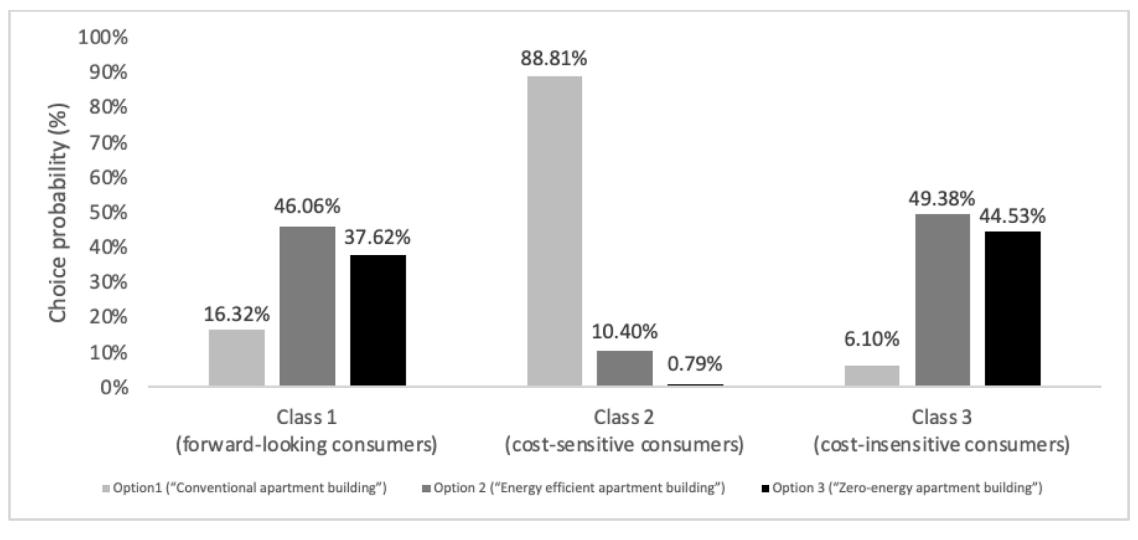
- 주요 발견: (1) 3 class 식별: Class 1 forward-looking 48.5% (Saving on energy bills RI 36.4% — 최우선), Class 2 cost-sensitive 28.5% (Additional cost RI 51.5%), Class 3 cost-insensitive 23.0% (Additional cost RI 51.0% 이나 positive 부호 — 가격이 quality signal). (2) Class 1 MWTP: bill savings KRW 4,479,617 ($3,869), CO2 reduction KRW 184,842/ton, opt-out KRW -1,703,929. (3) Membership: Class 2 는 Seoul 거주 -2.13***, 환경 인식 -0.47*, innovativeness -0.64**. (4) 시뮬레이션: 보조금 0 일 때 Class 1 은 Option 2 (efficient) 46.06% / Option 3 (ZEB) 37.62%, Class 2 는 Option 1 (conventional) 88.81%. (5) ZEB subsidy KRW 9M/주택 (≈ Japan METI JPY 0.75M) 시 Class 1 Option 3 점유율 +5.03%p, Class 2 거의 무반응.
- 시사점: Heterogeneous subsidy targeting — Class 1 (잠재 수요자) 에 보조금 집중 유효, Class 2 (cost-sensitive) 에는 보조금 무용, 대신 retrofit 보조 (예: 서울시 BRP) 권장. Class 3 의 lexicographic / signaling 행동은 기존 합리적 소비자 모형의 한계 — 추가 연구 필요.
요약
이 paper 는 이종수 의 3 기 (에너지 정책 + 소비자 선호 deepening — 건물 부문 확장) 의 대표 작업으로, 이종수 author page anchor 의 건물·도시 sustainability 라인에 위치. 한국이 2012 년부터 신축 주거 건물의 ZEB 의무화 phase-in 을 시작했지만 (BEEC Level 1++ 이상, 에너지 자립도 20% 이상), low ROI (5-15% 초과 건설비) + 인식 부족 + 정보 비대칭으로 시장 보급 정체. 본 paper 는 demand-side 의 정량 진단 으로 정책 input 제공.
방법은 latent-class-model (Magidson & Vermunt 2002) — segment 의 사후 추정 이 strength. 다른 random parameter model (mixed logit) 대비 (i) heterogeneity 의 cause (membership function 으로 demographic·psychographic 매개) 를 explicit 하게 모형화, (ii) segment 별 별도 utility function 추정 (각 segment 내부는 동질) — segment 간 질적으로 다른 결정 구조 식별 가능. EM algorithm 사용 (Newton-Raphson 대비 numerical stability + local maxima 수렴 보장). AIC / CAIC / BIC 의 3 indices 비교로 3 class 가 optimum (BIC 5,935.7 최소).
핵심 발견: Class 1 (forward-looking, 48.5%) — energy bill savings 가 RI 36.4% 로 압도적, CO2 reduction 도 유의 (RI 10.81%). Opt-out (status quo) coefficient -1.19*** — 현재 비효율 주택 유지 disutility. 이 class 는 ZEB 의 장기 monetary 효과 를 internalize. MWTP for bill savings KRW 4,479,617 ($3,869). Class 2 (cost-sensitive, 28.5%) — Additional cost RI 51.5% 가 압도, 나머지 attribute 대부분 비유의. 단 bill savings 만 RI 18.71% 로 유의 (장기 절약 일부 internalize). Membership function: Seoul 거주 -2.13*** (Seoul 외 거주, 즉 광역시 거주), residential space -0.58*, 환경 인식 -0.47*, innovativeness -0.64** — 저소득·환경 무관심·non-innovative 프로필. Class 3 (cost-insensitive, 23.0%) — Additional cost coefficient +2.04* (positive sign, 비합리), 나머지 거의 모두 비유의. Lexicographic preference 또는 price-as-quality signal (Völckner 2008) 가능성. Seoul 거주 + 고소득 + 고교육 프로필.
시뮬레이션 (3 hypothetical option: Conventional BEEC 3, Efficient BEEC 1, ZEB BEEC 1++): Class 1 의 baseline 점유율 — Option 1 16.32% / Option 2 46.06% / Option 3 37.62%. Class 2: Option 1 88.81% / Option 3 0.79% — ZEB 무관심. ZEB subsidy KRW 0.1M/3.3m² 증가 시 Class 1 의 Option 3 점유율 +1.72%/step, KRW 0.3M (=주택당 KRW 9M, Japan METI 보조금 수준) 시 Option 3 가 Option 2 추월. Class 2 는 보조금 KRW 0.5M 까지 +0.21%/step 만 — 거의 무반응. 시사점: blanket 보조금 정책의 비효율 — Class 1 에 targeted subsidy 가 cost-effective, Class 2 는 retrofit 보조 (서울시 BRP 같은 long-term low-interest loan) 가 더 적합.
핵심 결과
LCM 3-class estimation (701 응답자, EM algorithm, BIC 5,935.7):
| Attribute | Class 1 Coef | Class 2 Coef | Class 3 Coef | C1 MWTP | C1 RI (%) | C2 RI (%) | C3 RI (%) |
|---|---|---|---|---|---|---|---|
| Construction company | +0.450* | +0.314 | +0.924 | KRW 644K | 5.23 | 4.34 | 11.55 |
| Accessibility | -0.113*** | -0.017 | +0.037 | KRW -162K | 13.17 | 2.40 | 4.64 |
| RE facility | +0.186 | -0.127 | -0.653 | — | 2.17 | 1.75 | 8.16 |
| Mechanical ventilation | +0.140 | -0.301 | -0.414 | — | 1.63 | 4.16 | 5.18 |
| HRV | +0.042 | -0.699 | -1.076 | — | 0.49 | 9.67 | 13.45 |
| CO2 reduction | +0.129*** | -0.045 | -0.030 | KRW 185K/ton | 10.81 | 4.50 | 2.69 |
| Bill savings | +3.127*** | +1.353* | +0.032 | KRW 4.48M | 36.40 | 18.71 | 0.40 |
| Opt-out (status quo) | -1.189*** | -0.216 | +0.233 | KRW -1.70M | 13.85 | 2.98 | 2.91 |
| Additional cost | -0.698*** | -1.862*** | +2.040* | — | 16.25 | 51.50 | 51.01 |
| Class share | 48.5% | 28.5% | 23.0% | — | — | — | — |
시장 점유율 시뮬레이션 (baseline, no subsidy):
| Class | Option 1 (Conventional) | Option 2 (Efficient) | Option 3 (ZEB) |
|---|---|---|---|
| Class 1 | 16.32% | 46.06% | 37.62% |
| Class 2 | 88.81% | 10.40% | 0.79% |
| Class 3 | 3.95% | 23.62% | 72.43% |
ZEB subsidy 효과 (per KRW 100,000/3.3m² 증가): Class 1 Option 3 점유율 +1.72%p/step, KRW 9M/주택 (≈ Japan JPY 0.75M METI 보조금) 도달 시 Option 3 점유율 +5.03%p. Class 2 거의 무반응 (+0.21%p/step).
*** p<0.01, ** p<0.05, * p<0.10. $1 ≈ KRW 1,157.80 (2019 년말).
방법론 노트
latent-class-model 은 random utility framework 안에서 unobserved heterogeneity 를 discrete segment 로 모형화. Mixed logit (continuous random coefficient) 대비 (i) heterogeneity 의 원인 (demographic·psychographic) 을 explicit, (ii) segment 별 별도 utility function 으로 질적으로 다른 결정 구조 capture 가능, (iii) segment membership 의 사후 확률 계산.
핵심 식 (utility for q-th class member):
여기서 type-I extreme value. Class-conditional choice probability:
Membership probability (multinomial logit on = age, residence, environmental awareness, innovativeness 등):
Joint log-likelihood: . EM algorithm 으로 최적화 — E-step 에서 conditional membership posterior, M-step 에서 update. 최적 class 수 결정: AIC / CAIC / BIC 비교 — 본 paper 는 BIC 기준 3 class (5,935.7) 가 4 class (5,927.5) 대비 해석 가능성 때문에 선택.
연구 계보
본 paper 는 (i) Magidson & Vermunt (2002) 의 LCM 표준화, (ii) Greene & Hensher (2003) TRB 의 LCM econometric 구현, (iii) Train (2009) Cambridge UP 의 discrete choice with simulation, (iv) Achtnicht (2011) Ecological Economics 의 독일 energy-efficient retrofit DCE, (v) Hu et al. (2014) Cities 의 Nanjing 주택 segment 분석, (vi) Brounen et al. (2011) · Fuerst et al. (2015) 의 EPC + 주택 가격 hedonic 분석 — 6 갈래의 종합. 이종수 author page anchor 3 기 (에너지·건물·도시 sustainability) 라인에서, sibling 작업 — Household Electricity and Gas Consumption for Heating Homes (가구 난방 에너지 소비), Reference-Dependent Preferences on Smart Phones in South Korea: Focusing on Attributes with Heterogeneous Preference Direction (reference-dependent DCM), Public Willingness to Pay for Mitigating Local Conflicts over the Construction of Renewable Energy Facilities: A Contingent Valuation Study in South Korea (재생에너지 시설 갈등 CVM) — 모두 energy + consumer preference heterogeneity cluster.
See also
- 이종수
- jihye-choi
- justine-jihyun-kim
- latent-class-model
- discrete-choice-experiment
- zero-energy-buildings
- preference-heterogeneity
- housing-choice
- green-housing-subsidy
- Sustainable Cities and Society
- Public Willingness to Pay for Mitigating Local Conflicts over the Construction of Renewable Energy Facilities: A Contingent Valuation Study in South Korea
- Household Electricity and Gas Consumption for Heating Homes
- Reference-Dependent Preferences on Smart Phones in South Korea: Focusing on Attributes with Heterogeneous Preference Direction
인접 그래프
- 인물 1
- 수록처 2
- 논문 3