Role-based Access Control for Collaborative Enterprise in Peer-to-Peer Computing Environments
Joon S. Park, 황준석 (2003) · ACM Symposium on Access Control Models and Technologies (SACMAT)
협업 기업 환경의 P2P 컴퓨팅에 Role-Based Access Control (RBAC) 보안 모델을 적용한 미들웨어 설계. brokered P2P (Napster·Groove·Kazaa) 와 purist P2P (Gnutella·FreeNet·JXTA) 의 두 모델을 통합하면서, 정책 결정을 peer 측에서 자율 수행 하도록 enterprise / community / peer 3-계층 정책을 metadata (XML) 로 전달. 정책 충돌 시 EP > CP > PP 우선순위, 그리고 role ontology 로 Community A 의 Editors 와 Community B 의 Reviewers 같은 inter-community role 등가를 처리.
- RQ: 협업 기업 (collaborative enterprise) 의 P2P 컴퓨팅 환경에서 brokered 와 purist 모델을 통합하면서 enterprise·community·peer 3-계층 정책을 peer 측 자율 결정 으로 enforce 하는 access control 메커니즘은 어떻게 설계해야 하는가?
- 방법론: 아키텍처 설계
- 데이터: 개념·아키텍처 설계 paper; 전자 출판 협업 시나리오 (Alice/Bob/Chris, Community A:Authors/Editors/Illustrators × Community B:Writers/Reviewers/Distributors) 7-step 운영 예시
- 주요 발견: 5 모듈 미들웨어 (Communication Gateway / Service Identifier / Manager / XML Generator / Metadata Information Base) + add-on policy server. 3 정책 계층 EP > CP > PP, URA / PRA / Role Hierarchy / Constraints / Role Ontology 의 정책 구성요소. brokered 메커니즘은 enterprise / community 수준 중앙 enforce, purist 메커니즘은 peer 수준 자율 enforce 를 담당해 통합 가능.
- 시사점: P2P 보안은 identity-based access control 의 확장이 아니라 role + ontology + 다중 계층 정책 + metadata 전달 의 조합으로 풀어야 organization scale 에서 작동. Identity-based mapping 은 large system 에서 비효율적이고 관리 불가능.
요약
본 paper 는 황준석 1기 Syracuse 시기 Joon S. Park 와의 P2P 보안 라인 sibling 작업으로, SACMAT’03 (8th ACM Symposium on Access Control Models And Technologies) 에서 발표된 정식 access control 논문이다. 출발 진단은 (1) P2P 의 control 메커니즘 결여가 wide-scale 적용을 막고 있다, (2) identity-based access control 은 peer 수가 많아지면 비효율적·복잡, (3) brokered (Napster 류) 와 purist (Gnutella 류) 두 모델은 서로 다른 control 위치를 가져 통합이 어렵다, (4) 협업 기업 (multi-community collaborative enterprise) 에서는 peer 가 동시에 여러 community 에 속하고 community 별로 다른 role 을 가지므로 단순 role binding 으론 부족하다는 점이다.
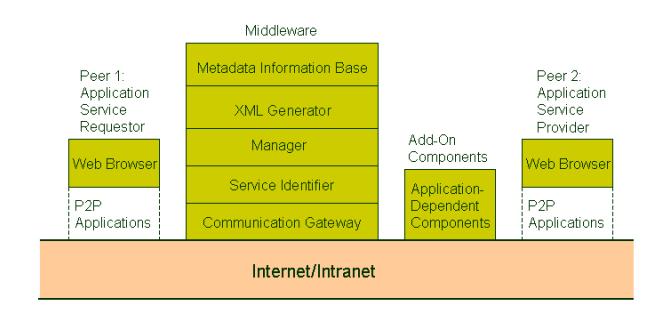
본 paper 의 통합 모델은 IRTL (Information Resource Transaction Layer) Middleware Design for P2P and Open GRID Services 의 5 모듈 generic 미들웨어 위에 policy server add-on 을 얹은 구조다. 정책은 3 계층으로 분리된다: Enterprise Policy (EP) — 전체 enterprise 의 URA / PRA / role hierarchy / constraints / role ontology, Community Policy (CP) — 개별 community 의 URA / PRA / role hierarchy, Peer Policy (PP) — 각 peer 가 자기 자원에 대해 정의하는 PRA·constraints. 우선순위는 EP > CP > PP 가 default 이나 specific override 가능. enterprise 차원의 role ontology (RO) 가 Community A 의 Editors 와 Community B 의 Reviewers 같은 inter-community role 등가를 명시해, peer 가 community 를 이동해도 자동 role mapping. URA, PRA 는 NIST RBAC (Sandhu·Coyne·Feinstein·Youman 1996) 의 표준 구조 따름.
운영 시나리오 (Alice 가 Bob 의 article 에 접근, Section 4.2 의 7-step): (1) Alice 가 Enterprise Member 역할로 Community A 참여 → (2) Metadata Information Base 검색 → (3) Bob 선택 → (4) 미들웨어가 RO1 (Editors ↔ Reviewers) 에 따라 Alice 를 Community B 의 Reviewers 로 매핑해 XML 로 전달 → (5) policy server 가 Bob article 의 정책 metadata 를 Bob 에게 전달 → (6) Bob 측 P2P 앱이 Alice 의 역할과 정책 metadata 를 읽어 자율 결정 → (7) Bob 의 PP (Bob_PRA1: Editor 는 contact info 접근 가능) 도 자율 enforce. 핵심 design 은 모든 정책 결정을 peer 측 P2P 앱이 자율 수행 한다는 점 — policy 가 metadata 형태로 peer 에 push 됐기 때문에 외부 의존 없이 enforcement 가능. 같은 1기 sibling 으로 A Middleware Approach for SAINT (Secure, Automatic, Interoperable, and Transparent) Peer-to-Peer Content Services (SAINT 서비스 속성, mobile security policy 의 짝), IRTL (Information Resource Transaction Layer) Middleware Design for P2P and Open GRID Services (IRTL 5 모듈 기반 architecture), Charging Control and Transaction Accounting Mechanisms Using IRTL (Information Resource Transaction Layer) Middleware for P2P Services (charging 차원) 와 함께 P2P 미들웨어 가족을 형성한다.
핵심 결과
3 정책 계층의 구성요소 (Section 4.2):
| 계층 | 구성요소 | enforce 메커니즘 |
|---|---|---|
| Enterprise (EP) | URA, PRA, role hierarchy, constraints, role ontology | brokered (중앙 enforce, 모든 community 적용) |
| Community (CP) | URA, PRA, role hierarchy | brokered (중앙 enforce, 해당 community 만) |
| Peer (PP) | PRA, constraints | purist (peer 측 P2P 앱 자율 enforce) |
우선순위: EP > CP > PP (specific override 가능). Role ontology (예: Editors_A ↔ Reviewers_B) 가 inter-community role 매핑 담당.
미들웨어 구성 (IRTL 확장): Communication Gateway (HTTP/SOAP) / Service Identifier (WSDL) / Manager (자원 할당) / XML Generator (정책 metadata 생성) / Metadata Information Base (분산 DB) + add-on policy server (EP/CP source).
P2P control 모델 두 유형: brokered (Napster, Groove, Kazaa, Blubster — data path P2P, control path 중앙) vs purist (Gnutella, Morpheus, Limewire, FreeNet, JXTA, Publius — 모든 control 도 P2P). 본 paper 는 두 모델을 정책 계층 별로 통합 (EP/CP brokered, PP purist).
연구 계보
황준석 1기 P2P middleware 라인의 보안 분파. 직접 predecessor 는 (1) Sandhu·Coyne·Feinstein·Youman (1996) “Role-based access control models” — RBAC 의 표준 모델, (2) Park·Sandhu·Ahn 의 후속 RBAC 연구, (3) Hwang·Aravamudham·Liddy·Stanton·MacInnes (2002, HALSM02) IRTL middleware (= Charging Control and Transaction Accounting Mechanisms Using IRTL (Information Resource Transaction Layer) Middleware for P2P Services), (4) Foster·Kesselman·Nick·Tuecke (2002) OGSA “The Physiology of the Grid”, (5) Fensel (2001) Ontologies for Knowledge Management, (6) Christensen et al. (2001) W3C WSDL, (7) W3C SOAP / UDDI 표준, (8) P2P 시스템 (Napster, Groove, Kazaa, Gnutella, FreeNet, JXTA) 의 brokered·purist 분류 문헌이다. 같은 1기 sibling 으로 A Middleware Approach for SAINT (Secure, Automatic, Interoperable, and Transparent) Peer-to-Peer Content Services (SAINT 서비스 속성, mobile security policy 의 짝), Charging Control and Transaction Accounting Mechanisms Using IRTL (Information Resource Transaction Layer) Middleware for P2P Services (charging 차원), IRTL (Information Resource Transaction Layer) Middleware Design for P2P and Open GRID Services (IRTL OGSA 통합) 와 함께 P2P 미들웨어 SAINT 가족 을 형성한다.
See also
- 황준석
- Joon S. Park
- ACM Symposium on Access Control Models and Technologies (SACMAT)
- P2P 컴퓨팅
- 정보 보안
- 미들웨어
- A Middleware Approach for SAINT (Secure, Automatic, Interoperable, and Transparent) Peer-to-Peer Content Services
- Charging Control and Transaction Accounting Mechanisms Using IRTL (Information Resource Transaction Layer) Middleware for P2P Services
- IRTL (Information Resource Transaction Layer) Middleware Design for P2P and Open GRID Services
- Trust Embedded Grid System for the Harmonization of Practical Requirements
인접 그래프
- 인물 2
- 방법론 1
- 개념 1
- 주제 2
- 수록처 1
- 분류 1
- 논문 5