Policy Designs to Increase Public and Local Acceptance for Energy Transition in South Korea
문성호, youngwoo-kim, minsang-kim, 이종수 (2023) · Energy Policy 182:113736 · DOI ↗
한국 재생에너지 확대 정책의 공중 (general public, N=1,050) 과 발전소 인근 지역민 (local, N=310) 사이 수용성 비대칭 을 discrete-choice-experiment + 혼합 로짓 (Bayesian MCMC) 로 측정. 양 그룹 모두 offshore wind oriented mix 최선호, hydrogen fuel cell oriented mix 최비선호. 지역민은 경제적 이익 (job, revenue share) 에 더 큰 MWTP, 전기료 인상에 더 민감. Scenario 분석으로 지역민 incentive 강화 (job 100/1000 + revenue share 10%) 시 지역 수용률 > 공중 수용률 역전 가능.
- RQ: 한국 에너지 전환 (renewable share 확대) 정책 설계에서 (i) 공중과 지역민이 energy mix, GHG 감축, 새 일자리, revenue share, visual intrusion, 전기료 에 부여하는 MWTP 가 어떻게 다른가, (ii) 정책 design 변수 (incentive, differential tariff) 가 공중 vs 지역 수용률 격차 를 어떻게 좁히는가?
- 방법론: discrete-choice-experiment (4,608 조합 → orthogonal design 24 alt → 8 sets × 3 + no-choice), 혼합 로짓 (normal coefficient distribution), 베이지안 추정 + markov-chain-monte-carlo (30,000 iter, 15,000 burn-in), MWTP per attribute, T-test on group-level MWTP difference
- 데이터: Gallup Korea 온라인 survey 2021-11, 공중 N=1,050 + 지역민 (재생 발전소 인근) N=310. Purposive quota sampling, region/gender/age 매칭. P-value of demographic 차이: regional 만 유의 (지역민은 Gyeonggi 41.6%, Incheon 13.5%, Gangwon/Jeju 8.1% 비중 높음).
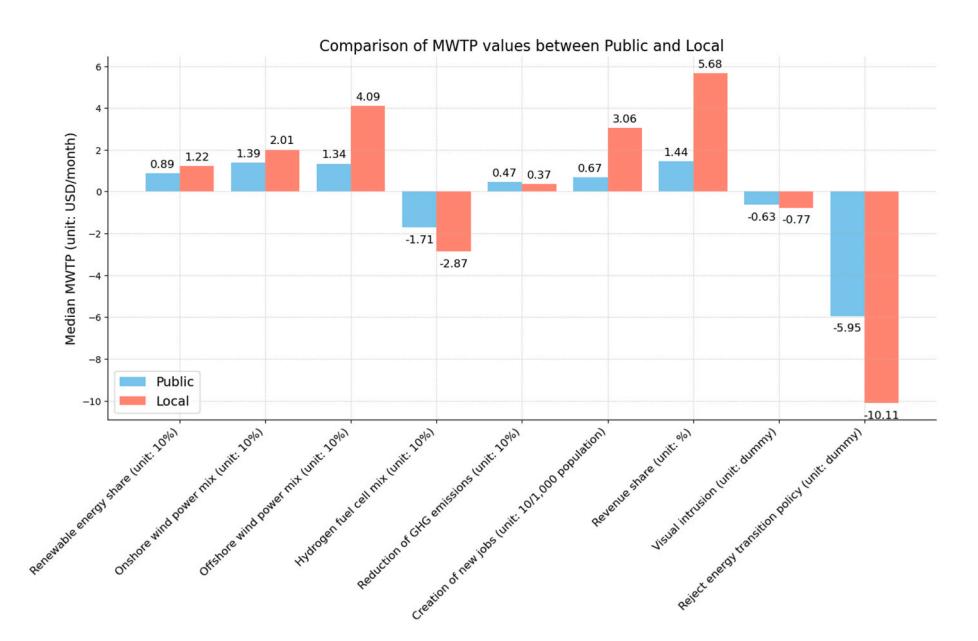
- 주요 발견: (i) Renewable share 10%↑ MWTP: 공중 +USD 0.89, 지역 +USD 1.22 (p=0.039, 지역이 더 높음). (ii) Mix 선호: offshore wind (공중 +USD 1.39, 지역 +USD 4.09, p=0.039 — 지역이 3 배 강한 선호) > onshore wind > solar PV (baseline) > hydrogen fuel cell (공중 -USD 1.77, 지역 -USD 2.87, p=0.075). (iii) Job 창출 MWTP: 공중 +USD 0.67/10 jobs, 지역 +USD 3.06/10 jobs (4.5 배). (iv) Revenue share MWTP: 공중 +USD 1.44/%, 지역 +USD 5.68/% (4 배). (v) 정책 거부 dummy MWTP: 공중 -USD 5.95, 지역 -USD 10.11 (p=0.091 — 지역이 더 강한 정책 지지). (vi) Scenario 4: incentive 100 jobs/1000 + 10% revenue share 도달 시 지역 수용률 > 공중 수용률. (vii) Scenario 5: 전기료 40% 인상 지점부터 공중-지역 격차 확대 → differential tariff 의 정당화 근거.
- 시사점: (a) NIMBY 가설의 조건부 반전 — 지역민이 fuel cell 안전 이슈와 가격에 더 민감하지만 경제적 이익 보장 시 공중보다 더 강력 지지. (b) just-transition 의 distributional + procedural justice 원칙의 정책 설계 함의: revenue share + job 의 적정 수준 (10% rate of return, 100 jobs/1000) 의 정량 식별. (c) Offshore wind 의 dual-acceptance 우위 — 정부의 13 GW offshore + 3 GW onshore (2030) 계획 정합. (d) Differential electricity tariff 의 수용성 격차 완화 가능성 — 발전 지역-소비 지역 불균형 해소.
요약
이 paper 는 이종수 의 consumer/citizen preference 라인 (2010-2025) 의 energy justice 확장이다. 기존 한국 RPS / 재생에너지 수용성 연구 (Shin et al. 2014, Huh et al. 2015, Kim et al. 2018, 2020b) 는 공중 단일 표본 만 다뤘고, 독일/스코틀랜드/미국에서만 지역 vs 공중 비교 (Sonnberger & Ruddat 2017, Bergmann et al. 2008, Sharpton et al. 2020) 가 진행됐다. 본 paper 는 (i) 한국에서 공중 N=1,050 + 발전소 인근 지역민 N=310 의 동일 attribute 동시 비교, (ii) renewable mix 를 4 source (onshore/offshore wind, solar PV, fuel cell) oriented 로 세분화, (iii) attribute 1 (share) × attribute 1.1 (mix) 의 interaction term 으로 share-mix 결합 효과를 명시 추정한다.
방법론은 6 개 attribute (share 4, mix 4, GHG 4, jobs 3, revenue share 3, visual 2, price 4) → 4,608 조합 → orthogonal design 으로 24 alt → 8 sets × 3 alt + no-choice. Coefficient 는 normal distribution 가정, Bayesian MCMC 30,000 iter (15,000 burn-in). 식 (7) 의 utility 함수에 mix × share interaction 가 들어가 있어 — solar PV-oriented mix 가 baseline 으로 fixed — 다른 mix dummy 가 share 와 곱해져 해석은 “share 10%↑ + mix shift” 의 결합 marginal utility. MWTP 도출은 표준 , T-test 로 공중-지역 차이 유의성 검증.
핵심 발견은 지역민이 ICEV 같은 NIMBY 단순 반대자가 아니라 sophisticated participatory actor 라는 점. (i) 양 그룹 모두 정책 거부 dummy 가 강한 음 (no-choice MWTP 공중 -USD 5.95, 지역 -USD 10.11) — 지역민이 더 강하게 정책 지지. (ii) 양 그룹 모두 fuel cell 최비선호 — 2019 강릉 수소 폭발 사고 영향 + 75% 미만이 hydrogen 에 익숙. (iii) 지역민의 revenue share MWTP 가 공중의 4 배 — 단순 보상 욕구가 아닌 participation = ownership 의 institutional 선호. Scenario 분석은 4 가지: 2030 NDC (이전 정부), 10차 기본계획 (현 정부), mix 변경, 지역 incentive, differential tariff. Incentive scenario 에서 100 jobs/1000 + 10% revenue share 도달 시 지역 수용률 > 공중 수용률 — 이 역전점 이 just-transition 정책 design 의 quantitative threshold. Offshore wind 가 dual-acceptance maximum (공중 +4.11%p, 지역 +6.87%p) + acceptance gap 최소 (3.69%p → 0.93%p) — 정부의 offshore-priority 13 GW 계획에 empirical mandate 제공.
핵심 결과
| Attribute | Public mean (b) | Local mean (b) | MWTP public | MWTP local | T-test p |
|---|---|---|---|---|---|
| Renewable share (10%) | 1.169*** | 1.048*** | USD 0.89 | USD 1.22 | 0.039 |
| Onshore wind mix (vs solar) | 1.659*** | 1.413*** | USD 1.43 | USD 2.01 | 0.763 |
| Offshore wind mix | 1.751*** | 2.848*** | USD 1.39 | USD 4.09 | 0.039 |
| Fuel cell mix | -2.155*** | -2.607*** | -USD 1.77 | -USD 2.87 | 0.075 |
| GHG reduction (10%) | 0.580** | 0.368 (n.s.) | USD 0.47 | USD 0.37 | 0.915 |
| Jobs (10/1000) | 0.749*** | 2.277*** | USD 0.67 | USD 3.06 | 0.176 |
| Revenue share (%) | 2.666*** | 3.581*** | USD 1.44 | USD 5.68 | 0.059 |
| Visual intrusion (dummy) | -0.175*** | -0.312*** | -USD 0.63 | -USD 0.77 | 0.351 |
| Electricity bill (100 KRW) | -0.064*** | -0.075*** | — | — | — |
| Reject policy (dummy) | -5.895*** | -7.058*** | -USD 5.95 | -USD 10.11 | 0.091 |
Scenario 결과 정량 (acceptance rate, %):
- Sc 1 (2030 NDC): 공중 87.4%, 지역 86.0% (격차 +1.42%p)
- Sc 2 (10차 기본계획, electricity ↓): 공중 88.2%, 지역 87.9% (격차 +0.31%p, 좁혀짐)
- Sc 3 (offshore wind mix): 공중 +4.11%p, 지역 +6.87%p — 격차 3.69%p → 0.93%p
- Sc 4 (지역 incentive 강화): 100 jobs/1000 + 10% revenue 도달 시 지역 > 공중 역전, 지역 최대 90.16%
- Sc 5 (electricity 40% ↑): 공중-지역 격차 확대 → differential tariff 정당화
방법론 노트
혼합 로짓 sequential choice utility (t = 1, …, T choice sets):
Probability of choice sequence:
. Bayesian 추정의 joint posterior:
markov-chain-monte-carlo 로 30,000 iter, burn-in 15,000. Utility specification 에 share × mix interaction:
Solar PV-oriented mix 가 baseline (계수 0). Identification: (i) orthogonal fractional factorial 의 attribute 직교성, (ii) Bayesian 안정성 (MCMC convergence), (iii) 동일 design 의 공중/지역 별도 추정 → MWTP T-test 로 group difference 식별. 한계: (a) coefficient 정규분포 가정의 fuel cell 강한 두꺼운 꼬리 미반영 가능성, (b) electricity price 가 mix 별 동일 가정 — 실제 fuel cell vs solar 의 LCOE 차이 미반영.
연구 계보
본 paper 는 (a) Shin et al. (2014 Energy Economics) 의 한국 RPS 수용성, (b) Huh et al. (2015) 의 혼합 로짓 한국 전력 수용성, (c) Kim et al. (2018) 의 reference-dependent + hierarchical Bayesian, (d) Kim et al. (2020b) 의 4-source 전력 mix 분석, (e) Sonnberger & Ruddat (2017) 독일 wind farm 의 public-local 비교, (f) Bergmann et al. (2008) Scotland rural-urban 차이, (g) Tanujaya et al. (2020) 한국 community renewable 분석, (h) just-transition 문헌 (Heffron & McCauley 2014, Jenkins et al. 2016, McCauley et al. 2019, Dallenes et al. 2023), (i) 정부의 2030 NDC (이전 정부) + 10차 기본계획 (현 정부) + Carbon Neutrality Act + Hydrogen Act 를 결합한다. TEMEP 내 sibling: 이종수 의 energy preference 라인 — Impact of Energy Production Mix on Alternative Fuel Vehicle Adoption in Korea (AFV mix, 동일 1 저자) 의 후속 + Analysis on the Acceptance of Coal Phase-Out Policy Considering Public Preferences: Policy Implications and Future Direction Based on Empirical Evidence from South Korea 의 직접 선행.
See also
- 이종수
- 문성호
- youngwoo-kim
- minsang-kim
- 혼합 로짓
- discrete-choice-experiment
- 베이지안 추정
- energy-transition
- just-transition
- public-acceptance
- local-acceptance
- nimby
- Energy Policy
- Impact of Energy Production Mix on Alternative Fuel Vehicle Adoption in Korea
- Analysis on the Acceptance of Coal Phase-Out Policy Considering Public Preferences: Policy Implications and Future Direction Based on Empirical Evidence from South Korea
인접 그래프
- 인물 2
- 방법론 2
- 주제 1
- 수록처 2
- 논문 2