Model for identifying firm's product innovation dynamics: applied to the case of the Korean mobile phone industry
Woolrim Lee, Jungsub Yoon, Jörn Altmann, 이정동 (2021) · Technology Analysis & Strategic Management 33:335-348 · DOI ↗
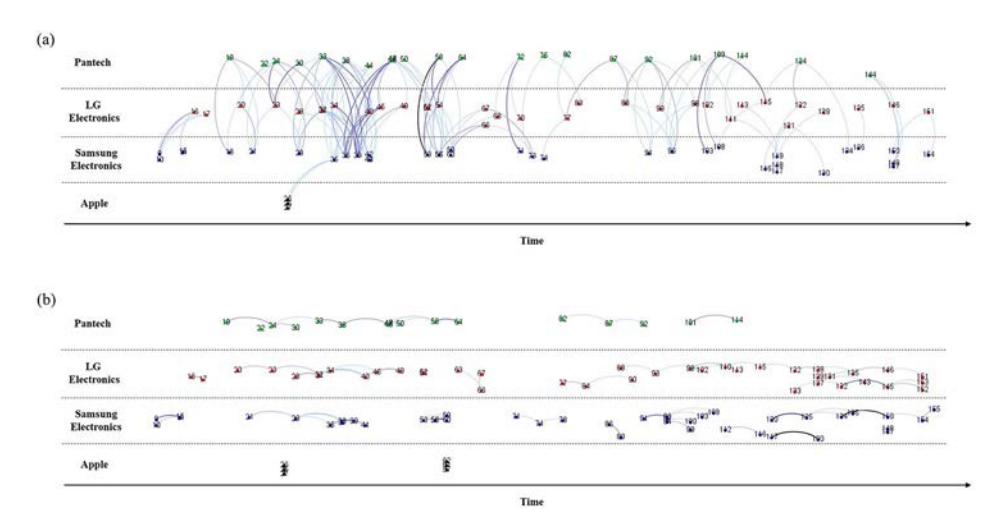
기존 제품 진화 연구가 특허 분석 + 기업 수준 평균에 의존해 제품 자체의 동학 을 놓쳤다는 문제의식에서, 한국 스마트폰 산업 2010-2015 의 155 개 모델을 14 개 기술 feature 벡터로 표현하고 자카드 유사도 유사도 + threshold T=0.55 로 제품 네트워크 을 구축한다. In-degree 중심성 · Out-degree 중심성 로 모방자 (imitator) · 확산자 (disseminator) · 자기 routine 추종자 (own-routine follower) 의 세 전략 유형을 식별 가능. Pantech 는 최고 in-degree (모방자), Samsung · LG 는 최고 out-degree (확산자), Apple 은 자기 component 안에서 거의 독립적 진화 (own-routine).
- RQ: 제품 진화 을 제품 수준 에서 어떻게 정량화할 것인가, 그리고 그 정량화가 기업의 혁신 전략 (모방·혁신·routine) 을 식별할 수 있는가.
- 방법론: 자카드 유사도, 사회 네트워크 분석, 연결중심성, 네트워크 분석
- 데이터: 한국 스마트폰 산업 (Samsung, LG, Pantech, Apple), 155 product model, 14 technological feature, 2007.10-2015.05 (분석 핵심 2010-2015).
- 주요 발견: T=0.55 threshold 에서 component 4 개 · 노드 149 개 · 링크 732 개 의 product network. Component 3 (130 model) 이 dominant — 모든 firm 의 incremental innovation 가 여기서 공진화. Pantech 의 IM-A725L 이 최고 in-degree (외부 모방), Samsung-SHW-M110S · LG-LU2300 등이 최고 out-degree (혁신 확산). Apple 은 자기 component 2 · 4 에 거의 고립된 own-routine 패턴.
- 시사점: 기업 routine 의 행동 패턴 이 product feature 분포에 각인되므로 SNA 가 competitor monitoring tool 로 활용 가능. 신생 산업 진입 전략 설계의 경쟁사 routine 식별 도구.
요약
기존 제품 진화 연구의 두 한계 — (i) 특허 분석 의존으로 기술 진화만 포착, (ii) 기업·산업 수준 평균에 머물러 제품 단위 의 routine 차이 미식별 — 를 동시 해소하려는 제품 수준 SNA 모델 제안. Khanafia · Situngkir (2006) 의 휴대폰 phylogenetic tree 가 분류 (static categorisation) 에 머물고, Valverde · Solé (2015) 의 SNA 가 parent-child link 만 보고 feature 는 누락한 두 빈자리를 feature 기반 similarity + chronological direction 로 결합. 기술경영경제정책전공 에서 이정동 의 제품 진화 (product evolution) 라인 (2003 디스플레이 → 2013 phylomemetic tree → 2021 본 paper) 의 firm 수준 routine 식별 갈래를 가장 정량화된 형태로 surface 한 작업.
데이터는 한국 시장에서 2007.10-2015.05 에 출시된 smartphone 155 개. Samsung, LG, Pantech, Apple 4 firm 의 공식 사이트 + Danawa.com 의 14 기술 feature (Mobile Telecommunication Technology, Display Size, AP Chipset, RAM, OS, Volume, Weight, Battery Capacity, Camera Pixel, ROM, Touch, Bluetooth, Wi-Fi, GPS) 중 Touch · Bluetooth · GPS · Wi-Fi 의 4 보편적 binary feature 를 1 개로 통합해 11 feature 사용. 자카드 유사도 로 두 product 의 feature 중첩 측정 후 threshold T 이상이면 제품 네트워크 의 edge 형성. T={0.18, 0.27, 0.36, 0.45, 0.55, 0.64, 0.73, 0.82, 0.91} 비교에서 T=0.55 가 4 component + 149 node 의 첫 multi-component 해상도로 선택 (T<0.55 면 단일 component, T>0.55 면 노드 다수 소실). Component 3 (130 model, 4-firm 공진화 dominant cluster) 안의 KH5200 → SHW-M100S (RAM 256→384MB) 는 점진적 혁신 의 대표 예. Component 1·3 사이의 단절 (display size 확대 + AP 성능 도약) 은 급진적 혁신 의 신호. In-degree 중심성 최고가 Pantech IM-A725L (이전 model 의 feature 를 흡수하는 imitator), Out-degree 중심성 최고가 Samsung SHW-M110S · SHV-E330K · LG LU2300 · F240K (이후 model 에 feature 를 disseminate 하는 innovator).
한계는 한국 시장 단일성 (글로벌 확장 가능) + product feature 만 사용 (market share · 가격 미고려) + threshold T 의 해상도-노드 손실 trade-off 의 휴리스틱 선택. 그러나 본 paper 의 제품 단위 SNA + chronological directed network 가 batch 18 의 후속 Episodic change: A new approach to identifying industrial transition (동일 모바일 데이터를 episodic event 로 재해석) 와 batch 14 의 Creative destruction of the sharing economy in action: The case of Uber (또 다른 routine-disruption 정량화) 와 제품 수준 진화 측정 anchor 라인을 형성. 이정동 author page anchor 의 실타래 3: 제품의 탄생과 죽음 + 제4기 진화론적 전환의 조용한 복선 의 2021 cohort 위치.
핵심 결과
| Threshold T | Component 수 | Node 수 | Link 수 |
|---|---|---|---|
| 0.36 | 1 | 155 | 3,480 |
| 0.45 | 1 | 154 | 1,717 |
| 0.55 (선택) | 4 | 149 | 732 |
| 0.64 | 16 | 133 | 223 |
| 0.73 | 31 | 89 | 89 |
| Firm | Centrality 패턴 | 전략 분류 |
|---|---|---|
| Pantech | 최고 In-degree 중심성 (IM-A725L) | Imitator |
| Samsung | 최고 Out-degree 중심성 (SHW-M110S, SHV-E330K) | Disseminator |
| LG | 최고 Out-degree 중심성 (LU2300, F240K) | Disseminator |
| Apple | 독립 component (2, 4) + 약한 inter-firm link | Own-routine |
방법론 노트
핵심 통찰: 제품 = feature vector 이고 진화 = feature 보존 + 변화 의 점진적 사슬이라면, 두 model 간 feature 중첩의 정량 지표인 자카드 유사도 가 자연스럽게 진화적 거리 측도. SNA 는 추가로 chronological order (출시일) 와 directionality (먼저 출시된 model → 이후 model) 를 도입해 static categorisation 을 evolutionary tree 로 격상.
핵심 식:
여기서 는 두 product model 의 feature set, 는 공통 feature 수, 는 에서 로의 directed link 수, 는 adjacency 결정 threshold (T=0.55).
식별 전략: 모든 product model 을 출시일 기준 정렬 → adjacency matrix 의 lower-triangular 만 사용 (시간 비대칭성). T 의 선택은 4 component + 노드 손실 최소화 의 데이터-driven 휴리스틱. In-degree 의 의미: 이 model 이 과거 model 들의 feature 를 얼마나 흡수했는가 — 모방의 정량. Out-degree: 이 model 이 이후 model 들에 얼마나 feature 를 전파했는가 — 혁신 확산의 정량.
연구 계보
본 paper 의 직접 선조는 기술경영경제정책전공 내부의 Evolutionary Patterns of an Artifact: The Mobile Phone (한국 휴대폰 370 model 의 phylomemetic tree 첫 구축 — 제품 진화 의 비유 → 알고리즘 격상) 과 외부의 Khanafia · Situngkir (2006, 휴대폰 phylogenetic tree), Valverde · Solé (2015, SNA-기반 product evolution), Iwai (2000, 모방 전략 의 evolutionary economics), Nelson · Winter (1982, firm routine 의 product 각인). 자카드 유사도 의 sociometric application 은 Choi · Cha · Tappert (2010) 의 biology 도입을 참조. Centrality 측도는 Freeman (1979) 의 SNA fundamental. 이정동 author page anchor 의 제4기 (2020-2023) 진화론적 전환의 조용한 복선 시기 분류 + 실타래 3: 제품의 탄생과 죽음 라인에 위치. TEMEP 내 자매 작업은 Episodic change: A new approach to identifying industrial transition (같은 한국 모바일 데이터의 episodic change 재해석) 와 Effects of knowledge accumulation strategies through experience and experimentation on firm growth (firm routine 의 R&D side 정량화).
See also
- 자카드 유사도
- 사회 네트워크 분석
- 제품 진화
- 제품 혁신 동학
- 스마트폰 산업
- Evolutionary Patterns of an Artifact: The Mobile Phone
- Episodic change: A new approach to identifying industrial transition
- Woolrim Lee
- Jungsub Yoon
- Jörn Altmann
- 이정동
인접 그래프
- 인물 4
- 개관 1
- 방법론 8
- 개념 2
- 주제 6
- 수록처 1
- 분류 2
- 논문 4