Cybersecurity challenges and adaptive strategies in smart mobility: a systematic literature review
Dany Pambudi, 황준석 (2025) · Iran Journal of Computer Science · DOI ↗
스마트 모빌리티 (자율차·V2X·rideshare·IoT 신호) 의 사이버 위협을 prisma 절차로 선별한 56 편 peer-review 문헌 (2014~2024, Scopus + Web of Science 3,703 → 359 → 56) 의 체계적 문헌 고찰 와 Bibliometric Analysis (VOSviewer 공동출현 네트워크 분석, 7 thematic cluster) 로 매핑한다. 핵심 발견: 선진국 (malware, DoS, GPS spoofing, data breach) 과 개도국 (인프라·전문성·규제 미비의 기초 취약성) 의 위협 프로파일이 fundamental 하게 다르며, 따라서 처방도 region-specific 해야 한다. Blockchain + AI intrusion-detection + PPP 가 보편적 처방이지만 scalability·interoperability·규제 공백이 한계.
- RQ: (RQ1) Smart mobility 의 cybersecurity 위협이 선진국 vs 개도국에서 어떻게 다르고, 어떤 요인이 기여하는가? (RQ2) 어떤 adaptive strategy 가 효과적이며 어떤 실행 장벽에 부딪히는가?
- 방법론: 체계적 문헌 고찰, prisma, Bibliometric Analysis, 공동출현 네트워크 분석 (VOSviewer v1.6.20, 7 cluster)
- 데이터: Scopus + Web of Science 검색 3,703 건 (3,537 Scopus + 166 WoS) → PRISMA 4 단계 (중복 제거 3,603 → 제목/초록 screening 359 → 전문 eligibility 242 → 최종 56 편). 2014~2024 timespan. 41 sources, 230 authors, 평균 22.93 citation/doc, international co-authorship 35.71%, 연 성장률 42.5%
- 주요 발견: 7 VOSviewer thematic cluster — secure connected transport, advanced shared/sustainable mobility, in-vehicle communication security, secure EV ecosystems, autonomous vehicle threat, risk·decision management, blockchain/real-time. 선진국 → CAV/V2X 의 sophisticated threat (Uber 2017 데이터 침해, GPS spoofing 실험), 개도국 → 인프라·암호화·규제 미비 (Indonesia GoJek 사례, 남아시아 phishing). Top-cited: Ju et al. 2022 (109 cite, CAV resilience) > Aliwa et al. 2022 (108) > Shokouhyar et al. 2021 (105, post-COVID shared mobility)
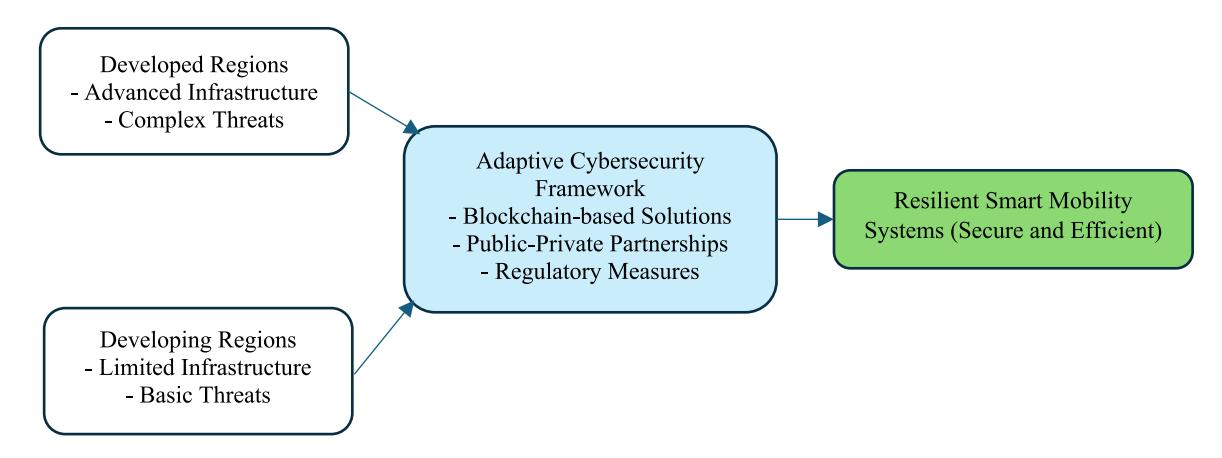
- 시사점: Region-specific cybersecurity framework 의 4 차원 — (1) threat 분류, (2) adaptive strategy 매핑, (3) regional readiness 필터, (4) feasibility 검증. PPP, modular blockchain, AI-IDS 가 핵심 lever 이지만 자원·상호운용성·규제 표준이 전제
요약
본 review article 는 스마트 모빌리티 (자율차·V2X·rideshare·IoT 신호·EV 충전 인프라) 의 cybersecurity 지형을 지역별 비대칭 관점에서 정리한다. 기존 cybersecurity 문헌은 (i) 기술적 취약성 (Aliwa et al. 2022 in-vehicle networks; Khan et al. 2020 CAV; Ju et al. 2022 attack detection) 과 (ii) 정책·규제 (Sharma et al. 2022, Baksi et al. 2023) 가 분리돼 있고, 무엇보다 region-sensitive framework 가 부재. 저자들은 prisma 4 단계로 2014~2024 의 56 편을 추출하고 Bibliometric Analysis + VOSviewer 공동출현 네트워크 분석 (7 thematic cluster) 로 지형을 매핑한다.
방법론 chain: Scopus + Web of Science 검색 (“cybersecurity OR data privacy OR cyber threats OR data protection”) AND (“smart mobility OR connected vehicles OR urban mobility OR intelligent transport”) → 3,703 건 → 중복 제거 3,603 → 제목/초록 screening 359 → 전문 eligibility (smart mobility 미연관, 2014 미만, peer-review 미달, 영어 미달 제외) 117 건 추가 제외 → 56 편 확정. Co-word 분석으로 7 cluster 식별: (1) Secure Connected Transportation Systems (5G/ITS/V2X), (2) Advanced Shared/Sustainable Mobility (AI/sharing/sustainability), (3) In-vehicle Communication Cybersecurity (cryptography/IDS/ML), (4) Secure EV Ecosystems (battery management/smart grid), (5) Autonomous Vehicle Threat Analysis, (6) Risk and Decision Management (MCDM), (7) Blockchain and Real-Time Transportation.
핵심 발견 (RQ1, 지역 비대칭): 선진국 — CAV/V2X 의 sophisticated threat (Uber 2017 데이터 침해, 유럽·북미 GPS spoofing 실험, Aliwa et al. 2022 in-vehicle network 침투 등). 개도국 (ASEAN, 남아시아, 아프리카) — 기초 인프라·전문성·규제 미비에서 오는 fundamental 취약 (Indonesia GoJek 사례, 약한 암호화 표준, 인식 부족 phishing). 핵심 발견 (RQ2, adaptive strategy): Blockchain (decentralized tamper-proof ledger, 데이터 무결성), AI/ML intrusion-detection (real-time anomaly), MCDM 기반 risk assessment, PPP (Public-Private Partnership). 실행 장벽: scalability (개도국 컴퓨팅 제약), interoperability (proprietary platform 의 표준화 부재), 인적 요인 (디지털 리터러시·교육 부족, 규제 incident response 표준 결여).
저자들은 4 차원 통합 프레임을 제시 — (1) threat categorization 으로 malware/ransomware/data breach/spoofing/DDoS 를 V2X/CAV/public transit infra 에 매핑, (2) 각 threat → adaptive strategy 페어링 (AI-IDS, blockchain, PPP), (3) regional readiness 를 moderating filter 로 (선진국 high-complexity, 개도국 scalable low-cost), (4) 실행 feasibility 평가. 한계: secondary source 의존 (empirical validation 부재), 5G/quantum 등 future tech 의 frame 변화 가능성. 향후: modular blockchain·AI-IDS 의 field test, 지역별 pilot 배포, 현장 stakeholder 인터뷰. 황준석 author page anchor 의 제 5 기 (글로벌 스마트시티와 AI, 2024~2026) 의 “사회기술적 전환”, “개도국 ICT 혁신” 실타래에 cybersecurity 차원을 더한 review.
특집호 구성
본 paper 는 자체 empirical 결과 없이 56 편의 review-driven synthesis 이므로 7 cluster + 위협-전략 매트릭스를 surfacing.
| Cluster (VOSviewer) | 핵심 키워드 | 대표 raw 문헌 |
|---|---|---|
| 1. Secure Connected Transportation | 5G, anomaly detection, cyber-physical, V2X | Sharma et al. 2022, Baksi et al. 2023 |
| 2. Shared / Sustainable Mobility | AI, shared mobility, urban transport, sustainability | Shokouhyar et al. 2021 (105 cite) |
| 3. In-Vehicle Communication | cryptography, IDS, ML, in-vehicle network | Aliwa et al. 2022 (108 cite), Karopoulos et al. 2022 |
| 4. Secure EV Ecosystems | EV, battery management, smart grid | Antoun et al. 2020 (74 cite), Mousavian et al. 2018 |
| 5. Autonomous Vehicle Threat | CAV, malware, vulnerabilities | Ju et al. 2022 (109 cite), Chowdhury et al. 2020 (93) |
| 6. Risk·Decision Management | MCDM, risk assessment, accident prevention | Khan et al. 2020 (92 cite), Park & Park 2024 |
| 7. Blockchain·Real-Time | blockchain, data privacy, intelligent systems | Juárez & Bordel 2023, Sun et al. 2021 |
위협-전략 매핑 (선진국 vs 개도국): 선진국 — sophisticated threat (DoS, GPS spoofing, V2X 침투, CAV control hijack) → AI-IDS + blockchain + multi-auth + 정책 표준화 (EU/US 의 GDPR/SAE 같은 통합 프레임). 개도국 — 기초 취약 (약한 암호화, regulatory fragmentation, 인식 부족) → scalable·low-cost 솔루션 (role-based access, awareness training, baseline encryption), PPP 통한 자원·전문성 공유 (cyber hygiene training, minimum viable encryption, 국가 사이버보안 정책 표준화).
Descriptive stats: 56 doc, 230 author, 35.71% international co-authorship, 평균 4.16 co-author/doc, 평균 22.93 cite/doc, 평균 doc age 1.98 년. 연간 publication 추이 — 2014~2015 0 건, 2016 부터 증가, 2020 부터 가속 (2020: 8 → 2021: 6 → 2022: 8 → 2023: 12 → 2024: 17). Subject 분포 — Computer Science 31.9%, Engineering 30.2%, Social Sciences 12.1%, Mathematics 5.2%, Business 4.3%.
연구 계보
본 review 는 세 갈래 문헌을 통합한다. 첫째, CAV/V2X cybersecurity — Ju et al. (2022), Aliwa et al. (2022), Chowdhury et al. (2020), Khan et al. (2020, 2024), Qurashi et al. (2023), Dibaei et al. (2019), Jahan et al. (2020). 둘째, adaptive strategy 기술 — Rajapaksha et al. (2023) AI-IDS, Juárez & Bordel (2023) blockchain, Mousavian et al. (2018) risk-based optimization, Deveci et al. (2023) MCDM. 셋째, regional·policy frame — Tan & Taeihagh (2021) Singapore adaptive governance, Park & Park (2024) PIER cyber-resilient risk model, Shokouhyar et al. (2021) post-COVID shared mobility, Plappert et al. (2023) automotive trust anchor. 방법론적 baseline: Sharma et al. (2022) SLR 절차, VOSviewer (van Eck & Waltman 2018) co-occurrence clustering, PRISMA framework.
황준석 author page anchor 의 제 5 기 (글로벌 스마트시티와 AI, 2024~2026) 의 “사회기술적 전환” + “개도국 ICT 혁신” 실타래에 cybersecurity 차원을 더한 review-type 작업. Sustainability of ride-hailing services in China's mobility market: A simulation model of socio-technical system transition 의 공유 모빌리티 sociotechnical 분석의 보안 측면 확장이며, What makes smart cities inclusive? The spillover effects of the intra-city digital divide on inter-city digital inequality 의 smart city 거버넌스 라인의 cybersecurity 자매. Smart Mobility Solutions for Urban Transportation in ASEAN: A Bibliometric Study of Trends and Innovations (ASEAN smart mobility bibliometric) 와 함께 Dany Pambudi 의 smart mobility × review 시리즈를 구성.
See also
- 황준석
- Dany Pambudi
- Iran Journal of Computer Science
- 스마트 모빌리티
- 사이버 보안
- autonomous-vehicles
- Blockchain
- intrusion-detection
- v2x-connectivity
- 개도국 ICT 혁신
- 체계적 문헌 고찰
- prisma
- Bibliometric Analysis
- 공동출현 네트워크 분석
- Smart Mobility Solutions for Urban Transportation in ASEAN: A Bibliometric Study of Trends and Innovations
- What makes smart cities inclusive? The spillover effects of the intra-city digital divide on inter-city digital inequality
- Sustainability of ride-hailing services in China's mobility market: A simulation model of socio-technical system transition
인접 그래프
- 인물 2
- 방법론 3
- 개념 1
- 주제 3
- 수록처 1
- 분류 1
- 논문 3