Research on secondary spectrum trading mechanisms based on technical and market changes
Hyenyoung Yoon, 황준석, Martin B.H. Weiss (2010) · IEEE Symposium on New Frontiers in Dynamic Spectrum Access Networks (DySPAN)
Secondary spectrum trading 시장의 세 메커니즘 — brokerage (broker 가 매칭 mediation), auction (first-price sealed-bid 의 SMR 방식), direct trading (사업자 간 직접 거래) — 을 agent-based-simulation (REPAST + Java) + 기술경제 시뮬레이션 + 후생 분석 로 비교한다. SINR 기반 subscriber utility (mixed spectrum framework 의 식 11 직접 사용) + Geometric Brownian Motion 스펙트럼 수요 + 사업자 acceptance probability 모형. 한국 800 MHz 대역 재할당 (2011) 시나리오 분석. 결과: 사업자 2 인 → 메커니즘 간 차이 작음. 4 인 → auction 이 사업자 profit 최고 (단 trading cap 적용 시 감소). 6 인 → direct trading 이 가장 높은 사업자 profit. 그러나 auction 은 6 인 시점에서 tipping effect (특정 사업자로 가입자 몰림) 가 강해 cap 규제 필요. 결론: 시장 경쟁 강화 시 third-party broker 역할 불요, direct trading 이 차세대 framework.
- RQ: Secondary 스펙트럼 거래의 세 메커니즘 (brokerage / auction / direct trading) 중 어느 것이 시장 경쟁 정도 (2/4/6 사업자) × cap 규제 (max trading 30%) 의 factorial 변화에서 사회후생을 극대화하고 fair competition 을 유지하는가
- 방법론: agent-based-simulation (REPAST + Java), 기술경제 시뮬레이션 (SINR utility, GBM 수요), 후생 분석 (subscriber surplus + provider profit + tipping effect)
- 데이터: 한국 800 MHz 대역 재할당 (2011 license 만료) 시나리오. Agent 3 종류 (incumbent · entrant · subscriber). 6,000 명 subscriber 고정 (사업자 수 증가 = 경쟁 강화). 사업자 수 2/4/6 + trading cap (initial 할당의 30%) 유무 factorial. Subscriber 2 type (quality-sensitive vs cost-sensitive)
- 주요 발견: 2 사업자: 메커니즘 간 차이 작음. 4 사업자: 모든 메커니즘에서 subscriber surplus + provider profit 증가. Auction 이 provider profit 최고 (단 cap 적용 시 감소). 6 사업자: subscriber surplus 가 가장 크고 direct trading 이 provider profit 최고. Tipping effect: 6 사업자 + auction 시 특정 사업자에 subscriber 몰림 → cap 규제로 해결. Brokerage·direct trading 은 tipping 거의 없음
- 시사점: 시장 경쟁 강화 (6 사업자) 시 third-party broker 의 mediation 역할 불요 — direct trading 이 가장 경쟁 친화적 framework. 단 spectrum cap (incumbent 의 monopoly 방지) + spectrum property 의 법적 정의 + 기술·서비스 중립성 보장이 정책 전제. KCC 의 2011 년 온라인 spectrum 거래 시장 출범 계획과 일관
요약
황준석 · Martin B.H. Weiss (University of Pittsburgh, 황준석 의 박사 지도교수) 의 장기 주파수 정책 협업 라인에서 Hyenyoung Yoon (제자) 의 박사 라인 paper. 2011 년 한국 800 MHz 대역의 사용 기간 만료를 앞두고 market-based 재할당 메커니즘 설계가 정책 과제로 부상한 시점의 작업. Valletti (2001) Telecommunications Policy “Spectrum trading”, Xavier & Ypsilanti (2006) INFO “Policy issues in spectrum trading”, Coase (1959) 의 재산권 패러다임 이후 spectrum trading 의 자유화 가 학술·정책 의제로 정립됐지만, 실제 거래 사례는 Australia, Guatemala, New Zealand, UK, US 5 개국에 그쳤고 그마저 active 한 시장은 부재. 본 paper 는 어떤 secondary trading 메커니즘이 사회후생·경쟁 양 측면에서 우월한가 를 한국 800 MHz 사례에 적용한 시뮬레이션 비교.
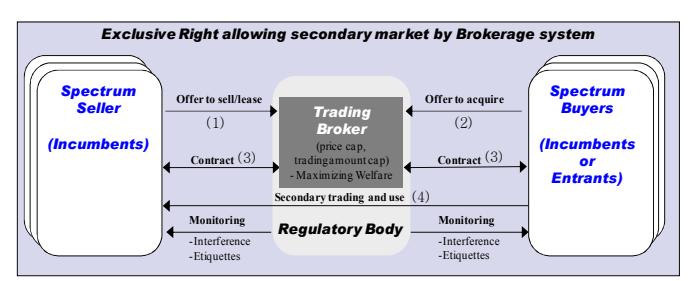
3 메커니즘 — (i) Brokerage: broker (정부 또는 third party) 가 sellers·buyers 거래 정보 집중 + 사회후생 최대화 매칭. Broker 의 목적 = subscriber surplus + provider profit 합 극대화. (ii) Auction: first-price sealed-bid 의 SMR (Simultaneous Multiple-Round, FCC 표준) 방식. Auctioneer 의 목적 = revenue 극대화. Bidders (사업자) 의 목적 = 원하는 양·가격에 spectrum 획득. (iii) Direct trading: broker 무, 사업자 간 직접 거래. Supply > demand 면 spectrum buyer 가 가격 결정, demand > supply 면 spectrum seller 가 가격 결정.
Agent-based simulation (REPAST + Java) 으로 3 entity 모델링 — incumbent (4~5 인) + entrant + subscriber (6,000 명 고정). 사업자 수 2/4/6 변화 (경쟁 강화) + trading cap (initial 할당의 30%) 유무 의 factorial 실험. Subscriber 는 quality-sensitive 와 cost-sensitive 두 type, soft-max (Gibbs/Boltzmann) action selection 으로 service provider 선택 + 효용 기반 reinforcement learning 으로 propensity 업데이트. Spectrum demand 는 Geometric Brownian Motion (real options 모델, Kawaguchi & Tsubokawa 2001, Kim 2005) 으로 stochastic 증가. SINR 기반 subscriber utility 는 A mixed spectrum management framework for the future wireless service based on techno-economic analysis: The Korean spectrum policy study 의 식 11 () 을 직접 사용.
결과의 핵심 메시지는 경쟁 강도에 따라 우월 메커니즘이 변화 한다는 조건부 명제. (1) 2 사업자 (저경쟁): 메커니즘 간 차이가 작음, cap 효과도 미미. (2) 4 사업자 (중경쟁): 모든 메커니즘에서 후생 증가, auction 이 provider profit 최고 (단 cap 적용 시 감소; brokerage·direct 는 cap 영향 없음). (3) 6 사업자 (고경쟁): subscriber surplus 가 가장 크고 direct trading 이 provider profit 최고 — 경쟁이 충분히 강하면 broker mediation 이 불필요. Tipping effect 분석에서는 6 사업자 + auction 시 특정 사업자로 subscriber 가 몰리는 시장 집중 강화 가 관측 → cap 규제로 해결, brokerage·direct trading 은 tipping 거의 없음.
정책 함의는 (i) spectrum cap (incumbent 의 monopolization 방지) 의 필수성, (ii) “Radio Waves Act” 의 spectrum property 법적 재정의 (분할·결합·interference 손실 가능성 포함), (iii) 기술·서비스 중립성 보장, (iv) 신규 진입 장벽 완화의 4 가지. 결론으로 direct trading 을 차세대 framework 로 권고 — 이는 KCC 의 2011 년 온라인 spectrum 거래 시장 출범 계획과 정확히 일관. 황준석 의 시장 기반 메커니즘 설계 라인 (대역폭 시장 · 그리드 경제학 와 자매) 의 spectrum 적용판, A mixed spectrum management framework for the future wireless service based on techno-economic analysis: The Korean spectrum policy study · Efficient Spectrum Policy Using Real Options and Game Theoretic Methods 와 자매.
핵심 결과
| 사업자 수 | 우월 메커니즘 (profit) | Subscriber surplus | Tipping effect (6 사업자) |
|---|---|---|---|
| 2 (저경쟁) | 차이 미미 | 차이 미미 | — |
| 4 (중경쟁) | Auction (cap 시 감소) | 모두 증가 | — |
| 6 (고경쟁) | Direct trading | 최대 | Auction = 강함 (cap 필요) / Brokerage·Direct = 없음 |
| 메커니즘 | Subscriber surplus | Provider profit | 신규 진입 | Tipping (6 사업자) |
|---|---|---|---|---|
| Brokerage | 중 | 중 | 우호 | 없음 |
| Auction | 중 (cap 영향) | 높음 (4 사업자), cap 시 감소 | 제약 | 강함 → cap 필요 |
| Direct trading | 최대 (6 사업자) | 최대 (6 사업자) | 우호 | 없음 |
핵심 명제: 경쟁 강도가 우월 메커니즘을 결정. 6 사업자 시 direct trading 이 subscriber surplus + provider profit 모두 최대, 차세대 framework 권고. Spectrum cap 은 auction 의 tipping effect 차단에 필수. 정부의 broker 역할은 저·중경쟁 환경에만 가치 있다.
방법론 노트
Subscriber utility 는 SINR 기반 (받은 신호 대 간섭+잡음비) 의 exponential 함수 — A mixed spectrum management framework for the future wireless service based on techno-economic analysis: The Korean spectrum policy study 의 식 11 직접 사용:
여기서 = 받은 SINR, = 서비스별 임계값, = 응용 요구 수준. Subscriber surplus = ( = QoS 민감도, = 비용 민감도, = subscription fee). Service provider profit:
여기서 = provider 의 가입자 수, = 거래 profit (-cost), = administration cost (메커니즘별 다름), = 라이선스 fee. 사업자의 trading 참여 결정은 acceptance probability:
여기서 = spectrum 할당에 대한 만족도, = relative spectrum 가격, = profit 민감도, = 가격 민감도. Spectrum demand 는 GBM (Geometric Brownian Motion):
( = drift, = volatility). Subscriber 의 reinforcement learning 은 Gibbs/Boltzmann soft-max action selection 으로 propensity update. 식별은 (i) 6 entity (3 agent class × incumbent/entrant) × 3 메커니즘 × 3 사업자 수 × 2 cap regime 의 factorial 시뮬레이션 + (ii) GBM stochastic 수요로 noise 흡수 + (iii) A mixed spectrum management framework for the future wireless service based on techno-economic analysis: The Korean spectrum policy study 모형의 직접 reuse 로 비교 가능성 확보에서 온다.
연구 계보
직접 선행: A mixed spectrum management framework for the future wireless service based on techno-economic analysis: The Korean spectrum policy study Telecommunications Policy — SINR utility + welfare 모형의 직접 출처, 본 paper 의 모형 재사용. Tonmukayakul & Weiss (2006) — secondary spectrum 후생 비교 정전, Martin B.H. Weiss 자신의 직접 선행. Valletti (2001) Telecommunications Policy “Spectrum trading” — spectrum 거래 자유화 정전. Xavier & Ypsilanti (2006) INFO “Policy issues in spectrum trading” — 정책 의제. Coase (1959) 의 spectrum 재산권 패러다임. Kwerel & Williams (2002) FCC WP — market allocation 전환 제안. Cave (2006), Werbach (2004), Hazlett & Bazelon (2007), Baumol & Robyn (2006) 의 spectrum 시장 메커니즘 라인. Ofcom (2004) Spectrum liberalization consultation. Bai et al. (2008) — broker 모형 (본 paper 가 brokerage 메커니즘에 차용). Argyroudis, Forde, Doyle & O’Mahony (2007) — policy-driven trading framework. Banks, Olson, Porter, Rassenti & Smith (2003) — FCC auction theory + experiment. Bajari & Yeo (2009), Cramton & Schwartz (2002), Weber (1997) 의 auction collusion 분석. Frutos & Jarque (2007), Gandhi et al. (2008) — auction 메커니즘. Al Daoud, Alanyali & Starobinski (2007) — CDMA secondary pricing. Sutton & Barto (1998) Reinforcement Learning — subscriber agent 학습 알고리즘. Kawaguchi & Tsubokawa (2001), Kim (2005) — real options + GBM. 황준석 · Martin B.H. Weiss 의 장기 협업 (Hyenyoung Yoon 박사 라인) 의 capstone, A mixed spectrum management framework for the future wireless service based on techno-economic analysis: The Korean spectrum policy study · Efficient Spectrum Policy Using Real Options and Game Theoretic Methods · Policy Welcome (DySPAN 2010) 와 자매.
See also
- 황준석
- Hyenyoung Yoon
- Martin B.H. Weiss
- IEEE Symposium on New Frontiers in Dynamic Spectrum Access Networks (DySPAN)
- 주파수 정책
- 이차 스펙트럼 거래
- agent-based-simulation
- 후생 분석
- A mixed spectrum management framework for the future wireless service based on techno-economic analysis: The Korean spectrum policy study
- Efficient Spectrum Policy Using Real Options and Game Theoretic Methods
- Policy Welcome (DySPAN 2010)
인접 그래프
- 인물 3
- 방법론 3
- 주제 5
- 수록처 1
- 분류 2
- 논문 4