Profiting from innovations: the role of new game strategies in the case of Lipitor of the US pharmaceutical industry
강진아, Allan Afuah (2010) · R&D Management 40(2):124-137
Teece (1986) 의 profiting from innovation (PFI) 프레임을 imitator vs innovator 와 complementary assets 의 이분법을 넘어 co-opetitor 와의 positioning 차원으로 확장한다. 신약 통념에 따르면 statin 계열의 5 번째 진입자 (Lipitor) 가 세계 최다 매출 약품이 될 가능성은 거의 없으나, Warner-Lambert/Pfizer 팀의 new game strategy (DTC marketing, Pfizer 와의 alliance, head-to-head trial, fast-track FDA approval, 저가 진입) 가 perfect competition 의 5 가지 가정을 동시에 위반 하여 quadrant II → III 로 positioning 을 이동시켰음을 사례 분석으로 보인다. 강진아 의 1기 마무리 작업이자 전유성 라인의 출발.
- RQ: 동일한 전유성 와 보완 자산 를 가진 약품들 사이에서, 왜 5 번째 진입자 (Lipitor) 가 최다 매출 을 달성했는가? co-opetitor (suppliers, customers, complementors, followers, imitators, universities) 와의 positioning 이 어떻게 innovator 의 rent 전유를 결정하는가?
- 방법론: 사례연구 (Lipitor 단일 사례 + 4 개 선행 statin 비교: Mevacor by Merck, Pravachol by Bristol Myers Squibb, Zocor by Merck, Lescol by Novartis). 이론 프레임: perfect competition 의 5 가정 (atomicity, homogeneity, free entry/exit, perfect information, equal resource access) 의 위반 으로서 new game activity 분류
- 데이터: 미국 제약 산업 1990s-2005, Lipitor (atorvastatin) 사례, Leafstedt et al. (2003) 사례 자료, Warner-Lambert/Pfizer alliance 및 acquisition (2000) 기록
- 주요 발견: Lipitor 는 statin 5 번째 진입자임에도 LDL 감소 40-60% (vs Zocor 40%), triglyceride 19-40% (vs Zocor 17%) 의 head-to-head 우위 데이터 + DTC marketing 으로 patient pull 생성 + Pfizer 와의 alliance 로 sales force 확대 + familial hypercholesterolemia 적응증으로 fast-track FDA 6 개월 patent life 확대 + 저가 진입으로 PBM formulary 등재 → 5 가지 new game activity 의 interrelated system 이 quadrant II → III 이동. 2005 년 세계 최다 매출 약품 등극.
- 시사점: PFI 의 결정 요인을 imitability + complementary asset 의 2 차원에서 positioning vis-à-vis co-opetitors 의 3 차원으로 확장. positioning 의 세 유형: PMP 식 bargaining power, network 식 cooperation, structural hole 식 information advantage. late entrant 도 new game strategy 로 incumbent 의 prior commitment 를 우회할 수 있음.
요약
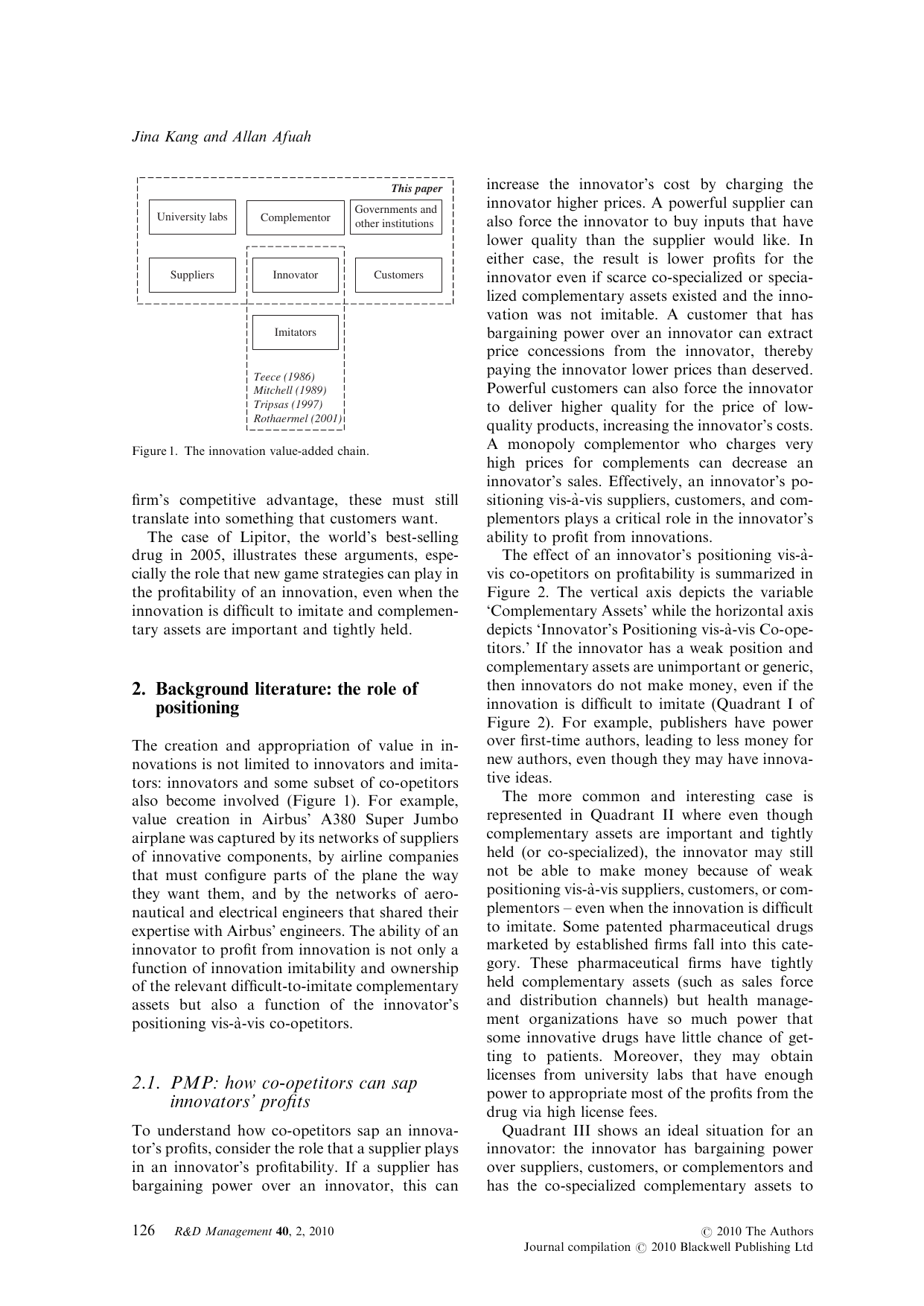
이 paper 는 Teece (1986) 의 profiting from innovation 프레임의 한계를 진단하면서 시작한다. Teece 의 핵심 명제 — “imitator 가 모방하기 쉬운 환경에서는 co-specialized complementary asset 을 가진 actor 가 rent 를 가져간다” — 는 강력하지만, co-opetitor (suppliers, customers, complementors, followers, universities, professional bodies, institutions) 의 역할을 충분히 다루지 않는다. Teece 자신도 286 페이지에서 이를 언급하나 후속 연구 (Mitchell 1989; Tripsas 1997; Rothaemel 2001; Chesbrough 2003) 는 incumbent vs new entrant 의 complementary asset 비교에만 집중. 강진아 과 Allan Afuah 는 이를 positioning 차원으로 확장.
이론 frame 의 핵심은 perfect competition 의 5 가지 가정 (atomicity, homogeneity of products, free entry/exit, perfect and complete information, equal access to resources) 의 의도적 위반 으로서 new game strategy 를 분류한 것. 각 가정 위반은 특정 new game activity 와 대응: (1) atomicity → alliance·M&A·first move 로 size 증가, (2) homogeneity → R&D·광고로 differentiation, (3) free entry → barrier 구축 (patent, dominant design), (4) perfect information → vertical integration 으로 정보 비대칭 활용, (5) equal resource → strategic collaboration 으로 scarce resource 접근. 이 5 차원이 innovation value-added chain 의 어느 단계에서든 적용 가능.
Lipitor 사례 분석은 이 5 가지 위반을 동시에 수행한 입체적 시연이다. statin 계열 5 번째 진입자 (Mevacor 1987, Pravachol 1991, Zocor 1991, Lescol 1993, Lipitor 1997) 라는 불리한 timing 을 다섯 new game activity 의 interrelated system 으로 극복: (1) DTC marketing — 처방약을 환자에게 직접 광고 (이전 statin 은 의사에게만 marketing), homogeneity 위반 + 의사의 bargaining power 우회, (2) Pfizer alliance → acquisition (2000) — Warner-Lambert 의 cholesterol sales force 에 Pfizer 의 cardiovascular 전문 sales force 결합, atomicity 위반 + equal resource 위반, (3) head-to-head clinical trial — 4 개 선행 statin 과 직접 비교 (제약 산업 초유), Lipitor LDL 감소 40-60% (Zocor 40%) + triglyceride 19-40% (Zocor 17%) 우위 데이터로 doctor switching 인센티브 제공, (4) familial hypercholesterolemia 적응증 — 희귀 유전 질환에 대한 fast-track FDA review 로 6 개월 patent life 확대, free entry 위반 + monopoly rent 기간 extension, (5) 저가 진입 — Pharmaceutical Benefit Manager (PBM) formulary 등재로 HMO 보험 coverage 확보, perfect information 위반. 이 다섯 activity 의 결합이 Lipitor 를 quadrant II (강한 IP + 강한 complementary asset 이지만 weak positioning) 에서 quadrant III (강한 IP + 강한 complementary asset + strong positioning) 로 이동시켜 2005 년 세계 최다 매출 약품 등극. 강진아 1기 (UCLA/CSU Fullerton 시대) 의 수익 전유 전략 라인의 핵심 작업이며, 이후 전유성 regime 의 역할 (Determinants of Firm's Innovation-Related External Knowledge Search Strategy: The Role of Potential Absorptive Capacity and Appropriability Regime) 으로 발전.
핵심 결과
| Perfect competition 가정 | Lipitor 의 new game activity | 효과 |
|---|---|---|
| 1. Atomicity (작은 행위자) | Pfizer 와의 alliance → acquisition (2000) | Sales force 확대, 가격 영향력 |
| 2. Homogeneity (동질 제품) | DTC marketing, head-to-head trial | Patient pull, 의사 power 약화 |
| 3. Free entry/exit | Patent + FDA 적응증 fast-track | Patent life 6 개월 연장, barrier |
| 4. Perfect information | Pfizer alliance 로 sales force 정보, DTC 로 환자 정보 | 정보 비대칭 활용 |
| 5. Equal resource access | Pfizer alliance 의 sales force (Mitchell 1989 의 critical complementary asset) | Scarce resource 우선 접근 |
결과 수치: Lipitor LDL 감소 40-60% (Zocor 40%), triglyceride 19-40% (Zocor 17%). statin 계열 5 번째 진입자 → 2005 년 세계 최다 매출 약품. 통념의 3-4 번째 진입자 = 실패 패턴을 정면 반박.
방법론 노트
본 paper 는 실증 econometrics 가 아닌 이론적 case study. 핵심 기여는 PFI 프레임의 2 × 2 quadrant 확장 (figure 2):
| Weak positioning vs co-opetitor | Strong positioning vs co-opetitor | |
|---|---|---|
| Weak / generic complementary asset | Quadrant I: 이익 거의 없음 (예: 첫 출판 저자) | Quadrant IV: 강한 positioning 만으로 이익 가능 |
| Strong / co-specialized complementary asset | Quadrant II: complementary asset 있어도 이익 없음 (예: 약점 있는 처방 약, university license 의존) | Quadrant III: 이상적 (예: Microsoft) |
Lipitor 분석의 movement: 4 개 선행 statin 은 quadrant II (강한 IP + sales force 있으나 doctor·HMO 의 bargaining power 에 막힘) → Lipitor 는 5 가지 new game activity 의 system 으로 quadrant III 로 이동. 핵심 driver 둘: (i) industry value driver 활용 (제약은 patient demand pull + sales force 가 결정), (ii) co-opetitor 의 prior commitment 가 imitation 을 막음 (예: Compaq 의 direct sale 시도가 distributor agreement 로 좌절).
연구 계보
이 paper 는 강진아 1기 (UCLA/CSU Fullerton 시대, 2002-2010) 의 수익 전유 전략 라인의 대표작이며, 미시간 비즈니스 스쿨의 Allan Afuah 와의 국제 공저. 이론적 선행: Teece (1986) 의 profiting from innovation 핵심 프레임 (직접 확장 대상), Mitchell (1989) 의 incumbent entry probability, Tripsas (1997) 의 complementary asset incumbent survival, Rothaemel (2001) 의 biopharm complementary asset 라인, Chesbrough (2003) 의 개방형 혁신 (control), Porter (1980) 의 PMP, Barney-Arikan (2001) 의 RBV (두 perspective 모두 critique 대상), Brandenburger-Stuart (1996) 의 co-opetition (Lewis-Carroll 식 게임 이론), Buaron (1981) 과 Afuah (2003) 의 new game strategy 개념 origin, Lieberman-Montgomery (1988, 1998) 의 선발자 이익, Cohen-Levinthal (1990) 의 흡수능력, Williamson (1999, 2002) 의 governance, Dyer-Nobeoka (2000) 의 Toyota network learning. 후속 자매로 Determinants of Firm's Innovation-Related External Knowledge Search Strategy: The Role of Potential Absorptive Capacity and Appropriability Regime (PACAP 와 appropriability regime 의 외부 탐색 조절) 가 같은 수익 전유 명제를 실증 모델로 확장.
See also
- 강진아
- Allan Afuah
- R&D Management
- 혁신으로부터의 수익 전유
- 포지셔닝
- 코오피티션
- 전유성
- 보완 자산
- 선발자 이익
- Determinants of Firm's Innovation-Related External Knowledge Search Strategy: The Role of Potential Absorptive Capacity and Appropriability Regime
인접 그래프
- 인물 2
- 방법론 1
- 개념 8
- 주제 1
- 수록처 1
- 논문 2