Factors affecting successful innovation by content-layer firms in Korea
황준석, Seunghyun Kim (2011) · The Service Industries Journal 31(7):1093-1107 · DOI ↗
ICT 산업의 계층 모형 (Benkler 1998, Lessig 2001, Werbach 2002 의 content / service-network / terminal 3-layer) 구조에서 콘텐츠 계층 기업의 혁신 성공 요인을 한국 모바일·인터넷 콘텐츠 85 개 기업 설문으로 분석한다. 24 개 변수를 주성분 분석 (varimax rotation) 로 6 factor 로 추출하고 다중회귀분석 하여, user-level participation (β=0.299, 1% 유의) 이 firm-level participation (β=0.319, 1% 유의) 에 거의 동등한 firm performance 설명력을 가짐을 보인다.
- RQ: 콘텐츠 계층 기업의 혁신 성공 요인은 무엇이고, user-involved innovation 관점이 기존 Montoya-Weiss-Calantone (1994) 의 일반 frame 보다 ICT 콘텐츠 산업의 변화를 더 잘 포착하는가
- 방법론: 요인분석 (주성분 분석 + varimax rotation, eigen value ≥ 1, factor loading ≥ 0.5), Cronbach’s α ≥ 0.6 신뢰도, 다중회귀분석 (sales contribution / firm performance 2 종속), Kaiser-Meyer-Olkin (KMO) 표본 적정성, Bartlett’s sphericity test
- 데이터: KIPA + Korea Culture & Content Agency 의 1,100+ 디지털 콘텐츠 기업 중 200 무작위 contact → 85 응답 (응답률 42.5%); SME 96.5%, 4 년 이상 근속 응답자 76.2%; 7-point Likert; 24 변수 측정
- 주요 발견: (i) 24 변수가 6 factor (firm-level participation, user-level participation, government policy, competitive conditions, common infrastructures, high-loyalty user group) 로 수렴 — user-involved innovation perspective 와 정확히 일치; (ii) firm performance 회귀: firm-level (β=0.319, 1% 유의), user-level (β=0.299, 1% 유의), competitive conditions (β=0.194, 10% 유의), 나머지 무의미; ; (iii) sales contribution 회귀: user-level 만 β=0.253 (10% 유의), (약함)
- 시사점: 한국 콘텐츠 SME 의 혁신 정책은 user pool 형성·중개 가 핵심; 정부의 R&D 자금 중심 정책은 user-side 보완 필요; lead user / early adopter / general user 의 3 유형별 차별 정책
요약
황준석 의 2 기 한국 ICT 정책 / 혁신 경제학 라인 paper. ICT 산업의 기술 융합이 두 가지 변화를 가져왔다는 진단이 출발점 — (1) 산업 분류가 vertical (제품별) → horizontal (계층 모형 별) 로 재편 (Li-Whalley 2002), (2) 사용자가 passive consumer → active prosumer 로 전환 (Jakobs 2006). Werbach (2002) 의 3-layer (content / service-network / terminal) 분류에서 content layer 가 사용자에게 가장 가깝고 변화 속도가 가장 빠르다. 본 paper 는 이 콘텐츠 계층 기업의 혁신 성공 요인을 분석하면서 user-involved innovation 이라는 새로운 frame 을 정량적으로 검증한다.
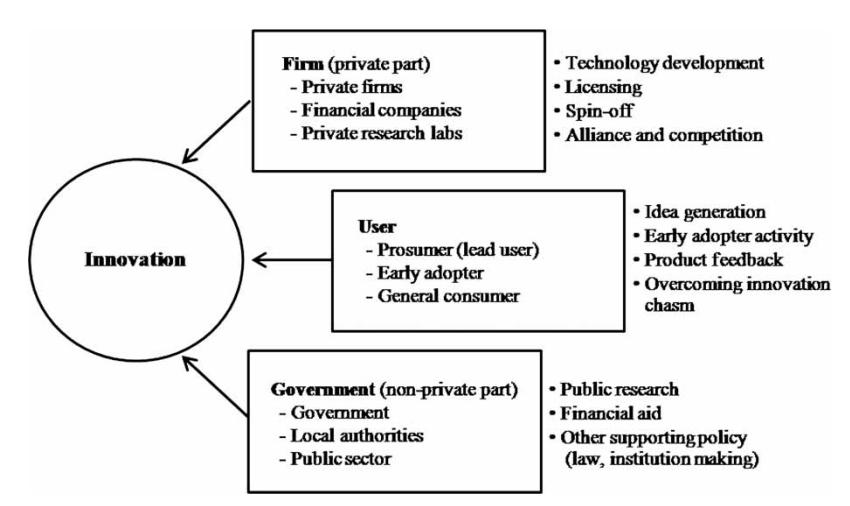
방법론적으로 두 가지 categorization 을 비교: (A) Montoya-Weiss-Calantone (1994) 의 4-category (development process, product strategy, market environment, organization) — 18 factor 메타분석 기반의 일반 frame, (B) user-involved innovation (Hwang-Kim 2008b) — Edquist (1997) 의 systems of innovation 에 von Hippel (1988, 2005) 의 democratizing innovation 을 결합한 3-actor frame (firm / user / government). 24 개 변수를 7-point Likert 로 측정 (firm 의 R&D 인력·자원·top management, user 의 R&D 직접 참여·early adopter 활동·신아이디어 제공, government 의 세금·R&D 자금·기술 이전, 시장 환경 7 변수). KIPA + Korea Culture & Content Agency 의 디지털 콘텐츠 기업 1,100+ 중 200 contact, 85 응답 (96.5% SME). 주성분 분석 (varimax rotation) 으로 KMO 0.777 (factor), 0.801 (performance) 의 양호한 표본 적정성.
결과는 user-involved innovation frame 의 강력 지지. 24 변수가 정확히 6 factor 로 수렴 — firm-level participation (eigen 8.97), user-level participation (3.41), government policy (1.78), competitive conditions (1.66), common infrastructures (1.32), high-loyalty user group (1.13). 특히 user 가 user-level participation (lead user + early adopter) 와 high-loyalty user group (feedback + 소비) 의 두 factor 로 분기되는 것이 user-involved innovation 이론의 lead/early-adopter/general user 3-유형 분류와 정확히 매핑된다. Firm performance () 회귀에서 firm-level (β=0.319, 1% 유의), user-level (β=0.299, 1% 유의), competitive conditions (β=0.194, 10% 유의) 만 유의. user-level 이 firm-level 에 거의 동등하다는 것이 핵심 finding — 콘텐츠 산업의 혁신 거의 절반이 user 가 만든다. 정책 함의: KAIS (2006) 가 한국 SW 기업이 R&D 자금 + user pool 을 요구한다고 보고했음에도 정부 정책은 R&D 자금에만 집중 — user pool 형성, user-SME 중개, active user 선발이 누락된 정책. 황준석 의 콘텐츠 산업 라인의 초기 정량 paper 로, Convergence and Merger Performance of Acquiring Firms in the Broadcasting and Telecommunication Industries: Evidence from Korean Case 의 콘텐츠 M&A 분석과 짝을 이루어 콘텐츠 산업 전략·거버넌스를 다면적으로 다룬다.
핵심 결과
| 추출 factor | Eigen value | Cronbach’s α | Firm perf. β | Sales β |
|---|---|---|---|---|
| Firm-level participation | 8.97 | 0.900 | +0.319* | +0.097 |
| User-level participation | 3.41 | 0.756 | +0.299* | +0.253* |
| Government policy | 1.78 | 0.834 | +0.043 | +0.031 |
| Competitive conditions | 1.66 | 0.806 | +0.194* | +0.159 |
| Common infrastructures | 1.32 | 0.681 | +0.012 | -0.034 |
| High-loyalty user group | 1.13 | 0.653 | -0.059 | +0.049 |
| 0.376 | 0.105 | |||
| (sig.) | 3.945 (0.002) | 0.838 (0.547) |
N = 85 콘텐츠 기업, 96.5% SME. * p<0.1, ** p<0.05, *** p<0.01. KMO 0.777, Bartlett’s sphericity p < 0.001. 24 변수가 6 factor 로 정확히 분해되며 user-involved innovation 의 3-actor + 시장환경 frame 과 매핑.
방법론 노트
요인분석 단계: 주성분 분석 + varimax rotation 으로 24 변수를 직교 factor 로 분해. 결정 기준: eigen value , factor loading (Hair-Anderson-Tatham 1979). 추출된 factor 는:
신뢰도: Cronbach’s (Pedhazur-Schmelkin 1991). 표본 적정성: Kaiser-Meyer-Olkin (KMO) . Sphericity: Bartlett’s test 의 검정으로 변수 간 무상관 귀무 기각.
다중회귀분석 단계: factor score 를 독립변수로, 두 종속변수 (sales contribution = 혁신 제품의 매출 비중, firm performance = 7 변수 합성 factor) 에 대해:
표준화 β 로 효과 크기 비교. 0.3-0.4 면 사회과학 적정 설명력 (본 paper 의 firm performance 모형 적정, sales 모형 0.105 약함). User-level participation 이 두 종속변수 모두에서 양 (+) 유의한 유일 변수 — user 는 firm 의 혁신 산출 모두에 기여 의 정량 증거.
연구 계보
황준석 의 2 기 한국 ICT 정책 / 콘텐츠 산업 라인 paper. 직접 선행은 본 저자 군의 Hwang-Kim (2008a) “A layer-based innovation strategy” (한국 ICT 3-layer 분석), Hwang-Kim (2008b) “A user-involved system for innovation” (frame 제시 paper). 도구 lineage 는 Cooper (1979) 의 NewProd 산업 신제품 성공 요인, Cooper-Kleinschmidt (1987) 의 4-criteria 모형, Montoya-Weiss-Calantone (1994 JPIM) 의 18-factor 메타분석 + 4-category — 본 paper 의 비교 대상 frame, Lilien-Yoon (1989), Lim-Ribeiro-Lee (2008) 의 서비스 기업 성과 23 요인. Layer model lineage: Benkler (1998) 의 layer separation, Lessig (2001, 2004) 의 commons 분류, Werbach (2002 JTHTL) 의 3-layer Internet policy. User innovation lineage: Schumpeter (1934), Freeman (1987) / Lundvall (1992) / Nelson (1993) 의 NIS, Edquist (1997) 의 systems of innovation, Malerba (2004) 의 sectoral systems, von Hippel (1988, 2005) 의 democratizing innovation, Urban-von Hippel (1988) 의 lead user analysis, Jakobs (2006 TFSC) 의 user-side innovation in ICT standards, Chesbrough (2003) 의 open innovation. 자매 paper Convergence and Merger Performance of Acquiring Firms in the Broadcasting and Telecommunication Industries: Evidence from Korean Case 가 같은 시기 같은 broadcasting/telecom 융합 환경의 M&A 분석.
See also
- 황준석
- Seunghyun Kim
- The Service Industries Journal
- 요인분석
- 주성분 분석
- 다중회귀분석
- 콘텐츠 산업
- 사용자 참여 혁신
- 계층 모형
- prosumer
- Convergence and Merger Performance of Acquiring Firms in the Broadcasting and Telecommunication Industries: Evidence from Korean Case
인접 그래프
- 인물 2
- 방법론 3
- 개념 1
- 주제 3
- 수록처 1
- 분류 2
- 논문 1