The Effects of Alliance Portfolio Diversity on Innovation Performance: A Study of Partner and Alliance Characteristics in the Bio-Pharmaceutical Industry
Kerstin Marhold, Marco Jinhwan Kim, 강진아 (2017) · International Journal of Innovation Management 21(1):1750001 · DOI ↗
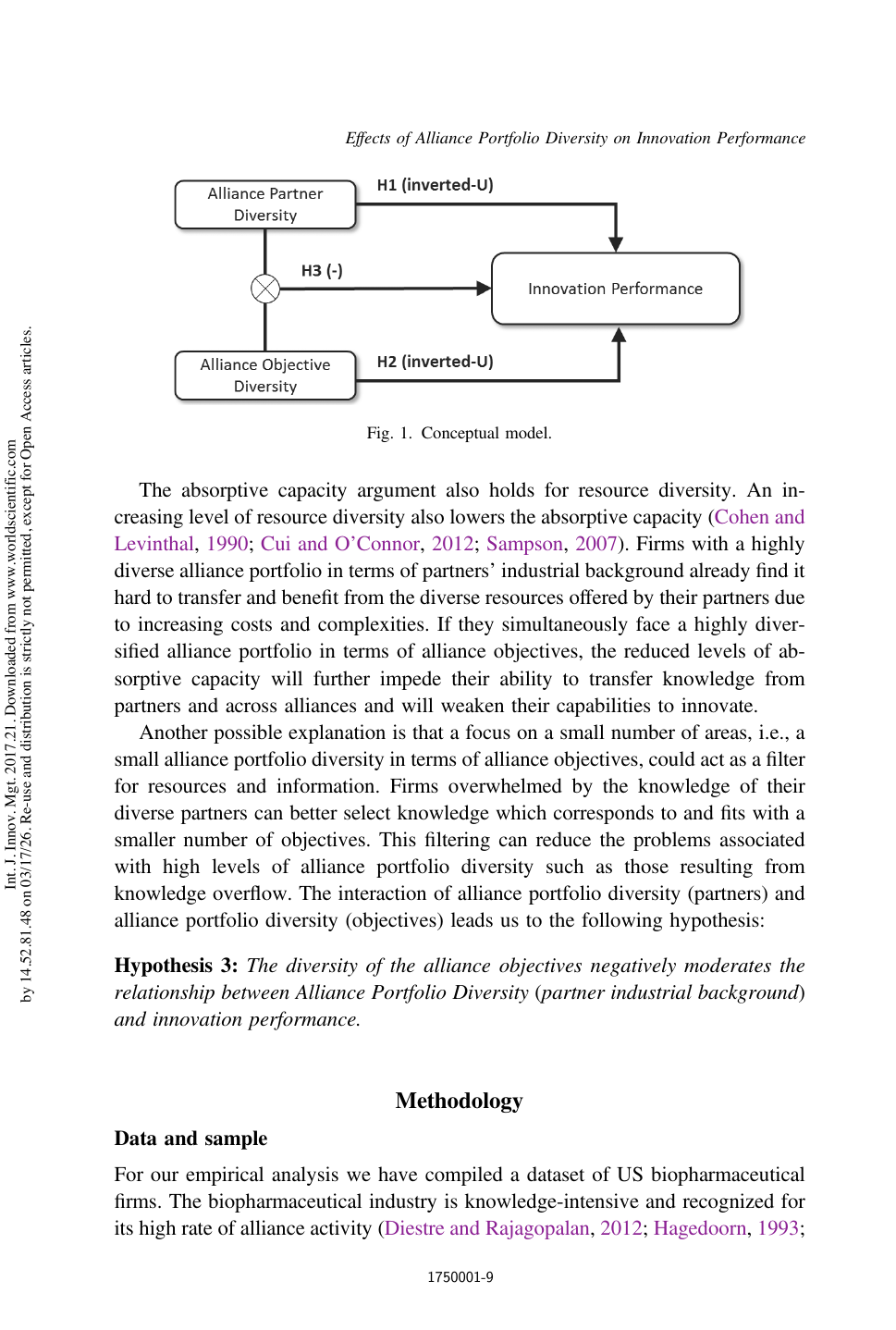
alliance portfolio diversity 의 결과 측면을 partner 산업 배경 다양성 과 alliance 목적 다양성 의 두 차원에서 분석한다. 1998-2002 미국 bio-pharmaceutical 산업 R&D 동맹 70개 기업 데이터 (SDC Platinum + Compustat + USPTO) 를 음이항 회귀 으로 분석해 partner 다양성과 혁신 성과 (Trajtenberg weighted patent count) 의 역-U 관계 와 partner × objective 다양성의 부정적 상호작용 을 확인한다. 다양한 partner 를 가진 기업이 동시에 다양한 목적을 추구하면 absorptive capacity 가 고갈되어 혁신 성과가 급감한다.
- RQ: alliance portfolio 의 partner 산업 배경 다양성 과 alliance 목적 다양성 이 혁신 성과에 어떻게 영향을 주며, 두 다양성은 어떻게 상호작용하는가?
- 방법론: 음이항 회귀, 허핀달 지수, 특허 분석 (Trajtenberg weighted patent count)
- 데이터: 미국 bio-pharmaceutical (SIC 283) R&D 동맹 70개 기업, 1998-2002 portfolio → 2002-2006 patent (citations 2010년까지), Thomson Reuters SDC Platinum + Compustat North America + USPTO
- 주요 발견: H1 지지 (Model 3·7) — Partner diversity = +3.62 (p<0.05), partner diversity² = -4.75 (p<0.01) → 역-U 관계. H2 비지지 — objective diversity 의 직접 효과 미확인. H3 지지 (Model 6·7) — Partner × Objective 상호작용 = -3.30 (p<0.01).
- 시사점: alliance portfolio 관리에서 partner 다양화 와 목적 다양화 는 동시에 추구하지 말아야 한다. 한 차원을 다양화하면 다른 차원은 집중. 기업 이질성 (managerial resources, internal routines, Wuyts 2014) 이나 core-crust 설계 (Bahlmann et al. 2012) 가 최적 다양성을 결정.
요약
alliance portfolio diversity 문헌 (De Leeuw et al. 2014, Duysters et al. 2012, Jiang et al. 2010, Oerlemans et al. 2013) 은 대부분 partner 특성 (산업 배경, 기술 자원, partner 유형) 에 집중했고, alliance 자체의 특성 — 특히 alliance 목적 — 을 portfolio 수준 diversity 차원으로 도입한 연구는 거의 없었다. dyadic 수준에서 Wen 과 Chuang (2010) 이 alliance background 를 다뤘으나 portfolio 차원의 분석은 부재. 동시에 다양한 dimension 사이의 interaction 도 미개척 영역이었다 (Bengtsson et al. 2015 의 partner × explorative-exploitative knowledge content 가 가장 가까운 사례).
저자들은 이 두 빈자리를 함께 채운다: (1) alliance objective diversity 라는 새 차원 도입 (SDC Platinum 의 alliance-level SIC 기반), (2) partner diversity × objective diversity 의 상호작용 검증. 1998-2002 미국 bio-pharmaceutical (SIC 283) 70개 기업 R&D-focused alliance 데이터 (SDC Platinum + Compustat + USPTO). 종속변수는 Trajtenberg (1990) weighted patent count = (Sampson 2007 등에서 사용) — 4년 시차 (alliance 후 patent 생성·신청까지의 lag) 로 2002-2006 patent, citation 은 2010년까지 (3년 내 peak 이므로 truncation 무시 가능, Mehta et al. 2010). VIF 평균 1.74 < 10 으로 다중공선성 부재.
결과는 세 가설 중 두 개 지지된다. (i) Partner diversity → 혁신 성과: 선형항 +3.62, 제곱항 -4.75 (p<0.01, Model 3) — 역-U 관계 H1 지지. 낮은 다양성은 redundancy (Bruyaka 와 Durand 2012), 높은 다양성은 transaction cost (Goerzen 와 Beamish 2005) + attention allocation 문제 (Koput 1997). (ii) Objective diversity 단독 효과 H2 미지지 — linear/quadratic 모두 비유의. (iii) Partner × Objective 상호작용 -3.30 (p<0.01, Model 6) — H3 지지. absorptive capacity 논리 (Cohen 과 Levinthal 1990): 두 차원 동시 고도 다양화는 기업의 흡수·통합 capacity 한계 를 초과해 혁신 성과가 급감. 강진아 의 SNU 이론기 alliance portfolio 라인의 외부 자원 다양성 × 내부 흡수역량 fit framework 를 multi-dimensional diversity 로 확장한 핵심 작업이며, 동일 저자팀 The effects of internal technological diversity and external uncertainty on technological alliance portfolio diversity (다양성의 결정요인 측면) 와 짝을 이룬다. 강진아 의 UCLA/CSU Fullerton 시기 Marhold 와의 국제 공동연구를 SNU 이론기에 incumbent 연구 프로그램으로 결합한 결과물.
핵심 결과
| 변수 | Model 7 (full) 계수 | 표준오차 | 가설 |
|---|---|---|---|
| Alliance portfolio diversity (partner) | +5.132*** | 1.567 | H1 지지 (선형) |
| Alliance portfolio diversity (partner)² | -3.849* | 2.234 | H1 지지 (역-U) |
| Alliance portfolio diversity (objective) | +1.678 | 1.590 | H2 비지지 |
| Alliance portfolio diversity (objective)² | -0.647 | 2.615 | H2 비지지 |
| APD(partner) × APD(objective) | -5.531** | 2.479 | H3 지지 (부정적 상호작용) |
| Firm size (log sales, control) | +0.287*** | 0.070 | — |
| Knowledge stock (control) | +0.0025*** | 0.0009 | — |
표본: N=70 미국 bio-pharmaceutical 기업, 1998-2002 alliance → 2002-2006 patent (citations to 2010). Pseudo-R²(McFadden) = 0.0793. *p<0.10, **p<0.05, ***p<0.01.
방법론 노트
종속변수 innovation performance 가 over-dispersed count 라 음이항 회귀 (Barron 1992). Trajtenberg (1990) weighted patent count 로 patent 수 + 인용 가중치 결합:
여기서 는 firm 의 2002-2006 신청 grant patent 수, 는 patent 의 forward citation 수 (2010까지).
다양성은 허핀달 지수 기반 1-HHI:
여기서 는 (partner 다양성의 경우) partner 의 primary SIC code 의 비중, (objective 다양성의 경우) alliance 의 SDC-assigned main SIC code 의 비중. 값이 0이면 완전 집중, 1이면 완전 분산. 역-U 검증을 위해 quadratic term, 상호작용 효과는 두 다양성의 곱 항으로 식별. 4년 alliance-to-patent lag 으로 reverse causality 완화.
연구 계보
Jiang, Tao, Santoro (2010) 의 alliance portfolio diversity 다차원 framework (partner 산업 배경, mode of governance, functional diversity), Bengtsson et al. (2015) 의 partner diversity × explorative-exploitative knowledge content 상호작용, De Leeuw et al. (2014), Duysters et al. (2012), Oerlemans et al. (2013) 의 다양성 ↔ 혁신 성과 역-U 실증, Srivastava 와 Gnyawali (2011), Vasudeva 와 Anand (2011) 의 partner 기술 자원 다양성, Cohen 과 Levinthal (1990) 의 absorptive capacity, Wen 과 Chuang (2010) 의 dyadic 수준 co-exploration/exploitation/learning 분류, Trajtenberg (1990), Albert et al. (1991), Harhoff et al. (1999), Hall et al. (2005) 의 weighted patent count 방법론, Wuyts (2014), Bahlmann et al. (2012), Hoffmann (2005) 의 alliance portfolio management 실무 framework 를 종합한다. 강진아 author page 의 실타래 2 (“양날의 검”) 와 alliance portfolio diversity 라인의 multi-dimensional 확장. CSU Fullerton 시기 시작된 강진아-Marhold 국제 공동연구 (2002-2005년 강진아 CSU Fullerton 조교수 재직) 가 SNU 이론기 (2013-2018) 에 제휴 포트폴리오 · 흡수능력 라인으로 incubation 된 결과. 동일 저자팀 The effects of internal technological diversity and external uncertainty on technological alliance portfolio diversity (다양성의 결정요인 — 내부 기술 다양성·외부 불확실성) 와 짝을 이뤄 결과 ↔ 결정요인 양방향을 완결한다.
See also
- 강진아
- Kerstin Marhold
- Marco Jinhwan Kim
- International Journal of Innovation Management
- 제휴 포트폴리오
- 동맹 포트폴리오 다양성
- 허핀달 지수
- 흡수능력
- 음이항 회귀
- 특허 분석
- The effects of internal technological diversity and external uncertainty on technological alliance portfolio diversity
인접 그래프
- 인물 3
- 방법론 4
- 개념 3
- 주제 2
- 수록처 1
- 분류 1
- 논문 3
이 문서를 가리키는 페이지
논문 (3)
- Determinants of Firm's Innovation-Related External Knowledge Search Strategy: The Role of Potential Absorptive Capacity and Appropriability Regime
- Does partner type matter in R&D collaboration for product innovation?
- The effects of internal technological diversity and external uncertainty on technological alliance portfolio diversity