Chemistry-informed machine learning: Using chemical property features to improve gas classification performance
Yeram Kim, Chiehyeon Lim, 이정혜, Sungil Kim, Sewon Kim, Dong-Hwa Seo (2023) · chemometrics-and-intelligent-laboratory-systems 237:104808 · DOI ↗
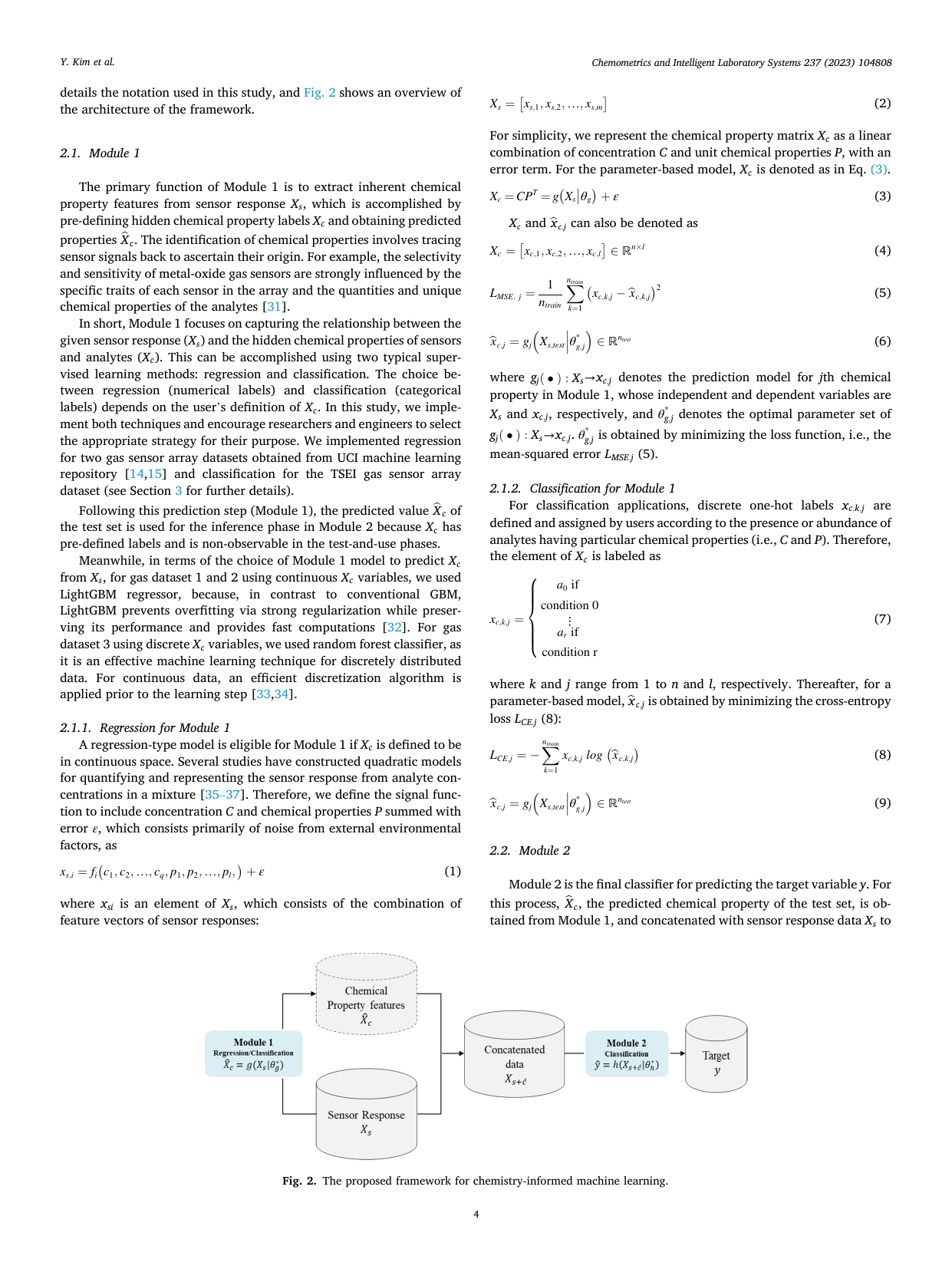
Chemistry-informed ML 은 가스 sensor selectivity 를 결정하는 분자 chemical property (bond dissociation energy, molar mass function, electron donation effect, ionization potential, sulfur 함량) 를 sensor 응답에서 예측 한 뒤 raw response 와 concatenate 해 classification 에 투입한다. 2-module framework — Module 1 (sensor → chemical property regression/classification), Module 2 (raw + predicted property → gas class). 3 dataset (UCI twin · UCI turbulent · Taesung 실험실) 모두에서 best F1 score 가 raw-only baseline 대비 개선. UCI twin dataset 에서 elastic net + concatenated feature 가 F1 0.910, turbulent dataset 에서는 SVC + concatenated 가 CO 0.946 / ethylene 0.972 / methane 0.930. SHAP 분석으로 molar mass function · BDE · EDE 가 top contributing feature 임을 확인.
- RQ: 가스 sensor 의 raw response 만으로는 sensor selectivity 를 결정하는 unobservable chemical property 정보가 누락되어 분류 성능이 한계. Domain knowledge 기반 chemical property feature 를 ML 에 통합하면 (a) 어떤 property 가 어느 dataset 에서 영향력 있는가? (b) raw + predicted property concatenation 이 raw-only / raw + random noise baseline 대비 얼마나 향상하는가?
- 방법론: 2-module chemistry-informed-ml framework. Module 1 = lightgbm regressor (continuous property) 또는 random-forest classifier (binary property), Module 2 = 6종 classifier (elastic net, RF, extra trees, LightGBM, KNN, SVC). Bayesian hyperparameter tuning + 3-fold CV. shap 으로 feature contribution 해석. Baseline 비교: raw-only, raw + random Gaussian noise concatenation.
- 데이터: (i) Gas dataset 1 (UCI twin, Fonollosa et al. 2016) — 8 MOX sensor, 640 sample, 4 target (ethylene · ethanol · CO · methane). (ii) Gas dataset 2 (UCI turbulent, Fonollosa et al. 2014) — 8 MOX sensor, 180 sample, 3 target (CO · methane · ethylene 의 turbulent mixture). (iii) Gas dataset 3 (Taesung TSEI) — MOX 2 + electrochemical 5 + PID 1 = 7 sensor, 104 sample, 3 target (toluene · butyl acetate · dimethyl sulfide). Train/test = 75/25, 100 random repeat
- 주요 발견: (i) UCI twin (dataset 1): raw + concatenation 이 6 분류기 중 5 개에서 raw-only 우월. 최고 평균 F1 = 0.910 (elastic net). (ii) UCI turbulent (dataset 2): 3 binary task 모두 best 가 — CO 0.946 (SVC), ethylene 0.972 (SVC), methane 0.930 (RF). (iii) Taesung (dataset 3): butyl acetate 0.791 (extra trees), dimethyl sulfide 0.852 (extra trees), toluene 0.829 (LightGBM). 모두 raw-only baseline + random noise baseline 보다 우월. (iv) SHAP top contributor: dataset 1 에서 molar mass function
1/sqrt(M)가 1st, EDE 3rd, BDE 4th — chemical property feature 가 raw sensor response 보다 더 informative. dataset 3 에서 sulfur/sulfide indicator 가 모든 task 에 핵심 (dimethyl sulfide 검출 핵심). - 시사점: (a) Physics-informed ML 의 chemistry 변종 — domain expert 가 sensor 응답의 physical 근거 (BDE 가 redox reaction kinetic 결정, molar mass 가 adsorption rate 결정) 를 ML feature 로 명시화. (b) Small-sample regime 에서 external scientific knowledge 의 명시적 통합 이 representation learning 보다 효율적일 수 있다 — Multichannel convolution neural network for gas mixture classification 의 순수 데이터 기반 접근과 직교 보완. (c) e-nose (식품 보관·산업 안전·의료 진단) 의 실배포 framework — domain knowledge 통합으로 작은 training data + 새 gas 변종 에서도 일반화 가능.
요약
본 paper 는 이정혜 의 제3기 SNU TEMEP 화학계량학 라인 의 핵심 작업으로, UNIST 산업공학 Chiehyeon Lim (main supervisor) · 1 저자 Yeram Kim · Sungil Kim · UNIST 에너지공학 Dong-Hwa Seo (validation, 화학 도메인) · Taesung Environmental Research Institute Sewon Kim (data curator) 6 인 협업. 자매 Multichannel convolution neural network for gas mixture classification 와 같은 도메인 (혼합 가스 분류) 의 직교 접근 — multichannel CNN 이 순수 representation learning 이라면 본 paper 는 domain knowledge (chemistry) 의 명시적 ML 통합.
기존 ML 접근의 한계는 sensor 응답의 정보 손실 — sensor 신호는 concentration × chemical property × external factor + noise 의 결합 출력으로, chemical property 자체는 unobservable 이라 raw response 만으로는 학습이 어렵다. Karniadakis et al. (2021) 의 physics-informed neural network 가 PDE 형태의 governing law 를 loss regularizer 로 넣지만, gas sensor 의 chemical reaction 은 PDE 로 정식화하기 어렵다. 본 paper 의 해결책은 — Module 1 에서 raw response → chemical property 회귀/분류 로 unobservable 변수를 예측한 뒤, Module 2 에서 raw + predicted property concatenation 으로 final classification.
방법론 핵심은 5 chemical property 의 도메인 식별 + ML 통합. (i) Bond dissociation energy (BDE) — redox reaction kinetic 결정, 정의. (ii) Molar mass function — Langmuir adsorption kinetic 에서 도출, saturation curve 의 exponential coefficient 와 강한 상관. (iii) Electron donation effect (EDE) — gas 분자당 방출 전자 수, sensor 응답 강도 직접 결정. (iv) Ionization potential (IP) — PID sensor 의 selectivity, 10.6 eV UV 광원 미만 IP 가스 검출 가능 여부 binary indicator. (v) Sulfur/sulfide concentration (SUL) — electrochemical sensor 의 dimethyl sulfide 특이 검출. Continuous property (BDE · molar mass · EDE) → LightGBM regression, discrete property (IP · SUL) → random forest classification. Module 2 도 6 분류기 비교.
발견은 세 layer. (a) 분류 성능 우월 — 3 dataset 모두에서 가 raw-only 와 random concatenation 보다 평균 F1 우위. UCI twin dataset best F1 0.910, turbulent dataset 의 SVC + concatenated 가 ethylene 0.972 까지. (b) SHAP 해석 — molar mass function 이 dataset 1 에서 1st contributor, BDE/EDE 가 turbulent dataset 의 각 target gas 분류에 chemistry 와 일치하는 ordering (CO 의 highest BDE/lowest EDE → BDE·EDE 가 CO 분류 top, ethylene 의 highest EDE → EDE 가 ethylene 분류 top, methane 의 lowest BDE → BDE 가 methane 분류 top). Domain knowledge 가 interpretable + 효율적 feature 동시 달성. (c) 일반화 가능성 — framework 가 chemical sensor 외 domain knowledge 활용 가능 모든 분류 (biosensor, electronic tongue, chromatographic analysis, food spoilage detection) 에 확장 가능. 한계: (i) Module 1 과 2 가 separate training — joint end-to-end 미적용, (ii) classification 에 한정 (regression task 미검증), (iii) 시계열 contrastive learning 와의 결합 미수행.
핵심 결과
3 dataset best F1 score (raw + predicted chemical property concatenation, 100 repeat 평균)
| Dataset | Target gas | Best classifier | F1 () |
|---|---|---|---|
| UCI twin (gas 1) | 4-class | Elastic net | 0.910 |
| UCI turbulent (gas 2) | CO | SVC | 0.946 |
| UCI turbulent | Ethylene | SVC | 0.972 |
| UCI turbulent | Methane | Random forest | 0.930 |
| Taesung (gas 3) | Butyl acetate | Extra trees | 0.791 |
| Taesung | Dimethyl sulfide | Extra trees | 0.852 |
| Taesung | Toluene | LightGBM | 0.829 |
SHAP top contributor (UCI twin, elastic net + )
| Rank | Feature | 역할 |
|---|---|---|
| 1 | Molar mass function 1/sqrt(M) | Langmuir adsorption kinetic |
| 3 | EDE (electron donation effect) | 방출 전자 수 |
| 4 | BDE (bond dissociation energy) | Redox reaction kinetic |
정량 결론. Chemistry-informed concatenation 이 6/6 Module 2 task 에서 raw-only 우월. SHAP 가 chemistry 기반 ordering (target gas 별 BDE/EDE 의 직접 mapping) 을 확인 — feature 가 단순 noise 가 아니라 domain-meaningful predictor.
방법론 노트
Module 1 의 regression 형식 (continuous property):
여기서 는 chemical property matrix, 는 concentration, 는 unit-property matrix. Loss = MSE:
Module 1 의 classification 형식 (binary property, IP/SUL):
Module 2 는 raw response 와 predicted property concatenation:
최종 분류 . 식별 가정: (i) chemical property 가 sensor response 로 예측 가능 (Module 1 의 ), (ii) predicted property 가 raw response 가 capture 못한 추가 정보 보유, (iii) domain expert 가 sensor selectivity 와 chemically 연관된 property 를 사전 선택 가능. Robust scaling (Q1/Q2/Q3) 으로 sensor drift 정규화, Bayesian hyperparameter tuning 으로 over-fitting 회피.
연구 계보
본 paper 의 직접적 predecessor 는 세 라인. (i) Physics-informed ML 의 chemistry 변종 — Karniadakis et al. (2021, Nat. Rev. Phys.) 의 physics-informed neural network 정통, Zhang et al. (2022) 의 alkali-activated material 강도 예측, Shih et al. (2022) 의 glass property 예측. 본 paper 는 PDE 기반 regularization 대신 property prediction → concatenation 의 modular 변형. (ii) Gas sensor + ML literature — Pardo et al. (2005), Cho et al. (2020), Krivetskiy et al. (2021), Acharyya et al. (2020-2021), Wang et al. (2019) 의 conventional feature engineering. 본 paper 는 raw feature 극대화 가 아니라 feature 확장 의 새 방향. (iii) MOX sensor 화학 — Mirzaei et al. (2019, BDE), Rai-Yu (2012, EDE), Nallon et al. (2016, molar mass + saturation curve) — domain knowledge 의 ML feature 원천.
이정혜 의 연구 궤적 안에서 본 paper 는 제3기 SNU TEMEP 화학계량학 + 도메인 통합 라인 의 anchor 다. Kernel-based calibration methods combined with multivariate feature selection to improve accuracy of near-infrared spectroscopic analysis (NIR 분광 + kernel statistics) 의 화학 도메인 직접 후속이며, Multichannel convolution neural network for gas mixture classification (multichannel CNN) 와 gas mixture classification 자매 페어 — 두 paper 는 같은 UCI + Taesung dataset 에서 domain knowledge 명시 통합 (본 paper) vs 순수 representation learning (Multichannel convolution neural network for gas mixture classification) 의 직교 접근으로 동일 문제를 분담. UNIST 산업공학 Sungil Kim · Chiehyeon Lim 그룹과의 협업 라인이 이정혜 author page 의 제3기 핵심 외부 협력자 로 기록.
See also
- 이정혜
- Yeram Kim
- Chiehyeon Lim
- Sungil Kim
- chemistry-informed-ml
- lightgbm
- random-forest
- shap
- gas-classification
- gas-sensor
- mox-sensor
- domain-knowledge-ml
- chemometrics-and-intelligent-laboratory-systems
- Multichannel convolution neural network for gas mixture classification
- Kernel-based calibration methods combined with multivariate feature selection to improve accuracy of near-infrared spectroscopic analysis
인접 그래프
- 인물 6
- 방법론 1
- 논문 2