Do Software Intellectual Property Rights Affect the Performance of Firms? Case Study of South Korea
Dukrok Suh, 황준석, Donghyun Oh (2008) · International Conference on Software Engineering Advances · DOI ↗
한국 소프트웨어 산업 1995
2005 의 firm-level 데이터 (1,026 firm-year, Group I 171 firms with IPR vs Group II 234 without) 를 DEA CRS/VRS 모형으로 효율성 측정한 뒤 토빗 회귀 으로 IPR 효과를 식별한 컨퍼런스 페이퍼. IPR 보유 기업의 평균 효율성이 미보유 대비 유의하게 높고 (Mann-Whitney 통계량 115,680, p<0.10), Tobit 회귀에서 patent 계수 0.0207** (t≈3.6) > copyright 계수 0.0042** (t≈2.8) 로 두 IPR 모두 양의 효과를 갖지만 patent 의 효과가 약 5 배 강함. 19981999 의 효율성 급증은 동아시아 위기 후 한국 정부의 software firm 세금 감면·저리 대출·직접 보조 (sales 위기 전 대비 3 배 = 2000 년 $10.7B) 효과로 해석. capital intensity 는 음의 효과 (-0.036**) — 한국 SW 기업이 capital stock 보다 human capital 투자 전략을 채택.
- RQ: 한국 소프트웨어 산업에서 소프트웨어 IPR (특허·저작권) 보유가 기업의 효율성 기반 성과에 어떻게 영향을 미치는가. 두 IPR 형식 (patent vs copyright) 간 효과 차이는 있는가.
- 방법론: DEA (Charnes-Cooper-Rhodes 1978 CCR output-oriented, CRS / Banker-Charnes-Cooper 1984 VRS), 토빗 회귀 (효율성 unit-censored), mann-whitney-test
- 데이터: KIS-VALUE (재무제표) + SORS (소프트웨어 저작권) + KIPRIS (특허 출원, 키워드 검색: software, program, Internet, computer, arithmetic, logic 한·영) 통합. 1995~2005 한국 SW firm-level panel, N=1,026 firm-year. value-added 평균 9,183,054 천원, capital 4,243,186 천원, wage 5,499,129 천원, worker 평균 175.3, patent 평균 0.36 (최대 22), copyright 평균 1.28 (최대 93), 2000 KRW 기준 deflate.
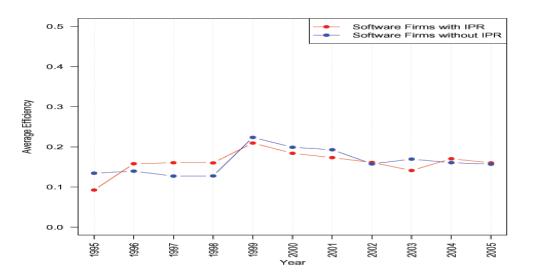
- 주요 발견: (1) Group I (IPR 보유 171 firms) 의 pure efficiency > Group II (234 firms) 평균 (2003 년 제외 전 기간), Mann-Whitney 115,680 (p<0.10). (2) Tobit (Model 2, log-likelihood -21.64, preferred): patent 0.0207** (1% 유의), copyright 0.0042** (1% 유의), log(CAP) -0.036** (1% 유의), age 0.004* (10% 유의), log(R&D) -0.0007 (유의 X). (3) 효율성 추세: 1995~1999 상승 → 1999 급증 (정부 지원) → 2000 이후 IT 버블 붕괴로 하락. (4) Scale efficiency 가 점진 상승, 대다수 firm 이 optimal scale 로 input 조정 중.
- 시사점: 소프트웨어 산업 R&D 회수 메커니즘 설계에서 특허 보호가 저작권 보호보다 효율성 견인력이 약 5 배 강함. 한국 SW firm 의 capital intensity 음 효과는 human capital 우선 투자 전략 반영. R&D 가 효율성에 직접 연결되지 않음은 R&D 의 효과가 단기보다 장기 capability 축적 경로를 거침을 시사.
요약
본 페이퍼는 황준석 2기 (2007~2013) ICT 정책 라인이 한국 ICT 산업의 기업 단위 효율성 분석으로 본격 이동하는 초기 작업이다. 소프트웨어가 knowledge economy 의 핵심이며 IPR 이 R&D 투자 회수 인센티브로 기능한다는 전제에서, 한국 software firm 의 IPR 보유 여부가 성과에 미치는 영향을 효율성 frontier 로 측정한다. 종전 문헌은 patent 효과에 집중 (Bessen & Hunt 2007, Lerner & Zhu 2007 의 Lotus v. Borland 사례 분석 등) 했고 copyright 효과는 데이터 부재로 미탐사 (대부분 경제국이 reliable copyright 데이터 부재) 했는데, 한국의 sors (Software Online Registration System) 가 copyright 데이터를 제공해 양쪽을 동시에 식별할 수 있었다.
방법론은 두 단계. 1 단계 DEA: 번째 firm 의 기술 효율성을 CCR output-oriented 모형 ( s.t. , CRS 가정) 과 BCC 모형 ( 추가, VRS 가정) 으로 측정. CRS 와 VRS 의 차이가 scale efficiency . inputs: capital, wage, worker. outputs: value-added. 2 단계 토빗 회귀: 효율성 score 가 unit-censored 이므로 Tobin (1958) 의 censored regression. 모형: , 통제 변수 = log(capital intensity), age, log(R&D).
데이터 통합은 KIS-VALUE 재무제표 + SORS 저작권 + KIPRIS 특허 출원 (출원 기준 사용, grant 데이터는 patent office 정책 변동 영향과 invention 시점과의 시차 때문에 회피, Griliches 1990 의 patent statistics survey 근거) 의 firm name matching 으로 1,026 firm-year, 19952005. Group I (IPR 보유) 171 firms, Group II 234 firms. 추정 결과 IPR 보유 그룹의 pure efficiency (VRS) 가 미보유 그룹보다 2003 을 제외한 전 기간 높고 Mann-Whitney 통계량 115,680 으로 10% 수준에서 유의. 19981999 효율성 급등 (1997 동아시아 위기 후 한국 정부의 SW firm 세금 감면 + 저리 대출 + 직접 보조 정책 효과로 2000 년 sales 가 위기 전 대비 3 배인 $10.7B 로 확대) 후 2000 IT 버블 붕괴로 VC 회수 → 하락. Tobit 회귀에서 patent 0.0207** > copyright 0.0042** 로 patent 효과가 약 5 배 강하며, capital intensity 가 음의 효과 (한국 SW firm 이 human capital 우선 투자), age 가 양의 효과 (오래된 firm 일수록 효율), R&D 는 효율성과 직접 무관. 본 페이퍼의 자매·후속은 An analysis of the effect of software intellectual property rights on the performance of software firms in South Korea (Technovation 2010, zero-inflated 회귀 확장) 이며, 황준석 자기 인식 자료의 “혁신과 기업 성과” + “효율성 분석” 개념 라인의 출발점이다. 한국 ITRC (MKE/IITA, IITA-2008-C1090-0801-0041) 지원.
핵심 결과
| 변수 | Model 1 | Model 2 (preferred) | Model 3 | Model 4 |
|---|---|---|---|---|
| intercept | 0.3262*** | 0.8641*** | 0.8605*** | 0.8664*** |
| patent | 0.0186*** | 0.0207* | 0.0207*** | 0.0207*** |
| copyright | 0.0041*** | 0.0042* | 0.0042*** | 0.0042*** |
| log(CAP) | — | -0.0336*** | -0.0356*** | -0.0359*** |
| age | — | — | 0.0042* | 0.0043* |
| log(R&D) | — | — | — | -0.0007 (n.s.) |
| log-likelihood | -28.79 | -21.64 | -20.23 | -20.07 |
*** 1%, ** 5%, * 10% 유의. patent 효과가 copyright 의 약 5 배. Group I (171 firms) vs Group II (234 firms) pure efficiency Mann-Whitney 115,680**.
방법론 노트
DEA 의 CCR output-oriented 모형 (Charnes, Cooper, Rhodes 1978) 은 CRS 가정 하에서
이고 BCC 모형 (Banker, Charnes, Cooper 1984) 은 VRS 가정으로 제약 추가. CRS 와 VRS 효율성 차이가 scale efficiency:
토빗 회귀 (Tobin 1958) 은 효율성 점수 의 unit-censoring 처리. latent variable 모형:
본 페이퍼의 functional form:
reciprocal 사용 이유는 본문 footnote 7: “reciprocal 을 쓰면 unity = 효율, 0 근방 = 비효율” 의 직관적 해석. patent 데이터는 출원 기준 (grant 가 아니라) — Griliches (1990) 의 patent statistics 가이드 + McQueen & Olsson (2003) 의 embedded software patent 라인. capital intensity 가 음 효과인 점은 Bessen & Hunt (2007) 와 Buzzell & Gale (1987) 의 일반적 양 효과와 반대로, 한국 SW 산업의 human capital 우선 전략 (Korea Association of Information & Telecommunication 통계) 으로 해석.
연구 계보
본 페이퍼는 Hall & Ziedonis (2001) 의 R&D 회수 메커니즘 + Cohen, Nelson, Walsh (2000) 의 patent vs secrecy 비교 + Lerner & Zhu (2007, IJIO) 의 Lotus v. Borland 사례 + Bessen & Hunt (2007, JEMS) 의 US software patent R&D 효과 + Chabchoub & Niosi (2005, Technovation) 의 software patent propensity 같은 SW IPR 경제 분석 라인의 한국 적용판이다. DEA 자체는 Charnes, Cooper, Rhodes (1978, EJOR) 의 CCR + Banker, Charnes, Cooper (1984, Management Science) 의 BCC 가 토대이고, SW 도메인 적용은 Banker & Slaughter (1997, Management Science) 의 software maintenance scale economies + Herrero & Salmeron (2005, CACM) 의 file compression software benchmarking 에서. 토빗 회귀 은 Tobin (1958, Econometrica) 의 원전 + Leigh & Fries (1993, SSM) 의 censored data 효율성. 한국 specific 으로는 KIS-VALUE / SORS / KIPRIS 의 firm-level 데이터 매칭이 핵심 기여. 직접 후속 An analysis of the effect of software intellectual property rights on the performance of software firms in South Korea (Technovation 2010) 가 zero-inflated 회귀로 확장. 황준석 자기 인식 자료의 “2기 ICT 정책과 산업 경제학 시대” 의 효율성 분석 라인 출발점이며, 후속 The influence of regulations on the efficiency of telecommunications operators: A meta-frontier analysis (telecom 규제 메타프론티어), Network neutrality and difference in efficiency among Internet application service providers: A meta-frontier analysis (network neutrality), Platform openness and the productivity of content providers: A meta-frontier analysis (iOS vs Android platform) 의 효율성·메타프론티어 라인을 예고. 한국 ITRC (MKE/IITA, IITA-2008-C1090-0801-0041) 지원.
See also
- 황준석
- International Conference on Software Engineering Advances
- DEA
- 토빗 회귀
- 기업 성과
- software-patent
- software-copyright
- 한국 ICT 정책
- An analysis of the effect of software intellectual property rights on the performance of software firms in South Korea
- Network neutrality and difference in efficiency among Internet application service providers: A meta-frontier analysis
- Platform openness and the productivity of content providers: A meta-frontier analysis
인접 그래프
- 인물 3
- 방법론 2
- 개념 1
- 주제 1
- 수록처 1
- 분류 2
- 논문 4