Platform openness and the productivity of content providers: A meta-frontier analysis
Changjun Lee, Daeho Lee, 황준석 (2014) · Telecommunications Policy · DOI ↗
ICT ecosystem 의 C-P-N-D 구조에서 content provider (CP) 가 iOS (closed) 와 Android (open) platform 중 어디에 입주하느냐가 생산성에 미치는 영향을 meta-frontier 분석으로 비교한다. 한국 102 개 모바일 CP 의 2000~2012 패널 (684 obs) 에 SFA + meta-frontier 적용 결과, iOS group 은 group-internal TE 평균 0.891 (저분산) 으로 우월하지만 Android group 은 TGR 0.391 > iOS 0.339 로 meta-frontier 잠재력이 높다. Both-platform group 이 TE* 0.669 로 economies of scale 효과로 가장 효율적임을 보인다.
- RQ: open (Android) vs closed (iOS) platform 의 선택이 content provider 의 생산성 (technical efficiency) 에 어떻게 다르게 영향을 미치며, 양쪽 platform 동시 진입이 어떤 효과를 가지는가
- 방법론: 메타프론티어 분석 (O’Donnell-Rao-Battese 2008), SFA (확률적 프론티어 분석) (random effects time-varying, FRONTIER 4.1), 토빗 회귀 (TGR ~ size·age·platform dummy)
- 데이터: 한국 102 개 모바일 CP 의 2000~2012 패널 (684 obs); group: iOS-only 10 (59 obs), Android-only 19 (128 obs), Both 73 (497 obs); output = sales, inputs = labor·material cost·capital cost; 9 콘텐츠 카테고리 (게임, e-book, 음악, 라이프스타일 앱, 영상, 교육, 광고, 솔루션, SNS)
- 주요 발견: (i) Group-internal TE: iOS 0.891 > Android 0.804 > Both 0.778 — iOS 의 quality control 이 가장 효율, (ii) TGR (meta-frontier 격차): Both 0.862 >> Android 0.391 > iOS 0.339 — Android 가 long-term potential 우월, (iii) TE* (=TE×TGR): Both 0.669 >> Android 0.317 > iOS 0.289 — Both group 이 economies of scale 로 최고, (iv) Tobit 결과 firm size +4.27×10⁻⁶ (p<0.01), D.android −0.476 (p<0.01), D.iOS −0.477 (p<0.01) — 한 platform 만 focus 하는 게 불리, (v) Atari shock (1983) 사례 — 완전 open + 통제 부재는 collapse
- 시사점: Platform 의 selection process / risk transfer 설계가 CP 생산성의 분포 양상을 좌우; 정책적으로 다중 platform 진입 유도가 ecosystem 전체 효율에 기여; CP 의 초기에는 한 platform focus + 성공 후 양쪽 확장 전략이 우월
요약
본 paper 는 ICT ecosystem 의 C-P-N-D (Content-Platform-Network-Device) 4-layer 중 platform layer 의 openness 정책 이 content layer 의 생산성에 미치는 영향을 empirical 로 검증한다. Apple iOS 는 strict selection process (App Store approval) 를 platform 이 통제하는 closed/integrator 모델, Google Android Play 는 등록·배포·결제를 자유롭게 두는 open 모델. Iansiti-Levien (2004) 의 keystone advantage, Tiwana-Konsynski-Bush (2010) 의 platform evolution 4 lens (modular systems, evolutionary selection, real options, bounded rationality), Cusumano-Gawer (2002) 의 platform leadership 라인이 PP 중심으로만 분석돼 CP 관점 empirical 분석이 부재했다.
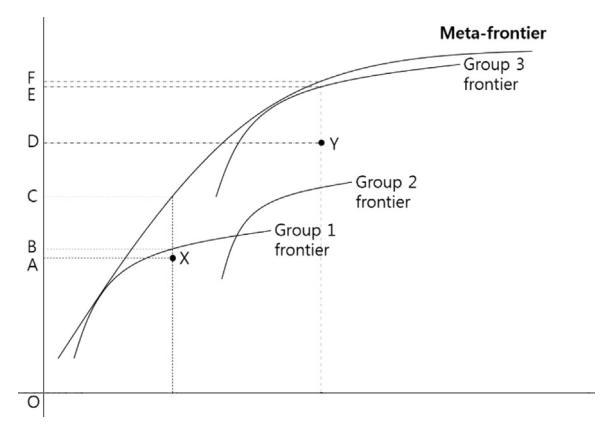
방법론은 메타프론티어 분석 (O’Donnell-Rao-Battese 2008). 102 개 한국 모바일 CP 의 2000~2012 패널 (684 obs, 9 카테고리) 을 iOS-only / Android-only / Both 3 group 으로 분할. Group-specific SFA 로 group frontier 추정 후, LP/QP 로 meta-frontier 도출. TE* = TGR × TE 로 효율 분해. 추가로 토빗 회귀 으로 TGR 의 결정요인 (firm size, age, platform dummy) 분석.
발견의 evolutionary 함의. (a) iOS group 의 높은 TE (0.891) + 낮은 분산: PP 의 selection 으로 novelty·uncertainty risk 를 통제 → CP 가 ecosystem 진입 후 value maximize 가능. (b) Android group 의 낮은 TE (0.804) + 높은 TGR (0.391 vs iOS 0.339): PP 가 risk management 를 CP 에 transfer → 초기 trial-and-error 비용 크나 long-term potential 우월. (c) Both group 의 최고 TE* (0.669): economies of scale + 양쪽 customer 채널 — 양쪽 platform 으로 콘텐츠 확장이 가능한 성공한 CP 의 차별화. (d) Atari shock 사례: 완전 open + 통제 부재 → 모방 게임 범람 → consumer 피로 → collapse. Openness 의 역할은 genuine diversity 통제 가 있을 때만 작동. 황준석 author page 의 2 기 (도구 확산기, 2007~2013) 의 ICT ecosystem · digital content 산업 효율 라인의 supply-side empirical 기둥. The influence of regulations on the efficiency of telecommunications operators: A meta-frontier analysis 가 telecom regulation 비교에 적용한 메타프론티어 분석 방법을 platform-CP 관계로 확장. 같은 해 demand-side 작업 The Determinants of purchasing the Charged Contents in the Smart-media environment 와 짝, 후속 Measuring the efficiency of standardisation policy using meta-frontier analysis: a case of mobile platform standardisation 가 WIPI 표준화 정책 평가에 같은 방법 적용. 한계: (i) 한국 단일국 표본, (ii) 102 CP 의 small sample, (iii) phase 별 (early/mature) 차별화 implication 미식별.
핵심 결과
Stochastic Frontier 추정 + Meta-frontier (Table 4)
| Group | TE (within-group) | TGR (vs meta) | TE* (=TGR×TE) |
|---|---|---|---|
| iOS-only | 0.891 | 0.339 | 0.289 |
| Android-only | 0.804 | 0.391 | 0.317 |
| Both | 0.778 | 0.862 | 0.669 |
Tobit Regression: TGR ~ Determinants (Table 5)
| 변수 | Estimate | t-value |
|---|---|---|
| Intercept | +0.844*** | 109.481 |
| Firm size (employees) | +4.27×10⁻⁶* | 5.112 |
| Firm age | −9.08×10⁻⁵ | −0.134 |
| D.Android (Android-only 더미) | −0.476* | −47.927 |
| D.iOS (iOS-only 더미) | −0.477* | −28.636 |
Sample 분포 (Table 1)
| Content category | N obs | Both | Android-only | iOS-only |
|---|---|---|---|---|
| Game | 157 | 128 | 19 | 10 |
| Lifestyle App | 139 | 119 | 0 | 20 |
| Solution App | 98 | 62 | 33 | 3 |
| Education | 78 | 45 | 20 | 13 |
| Video service | 73 | 43 | 30 | 0 |
| Advertisement | 54 | 46 | 8 | 0 |
| e-book | 44 | 37 | 0 | 7 |
| SNS | 21 | 13 | 5 | 3 |
| Music | 20 | 4 | 13 | 3 |
| Total | 684 | 497 | 128 | 59 |
방법론 노트
메타프론티어 분석 는 group-specific frontier 들을 envelope 하는 meta-frontier 를 추정해 group 간 비교 가능하게 한다. SFA 단일 frontier 는 group 차이를 dummy 로만 반영해 group 간 production function 자체의 차이를 측정 불가.
Group-specific frontier:
여기서 는 stochastic noise, 는 non-negative inefficiency.
Meta-frontier production function:
Meta-frontier 효율 분해:
여기서 TGR 은 group 의 frontier 와 meta-frontier 의 비율 (technology gap ratio), TE 는 group 내 효율.
TGR Tobit 회귀 (0~1 절단):
식별 전략: (a) FRONTIER 4.1 의 MLE 로 group-specific 추정, (b) MATLAB R2010a 로 LP/QP envelope 으로 도출, (c) Tobit 으로 TGR 의 결정요인 — size·age·platform 더미.
연구 계보
본 paper 는 (a) Hayami-Ruttan (1970) 의 meta-production function 원형, (b) O’Donnell-Rao-Battese (2008) 의 meta-frontier framework, (c) Aigner-Lovell-Schmidt (1977) SFA, (d) Iansiti-Levien (2004a, 2004b) 의 business ecosystem · keystone advantage, (e) Cusumano-Gawer (2002), Cusumano (2010) 의 platform leadership, (f) Tiwana-Konsynski-Bush (2010) 의 platform evolution 4 lens, (g) Katz-Shapiro (1994) 의 network effects · systems competition, (h) Rochet-Tirole (2003), Eisenmann-Parker-Van Alstyne (2006) 의 two-sided market, (i) Hilkert-Benlian-Hess (2011) 의 developer perspective survey 의 결합. TEMEP 내 직접 선행 작업: The influence of regulations on the efficiency of telecommunications operators: A meta-frontier analysis (Yang-Lee-Hwang-Shin 2013) 가 telecom regulation 비교에 meta-frontier 적용, Daeho Lee · 황준석 (2011) network neutrality 와 ISP efficiency 의 meta-frontier 분석. 황준석 author page 의 2 기 (도구 확산기, 2007~2013) 의 ICT ecosystem · digital content · platform economics 라인의 supply-side empirical 기둥으로, 같은 해 demand-side The Determinants of purchasing the Charged Contents in the Smart-media environment 와 짝. 후속 Measuring the efficiency of standardisation policy using meta-frontier analysis: a case of mobile platform standardisation 가 WIPI 표준화 정책 평가에 동일 방법 적용.
See also
- 황준석
- Changjun Lee
- Daeho Lee
- Telecommunications Policy
- 메타프론티어 분석
- SFA (확률적 프론티어 분석)
- 토빗 회귀
- 플랫폼 개방성
- ICT 생태계
- 양면 시장
- evolutionary-perspective
- The influence of regulations on the efficiency of telecommunications operators: A meta-frontier analysis
- The Determinants of purchasing the Charged Contents in the Smart-media environment
- Measuring the efficiency of standardisation policy using meta-frontier analysis: a case of mobile platform standardisation
인접 그래프
- 인물 3
- 방법론 3
- 개념 2
- 주제 3
- 수록처 1
- 분류 2
- 논문 9
이 문서를 가리키는 페이지
논문 (9)
- Do Software Intellectual Property Rights Affect the Performance of Firms? Case Study of South Korea
- Efficiency comparison of digital content providers with different pricing strategies
- Measuring the efficiency of standardisation policy using meta-frontier analysis: a case of mobile platform standardisation
- Research on public remuneration of open content based on collective license
- Research on the mutual relations between ISP and ASP efficiency changes for the sustainable growth of the Internet industry
- The Determinants of purchasing the Charged Contents in the Smart-media environment
- The effect of online platform maturity on the efficiency of offline industry
- The influence of regulations on the efficiency of telecommunications operators: A meta-frontier analysis
- Unveiling the Effect of Business Area Diversification: Does it Prevent or Promote the Corporate Efficiency of Biopharmaceutical Companies in Korea?