Governance and Institutional Frameworks in Ethiopian Integrated Agro-Industrial Parks: Enhancing Innovation Ecosystems and Multi Stakeholder Coordination for Global Market Competitiveness
Efa Muleta Boru, 황준석, Abdi Yuya Ahmad (2025) · Economies 13(3):79 · DOI ↗
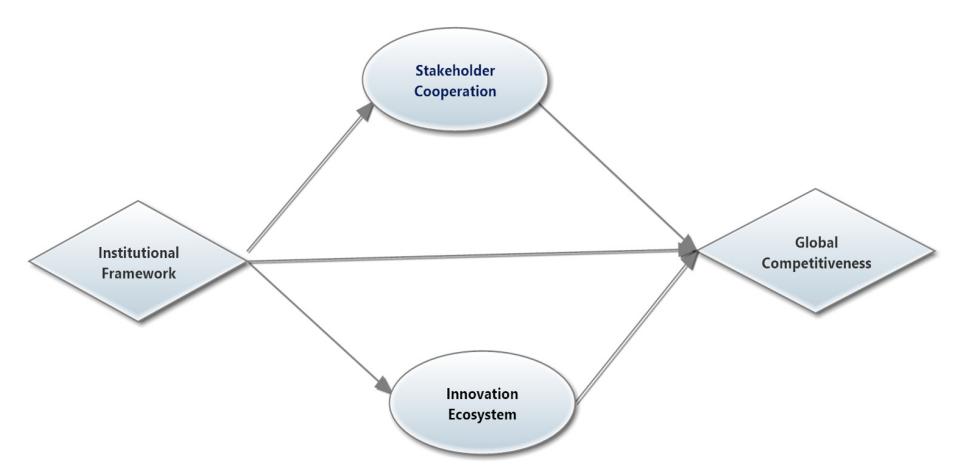
자매 작업 Understanding the Drivers of Agricultural Innovation in Ethiopia's Integrated Agro-Industrial Parks: A Structural Equation Modeling and Qualitative Insights Approach 가 driver 식별에 집중했다면 본 paper 는 governance & institutional framework 측면을 정면에서 다룬다. Bulbula + Yirgalem IAIP 두 곳의 stratified sampling 으로 5 stakeholder (smallholder farmer, industrial firm, research institute, government, development partner) 를 다층 자료 수집 (KII + FGD + document review) 후, PLS-SEM + thematic analysis + SWOT 의 3 분석 결합. 핵심 발견은 비직관적 — institutional framework → innovation ecosystem (β=+0.717, p<0.01) 양의 강한 효과지만, innovation ecosystem → global competitiveness 는 β=-0.744 (p<0.01) 음의 강한 효과. 즉 현재 IAIP 의 innovation system 이 global market 수요와 misaligned.
- RQ: 에티오피아 IAIP 의 거버넌스·제도 프레임워크가 (i) innovation ecosystem 형성, (ii) multi-stakeholder coordination, (iii) global market 경쟁력에 어떻게 영향을 미치며, 어디서 misalignment 가 발생하는가.
- 방법론: Mixed Methods Research — partial-least-squares-sem (SmartPLS 4.0, bootstrap 5,000), thematic-analysis (NVivo 9 / QDA LITE 2.0.9), Swot Analysis, stratified-sampling, in-depth-interview (semi-structured KII), focus-group-discussion (6-12 명 / FGD, audio + transcribe), document review.
- 데이터: Bulbula (Oromia) + Yirgalem (Sidama) IAIP. 5 stakeholder group — park manager, one-stop-shop staff, private sector, producer, researcher, development partner. Likert 1-5. 정량 sample 은 자매 paper 와 공유 (160/175). 정성 자료는 별도 KII + FGD.
- 주요 발견: (i) institutional framework → innovation ecosystem β=+0.717 (p<0.01) — 제도가 ecosystem 을 견인. (ii) institutional framework → stakeholder coordination β=+0.583 (p<0.01) — 제도가 협력도 견인. (iii) innovation ecosystem → global competitiveness β=-0.744 (p<0.01) — 비직관적 negative effect, ecosystem 이 시장 수요와 misaligned. (iv) institutional framework → global competitiveness total effect β=-0.451 (p<0.01) — rigid institutional 구조가 빠른 시장 적응을 저해. (v) 인구통계: lnage → competitiveness β=-0.187 (p<0.05) 음, household size → competitiveness β=+0.145 (p<0.05) 양.
- 시사점: IAIP 의 거버넌스를 (a) market-responsive flexible framework 로 재설계, (b) digital agriculture + traceability system 도입 (40% post-harvest loss 해결), (c) public-private partnership 강화, (d) 발달파트너 coordination platform 으로 task overlap 제거 필요. 강한 institution 만으로는 부족하다는 North (1990) 명제의 경험적 확인.
요약
황준석 의 5기 (개도국 ICT 혁신) 아프리카 분기의 두 paper 짝 중 governance 측면을 담당. Understanding the Drivers of Agricultural Innovation in Ethiopia's Integrated Agro-Industrial Parks: A Structural Equation Modeling and Qualitative Insights Approach 가 동일 IAIP 에서 driver 의 PLS-SEM 분석을 했다면, 본 paper 는 (i) endogenous 변수에 global competitiveness 추가, (ii) SWOT + thematic analysis 로 정성 측면 강화. 두 paper 는 의도된 분업 — drivers paper 는 “무엇이 innovation 을 견인하는가”, governance paper 는 “그 innovation 이 왜 global market 으로 이어지지 않는가”.
이론적 토대는 5 개 framework — Institutional Theory (North 1990, Dong et al. 2021), Innovation System Theory (Lundvall 1992, Adamides 2023), Sustainability Transition Theory (Ghazinoory et al. 2011), Governance Theory (Hassan et al. 2020), Complex Adaptive Systems Theory (Brown 2006, Stroink 2020). 본 paper 의 차별점은 이 5 theory 를 한 IAIP 사례에서 동시 검증하면서, 한국 (Lundvall & Johnson 1994 의 산업화) 과 중국 (Amsden 2001) 의 agro-industrial 성공 사례와 비교 framing 한다는 점.
핵심 발견은 hypothesis-과 반대로 나온 negative coefficient 다. institution → ecosystem (+0.717) 와 ecosystem → competitiveness (-0.744) 의 조합은 “강한 제도가 ecosystem 을 키우지만, 그 ecosystem 이 글로벌 시장 수요와 정렬되지 않아 경쟁력으로 이어지지 않는다” 는 의미. 저자들은 이를 Fagerberg et al. (2005) 의 “innovation system 은 market demand 와 alignment 가 필수” 명제로 해석. SWOT 분석으로 구체화된 7 영역 — infrastructure (강점이지만 유지비 위험), climate-smart varieties (강점이지만 외부 종자 의존), quality/traceability (현재 미흡, global market 진입 barrier), seasonality, limited supply, governance synergy, peace & security — 가 정량 결과의 정성 background. 특히 avocado 의 40% post-harvest loss, 발달파트너 coordination platform 의 task overlap 같은 구체적 문제가 정량 모델의 negative coefficient 를 설명한다. 한계: 2 IAIP 만, cross-sectional, longitudinal adaptive governance 효과 측정 부재.
핵심 결과
PLS-SEM Path coefficient (SmartPLS 4.0, bootstrap 5,000):
| Path | β | SE | p | 해석 |
|---|---|---|---|---|
| Institutional Framework → Innovation Ecosystem | +0.717 | 0.045 | <0.001 | 가장 강한 양의 효과 |
| Institutional Framework → Stakeholder Coordination | +0.583 | 0.058 | <0.001 | 제도가 협력 견인 |
| Stakeholder Coordination → Global Competitiveness | +0.142 | 0.260 | 0.586 | 비유의 (간접효과 약함) |
| Innovation Ecosystem → Global Competitiveness | -0.744 | 0.251 | 0.003 | negative — misalignment |
| Institutional Framework → Global Competitiveness (total) | -0.451 | 0.130 | 0.001 | total effect 음, 경직성 |
| lnage → Global Competitiveness | -0.187 | 0.079 | 0.018 | 노령일수록 경쟁력 ↓ |
| Household Size → Global Competitiveness | +0.145 | 0.070 | 0.037 | 가구 규모 클수록 경쟁력 ↑ |
- Construct quality: AVE (Innov Ecosystem 0.43, Instit Framework 0.43, Stake Coop 0.54, Global Comp 0.60), CR 모두 > 0.7 — 일부 Cr-α 임계치 미달이나 유의성으로 허용.
- SWOT 핵심 weakness: traceability system 미구축, food safety 표준 일관성 부재, post-harvest loss (avocado 40%), 종자 외부 의존, 발달파트너 coordination 부재.
- IAIP 별 specialized commodity: Yirgalem — avocado, coffee, pineapple, animal feed, organic fertilizer; Bulbula — tomato, dairy, bakery, honey, pasta. 7 commodity 중 5 가 각 park 고유.
방법론 노트
본 paper 는 partial-least-squares-sem (SmartPLS 4.0) 기반. 자매 paper 와 달리 endogenous 변수에 Global Competitiveness 추가. 핵심 식:
여기서 = institutional framework, = innovation ecosystem, = stakeholder coordination, = global competitiveness, = other exogenous (lnage, household size). 각 latent 의 measurement equation:
는 factor loading. 평가는 (i) measurement model — CR > 0.7, AVE > 0.5, HTMT discriminant validity, (ii) structural model — path coef, bootstrap 5,000 으로 p < 0.05, GoF index.
정성 측면은 (i) thematic-analysis — KII + FGD transcript 를 NVivo 9 / QDA LITE 2.0.9 로 systematic coding, (ii) Swot Analysis — thematic theme 을 strength/weakness/opportunity/threat 4 분면으로 재배치. triangulation 은 KII + FGD + document review 의 multi-method approach (Bryman 2016, Denzin 2017). 본 paper 의 강점은 PLS-SEM 의 비직관적 negative coefficient 를 SWOT 의 구체적 weakness (traceability 부재, post-harvest loss 등) 로 explanatory mechanism 까지 풀어낸 점.
연구 계보
황준석 의 5기 (개도국 ICT 혁신) 아프리카 분기의 자매 paper 짝 중 governance 측. 자매 Understanding the Drivers of Agricultural Innovation in Ethiopia's Integrated Agro-Industrial Parks: A Structural Equation Modeling and Qualitative Insights Approach 가 driver 식별이라면 본 paper 는 governance + global market alignment. 이론적 토대는 (i) Institutional Theory — North (1990) Institutions, Institutional Change, and Economic Performance, (ii) Innovation System Theory — Lundvall (1992) National Systems of Innovation, Malerba (2002) sectoral innovation systems, (iii) Governance Theory — Hassan et al. (2020), Liu et al. (2022) decentralized participatory governance, (iv) Sustainability Transition Theory — Ghazinoory et al. (2011), Costa et al. (2023), (v) Complex Adaptive Systems Theory — Brown (2006), Stroink (2020). 비교 framing reference 는 Lundvall & Johnson (1994) 의 한국 산업화 + Amsden (2001) 의 중국 사례. 황준석 author page anchor 의 “개도국 ICT 혁신” 라인 (Failure of E-Government Implementation: A Case Study of South Sulawesi → Appropriate technology for grassroots innovation in developing countries for sustainable development: The case of Laos) 의 에티오피아 연장. ITPP / GRC / ASPP 프로그램의 50 개국 200+ 공무원 교육 경험이 Efa Muleta Boru (에티오피아 농업부 + Adama Science and Technology U) 와의 협력으로 결실. An Energy-Efficient Data Collection Protocol for IoT Networks Using Social Network Search Metaheuristic (세네갈·카메룬 IoT) 와 함께 황준석 라인의 아프리카 협력 paper.
See also
- 황준석
- Efa Muleta Boru
- Abdi Yuya Ahmad
- Economies
- Understanding the Drivers of Agricultural Innovation in Ethiopia's Integrated Agro-Industrial Parks: A Structural Equation Modeling and Qualitative Insights Approach
- partial-least-squares-sem
- Swot Analysis
- governance-framework
- 혁신 생태계
- multi-stakeholder-coordination
- Integrated Agro Industrial Parks
- 개도국 ICT 혁신
- An Energy-Efficient Data Collection Protocol for IoT Networks Using Social Network Search Metaheuristic
인접 그래프
- 인물 3
- 방법론 2
- 주제 3
- 수록처 1
- 분류 2
- 논문 4