Disruptive technologies for knowledge management: bibliometric review and patent analysis
Jihye Lim, 황준석 (2025) · Kybernetes 54(11):6977-7002 · DOI ↗
지식 경영 (KM) 에 파괴적 기술 (DT) 가 어떻게 통합되는지를 학계·산업 양면에서 매핑한다. SCOPUS 논문 69 편 (2014
2023) + Google Patents 등록 특허 286 건 (19872023) 의 4 단계 분석 — (1) 학술 공동출현 네트워크 분석 (KCN), (2) cpc-co-classification 의 기술 융합 분석, (3) BERTopic 토픽 모델링, (4) DT 적용 매핑. KM 특허는 acquisition (38%) / sharing / searching / transfer 4 토픽으로 분류되고, DT 채택 30 건 중 AI 27 (90%), AR/VR 2, blockchain 1 으로 DT 는 transfer 와 acquisition 단계에 집중. AI 적용 분야 1 위 healthcare (degree 30), 2 위 SCM (25), 3 위 HRM (22).
- RQ: (RQ1) KM 기술의 주요 토픽과 기술 융합 추세는 무엇인가? (RQ2) 학계·산업에서 disruptive technologies 와 KM 적용 영역은 무엇인가?
- 방법론: 공동출현 네트워크 분석, cpc-co-classification, BERTopic, 특허 분석, bibliometric-review
- 데이터: SCOPUS 논문 69 편 (2014
2023, English) + Google Patents 등록 특허 286 건 (19872023, 11 개 특허청). US 60%, China + South Korea = 33% - 주요 발견: KM 토픽 점유율 acquisition 38% > sharing > searching > transfer. 핵심 CPC: G06F 1,020 회 (digital data processing), G06Q 575 (ICT), G06N 428 (knowledge-based computing). DT 적용 286 건 중 30 건만 — AI 27 (transfer 50%, acquisition 36.4%, searching 9.1%, sharing 4.5%), AR/VR 2 (transfer 100%), blockchain 1 (acquisition 100%). Cloud computing/metaverse 적용 0 건
- 시사점: 조직의 KM 기술 로드맵 수립 시 DT 도입 우선순위는 transfer · acquisition 단계. AI 가 KM 의 dominant DT 이지만 sharing 단계는 여전히 빈 공간. Latecomer (China, S. Korea) 가 emerging DT 영역에서 US 와 격차 축소
요약
본 review article 는 지식 경영 (KM) 와 파괴적 기술 (DT) 의 통합 지형을 최초로 patent-level 까지 매핑한다. KM 의 4 단계 (Alavi & Leidner 2001: creation / storage & retrieval / sharing / application) 프레임을 채택하고, DT 의 정의는 Christensen (1997) 의 disruption 이론을 따른다 — 기존 시장을 흔들고 새 경쟁 차원을 도입하는 기술. 연구 공백: KM 처리 기술과 DT 의 specific 결합에 대한 systematic·patent-based 분석 부재.
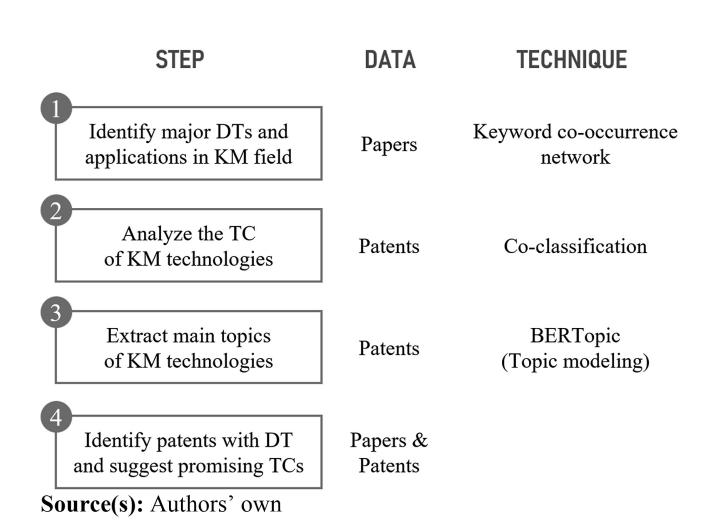
분석은 4 단계 chain 으로 진행된다. 첫째, SCOPUS 의 KM × DT 키워드 검색으로 20142023 논문 69 편을 수집해 keyword 공동출현 네트워크 분석 (KCN) 구축. degree ≥ 16 노드만 표시. 가장 빈번한 페어: DT–KM (weight 7), DT–innovation (4), innovation–KM (4), metaverse–SCM (4), DT–AI (3). 둘째, Google Patents 의 KM 등록 특허 286 건 (19872023, 11 개 특허청, English) 의 cpc-co-classification 으로 TC 측정 — Top CPC: G06F 1,020 (digital data processing), G06Q 575 (ICT), G06N 428 (knowledge-based computing), H04L 242 (digital transmission). 2021 까지 평균 CPC 다양도 10 → 2022~2023 22 로 급증, 특히 Y02 (기후 변화 mitigation) 클래스 출현이 두드러짐.
셋째, BERTopic (Grootendorst 2022; Sentence-BERT + UMAP + HDBSCAN + c-TF-IDF) 로 286 특허를 4 토픽으로 군집화: knowledge acquisition (38%, data/base/acquisition/rule/process), sharing (share/information/terminal/provide/user), searching (document/user/search), transfer (transfer/learn/network/train/neural). 넷째, DT 적용 매핑 — 286 건 중 30 건만 DT 적용 (AI 27, AR/VR 2, blockchain 1, cloud/metaverse 0). AI 는 transfer (50%) 와 acquisition (36.4%) 에 집중, AR/VR 은 transfer (100%), blockchain 은 acquisition (100%). 산업 적용 1 위 healthcare (degree 30), 2 위 SCM (25), 3 위 HRM (22), 4 위 technology management (20), 5 위 smart manufacturing (16). 저자들은 sharing 과 application 단계가 여전히 DT 침투의 frontier 임을 함의하고, 잠재 TC 조합 (예: G06F + G06N + G06Q + G16H 의 AI healthcare KM) 을 제안한다. 황준석 의 author page anchor 기준 제 5 기 (글로벌 스마트시티와 AI, 2024~2026) 의 “AI 와 국가 경쟁력 / 지식경영” 실타래의 신생 연결점.
특집호 구성
본 review 는 자체 empirical 결과보다 문헌·특허 매핑 이 핵심이므로 결과를 정리 매트릭스로 surfacing.
| KM 토픽 (BERTopic) | 대표 단어 | AI | AR/VR | Blockchain |
|---|---|---|---|---|
| Knowledge acquisition (38%) | data, base, acquisition, rule, process | 36.36% | — | 100% |
| Knowledge sharing | share, information, terminal, user | 4.55% | — | — |
| Knowledge searching | document, search, data | 9.10% | — | — |
| Knowledge transfer | transfer, learn, network, train, neural | 50.00% | 100% | — |
KM 특허 286 건 중 DT 적용 30 건. 국가 분포: US 60% (전체) vs US 13/30 (DT 적용); China 와 S. Korea 가 DT 영역에서 격차 축소. Cloud computing (0 건) 와 metaverse (0 건) 는 academic 관심에 비해 산업 적용 부재.
핵심 CPC Top 10 (전체 286 특허): G06F 1,020 (digital data processing) > G06Q 575 (ICT) > G06N 428 (knowledge-based computing) > H04L 242 (digital transmission) > Y10S 139 (cross-reference) > H04N 37 > G09B 33 > H04M 30 > G16H 27 (healthcare informatics) > Y02P 17 (기후 mitigation 제조).
Top Co-classification (TC 페어): G06F–G06N, G06F–G06Q, G06F–H04L, G06N–G06Q, G06Q–H04L, G06F–G10L, G06Q–H04N.
잠재 TC 조합 (DT 별):
- AI: G05B+G06N (제어), G06F+G06N+G06K+G06Q+G06V (vision + ICT), G06F+G06Q+G10L (음성), G06F+G16H (healthcare AI), G06N+G09B (교육), G06N+H04L (분산 AI).
- AR/VR: G06T+G09B (이미지 데이터 + 교육).
- Blockchain: G06F+H04L (secure transmission).
연구 계보
본 review 는 두 갈래 문헌을 통합한다. 첫째, KM 프로세스 분류 — Drucker (1998), Alavi & Leidner (2001), Bhatt (2001), Dalkir (2013), Blome et al. (2014), ISO 30401 — 본 연구는 Alavi & Leidner 의 4-process 프레임 채택. 둘째, DT 이론 — Christensen (1997, 2006), Danneels (2004), Tiwari & Sahay (2022), Saha et al. (2021), Olszak & Pałys (2023). 방법론적 기반: BERTopic (Grootendorst 2022), Sentence-BERT (Reimers & Gurevych 2019), UMAP (McInnes et al. 2018), HDBSCAN (McInnes et al. 2017), cpc-co-classification (Choi et al. 2015, Fleming et al. 2007, Curran & Leker 2011, Kangas et al. 2021). KM-DT 결합 선행 연구: Yao et al. (2023), Alvarenga et al. (2020), Castagna et al. (2020), Saratchandra & Shrestha (2022), Jha et al. (2022).
황준석 author page anchor 의 제 4~5 기 의 “AI 와 국가 경쟁력”, “지식경영” 그리고 토픽 모델링 방법론 라인의 후속. Exploring knowledge management technologies to enhance sustainability and mitigate technostress from a collaborative perspective · Exploring diverse interests of collaborators in smart cities: A topic analysis using LDA and BERT · Exploring trends and topics in hybrid intelligence using keyword co-occurrence networks and topic modelling 으로 이어지는 Jihye Lim 의 KM × topic modeling 시리즈의 한 매듭. Patent CPC 기반 TC 측정은 Technology convergence capability and firm innovation in the manufacturing sector: an approach based on patent network analysis 의 연장선.
See also
- 황준석
- Jihye Lim
- Kybernetes
- 지식 경영
- 파괴적 기술
- 기술 융합
- BERTopic
- 토픽 모델링
- 특허 분석
- cpc-co-classification
- 공동출현 네트워크 분석
- bibliometric-review
- Technology convergence capability and firm innovation in the manufacturing sector: an approach based on patent network analysis
- Exploring diverse interests of collaborators in smart cities: A topic analysis using LDA and BERT
인접 그래프
- 인물 2
- 방법론 4
- 개념 1
- 주제 3
- 수록처 1
- 분류 1
- 논문 4