Forecasting Demand for a Newly Introduced Product Using Reservation Price Data and Bayesian Updating
이종수, Chul-Yong Lee, Kichun Sky Lee (2012) · Technological Forecasting & Social Change · DOI ↗
Bass-style diffusion 의 historical sales 의존 한계를 reservation price (consumer 최대 지불의향) + Bayesian sequential updating 으로 극복하는 framework 제안. 핵심 가정 — reservation price 가 높을수록 adoption 시점이 빠르다 (innovator > early adopter > … > laggard). Conjoint 로 reservation price 분포 추정 → mixture normal density 로 adoption timing 모형화 → 출시 후 sales data 로 Bayesian MAP update. 한국 broadband Internet 23 분기 데이터 적용 결과 — Bass model · logistic growth · analogy-based Bayesian 의 3 benchmark 모두 보다 prelaunch · postlaunch 양쪽에서 우월한 forecast 성능.
- RQ: 신제품의 historical sales 없이 또는 극소량 sales 만으로 demand forecasting 가능한가? Consumer reservation price + Bayesian updating 의 결합이 Bass / logistic / analogy-Bayesian 보다 우월한가?
- 방법론: reservation-price-model, 베이지안 갱신, mixture-distribution, 컨조인트 분석, 혼합 로짓, map-estimator, ranking-model
- 데이터: 한국 broadband Internet (xDSL · 케이블 · LAN) 23 분기 sales (1998-2003 분기별); conjoint survey (한국, attribute = price · speed · stability 등)
- 주요 발견: Reservation price 기반 모형이 Bass + logistic + analogy-Bayesian 3 benchmark 보다 prelaunch (sales 없을 때) + postlaunch (소량 sales 시) 모두에서 forecast error 낮음; Bayesian updating 효과 — sequential sales 증가 시 forecast 정확도 단조 향상; mixture normal density (k components) 가 single normal 보다 적합도 우월
- 시사점: 신제품 출시 전 단계에서 reservation price survey + Bayesian framework 가 표준 forecasting 도구. 출시 후 sales streaming 환경에서 sequential update 의 정확도 이점
요약
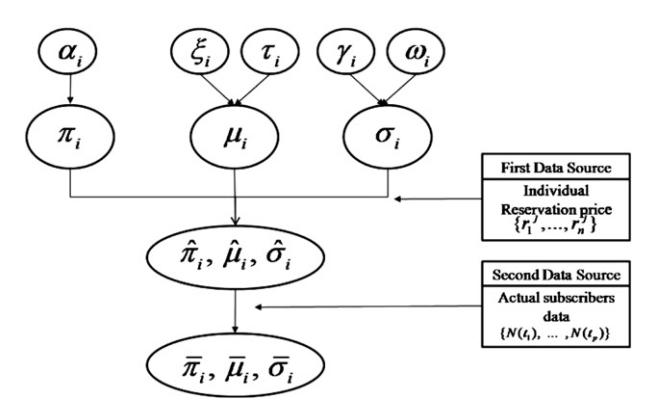
기존 Bass diffusion / logistic growth 는 historical sales 의존이 강해 신제품 launch 전후 forecasting 이 불안정하다. Analogy-based Bayesian (Lilien-Rao-Kalish 1981 등) 은 비슷한 선행 제품 의 존재가 필수 — ICT · 신기술처럼 비교 가능 제품 부재인 경우 적용 불가. 본 paper 는 이종수 · Chul-Yong Lee · Kichun Sky Lee 가 consumer reservation price (Varian 정의: 소비자가 받아들이고도 구매할 최대 가격) 라는 미시 정보를 활용해 analogy 없이 신제품 forecasting 하는 framework 를 제안. 이종수 연구실 제2기 도메인 심화 의 demand forecasting 방법론 진화 표지작이며, conjoint + diffusion 의 기존 라인에 Bayesian sequential update 차원을 추가.
핵심 가정 — reservation price 가 높을수록 adoption 시점이 빠르다 (innovator > early adopter > … > laggard 의 Rogers 5 분류와 정합). 컨조인트 분석 로 각 소비자 i 의 reservation price 추정:
여기서 는 price coefficient (log-normal로 음수 보장), 는 attribute vector. ranking-model (Davies 1979) 가정으로 adoption timing 와 reservation price 의 linear 매핑:
여기서 는 product life cycle (expert 가 peak time 추정, life cycle = 2 × peak). 모집단의 adoption timing density 는 mixture-distribution — k 개 Normal 의 weighted sum:
는 mixture proportion (sum = 1, Dirichlet prior ), , . map-estimator (generalized MLE = Bayesian MAP) 로 parameter 추정:
베이지안 갱신 — 출시 후 분기별 sales 가 누적되면 constraint 로 추가:
tolerance. Constraint 가 prior 를 truncated distribution 으로 변환 → MAP 가 sales data 반영해 update.
한국 broadband Internet 23 분기 (1998-2003) 데이터 적용. (i) Prelaunch forecast test — sales data 없이 reservation price 만으로 예측. 본 모형 vs Bass · logistic · analogy-Bayesian (3 benchmark). 결과: 본 모형이 모든 benchmark 보다 forecast error 낮음. (ii) Postlaunch forecast test — sales 1·2·…·22 분기 sequential update, 다음 분기 forecast. 결과: Bayesian updating 으로 forecast 정확도 단조 향상; 매 분기 본 모형이 benchmark 우월. (iii) Mixture order k 선택 — k=3~5 가 single normal 보다 적합도 우월 (BIC 기준). 해석 — reservation price 의 cross-section heterogeneity 가 adoption timing 의 time-series 분포를 잘 매핑; Bayesian update 가 sales streaming 환경에서 prior knowledge + new evidence 의 최적 결합.
핵심 결과
Framework 비교 (한국 broadband Internet 1998-2003)
| Model | Prelaunch | Postlaunch (sequential) |
|---|---|---|
| Bass model | 기준 | 기준 |
| Logistic growth | 다소 우월 | 다소 우월 |
| Analogy-based Bayesian | 비슷 | 비슷 |
| Reservation price + Bayesian (본 모형) | 모든 benchmark 보다 forecast error 낮음 | Sequential update 로 단조 향상 |
Adoption timing 변환 — 각 소비자의 reservation price → adoption 시점 . Innovator (최고 ) 는 , laggard (최저 ) 는 .
Mixture distribution — k=3~5 component normal 이 single normal 대비 적합도 우월.
Product life cycle — Expert 가 peak time 추정, (Mahajan-Muller-Bass diffusion 의 saturation at twice peak 정리).
방법론 노트
reservation-price-model 의 핵심 — 각 소비자의 최대 지불의향 가 utility-based choice theory 와 정합 (Jedidi-Zhang 2002):
혼합 로짓 의 utility:
로 log-normal price coefficient (음수 보장). Ranking survey 로 sequence likelihood, Metropolis-Hastings algorithm 추정.
mixture-distribution (Eq. 8) 의 장점 — flexible parametric framework, non-parametric 보다 parameter space 차원 낮음. k mixture components 의 parameter 는 .
베이지안 갱신 의 MAP framework — prior + likelihood → posterior . Sales data 가 constraint 로 추가되면 prior 가 truncated distribution 으로 변환. Dynamic grid search 로 고차원 optimization.
식별은 (i) conjoint design 의 orthogonal attribute variation, (ii) cross-section 의 reservation price heterogeneity, (iii) time-series sales 의 constraint, (iv) expert-elicited life cycle 의 외생성.
연구 계보
본 paper 의 직접 method 조상은 Varian (1992) reservation price + Jedidi and Zhang (2002) conjoint-based reservation price + Davies (1979) · Karshenas and Stoneman (1995) ranking model + Train (2003) mixed logit Bayesian + Lilien, Rao, Kalish (1981) analogy-based Bayesian. 비교 기준 selections — Bass (1969) · logistic (Griliches 1957) · Lenk and Rao (1990) analogy Bayesian. Diffusion literature 의 Bayesian 적용 부족 (Putsis-Srinivasan 2000 의 “underutilized”) 을 충족하는 시도. 이종수 author page 의 제2기 도메인 심화 라인 안에서 demand forecasting 방법론 진화 sub-line 의 표지작이며, sibling A Forecast Simulation Analysis of the Next-Generation DVD Market Based on Consumer Preference Data (DVD 표준 경쟁) · Forecasting future demand for large-screen television sets using conjoint analysis with diffusion model (TV demand) 와 함께 conjoint + diffusion + Bayesian 결합 시리즈를 구성한다. Chul-Yong Lee (Korea Energy Economics Institute) 와의 산학 협업.
See also
- reservation-price-model
- 베이지안 갱신
- mixture-distribution
- 컨조인트 분석
- 혼합 로짓
- map-estimator
- ranking-model
- 수요 예측
- new-product-introduction
- 이종수
- Chul-Yong Lee
- Kichun Sky Lee
- A Forecast Simulation Analysis of the Next-Generation DVD Market Based on Consumer Preference Data
- Forecasting future demand for large-screen television sets using conjoint analysis with diffusion model
인접 그래프
- 인물 3
- 방법론 3
- 주제 1
- 수록처 1
- 분류 2
- 논문 2