Beyond the Status Quo: Leveraging Reference-Dependent Theory in a Neural Network for Consumer Choice Analysis
Kibum Kim, 이종수, Junghun Kim (2025) · journal-of-choice-modelling 57:100579 · DOI ↗
A Machine Learning Technique Embedded Reference-Dependent Choice Model for Explanatory Power Improvement: Shifting of Reference Point as a Key Factor in Vehicle Purchase Decision Making (Kim et al. 2025, Transportation Research Part B) 의 2-stage hybrid (RDCM → ANN → shifted RDCM) 한계를 넘어, reference-dependent-choice-model (RDCM) 의 구조 자체 를 artificial-neural-network 의 architecture 안에 직접 내장 한 RD-ANN 제안. 3 input layer (reference price 결정 요인 / alternative price / 그 외 attribute) + 5 hidden layer (sigmoid 로 reference price 학습 → gain·loss 분리 → ReLU 결합 → softmax 확률 출력). 스마트폰 (N=984) + 자동차 (N=431) 데이터로 RD-MNL · RD-MXL · S-ANN · C-ANN 4 benchmark 와 비교 → 모든 metric (accuracy, recall, precision, F1, ROC-AUC) 에서 RD-ANN 우위. 스마트폰 케이스 weighted F1 마진 17.8%~48.6%. 개별 + alternative 별 heterogeneous reference price 추정으로 brand loyalty (Samsung/Apple/LG 만) + status quo bias 의 정량 식별 가능.
- RQ: RDCM 의 reference point 가 individual 별 + alternative 별 heterogeneous 라는 사실을 학습 과정 안에서 jointly 추정할 수 있는가? Behavioral economics 의 구조 자체를 신경망 architecture 에 내장 할 때 fixed reference RDCM + standard ANN 양쪽보다 성능이 향상되는가?
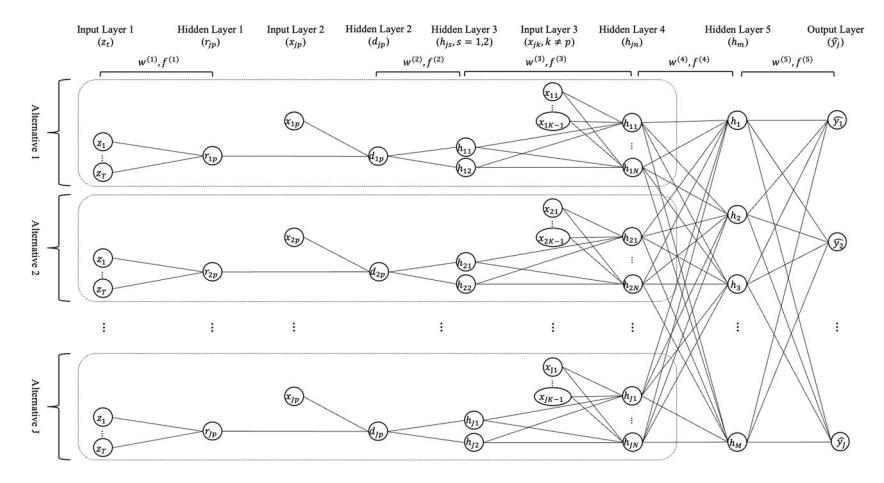
- 방법론: RD-ANN — 3 input × 5 hidden × 1 output layer. (1) 첫 input: reference price 결정 요인 → 첫 hidden: sigmoid 로 alternative-specific reference price . (2) 둘째 input: alternative price → 둘째 hidden: (parameter-free). (3) 셋째 hidden: ReLU 로 gain·loss split. (4) 셋째 input: 그 외 attribute → 넷째 hidden: alternative-internal connection. (5) 다섯째 hidden: cross-alternative connection. (6) output: softmax 확률. Cross-entropy loss. bayesian-hyperparameter-optimization (Turner et al. 2021).
- 데이터: 두 도메인 — (i) 스마트폰 DCE N=984 (서울 + 광역시), 5 attributes (brand, screen size, storage, recognition tech, price). (ii) 자동차 DCE N=431 (동일 표본 from A Machine Learning Technique Embedded Reference-Dependent Choice Model for Explanatory Power Improvement: Shifting of Reference Point as a Key Factor in Vehicle Purchase Decision Making). Train/Val/Test = 65/15/20%
- 주요 발견: (i) 모든 benchmark 압도 — RD-ANN > RD-MNL/RD-MXL/S-ANN/C-ANN in accuracy, recall, precision, weighted F1, ROC-AUC. 스마트폰 weighted F1 마진 17.8%~48.6%. (ii) C-ANN 보다도 우위 — 동일 input variable 사용하지만 RD 구조 내장한 RD-ANN 이 성능 우위 → 구조 내장의 가치 정량 입증. (iii) Brand loyalty 식별 — Samsung/Apple/LG 사용자는 자기 brand 의 reference price 가 다른 brand 보다 높음 (= brand loyalty 존재), “Others” 사용자는 없음. (iv) Reference price 의 bimodal 분포 (kernel density Fig. 6) — 모든 brand 에서 이질적 선호 그룹 2 개 확인 (vs purchase price 의 unimodal). (v) Reference price 가 평균적으로 purchase price 보다 높음 — 소비자가 aspirational reference 가짐.
- 시사점: (a) Behavioral economics 의 구조를 ML architecture 에 내장 하는 paradigm 의 정량 정당화 — interpretability + 예측력 동시 확보. (b) RD-ANN 으로 brand loyalty 와 status quo bias 의 정량 식별 가능 → 마케팅 + 정책에 응용 가능. (c) 이전 2-stage hybrid 보다 1-stage end-to-end 가 복잡한 nonlinear interaction 포착에 우월. (d) Reference price 의 bimodal 분포 발견 → 소비자 segmentation + targeting 의 새 도구.
요약
이 paper 는 이종수 의 4 기 (2023+) 신경망 내장 선택모형 시리즈의 architectural 정점. A Machine Learning Technique Embedded Reference-Dependent Choice Model for Explanatory Power Improvement: Shifting of Reference Point as a Key Factor in Vehicle Purchase Decision Making (Kim et al. 2025, Transportation Research Part B) 가 2-stage pipeline (RDCM → ANN 으로 shifted reference → 새 RDCM) 으로 ML 과 RDCM 을 느슨하게 결합 했다면, 본 paper 는 RDCM 의 구조 자체를 ANN architecture 안에 hard-coded 해 end-to-end jointly 학습. Behaviorally-informed neural network (BINN) 흐름 (Ghorbani et al. 2025, Han 2019, Le & Li 2022, Sifringer et al. 2020, Zhang et al. 2020) 의 한 갈래로 reference-dependent theory 의 첫 deep integration.
방법론 핵심은 RD-ANN 의 6-stage architecture. (1) 첫 input = reference price 결정 요인 vector (인구통계, 사용 행태, 보유 가격 등). (2) 첫 hidden = sigmoid activation 으로 alternative-specific reference price 학습. (3) 둘째 input = alternative price . (4) 둘째 hidden = parameter-free 계산 . (5) 셋째 hidden = ReLU 로 (s=1,2: gain·loss split). (6) 셋째 input = 그 외 attributes (). (7) 넷째 hidden = alternative-internal connection (Zhang et al. 2020 의 within-alternative wiring). (8) 다섯째 hidden = cross-alternative connection. (9) Output = softmax 로 J 개 alternative 선택 확률 . Cross-entropy loss. bayesian-hyperparameter-optimization 으로 layer depth, node count, activation 선택.
핵심 결과: 스마트폰 케이스 (N=984, train/val/test = 65/15/20%) 에서 4 benchmark (RD-MNL, RD-MXL, S-ANN, C-ANN) 와 비교 → RD-ANN 이 모든 metric 에서 우위. Weighted F1 마진이 17.8%~48.6% — 특히 imbalanced data (brand 분포 불균등) 에서 우월. ROC-AUC 도 RD-ANN 이 가장 top-left 로 skewed (sensitivity + specificity 동시 우수). 자동차 케이스에서도 동일 패턴. 중요한 비교: C-ANN (RD-ANN 과 동일 input variable 사용하지만 RD 구조 없는 standard ANN) 보다도 RD-ANN 우위 → 구조 내장이 단순 input 추가보다 정보를 잘 활용 한다는 정량 증거.
추가 분석: 학습된 RD-ANN 으로 alternative-specific reference price 추출. 스마트폰 brand 별 reference price 평균 분석 → Samsung/Apple/LG 사용자는 자기 brand 의 reference price 가 다른 brand 보다 높음 = brand loyalty (Kim 2019 의 정의), “Others” 사용자는 brand loyalty 없음. Reference price 의 kernel density 가 모든 brand 에서 bimodal — 가격 민감 그룹 + 프리미엄 추구 그룹의 segmentation 가능. 일반 purchase price 의 density 는 unimodal — reference price 가 추가 정보 를 담음. 이종수 의 연구 궤적 안에서 behavioral economics + deep learning 의 architectural integration 의 정점이며, A Machine Learning Technique Embedded Reference-Dependent Choice Model for Explanatory Power Improvement: Shifting of Reference Point as a Key Factor in Vehicle Purchase Decision Making 의 자매·계승 작업. 한계: (i) Price 외 attribute (brand, vehicle type) 의 reference effect 미내장, (ii) 모델 transparency (XAI) 부족 — RD-ANN 이 왜 그 reference 를 학습했는지 해석 어려움, (iii) Non-monotonic preference (e.g. 적당히 큰 화면) 미반영.
핵심 결과
스마트폰 케이스 (3-run 평균):
| Model | Accuracy | Recall | Precision | Weighted F1 |
|---|---|---|---|---|
| RD-MNL | 낮음 | 낮음 | 낮음 | 낮음 |
| RD-MXL | 중간 | 중간 | 중간 | 중간 |
| S-ANN (standard) | 중간 | 중간 | 중간 | 중간 |
| C-ANN (with consumer chars) | 중상 | 중상 | 중상 | 중상 |
| RD-ANN | 최고 | 최고 | 최고 | 최고 (+17.8%~48.6%) |
| 추가 발견 | 정량 결과 |
|---|---|
| Brand loyalty (자기 brand reference > 타 brand) | Samsung ✓, Apple ✓, LG ✓, Others ✗ |
| Reference price 분포 | 모든 brand bimodal (vs purchase price unimodal) |
| Reference vs purchase | reference 평균 > purchase 평균 (aspirational) |
| Status quo bias 식별 | RD-ANN 이 fixed-status-quo RD-MXL 보다 우월 → status quo 가 진짜 reference 아님 |
(자동차 케이스도 동일 패턴, A Machine Learning Technique Embedded Reference-Dependent Choice Model for Explanatory Power Improvement: Shifting of Reference Point as a Key Factor in Vehicle Purchase Decision Making 의 N=431 데이터 재사용)
방법론 노트
RD-ANN 의 핵심 식 (architecture 정의):
Reference price 학습 (Eq. 2):
Gain·loss split (Eq. 3, 4):
Cross-attribute 결합 (Eq. 5):
Cross-alternative + 출력 (Eq. 6, 7):
식별 핵심: (i) Reference price 가 alternative-specific ( 가 j 마다 다름) — brand loyalty 식별의 architectural foundation. (ii) Sigmoid 의 [0,1] 범위 제약 — price 가 0-1 normalize 되어 있어 자연스러운 mapping. (iii) Within-alternative + cross-alternative wiring (Zhang et al. 2020) — input 가까운 layer 는 alternative 내부, output 가까운 layer 는 cross-alternative — discrete choice 의 random utility maximization 구조와 정합. (iv) Bayesian hyperparameter optimization (Turner et al. 2021) 로 grid/random search 대비 효율적 architecture 선택.
연구 계보
이 paper 는 (i) Kahneman & Tversky (1991), Tversky & Kahneman (1991, 1974) 의 prospect theory + reference-dependent, (ii) De Borger & Fosgerau (2008), Hess et al. (2008, 2012), Glenk (2011) 의 RDCM in choice modeling, (iii) A Machine Learning Technique Embedded Reference-Dependent Choice Model for Explanatory Power Improvement: Shifting of Reference Point as a Key Factor in Vehicle Purchase Decision Making (Kim et al. 2025 TR-B) 의 2-stage ANN-shifted RDCM 직접 선행, (iv) Behaviorally-informed neural network (BINN) 라인 — Ghorbani et al. (2025) DCM-BINN, Han (2019) LCCM-ANN, Han et al. (2022) TasteNet-MNL, Le & Li (2022) SEM-ANN, Sifringer et al. (2020) L-MNL, Zhang et al. (2020) alternative-utility ANN, Pereira (2019) TBE, Sfeir et al. (2022) GP-LCCM, Ma & Seo (2025) RL + GNN, van Cranenburgh & Garrido-Valenzuela (2025) CV-DCM, Wang et al. (2024) DHM — 의 reference-dependent 가지. Kim et al. (2025 TR-B) 외 Kim (2019) 의 reference shifting by attribute importance, Baucells et al. (2011), Hardie et al. (1993) 의 empirical reference identification 도 직접 선행. 이종수 연구 궤적 안에서 4 기 RD-ANN architecture 의 정점이며 A Machine Learning Technique Embedded Reference-Dependent Choice Model for Explanatory Power Improvement: Shifting of Reference Point as a Key Factor in Vehicle Purchase Decision Making (2-stage soft) 와 architectural hard integration 의 두 갈래로 본 작업이 후자의 표지작.
See also
- 이종수
- Kibum Kim
- Junghun Kim
- neural-network-embedded-choice-model
- reference-dependent-choice-model
- artificial-neural-network
- 브랜드 충성도
- status-quo-bias
- A Machine Learning Technique Embedded Reference-Dependent Choice Model for Explanatory Power Improvement: Shifting of Reference Point as a Key Factor in Vehicle Purchase Decision Making
- Can Liquefied Petroleum Gas Vehicles Join the Fleet of Alternative Fuel Vehicles? Implications of Transportation Policy Based on Market Forecast and Environmental Impact
- journal-of-choice-modelling
인접 그래프
- 인물 3
- 개념 1
- 분류 2
- 논문 2
이 문서를 가리키는 페이지
논문 (2)
- A Machine Learning Technique Embedded Reference-Dependent Choice Model for Explanatory Power Improvement: Shifting of Reference Point as a Key Factor in Vehicle Purchase Decision Making
- Can Liquefied Petroleum Gas Vehicles Join the Fleet of Alternative Fuel Vehicles? Implications of Transportation Policy Based on Market Forecast and Environmental Impact