Household financial health: a machine learning approach for data-driven diagnosis and prescription
Kyeongbin Kim, Yoontae Hwang, Dongcheol Lim, Suhyeon Kim, 이정혜, Yongjae Lee (2023) · quantitative-finance
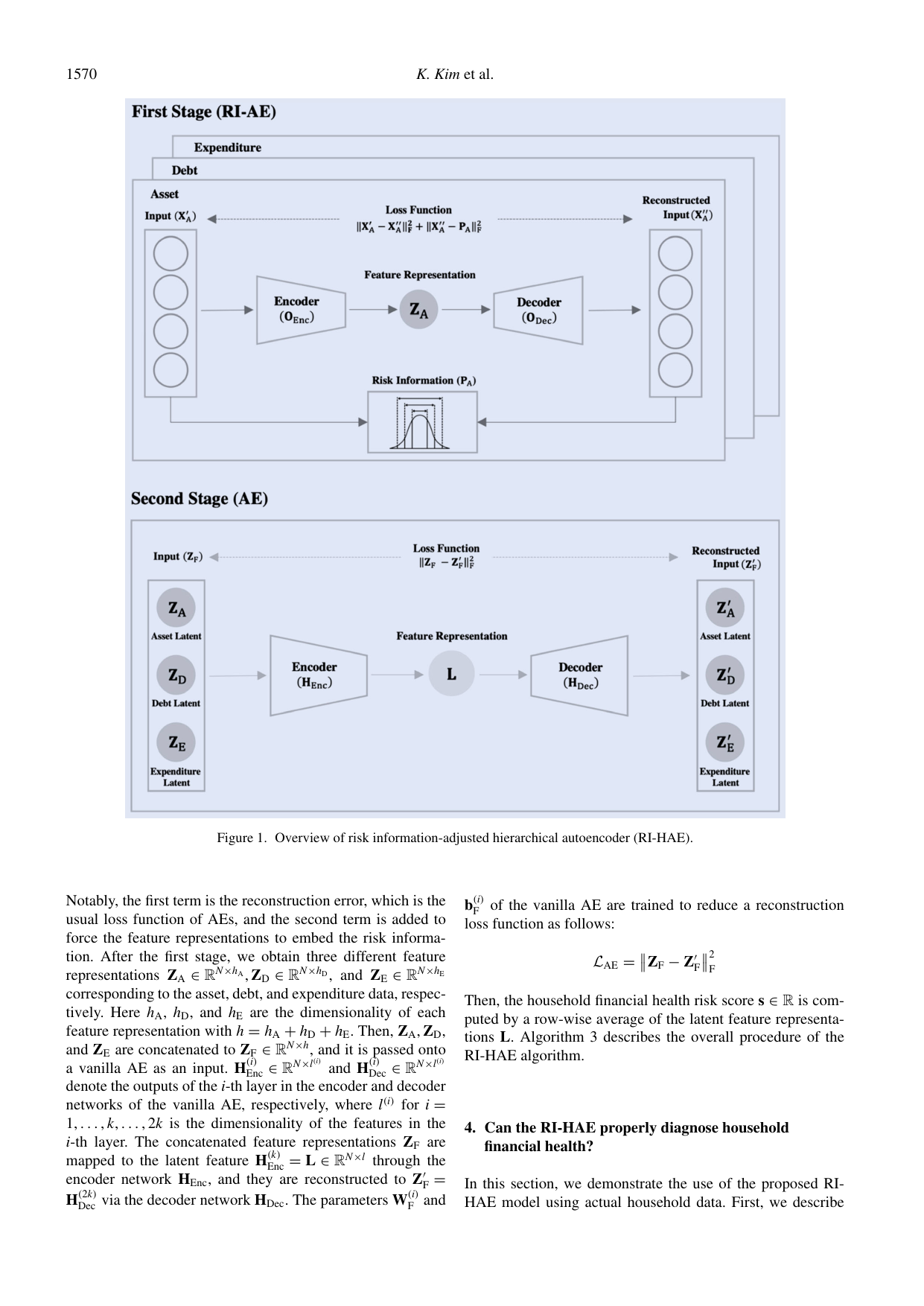
RI-HAE (Risk Information-embedded Heterogeneity-Aware Autoencoder) — 가계 재정 건강 의 데이터 기반 진단 + 처방. Risk score-embedded deep learning for biological age estimation: Development and validation 의 RSAE-BA (의료) 의 금융 버전 — “healthcare 개념을 가계 재정으로 확장”. Cohort-wise standardization + variable-wise risk information adjustment. 모형의 gradient 정보 가 재정 건강 개선 처방 제공.
- RQ: Heterogeneous household 의 재정 건강 을 어떻게 데이터 기반 으로 진단·개선할 수 있는가? Risk information 을 deep learning 에 통합하면?
- 방법론: RI-HAE = Risk Information-embedded Heterogeneity-Aware 오토인코더 + gradient-based prescription
- 데이터: 실세계 가계 balance sheet 데이터
- 주요 발견: (1) RI-HAE 가 가계 이질성 처리 — cohort-wise standardization + variable-wise risk adjustment. (2) 위험한 balance sheet 의 latent value 가 더 높게 생성 — 모델이 risk 인식. (3) Model gradient 가 개선 처방 제공 — 어느 변수를 조정하면 위험 감소? (4) 가계 재정의 healthcare-style 접근.
- 시사점: 가계 재정 진단 + 처방 의 AI 도구. 금융 advisor 의 자동화 + 개인화. 의료 도메인 방법론의 금융 도메인 transfer.
요약
이 paper 는 이정혜 의 *3 기 SNU TEMEP 의 금융 도메인 응용. Kyeongbin Kim (제 1 저자) + Yongjae Lee (UNIST quantitative finance) 와 협업. Risk score-embedded deep learning for biological age estimation: Development and validation 의 RSAE-BA 가 의료 BA 추정이라면, RI-HAE 는 가계 재정 건강 의 같은 패턴 응용 — healthcare → finance 도메인 transfer.
방법론적 핵심: RI-HAE = Risk Information-embedded Heterogeneity-Aware 오토인코더:
(i) Heterogeneity-aware: 가계의 이질성 (소득, 연령, 가족 구성 등) 을 cohort-wise standardization 으로 처리. 각 cohort 내에서 정규화 → 다른 cohort 간 공정한 비교.
(ii) Risk Information embedding: 변수별 위험 정보 (예: 부채 비율, 저축률, 소득 불안정성) 를 encoder loss 에 통합. 위험한 balance sheet 가 higher latent value 산출하도록 강제.
(iii) Gradient-based prescription: 학습 완료 후 gradient 산출 → 가장 영향 큰 변수가 개선 우선순위. Personalized recommendation.
핵심 발견: 가계 재정 건강 risk score 가 실제 재정 어려움 (default, 파산) 과 상관관계. Gradient 분석으로 어떤 행동 (저축 증가, 부채 감축) 이 가장 효과적인지 개인별 제안. 기존 rule-based 가계 재정 분석의 이질성 처리 한계 극복.
이정혜 의 연구 궤적 안에서 이 paper 는 3 기 응용 다변화 — 금융 도메인 확장. 실타래 4 (Representation Learning) 의 응용. Risk score-embedded deep learning for biological age estimation: Development and validation 의 직접 후속 (의료 → 금융 transfer).
핵심 결과
| 항목 | RI-HAE |
|---|---|
| Heterogeneity 처리 | Cohort-wise standardization |
| Risk embedding | Variable-wise adjustment |
| Latent value (위험 balance sheet) | Higher |
| Prescription | Gradient-based (변수별 영향) |
- Healthcare → Finance 도메인 transfer
- 기존 rule-based 한계 극복
- 개인별 자동화 advisor 가능
방법론 노트
RI-HAE encoder:
Risk-embedded loss:
Risk Loss 가 위험 변수 영향 을 latent value 에 통합.
Gradient prescription:
가장 큰 영향 변수 를 우선 개선.
식별 가정: (i) Balance sheet 의 완전성, (ii) Risk 변수의 식별 가능성, (iii) Gradient 의 causal interpretation.
연구 계보
이 paper 는 (i) Risk score-embedded deep learning for biological age estimation: Development and validation (RSAE-BA) 직접 선행, (ii) Hinton & Salakhutdinov (2006) AE 본가, (iii) Household finance literature — 의 결합. 이정혜 의 연구 궤적 3 기 금융 도메인 확장.
See also
- 이정혜
- Kyeongbin Kim
- Yongjae Lee
- 오토인코더
- household-finance
- financial-health
- quantitative-finance
- Risk score-embedded deep learning for biological age estimation: Development and validation
인접 그래프
- 인물 6
- 방법론 2
- 논문 1