Technological relatedness: how do firms diversify their technology?
Seung Hwan Kim, Bogang Jun, 이정동 (2023) · Scientometrics · DOI ↗
Hidalgo & Hausmann 의 principle of relatedness 는 country·region·city 수준에서 활발히 검증돼 왔지만 firm-level 증거는 빈약했다. 본 paper 는 1984–2014 년 한국 상장 제조기업 1,334 개·391,017 특허·123 기술 (IPC 3-digit) 의 unique panel 을 disambiguation 으로 구축하고, firm-technology bipartite network 위에서 density 지표를 정의해 firm 의 새 기술 진입 확률이 related technology 축적과 함께 1.39 배 (조건부 odds) 증가함을 보인다. 단, big 4 (Samsung·LG·Hyundai·Posco) 에서는 효과가 사라지고 broad diversification 패턴이 나타난다.
- RQ: principle of relatedness 가 firm-level 기술 다각화에도 성립하는가? Density 측정의 robustness 는 어떻게 되며, 대기업 vs 그 외 기업 사이 패턴 차이는 있는가?
- 방법론: 이분 네트워크, 고정효과 로짓 모형, 성향점수매칭, Box–Cox 변환, 현시 기술 우위 (RTA)
- 데이터: 한국 KOSPI/KOSDAQ/KONEX 상장 제조기업 1,334 사, KIPO/USPTO 특허 391,017 건, IPC 3-digit 123 기술, 1984–2014, panel obs 832,962 ((firm, technology, year) triples). PATSTAT + KIS-VALUE merger + OECD HAN ID disambiguation.
- 주요 발견: 모든 통제변수 (industry, age, sales, profit, debt) 포함 시 density (related technology proximity-weighted sum) 가 새 기술 진입 확률에 양의 효과 (계수 0.335***) → odds ratio 1.39 배. 2차항이 음수 (−0.010**) → inverted U-shape (optimal density 존재). Sub-period 분석: dotcom 충격 (1998–2003) 시기에 density 효과가 가장 크고 (0.680), 2004–2014 에는 2차항이 사라짐. Big 4 만 분석 → density 계수 −0.011 (무효), 2차항만 음 → 대기업은 broad diversification 으로 relatedness 무관.
- 시사점: 중소·중견 기업의 R&D 전략은 related technology 축적 위에 새 진입을 설계할 때 효과적. 반면 대기업은 unrelated jump 도 가능 (자본·인프라 잉여). The co-evolution of production and technological capabilities during industrial development 의 jump with knowledge 와 정량적으로 연결.
요약
본 paper 는 Hidalgo & Hausmann (2007) 의 product space 와 principle of relatedness 를 firm-level 기술 다각화로 확장한다. 기존 firm-level 연구 (Leten et al. 2016, Pugliese et al. 2019) 는 R&D 집약 기업으로 표본 제한 또는 다른 measure (citation-based proximity, coherent diversification) 사용. 본 paper 의 contribution 은 (i) 한국 상장 제조기업 전체 (R&D 집약 여부 무관) 를 30 년 panel 로 분석, (ii) OECD HAN ID 의 disambiguation 으로 unique unbalanced panel 구축, (iii) Hidalgo-Hausmann 방식의 density 측정을 firm-level 로 옮기되 6 가지 다른 proximity definition (Hidalgo, Pugliese, Jaccard, Cosine, Association, Revised Association) 으로 robustness 검증.
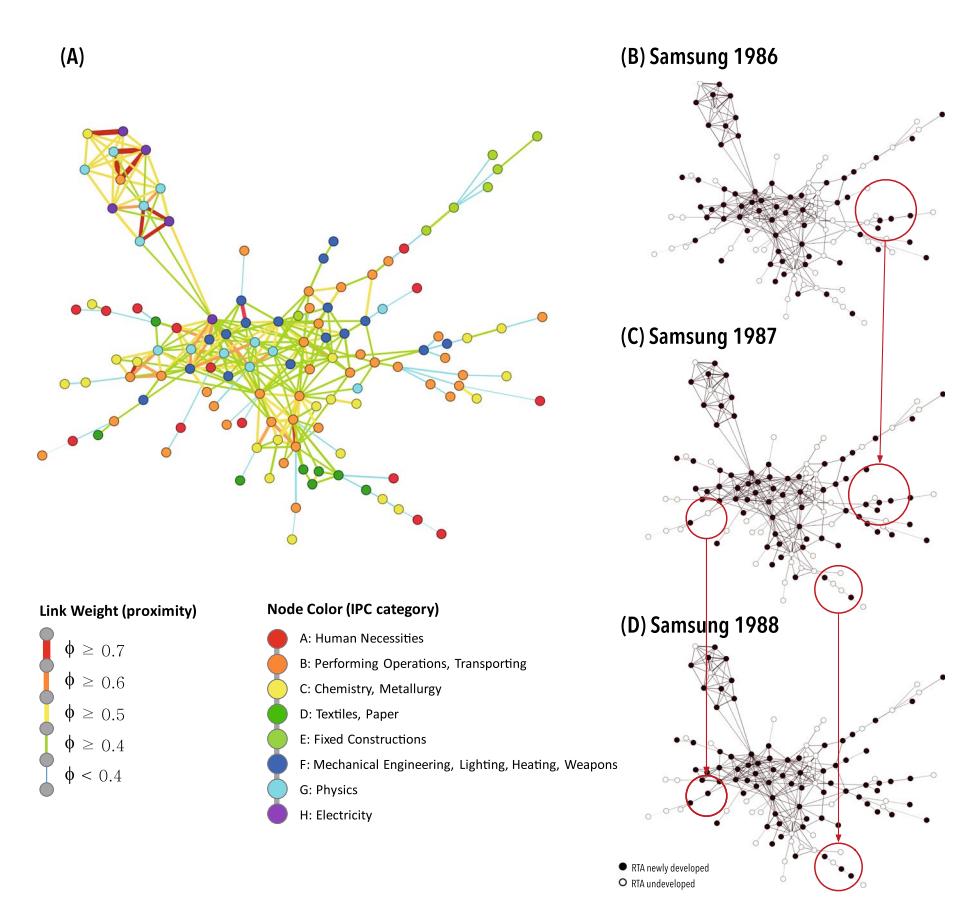
방법론 핵심은 firm-technology bipartite network: 기업 가 IPC 에 현시 기술 우위 (RTA) (RTA ) 를 가지면 link weight 1. 두 기술 사이 proximity 는 RTA 의 pairwise 조건부 확률 최솟값 (Hidalgo & Hausmann 정의). Firm 의 기술 주변 related density 는 proximity-weighted sum 의 정규화. 종속변수는 (2 년 내 새 RTA 획득 binary). 고정효과 로짓 모형 으로 추정, 모든 변수는 Box–Cox 변환 으로 정규화. 5 년 moving average 로 in-block nestedness 완화.
이정동 의 제4기 진화론적 전환 라인에서 본 paper 는 The co-evolution of production and technological capabilities during industrial development 의 jump with knowledge 를 firm 수준에서 정량 검증한다. Big 4 (Samsung Electronics, LG Electronics, Hyundai Motors, Posco) 에서 효과가 사라지는 발견은 흥미롭다. 해석: 대기업은 자체 기술 인프라가 다양해 relatedness 의 제약 을 우회 가능 (path-defying diversification). Samsung Electronics 의 IPC 점유율 30.24%, 상위 4 사 합계 55.25%. PSM 으로 confounding 통제 후에도 density 효과 견고 (계수 0.348***). 한계는 (i) 한국 표본 → 일반화 가능성 제한, (ii) bipartite 의 autocorrelation, (iii) 본 paper 의 proximity 는 단일 시점 기반 → 시계열 진화 미반영.
핵심 결과
| Specification (메인 결과 Table 2) | (density) 계수 | 해석 |
|---|---|---|
| (1) 단순 logit | 0.537*** | density 가 새 기술 진입 확률 증가 |
| (2) + 2차항 | 0.506*** (2차 +0.008*) | 약한 increasing return |
| (3) + 통제 (industry, age, sales) | 0.337*** (2차 −0.011***) | inverted U-shape 출현 |
| (4) + profit, debt | 0.335*** (2차 −0.010**) | odds ratio 1.39 배 |
| Sub-sample | density 효과 | 해석 |
|---|---|---|
| 1984–1997 (pre-Asian crisis) | 0.249*** | 약한 path-dependence |
| 1998–2003 (Asian crisis + dotcom) | 0.680*** | 위기 시기 path-dependence 강화 |
| 2004–2014 | 0.350*** | 2차항 무의미 (선형) |
| Big 4 only | −0.011 (무효) | 대기업 broad diversification |
| 그 외 기업 | 0.320*** | 중견 이하만 relatedness 의 제약 |
| Proximity definition (Robustness Table 7) | density 효과 |
|---|---|
| Hidalgo et al. (2007) [본 paper 기본] | 0.335*** |
| Pugliese et al. (2019) normalized | 0.335*** |
| Jaccard similarity | 0.452*** |
| Cosine similarity | 0.443*** |
| Association (Eck-Waltman) | 0.366*** |
| Revised Association (Steijn) | 0.366*** |
PSM 결과 (Table 8): density 계수 0.348*** 유지, confounding 통제 후에도 robust.
방법론 노트
본 paper 의 식별 (identification) 전략은 기업-기술-연도 triple panel 위에서 새 기술 진입 (binary outcome) 의 driver 가 density 인지 판별하는 것이다. 핵심 단계는 (i) RTA 정의, (ii) proximity 계산, (iii) density 계산.
핵심 식 (RTA, proximity, density 순):
여기서 는 firm 가 시점 에 기술 에서 보유한 특허 수, 는 firm 가 기술 에서 RTA 여부 (binary). 는 firm 가 기술 의 이웃들 (proximity 가중) 에 얼마나 많이 진입해 있는지의 정규화 점수.
추정 식 (multivariate fixed effects logit):
식별의 핵심은 (i) 새 RTA 진입의 forward-looking 정의 ( 에 RTA<1, 에 RTA≥1, 유지), (ii) 성향점수매칭 으로 confounding 통제, (iii) 6 가지 proximity 정의로 robustness, (iv) Big 4 분리로 heterogeneity 검증.
연구 계보
본 paper 의 직접적 predecessor 는 (a) Hidalgo & Hausmann (2007) 의 product space 와 density 측정, (b) Neffke et al. (2011) 의 regional industrial diversification, (c) Kogler et al. (2013) 과 Boschma et al. (2014) 의 city-level technological relatedness, (d) Leten et al. (2016) 의 firm-level (R&D 집약) technological relatedness, (e) Pugliese et al. (2019) 의 coherent diversification, (f) Jaffe (1986) 의 기업 기술 거리 측정, (g) Breschi et al. (2003) 의 cosine-similarity-based relatedness. 기술경영경제정책전공 내 자매 작업으로 Bogang Jun (2 저자) 의 Bilateral relatedness: Knowledge diffusion and the evolution of bilateral trade 가 international bilateral trade 의 relatedness 확장, 이정동 anchor 의 제4기 진화론적 전환 라인에서 The co-evolution of production and technological capabilities during industrial development 의 jump with knowledge 명제를 firm-level 정량으로 검증하는 짝 paper (author page 분류).
See also
- 이정동
- Seung Hwan Kim
- Bogang Jun
- 연관성의 원리
- 기술 연관도
- 밀도 측정
- 제품 공간
- 기술 공간
- 현시 기술 우위 (RTA)
- 고정효과 로짓 모형
- 성향점수매칭
- The co-evolution of production and technological capabilities during industrial development
- Drivers of institutional evolution: phylogenetic inertia and ecological pressure
인접 그래프
- 인물 11
- 개관 1
- 방법론 5
- 개념 6
- 주제 1
- 수록처 1
- 분류 2
- 논문 4
이 문서를 가리키는 페이지
논문 (3)
- Bilateral relatedness: Knowledge diffusion and the evolution of bilateral trade
- Drivers of institutional evolution: phylogenetic inertia and ecological pressure
- Winners and losers in a knowledge-based economy: investigating the policy packages for an inclusive growth based on a computable general equilibrium analysis of Korea