Measuring relatedness between technological fields
sihyung-joo, 김연배 (2010) · Scientometrics 83(2):435–454 · DOI ↗
기술 분야 (Technological Field, TF) 간 relatedness 측정 방법론을 새로 제안. 기존 co-classification analysis (Engelsman-Van Raan 1994, Breschi et al. 2003) 가 face validity (관찰되는 융합 경향과 측정값 불일치) 와 confounder (다른 TF 의 영향 미통제) 문제를 안고 있음을 비판. Multi-dimensional contingency table 표현 + Mantel-Haenszel common log odds ratio 로 두 문제 동시 해결. 한국 KIPO 특허 1980-2004 (30 개 TF) 데이터로 검증 — 기존 measure 는 technology convergence 추세를 못 잡음, 본 paper measure 는 2000 년부터 본격적 융합 시작 을 통계적으로 식별.
- RQ: 기술 분야 (TF) 간 진정한 relatedness — co-occurrence 의 pure pairwise interaction, 다른 TF 의 영향 제거 — 를 어떻게 측정할 것인가? 기존 co-classification 의 face validity 문제는 어떻게 해결되는가?
- 방법론: multi-dimensional-contingency-table 표현 ( binary classified/not-classified for each TF), mantel-haenszel-odds-ratio (common log odds ratio for pairwise pure relatedness, controlling other TFs), cochran-mantel-haenszel-test (통계적 유의성), ipc-co-classification (특허의 IPC code co-assignment) — 비교 대상: (Salton’s cosine), (Engelsman-Van Raan), (Breschi et al.)
- 데이터: 한국 KIPO 특허 데이터 (1980-2004, granted by 2007). 30 개 TF reclassification (Fraunhofer-INPI-OST 분류). 4 period: t1 (1980-1989, 14,151 patents), t2 (1990-1994, 50,545), t3 (1995-1999, 148,451), t4 (2000-2004, 192,106). 평균 IPC 분류 수 1.013-1.016 per patent
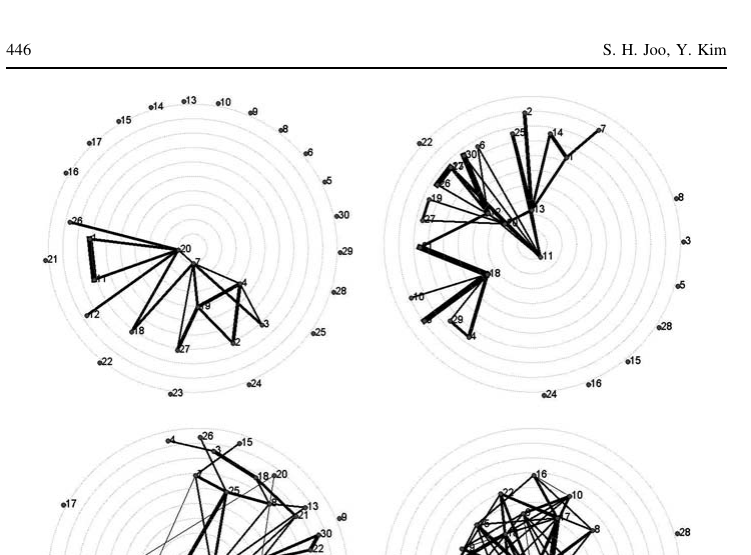
- 주요 발견: (i) 기존 measure () 는 1980-2004 의 technology convergence 추세를 못 잡음 — Engelsman-Van Raan (1994), Breschi et al. (2003) 의 “no significant change” 결과는 방법론적 결함의 산물. (ii) Mantel-Haenszel common log odds ratio () 는 t3 (1995-1999) → t4 (2000-2004) 의 significant convergence 식별 — 본격적 융합이 2000 년대 진입과 함께 시작. (iii) Network 구조 시각화: t1·t2 는 core-periphery (소수의 general purpose technology 가 dominance), t3 는 embryonic 융합 단계, t4 는 peripheral TF 간 직접 연결 폭발. (iv) TF 별로 convergence 시기 다름 — Electrical device·engineering 은 1990 년대 중반부터, Biotechnology 는 2000 년부터. (v) Cochran-Mantel-Haenszel 통계로 모든 유의한 관계는 양 (+) (negative pair 없음, 최저 p-value 0.45).
- 시사점: (a) Scientometrics 의 technology convergence 측정 위기 가 방법론적 원인이었음을 명시 — 향후 융합 연구의 표준 measure 변경 권고. (b) 한국 기술 시스템의 2000 년 이후 본격 융합 의 정량 evidence — IT-BT-NT 정책 (1990s 후반) 의 효과가 t4 시기 가시화. (c) Network analysis 와 결합한 TF 별 differential convergence timing 분석 가능 → 산업 정책의 sector-specific timing 권고.
요약
본 paper 는 김연배 author page 의 제2기 (2007-2017) 의 방법론 기여 작업으로, scientometric measurement 의 face validity 문제를 진단·해결한 technical paper. 기존 technology convergence 측정 의 학계 inconsistency — 질적으로는 융합 인식, 양적으로는 변화 없음 (Engelsman-Van Raan 1994, Breschi et al. 2003) — 이 측정 방법론 의 결함에서 기인한다는 가설. 본 paper 의 conceptual move 는 — patent classification data 의 전체 정보 보존 (multi-dimensional contingency table) + 다른 TF 의 confounder 통제 (Mantel-Haenszel common odds ratio) 의 두 device 로 pure pairwise relatedness 추정.
방법론 핵심은 — (i) 개 TF 에 대해 각 특허의 binary classification ( 의 contingency cell), (ii) TF 와 의 pure relatedness 를 다른 개 TF 의 fixed level 조건부 odds ratio 의 가중평균으로 정의 — Mantel-Haenszel common log odds ratio , (iii) 통계적 유의성은 Cochran-Mantel-Haenszel χ² (df=1), (iv) 비-interactive cell () 폐기는 information loss 아님 — 두 focal TF 간 relevant 정보 부재 의 cell, (v) 4 period × 4 measure () × 30 TF pairwise 의 complete comparison.
발견은 두 layer. (a) Methodological: 기존 3 measure 가 temporal trend 신호 부재, 새 measure 가 significant convergence 식별 — 방법론 우위. (b) Substantive: 한국 기술 시스템에서 2000 년 이후 본격적 융합. 1980-1994 의 general-purpose technology dominance (electronics, machinery 가 hub) → 1995-1999 의 embryonic convergence (peripheral TF 간 some links) → 2000-2004 의 dense peripheral connectivity (mechatronics, optoelectronics, biopharma 등 hybrid TF 의 출현). 한계: (i) 한국 KIPO 특허 limited 인 점 — international 비교 미수행, (ii) 30 TF 의 aggregation level choice 가 결과에 민감 (finer level 에서 다른 패턴 가능), (iii) IPC co-classification 이 technological similarity 의 imperfect proxy — 특허 examiner 의 classification 행위 변화 가능성, (iv) Software 등 patent 안 되는 영역 누락.
핵심 결과
제안된 measure 의 적용 결과 (한국 KIPO, 30 TF, Mantel-Haenszel log odds ratio)
| 기간 | 특허 수 | Network 특성 | pattern |
|---|---|---|---|
| t1 (1980-1989) | 14,151 | Core-periphery, GPT dominance | 약한 dispersed connectivity |
| t2 (1990-1994) | 50,545 | Core-periphery, hub 강화 | 유사 |
| t3 (1995-1999) | 148,451 | Embryonic convergence | Peripheral 간 some links 출현 |
| t4 (2000-2004) | 192,106 | Dense convergence | Peripheral 간 직접 연결 폭발 |
정량 결론. (i) 4 period 비교에서 는 모두 no significant trend, 만 significant convergence trend. (ii) TF 별 differential timing — Electrical device·engineering 의 convergence 가 mid-1990s, biotechnology 의 convergence 가 2000 — 산업의 technology life cycle 과 일치. (iii) Cochran-Mantel-Haenszel χ² 로 모든 유의 pair 가 양의 relatedness — negative relatedness 의 통계적 부재.
방법론 노트
기존 co-classification analysis 의 핵심 결함은 — (i) Salton’s cosine 가 두 TF 의 relatedness pattern 의 유사도 만 측정 (pure pairwise 아님), (ii) 다른 TF 와의 co-occurrence 가 confounder 로 작용해 spurious relatedness 생성, (iii) face validity 부재 (convergence 인식과 measure 불일치). 본 paper 는 Mantel-Haenszel common odds ratio 가 epidemiology 에서 covariate 통제 후 association 측정 의 표준임을 응용.
핵심 식. TF , , …, 의 multi-dimensional contingency table 에서 두 focal TF 의 partial table (다른 TF 의 level 고정) 에서 Mantel-Haenszel common log odds ratio:
여기서 는 -th partial table 의 (i,j) cell count, 는 총합. 이면 양의 relatedness, 이면 무관. 통계적 유의성:
식별은 (i) partial table conditioning 이 covariate-controlled association, (ii) common odds ratio 가 Cochran (1954) 의 weighted geometric mean 으로 stratification 효과 통합, (iii) discarded cells () 이 non-interactive — relatedness 식별과 무관 (Goodman 1968, Fienberg 1972).
연구 계보
본 paper 는 두 라인의 결합 — (a) Carpenter-Narin (1980), Engelsman-Van Raan (1994), Breschi et al. (2003), Leydesdorff (2008) 의 scientometric relatedness measurement literature 와 (b) Mantel-Haenszel (1959), Cochran (1954), Goodman (1968), Fienberg (1972) 의 categorical data analysis (epidemiology) literature. 두 lit 의 cross-pollination 으로 scientometrics 의 face validity 위기 해결. 김연배 author page 의 제2기 (SNU-TEMEP 확장기) 의 기술 분야·산업 분류 방법론 분기로 분류 (author page) — 본 paper 가 김연배 그룹 의 patent-based scientometric analysis 의 출발점. Roco-Bainbridge (2003), Nordmann (2004) 의 converging technologies (NBIC) 패러다임 인식을 empirical 정량 evidence 로 뒷받침. 이후 기술경영경제정책전공 의 The necessity of a new industrial classification based on value-creation behavior 의 value-creation-based industrial classification 같은 산업·기술 분류 라인과 연결된다 (sibling).
See also
- mantel-haenszel-odds-ratio
- multi-dimensional-contingency-table
- ipc-co-classification
- 기술 융합
- Scientometrics
- korean-patent-data
- sihyung-joo
- 김연배
- The necessity of a new industrial classification based on value-creation behavior
- patent-classification
인접 그래프
- 인물 1
- 개관 1
- 개념 1
- 주제 1
- 수록처 1
- 분류 2
- 논문 1