Learning by doing and spillovers: An empirical study on the TFT-LCD industry
Sung-Bae Park, 이정동, Tai-Yoo Kim (2003) · International Engineering Management Conference ‘03 pp.363–367 · DOI ↗
한국·일본·대만 TFT-LCD 18 firms × 44 plants 의 1996–2000 분기 panel 가격·물량 데이터로 학습곡선 의 internal/external spillover 를 분리 추정. 한 plant 에서 여러 panel size (10.4″ ~ 18.x″) 가 동시 생산되는 산업 특성 때문에 single-output 모형이 아닌 multi-output cost 제약 을 결합한 학습곡선 모형을 새로 제시. 결과: 2 세대 학습률 7.1%, 3 세대 14.7% — external (경쟁사 누적생산) 효과가 internal (자사 누적생산) 보다 훨씬 큰데, 한국 firm 은 DRAM 생산 경험 spillover 까지 결합해 일본 firm 의 leadership 을 짧은 시간 안에 catch-up 했다.
- RQ: TFT-LCD 산업의 학습곡선은 internal/external spillover 가 어떻게 나뉘는가? 한 plant 에서 multiple panel size 가 동시 생산되는 multi-output 환경에서 학습률을 어떻게 추정할 수 있는가? Korean 의 catch-up 은 학습 속도 차이 로 설명되는가?
- 방법론: 학습곡선 (Arrow 1962 / Irwin-Klenow 1994 의 internal+external decomposition), multi-output-cost-model (한 plant 의 panel-size 별 marginal cost 가 glass substrate 의 panel-yield 비율로 constrain 되는 새 specification), 외견상 무관 회귀 (AR(1) 보정, 7 product 방정식 동시 추정)
- 데이터: 한국·일본·대만 18 firms × 44 plants × 7 panel size (10.4″, 11.3″, 12.1″, 13.3″, 14.1″, 15.x″, 18.x″), 1996–2000 분기 (TSR Techno-System Research 발행). 2 세대 159 obs, 3 세대 112 obs
- 주요 발견: (i) 학습률 2 세대 7.1% (γ₁=−0.106 internal, γ₂=−1.914 external; γ₂ ≈ 18× γ₁), 3 세대 14.7% (γ₁=−0.229, γ₂=−0.800; 격차 축소). (ii) DRAM cross-product spillover 가 2 세대에서만 유의 (γ_DRAM=−0.097, t=−4.50); 3 세대엔 미유의. (iii) 한국 firm 의 2 세대 학습률 11.2% (γ₁=−0.171) vs 일본 9.8% (γ₁=−0.149), likelihood ratio χ²(7)=46.81 (p=0.000) — 통계적으로 유의한 catch-up evidence
- 시사점: external learning 이 dominant 한 산업에서 leadership 지속은 연속 대규모 투자 로 신규 진입 가능성을 미리 차단해야 가능. DRAM-TFT cross-product spillover 는 기존 강점 기술의 인접 산업 진출 전략 (Korean firm 의 1995 진입 모델) 의 정량 근거
요약
학습곡선 는 Wright (1936), Arrow (1962), Alchian (1963) 이래 production 누적 → marginal cost 하락 의 가장 robust 한 empirical 패턴 중 하나로, 반도체 (Dick 1991; Gruber 1994, 1998, 2000; Irwin-Klenow 1994; Udayagiri-Schuler 1999), 화학 (Lieberman 1984), 원전 (Lester-McCabe 1993), Rayon (Jarmin 1994) 등 기술집약 산업에서 반복 확인됐다. TFT-LCD 도 정밀·청정 제조 공정상 yield (양품률) 가 누적 생산에 따라 빠르게 올라가는 전형적 학습 산업이지만 (Fig.1 의 3 generation plant 데이터), TFT-LCD 의 한 plant 가 여러 panel size 를 동시 생산 한다는 multi-output 특성 때문에 traditional single-output 학습곡선을 그대로 적용하면 marginal cost 추정에 bias 가 생긴다. 본 paper 는 이 빈자리를 메우는 첫 systematic 시도다.
방법론 핵심은 multi-output framework. 한 plant 의 glass substrate 1 장에서 panel size 별로 produceable 한 max 수가 결정되므로 (예: 2 세대 370×470 glass 1 장 = 10.4″ 4 개 = 12.1″ 2 개 = 18.x″ 1 개), marginal cost 가 size 간 비율 constraint 로 묶인다 — 4 MC^{10.4} = 2 MC^{12.1} = ... = MC^{18.x} = MC_i. 이 constraint 와 Cournot 의 1차 조건 (price-cost margin 이 시장점유율·conjectural variation 에 의존) 을 결합해 7 panel size × 18 firms × 44 plants 의 seemingly-unrelated regression 시스템을 AR(1) 보정으로 동시 추정. price fluctuation bias 를 피하기 위해 conjectural variation θ 를 supply shortage/surplus ratio δ 의 함수 θ(δ)=a₀+a₁δ 로 모형화 — 1998 가격 폭락기의 과잉공급으로 인한 경쟁 강화 가 학습 추정에 introduce 하는 bias 를 직접 제거.
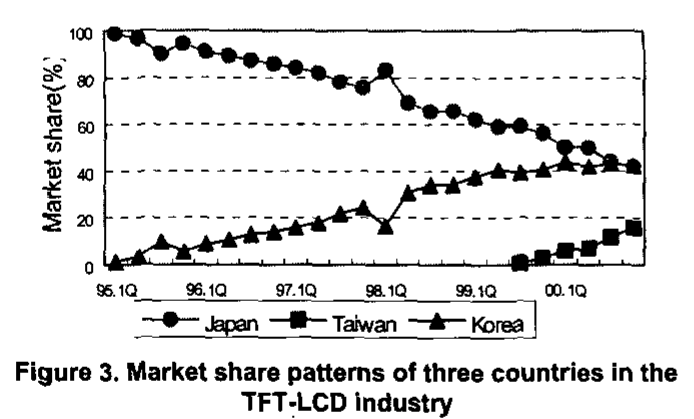
발견은 세 갈래. 첫째, external learning 이 internal learning 을 압도 — 2 세대에서 γ₂/γ₁ ≈ 18, 3 세대에서도 약 3.5 배. 즉 경쟁사의 누적 생산이 자사 누적 생산보다 marginal cost 감소에 더 기여한다. 두 번째, 한국 firm 의 DRAM 생산 경험이 2 세대 TFT-LCD 학습에 cross-product spillover 로 기여 (γ_DRAM=−0.097, p<0.01) — 단 3 세대엔 미유의로 추가 spillover 의 marginal benefit 이 소진. 셋째, 한국·일본 학습률 차이 — 2 세대에서 한국 11.2% vs 일본 9.8% 가 통계적으로 유의 (LR χ²(7)=46.81, p<0.001), 한국의 catch-up 이 단순 후발 이점이 아닌 학습 속도의 본질적 차이 임을 정량 입증. 한계는 (i) 3 세대 한국-일본 학습률 차이는 sample 부족으로 정밀 추정 미가능, (ii) post-2000 시기 (대만 진입) 의 dynamics 는 sample 밖. 시사점은 분명 — external spillover 가 큰 산업에서 leadership 유지엔 지속적 대규모 투자 가 진입 봉쇄 조건이고, 인접 기술 산업의 강점 (DRAM → TFT) 이 잘 정렬되면 빠른 catch-up 가능.
핵심 결과
학습률 분해 (Table 4, LSE+AR(1))
| 모델 | γ₀ constant | γ₁ internal | γ₂ external | DRAM spillover | N | 학습률 |
|---|---|---|---|---|---|---|
| 2 세대 (no DRAM) | 35.2** | −0.106** | −1.914** | — | 159 | 7.1% |
| 2 세대 + DRAM | 35.7** | −0.067 | −1.886** | −0.097** | 159 | 4.5% |
| 3 세대 (no DRAM) | 19.2** | −0.229** | −0.800** | — | 112 | 14.7% |
| 3 세대 + DRAM | 19.9** | −0.179* | −0.931** | 0.931 (n.s.) | 112 | 11.6% |
** p<0.01, * p<0.05. 학습률 = (1 − 2^γ₁) × 100. external 효과가 internal 의 3.5–18× 더 크고, DRAM 은 2 세대에서만 유의.
한국 vs 일본 비교 (Table 6, 2 세대)
| 국가 | γ₀ | γ₁ internal | γ₂ external | N | 학습률 |
|---|---|---|---|---|---|
| Korea | 40.7** | −0.171** | −2.296** | 51 | 11.2% |
| Japan | 34.1** | −0.149** | −1.803** | 108 | 9.8% |
LR χ²(7) = 46.81, p<0.001. 학습률 격차 + external 학습 흡수 속도 차이가 catch-up 의 정량 근거.
경제적 해석 callout
External spillover 가 internal 의 약 18 배인 산업에서 신규 진입자는 incumbent 의 누적 생산으로부터 무료로 학습한다. Leadership 지속은 (i) 신규 진입을 막을 만한 연속 대규모 투자, 또는 (ii) DRAM 같은 인접 산업의 강점 기술을 cross-product spillover 로 활용 가능한 기업만이 가능.
방법론 노트
본 paper 의 방법론적 기여는 multi-output 학습곡선 의 명시적 specification 이다. Single-output 모형에서 marginal cost 는 internal/external 누적 생산의 log 함수로 정의되지만 (식 2), TFT-LCD plant 가 동일 glass 에서 여러 panel size 를 생산하므로 각 size 의 marginal cost 는 yield 비율 constraint 로 묶인다.
핵심 식 1 — Cournot 1차 조건 (single-output, 가격 = marginal cost × markup):
여기서 = firm 의 시장점유율, = conjectural variation (Cournot 1, perfect competition 0), = 수요 탄력성, = 자사 누적 출하량 (internal), = 세계 누적 출하량 (external). 가 각각 internal/external 학습 elasticity.
핵심 식 2 — multi-output constraint. 한 plant 의 panel size 별 marginal cost 가 glass-yield 비율로 묶인다:
이를 7 product 의 1차 조건 + 수요 함수 (식 5) 에 대입하면 internal/external 학습률을 SUR + AR(1) 로 동시 식별 가능. Identification 은 (i) glass-yield 비율이 기술적 으로 결정돼 endogeneity 가 약하고, (ii) θ(δ) = a₀+a₁δ 가 price fluctuation bias 를 회피하며, (iii) 18 firms × 44 plants × 5 년 × 7 size = 충분한 panel 다양성에서 온다. 한계 — 어떤 size 가 어느 plant 에서 생산되는지 의 binary indicator 가 noisy 할 경우 constraint 자체가 misspecified.
연구 계보
본 paper 는 Arrow (1962 Review of Economic Studies) 의 learning-by-doing 이론, Alchian (1963 Econometrica) 의 airframe empirics, Spence (1981) 와 Fudenberg-Tirole (1983) 의 학습 + 시장구조 이론적 결합, Irwin-Klenow (1994 JPE) 의 internal/external 분해, Gruber (1994, 1998, 2000) · Udayagiri-Schuler (1999) · Dick (1991) 의 반도체 학습 시리즈, Lieberman (1984) · Lester-McCabe (1993) · Jarmin (1994) 의 화학·원전·Rayon 학습 연구 위에 multi-output constraint specification 을 추가한 응용. 한국 TFT-LCD catch-up 의 industrial-organization 측면은 Linden et al. (1998) 이 정성 분석, Dataquest (1998) 의 DRAM market share 가 cross-product spillover 의 base 데이터.
author page 분류상 이정동 의 제1 기 측정의 도구 (1997–2005) 라인의 industry-specific 응용 작품. 같은 시기 sibling 으로 Technological Progress versus Efficiency Gain in Manufacturing Sectors (한국 제조업 36 sector Malmquist), International comparisons of productivity and its determinants in the natural gas industry (천연가스 8 개국 3-method cross-checking), Estimation of the shadow prices of pollutants with production/environment inefficiency taken into account: a nonparametric directional distance function approach (한국 전력 환경비용) 이 frontier-based productivity 측정 의 다양한 sector 적용을 다룬다면, 본 paper 는 동적 학습 측면 으로 같은 author 그룹의 첫 deep dive. 공저자 Tai-Yoo Kim 은 기술경영경제정책전공 의 1990 년대 후반 productivity 측정 라인의 핵심 협업자.
See also
- 학습곡선
- multi-output-cost-model
- tft-lcd-industry
- 추격
- dram-tft-cross-spillover
- korean-electronics-industry
- Sung-Bae Park
- 이정동
- Tai-Yoo Kim
- Technological Progress versus Efficiency Gain in Manufacturing Sectors
- International comparisons of productivity and its determinants in the natural gas industry
인접 그래프
- 인물 3
- 개관 1
- 방법론 2
- 개념 1
- 수록처 1
- 분류 2
- 논문 4