Exploratory Innovation through Gaining Knowledge from Alliance Portfolio: Interplay between Network Structure and Knowledge Composition
S. Joseph Yoon, Gil S. Jo, 강진아 (2022) · International Journal of Innovation Management 26:2250053 · DOI ↗
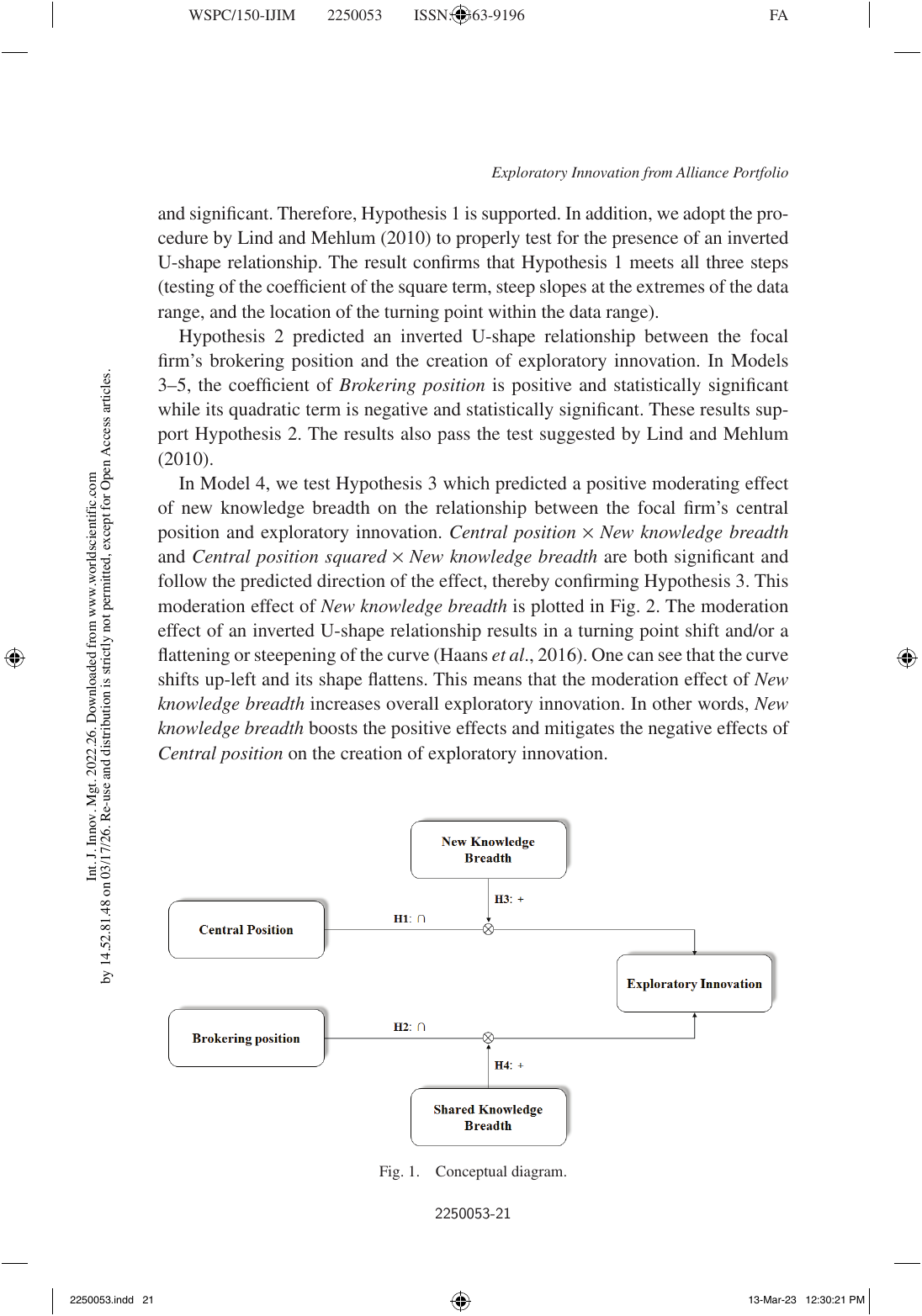
제휴 포트폴리오 에서 탐험적 혁신 의 결정 요인을 social network theory 와 지식 기반 관점 의 교호 로 통합 분석. knowledge flow (Hansen 1999 의 search-transfer 의 transfer 측) 와 search flexibility (search 측) 라는 두 요인을 새로 제안하고, 네트워크 central position (degree centrality) 과 brokering position (Burt 1992 구조적 공백) 가 각각 역-U 관계 (H1·H2), 그리고 두 가지 fit 조합 — central × new knowledge breadth (H3), brokering × shared knowledge breadth (H4) — 이 시너지를 낸다는 4가지 가설 검증. 1996–2010 미국·국제 bio-pharma 145개사 (SIC 2833–2836) 792 firm-year 패널, SDC Platinum + USPTO + Compustat, fixed-effect 음이항 회귀 (Lind 와 Mehlum 2010 turning-point test 통과) 결과 모든 가설 지지.
- RQ: alliance portfolio 에서 기업의 네트워크 위치 (central, brokering) 와 파트너의 지식 구성 (new knowledge breadth, shared knowledge breadth) 은 탐험적 혁신 에 어떻게 교호하는가? 어떤 fit 조합이 search-transfer trade-off 를 깨는가?
- 방법론: 음이항 회귀, 패널 분석, 사회 네트워크 분석, 특허 분석
- 데이터: 국제 bio-pharma (SIC 2833–2836) 145개 focal firm × 611개 파트너, 1996–2010, 5년 sliding window 10회 → 792 firm-year; Thomson Reuters SDC Platinum + USPTO + Compustat + Fung Institute patent-firm matching; UCINET6 로 네트워크 측정
- 주요 발견: H1 central position 역-U (1차 , 2차 , Lind-Mehlum 통과); H2 brokering position 역-U (1차 , 2차 ); H3 central × new knowledge + central² × new knowledge (Haans et al. 2016: 곡선 flatten + shift up-left); H4 brokering × shared knowledge n.s., brokering² × shared knowledge (shape-flip: 역-U → U)
- 시사점: alliance 전략 설계 시 네트워크 위치 + 파트너 지식 구성 의 fit 을 동시 고려. central → 다양한 new knowledge 보유 partner 와 매칭, brokering → 공유 지식 많은 partner 와 매칭. search-transfer trade-off 의 조합 해법
요약
기존 제휴 포트폴리오 ↔ 탐험적 혁신 연구는 social network theory 와 지식 기반 관점 두 lens 를 분리 또는 혼합 했다. Network 측 (Gulati 와 Gargiulo 1999, Phelps 2010, Wassmer 2010, Ma et al. 2020) 은 같은 네트워크 위치면 같은 지식 이라 가정하고, KBV 측 (Cui 와 O’Connor 2012, Wuyts 와 Dutta 2014) 은 같은 파트너면 같은 접근성 이라 가정. 현실은 둘 다 거짓 — 같은 중심성이라도 파트너 지식 구성이 다르면 효과가 다르고, 같은 파트너라도 네트워크 위치가 다르면 접근이 다르다. 이 paper 는 Hansen (1999), Lee (2011) 의 search-transfer problem 을 anchor 로, knowledge flow (지식 이전·복잡 tacit 지식의 stickiness 극복) + search flexibility (기술·시장 불확실성 대응을 위한 다대안 유지) 두 핵심 요인 framework 을 제안.
이론: (H1) Central position → 지식 흐름 ↑ (직접 접촉, 신뢰, 위상, 통제 — Bonacich 1987, Podolny 1993, Stuart 1998) 그러나 과도하면 search flexibility ↓ (status 보호, 강한 결속, 정보 노출, 자원 redundancy — Burkhardt 와 Brass 1990, Wassmer 2010) → 역-U. (H2) Brokering position → search flexibility ↑ (Burt 1992 의 structural holes, 서로 다른 group 간 정보 차익, 자율성 — Burt 2004, Zaheer 와 Bell 2005, Shipilov 2009) 그러나 과도하면 knowledge flow ↓ (소속감 부재 → 상대적 absorptive capacity 결핍, 신뢰 부족 — Cohen 과 Levinthal 1990, Lane 과 Lubatkin 1998) → 역-U. (H3) Central × New knowledge breadth: central position 의 부족한 search flexibility 를 partner 의 다양한 새 지식 이 보완, central 의 통제력은 new knowledge 의 information overflow 문제 (Koput 1997, Srivastava 와 Gnyawali 2011) 를 동시에 해결 → fit 시너지. (H4) Brokering × Shared knowledge breadth: brokering 의 부족한 absorptive capacity 를 공유 지식 폭 이 보완, brokering 위치는 shared knowledge 의 homogeneity trap (Janis 1972, Levinthal 과 March 1993) 을 동시에 방지 → fit 시너지.
방법: bio-pharma (SIC 2833–2836) 145개 focal firm, 5년 window (1996–2009) 10회 sliding 으로 792 firm-year. 종속변수 = 새 USPC class 를 포함하면서 alliance portfolio 의 지식 기반에 등장한 적 있는 class 의 신규 patent 수 (Guan 과 Liu 2016, Wang et al. 2014 의 exploratory innovation 정의 + alliance 매개 제약). 독립변수: central = degree centrality (Bonacich), brokering = Burt 의 structural holes 지수 (UCINET6), new/shared knowledge breadth = 파트너의 patent class 중 focal 비보유/공유의 수 (entropy 가 아닌 count 로 absolute 분산 포착). Fixed-effect NBR (Hausman test). Haans, Pieters, He (2016) 의 quadratic moderation: turning-point shift + flatten/steepen 동시 검증 위해 1차·2차 항 모두 moderator 와 교호. Lind 와 Mehlum (2010) 의 역-U 3-step test (square 계수 유의, 극단 기울기 가파름, turning point 가 표본 안) 모두 통과. 모든 가설 지지. 특히 H4 의 shape-flip — brokering 이 충분히 높고 shared knowledge 도 풍부하면 역-U → U 로 근본 관계 자체가 바뀜 (Haans et al. 2016: “fundamental nature of the relationship now depends on the moderator”). 강진아 author page 의 3기 (2019–2022) SNU 통합·확장기 의 가장 최근 이론 확장, 실타래 5: 네트워크와 지식의 상호작용 의 완성. 5년 전 Linking the firm's knowledge network and subsequent exploratory innovation: a study based on semiconductor industry patent data (knowledge network 의 dynamic framework) 에서 alliance portfolio 의 네트워크 + 지식 구성 교호 로 진화. Influence of alliance portfolio diversity on innovation performance: the role of internal capabilities of value creation 의 내부 역량 × 외부 전략 fit 명제를 네트워크 구조 × 지식 구성 차원으로 확장. 한계: bio-pharma 단일 산업, 비특허 혁신 누락, network 의 entire-network 차원 미분석.
핵심 결과
| 가설 | 변수 | β | 유의수준 | 지지 |
|---|---|---|---|---|
| H1 | Central position (1차) | +0.395 | p<.10 | 지지 |
| H1 | Central position² (역-U) | −0.026 | p<.05 | 지지 |
| H2 | Brokering position (1차) | +3.543 | p<.05 | 지지 |
| H2 | Brokering position² (역-U) | −5.996 | p<.01 | 지지 |
| H3 | Central × New knowledge | −0.007 | p<.05 | 지지 (1차 부호 분리) |
| H3 | Central² × New knowledge | +0.00042 | p<.05 | 지지 (flatten + shift) |
| H4 | Brokering × Shared knowledge | −0.122 | n.s. | — |
| H4 | Brokering² × Shared knowledge | +0.332 | p<.10 | 지지 (shape-flip 역-U→U) |
| Direct | New knowledge breadth | +0.041 | p<.01 | + |
| Direct | Shared knowledge breadth | −0.099 | p<.05 | − |
표본 평균: exploratory innovation 1.93, central position 3.03, brokering position 0.38, new knowledge breadth 25.35, shared knowledge breadth 8.48, firm size (log) −0.65, R&D intensity 418, AP experience 12.60, technology classes in knowledge base 14.80. N = 792 firm-year, 145 firms, Wald χ² 106.34 (full), VIF < 10. Lind-Mehlum 3-step test 모두 통과.
방법론 노트
종속변수 (count + over-dispersion) 에 fixed-effect 음이항 회귀 (Long 1997; Hausman 1978 test). 핵심 quadratic moderation 분석은 Haans, Pieters, He (2016) 의 framework — 단순 turning point shift 와 flattening/steepening 의 구분, shape-flip 의 조건. 핵심 회귀식:
여기서 = central position (degree centrality), = brokering position (Burt structural holes), = new knowledge breadth, = shared knowledge breadth. Burt 의 structural holes 측정식:
= firm 의 contact 비중, = 와 사이 관계 강도. 이면 모든 partner 가 서로 비연결 (full broker), 0 이면 완전 redundant. 식별: Lind 와 Mehlum (2010) 의 3-step — (i) 2차항 계수 유의, (ii) 표본의 양 극단에서 기울기 부호 다름 (slope sign change), (iii) turning point 가 데이터 range 안. 본 paper 의 H1·H2 가 모두 통과. Haans-Pieters-He 의 shape-flip 진단: H4 에서 brokering² × shared knowledge 가 +, brokering² 가 − → shared knowledge 가 충분히 크면 (Z* = β₄/β₁₀) 곡선이 역-U 에서 U 로 flip.
연구 계보
직접 선행은 Gulati 와 Gargiulo (1999), Phelps (2010), Gilsing et al. (2008), Wassmer (2010), Lin et al. (2009), Ma et al. (2020) 의 alliance network embedding ↔ 혁신, Cui 와 O’Connor (2012), Wuyts 와 Dutta (2014), Schildt et al. (2012), Kotha, Crama, Kim (2011) 의 alliance portfolio knowledge composition, Wang et al. (2014), Dibiaggio, Nasiriyar, Nesta (2014), Guan 과 Liu (2016) 의 exploratory innovation 정의. 이론 anchor 는 Burt (1992, 2000, 2004) 의 구조적 공백, Bonacich (1987), Podolny (1993, 2001), Freeman (1979) 의 centrality, Hansen (1999) 의 search-transfer problem (이 paper 의 framework 직접 source), Lee (2011) 의 search-transfer trade-off, Cohen 과 Levinthal (1990) 의 흡수능력, Kogut 과 Zander (1992) 의 지식 기반 관점, Fleming (2001), Weitzman (1998) 의 recombinant 혁신, March (1991) 의 탐색-활용. 방법론 anchor 는 Burt (1991) structural holes 측정, Haans, Pieters, He (2016) 의 quadratic moderation, Lind 와 Mehlum (2010) 의 역-U test. 강진아 author page 의 3기 (2019–2022) SNU 통합·확장기 의 가장 최근 이론 확장 — 실타래 5: 네트워크와 지식의 상호작용 의 완성 (배태성의 양면 효과 Two-Sided Effects of Embeddedness in Alliance Portfolios (2015) → 지식 네트워크 dynamic framework Linking the firm's knowledge network and subsequent exploratory innovation: a study based on semiconductor industry patent data (2017) → 네트워크 구조 × 지식 구성 교호 (본 paper, 2022)). 같은 1저자 S. Joseph Yoon 의 framework 진화의 종착점. 같은 3기 sibling: Influence of alliance portfolio diversity on innovation performance: the role of internal capabilities of value creation (alliance portfolio 다양성 × 내부 역량). 공저자 Gil S. Jo 의 Unravelling the Link between Technological M&A and Innovation Performance Using the Concept of Relative Absorptive Capacity (relative absorptive capacity) 의 네트워크 차원 응용.
See also
- 강진아
- S. Joseph Yoon
- Gil S. Jo
- International Journal of Innovation Management
- 제휴 포트폴리오
- 네트워크 embeddedness
- 구조적 공백
- 탐색-활용
- 지식 기반 관점
- 흡수능력
- double-edged-sword
- 사회 네트워크 분석
- 음이항 회귀
- 패널 분석
- Linking the firm's knowledge network and subsequent exploratory innovation: a study based on semiconductor industry patent data
- Influence of alliance portfolio diversity on innovation performance: the role of internal capabilities of value creation
- Two-Sided Effects of Embeddedness in Alliance Portfolios
- Unravelling the Link between Technological M&A and Innovation Performance Using the Concept of Relative Absorptive Capacity
인접 그래프
- 인물 3
- 방법론 4
- 개념 6
- 수록처 1
- 분류 1
- 논문 4