Investigating the asymmetric impact of energy consumption on reshaping future energy policy and economic growth in Iran using extended Cobb-Douglas production function
Bahareh Oryani, 구윤모, Shahabaldin Rezania, Afsaneh Shafiee (2021) · 에너지 · DOI ↗
이란 1970-2017 (48 년) 의 에너지 소비 → 실질 GDP 의 비대칭 영향 을 확장 Cobb-Douglas + ardl (linear) / nardl (nonlinear 양/음 충격 분해) 로 검정. Wald test 결과 양·음 충격이 GDP 에 대칭적 영향 (F-stat p=0.4021, χ² p=0.4150 — 대칭 가설 비기각), 즉 NARDL 비대칭이 통계적으로 무의미하므로 linear ARDL 해석. 장기 ARDL: 에너지 1% ↑ → GDP +5.31%, 자본 1% ↑ → GDP +0.22%, CO2 1% ↑ → GDP −4.89%, 노동 1% ↑ → GDP −0.99% (모두 1% 유의). ECM = −0.848 (1.2 년에 장기 균형 복원). Toda-Yamamoto: CO2 ↔ 에너지 양방향 인과 + 에너지 → GDP, CO2 → GDP 단방향. Bahareh Oryani 이란 시리즈의 두 번째 작업.
- RQ: 이란의 에너지 소비 → 경제성장 관계가 양·음 충격에 대해 비대칭 인가? CO2, 노동, 자본은 단기·장기 GDP 에 어떻게 작용하는가? 인과 방향은?
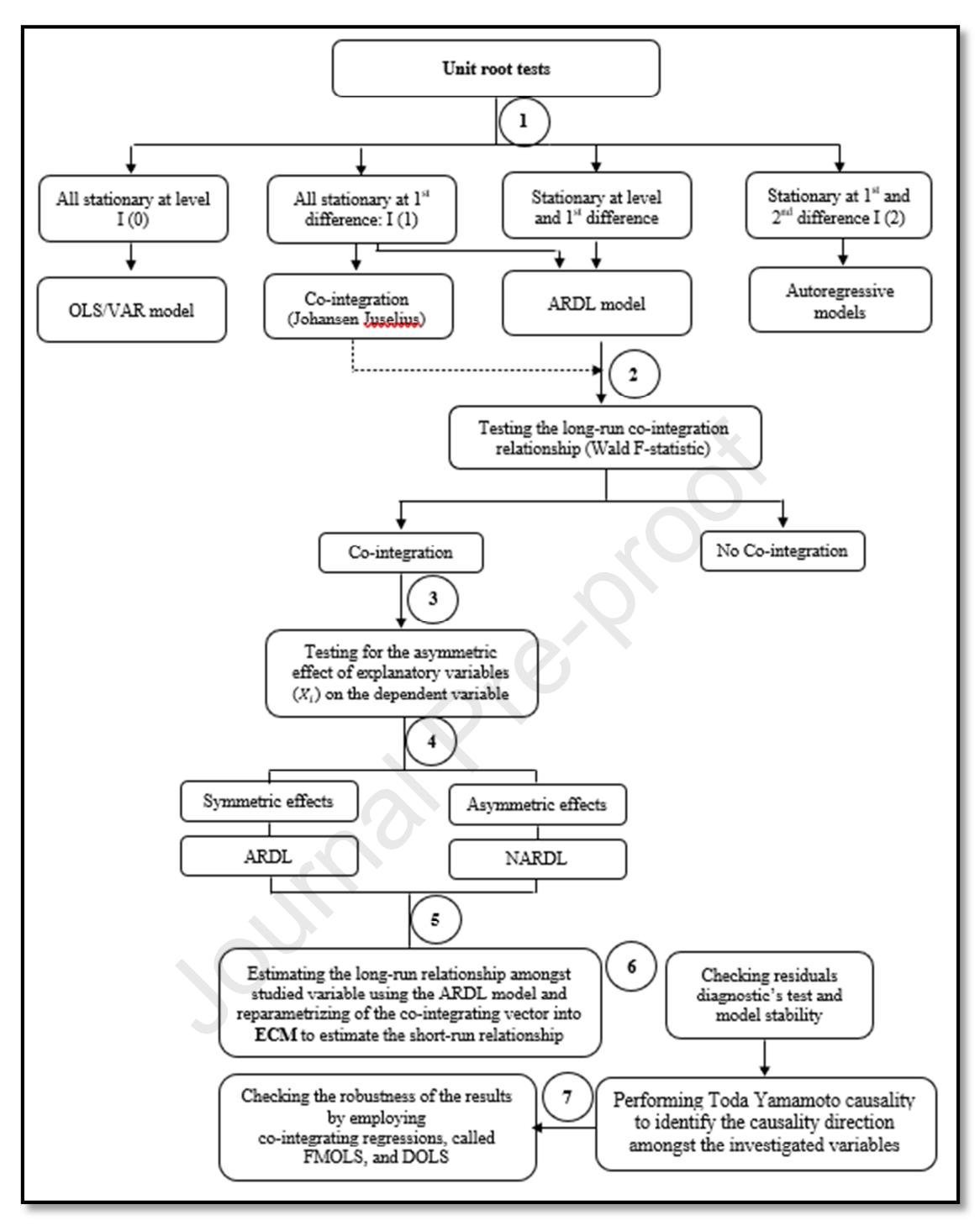
- 방법론: 확장 Cobb-Douglas + ardl (Pesaran bound test) + nardl (Shin-Yu-Greenwood-Nimmo 양/음 partial sum 분해) + toda-yamamoto-causality (augmented VAR, integration order robust) + fully-modified-ols + dynamic-ols (강건성 검정). KPSS unit root, AIC lag, ARDL(1,1,4,4,3), NARDL(1,0,2,1,2,2).
- 데이터: 이란 1970-2017 (48 년) 연간. Y = 실질 GDP (2010 constant USD), L = 노동력 (백만 명, Iran Statistical Centre), K = gross fixed capital formation (2010 USD), E = primary energy consumption (Mtoe, BP), CO2 = 배출량 (백만 톤, BP). 모든 변수 log.
- 주요 발견: (i) 대칭 — Wald test (F p=0.4021, χ² p=0.4150) 비기각. 따라서 linear ARDL 해석 채택. (ii) 장기 elasticity: β_E = +5.31 (1% 유의), β_K = +0.22, β_CO2 = −4.89, β_L = −0.99. (iii) 단기: ΔLE = +3.38, ΔLE(−1) = −1.51, ΔLE(−2) = −1.54, ΔLK = +0.20. ECM = −0.848 → 1.2 년에 장기 균형 복원. (iv) FMOLS/DOLS 강건성 확인 (β_E = 5.56 / 5.89, β_CO2 = −5.13 / −5.48). (v) Toda-Yamamoto: CO2 ↔ E 양방향 (F=4.02 / 8.67), E → Y 단방향 (F=5.03), CO2 → Y 단방향. 이란의 에너지 mix 99% fossil fuel (2018, BP) 이 양방향 인과의 배경.
- 시사점: 에너지 소비가 GDP 견인 + 환경 악화의 이중성 → 에너지 보존 정책 (소비 감축) 은 부적합. 재생 전환 + 시장 기반 개입 (재생 보조금, fossil 가격 자유화, 탄소세) + 비시장 기반 개입 (license 단일 창구, R&D 세제, 노동력 교육, 공공-민간 파트너십, 인프라 공공자금) 의 2 축 정책.
요약
구윤모 · Bahareh Oryani 이란 시리즈의 두 번째 작업. Structural vector autoregressive approach to evaluate the impact of electricity generation mix on economic growth and CO2 emissions in Iran (SVAR 으로 전원믹스 인과 식별) 의 후속으로, 에너지 소비 → GDP 관계의 비대칭성 (양 충격과 음 충격의 차등 효과) 검정에 초점한다. 기존 문헌 (Ahmad-Du 2017 ARDL Iran; Lotfalipour 등 2010 Iran fossil; MENA 패널 등) 이 linear 추정만 했음을 gap 으로 지목, NARDL 의 partial sum decomposition 으로 검정한다.
방법론적 핵심은 nardl (Shin-Yu-Greenwood-Nimmo 2014) — 변수의 양의 누적 부분 + 음의 누적 부분 으로 분해 → 각각의 short/long-run effect 별도 추정 → Wald test 로 대칭성 가설 검정. ardl bound test (Pesaran-Shin-Smith 2001, Narayan 2005 small-sample critical values) 로 장기 cointegration 확인 (ARDL F=4.44, NARDL F=4.22, 모두 upper bound 초과). toda-yamamoto-causality (1995) 로 integration order 에 강건한 인과 방향, fully-modified-ols / dynamic-ols 로 cointegration regression 강건성.
핵심 발견 — 대칭 (Wald test p=0.40 / 0.41). 즉 NARDL 의 비대칭 분해가 통계적으로 무의미하므로 linear ARDL 채택. 장기 elasticity 가 흥미롭다: 에너지 1% ↑ → GDP +5.31% (매우 큰 양), CO2 1% ↑ → GDP −4.89% (큰 음, 기존 문헌 — Lotfalipour 등 — 의 양 결과와 반대). 저자는 CO2 → GDP 음 효과를 환경 규제·오염 부담금 도입 후 생산 위축 으로 해석한다. 노동 → GDP −0.99% 의 음 효과는 brain drain, 미숙련·미교육 노동력, 낮은 노동 생산성 탓. ECM = −0.848 → 충격 후 1.2 년에 장기 균형 복원. Toda-Yamamoto — CO2 ↔ E 양방향 인과 (이란 에너지 mix 의 99% fossil 가 동시 결정 메커니즘), E → Y 단방향, CO2 → Y 단방향. caveat: NARDL 비대칭 비기각이 power 부족 일 가능성 (48 관측 small sample), 노동 → GDP 음 effect 의 해석이 sample-specific 일 가능성.
정책 함의는 2 축 — 시장 기반 (재생 보조금, fossil 가격 점진 자유화, 환경세, license 단일 창구) + 비시장 기반 (R&D 세제, vocational training, 공공-민간 파트너십, 인프라 공공자금). 에너지 소비가 GDP 견인 + 환경 악화의 이중성 → 에너지 보존 정책 (소비 감축) 은 GDP 손실 발생; 재생 전환 만이 두 효과 동시 해결.
핵심 결과
| 추정량 | 변수 | β (장기) | t-stat |
|---|---|---|---|
| ARDL (linear) | LE | +5.31 | 9.65 |
| ARDL | LK | +0.22 | 3.90 |
| ARDL | LL | −0.99 | −2.26 |
| ARDL | LCO2 | −4.89 | −9.36 |
| NARDL | LE⁺ | +5.62 | 7.18 |
| NARDL | LE⁻ | +5.42 | 7.41 |
| FMOLS | LE | +5.56 | 12.33 |
| DOLS | LE | +5.89 | 10.49 |
| ECM 계수 | — | −0.848 | −5.06 |
| Wald 대칭성 (LE⁺=LE⁻) | — | p=0.40 (비기각) | — |
Toda-Yamamoto 인과: CO2 ↔ E 양방향 (F=4.02 / 8.67), E → Y 단방향 (F=5.03), CO2 → Y 단방향.
방법론 노트
확장 Cobb-Douglas + 기술 항을 CO2 의 함수로 ():
nardl 의 양/음 partial sum decomposition (Shin et al. 2014):
장기 cointegration: ARDL bound test (Pesaran-Shin-Smith 2001) — F-statistic 이 upper bound I(1) 초과 시 cointegration 존재. 비대칭성 검정: 의 Wald test. Identification: AIC lag, KPSS unit root (모든 변수 I(0) 또는 I(1), 어느 것도 I(2) 아님 → ARDL 적용 가능), CUSUM/CUSUMSQ stability, FMOLS/DOLS 로 endogeneity·serial correlation·small-sample bias 강건성 검증, toda-yamamoto-causality 로 integration order 에 robust 한 인과 방향 (augmented VAR(p + d_max), modified Wald).
연구 계보
구윤모 의 2 기 탄소중립·기술확산·정책 평가 라인 안에서 Bahareh Oryani 이란 시리즈의 두 번째. Direct method predecessor: Pesaran-Shin-Smith (2001, ARDL bound test), Shin-Yu-Greenwood-Nimmo (2014, NARDL), Toda-Yamamoto (1995, causality), Kraft-Kraft (1978, 에너지-GNP 인과 효시). Direct empirical predecessor: Ahmad & Du (2017, Energy, ARDL Iran), Lotfalipour 등 (2010, Energy, Iran fossil consumption), Kahia-Aïssa-Lanouar (2017, MENA NOICs PECM), Ben Mbarek 등 (2018, Tunisia VECM). 시리즈 직속 선행 — Structural vector autoregressive approach to evaluate the impact of electricity generation mix on economic growth and CO2 emissions in Iran (SVAR 으로 전원믹스 식별); sibling — Barriers to renewable energy technologies penetration: Perspective in Iran (장벽 ISM 분석), The role of electricity mix and transportation sector in designing a green-growth strategy in Iran (수송 확장), Heterogeneous preferences for EVs: Evidence from Iran (EV 선호 DCM).
See also
- 구윤모
- Bahareh Oryani
- ardl
- nardl
- toda-yamamoto-causality
- fully-modified-ols
- dynamic-ols
- iran-energy-policy
- cobb-douglas-production
- Structural vector autoregressive approach to evaluate the impact of electricity generation mix on economic growth and CO2 emissions in Iran
- Barriers to renewable energy technologies penetration: Perspective in Iran
- The role of electricity mix and transportation sector in designing a green-growth strategy in Iran
- Heterogeneous preferences for EVs: Evidence from Iran
- 에너지
인접 그래프
- 인물 4
- 주제 1
- 수록처 1
- 분류 1
- 논문 4
이 문서를 가리키는 페이지
논문 (4)
- Barriers to renewable energy technologies penetration: Perspective in Iran
- Heterogeneous preferences for EVs: Evidence from Iran
- Structural vector autoregressive approach to evaluate the impact of electricity generation mix on economic growth and CO2 emissions in Iran
- The role of electricity mix and transportation sector in designing a green-growth strategy in Iran