Effects of regulation and economic environment on the electricity industry's competitiveness: A study based on OECD countries
Chulwoo Baek, Euy-Young Jung, 이정동 (2014) · Energy Policy 72:120-128 · DOI ↗
전력산업의 단일 성과 지표 (price · efficiency · investment) 한계를 극복하기 위해 efficiency · stability · growth 의 세 sub-factor 를 계층 분석법 로 가중한 경쟁력 지수 를 제안한다. 28 개 OECD 국가 1980-2007 unbalanced panel 에서 전력산업 규제완화 (entry · public ownership · vertical integration) 이 competitiveness 에 미치는 영향을 economic environment (GDP per capita · energy intensity · manufacturing share) 와의 interaction term 으로 분석. deregulation 의 효과가 국가 경제 맥락에 의존 하며, 특히 entry regulation 과 vertical integration 의 완화는 energy intensity 와 manufacturing share 가 낮은 국가 에서 더 효과적이라는 결과를 보고한다.
- RQ: 전력산업 규제완화 의 효과를 단일 지표 (price · efficiency · investment) 가 아닌 multi-dimensional 경쟁력 지수 로 측정할 때, regulation 변화의 효과가 국가 경제환경 (level of economic development · energy intensity · manufacturing share) 에 따라 어떻게 달라지는가?
- 방법론: 합성지수, 계층 분석법, 고정효과 회귀, 패널 데이터 분석, 상호작용항 회귀
- 데이터: 28 OECD 국가 unbalanced panel (1980-2007, 690 obs), OECD · EIA · UN · PATSTAT · IEA 데이터 결합
- 주요 발견: regulation index 의 competitiveness 계수가 −0.027*** (Model 4) — 즉 deregulation 이 일반적으로 competitiveness 증가. 단 interaction 항: regulation × energy intensity (+0.001***), regulation × manufacturing share (+0.050**) — energy 집약도와 제조업 비중이 높은 국가에선 deregulation 이 오히려 competitiveness 감소. entry regulation 과 vertical integration 의 sub-component 도 같은 패턴, public ownership 만 interaction 모두 ns.
- 시사점: British-style deregulation package 의 one-size-fits-all 적용은 부적절. Czech Republic · Hungary · South Korea 같은 high-energy-intensity + high-manufacturing-share 국가는 entry regulation 과 vertical integration 의 완화를 조심스럽게 진행해야 한다. 한국은 2000 년 reform 시작 후 regulation index 가 여전히 높고 (4.94, 평균 4.19) competitiveness 변화도 미미 (+0.002) — sibling Profitability and productivity changes in the Korean electricity industry 와 호응하는 한국 reform 진단.
요약
본 paper 는 이정동 의 자기 분류 제3기 성장의 역학과 거시적 전환 (2013-2019) 의 에너지 정책 심화 축 위에 있다. sibling Profitability and productivity changes in the Korean electricity industry 가 한국 KEPCO 단일 기업 + 6 개 GENCO 의 index-number 기반 productivity 분해 를 다뤘다면, 본 paper 는 OECD 28 개국 cross-country panel + composite index 로 국제 비교 차원을 추가한다. 두 paper 가 함께 한국 reform 의 micro 평가 + 국제 reform 의 macro 평가 의 paired contribution. 학술적 contribution 의 핵심은 두 가지: (1) British-style reform package 의 효과 분석에서 price 단일 지표 가 아닌 efficiency + stability + growth 의 7 sub-index 를 AHP 로 가중한 composite index, (2) reform 의 효과가 국가 경제환경 (GDP per capita · energy intensity · manufacturing share) 과의 interaction 으로 조절 된다는 식별.
분석 setting 은 4-Model 점층 구조. Model 1 (entry regulation), Model 2 (public ownership), Model 3 (vertical integration), Model 4 (regulation index = 세 sub-component 의 평균) 가 각각 economic environment 와의 interaction 항 을 포함한 고정효과 회귀. Model 4 (regulation index 전체) 에서 regulation index 의 main effect = −0.027*** (deregulation = competitiveness 증가), regulation × energy intensity = +0.001*** (energy intensity 가 1 단위 (kBTU per 2005 dollar GDP) 증가하면 deregulation 의 효과가 0.001 감소), regulation × manufacturing share = +0.050** (manufacturing share 가 1 단위 (= 100%pt) 증가하면 deregulation 효과가 0.050 감소). public ownership 만 interaction 모두 통계적으로 ns — 즉 민영화의 효과는 경제환경과 무관하게 불명확. 이 결과는 Fiorio–Florio (2013) 의 public ownership 이 가격 낮춤 과 Steiner (2001) 의 민영화가 가격 올림 의 상충 결과 와 부합 — 본 paper 의 composite index 도 단일 결론을 내지 못한다.
본 paper 의 한계는 두 가지. 첫째, AHP 가중치가 10 명의 한국 전문가 (generation · transmission · 대형 customer 조직 · power exchange · 정부) 의 사전 조사 에 의존 — 다른 가중치 set 에선 결과가 달라질 가능성. 둘째, 1980-2007 panel 이 2008 금융위기 이후 reform 의 후퇴 (재공기업화 · 정부 개입 강화) 트렌드 를 포함하지 못한다. 후속 연구는 2007 이후 데이터 update + composite weight sensitivity analysis 가 자연스러운 다음 단계. 셋째, competitiveness 의 정의 자체가 normative — 가령 renewable energy 비중 은 환경 측면에선 positive 지만 short-run 가격 측면 에선 부담일 수 있어 weight 선택이 결과를 좌우한다.
핵심 결과
| 변수 | Model 1 (entry) | Model 2 (public own.) | Model 3 (vert. int.) | Model 4 (reg. index) |
|---|---|---|---|---|
| Regulation main effect | +0.021*** | +0.012 ns | +0.025*** | +0.027*** |
| Level of econ. development (B) | −0.159*** | −0.017 ns | −0.165*** | −0.150*** |
| Energy intensity (C) | −0.012*** | −0.004 ns | −0.011*** | −0.012*** |
| Manufacturing share (D) | −0.172** | −0.160 ns | −0.214** | −0.218** |
| Reg × Econ dev (B) | +0.005 ns | +0.014 ns | +0.016** | +0.001 ns |
| Reg × Energy intens. (C) | +0.123*** | +0.024 ns | +0.109*** | +0.001*** |
| Reg × Manuf. share (D) | +0.034*** | +0.023 ns | +0.049*** | +0.050** |
| N | 690 | 690 | 690 | 690 |
| R² | 0.103 | 0.074 | 0.090 | 0.115 |
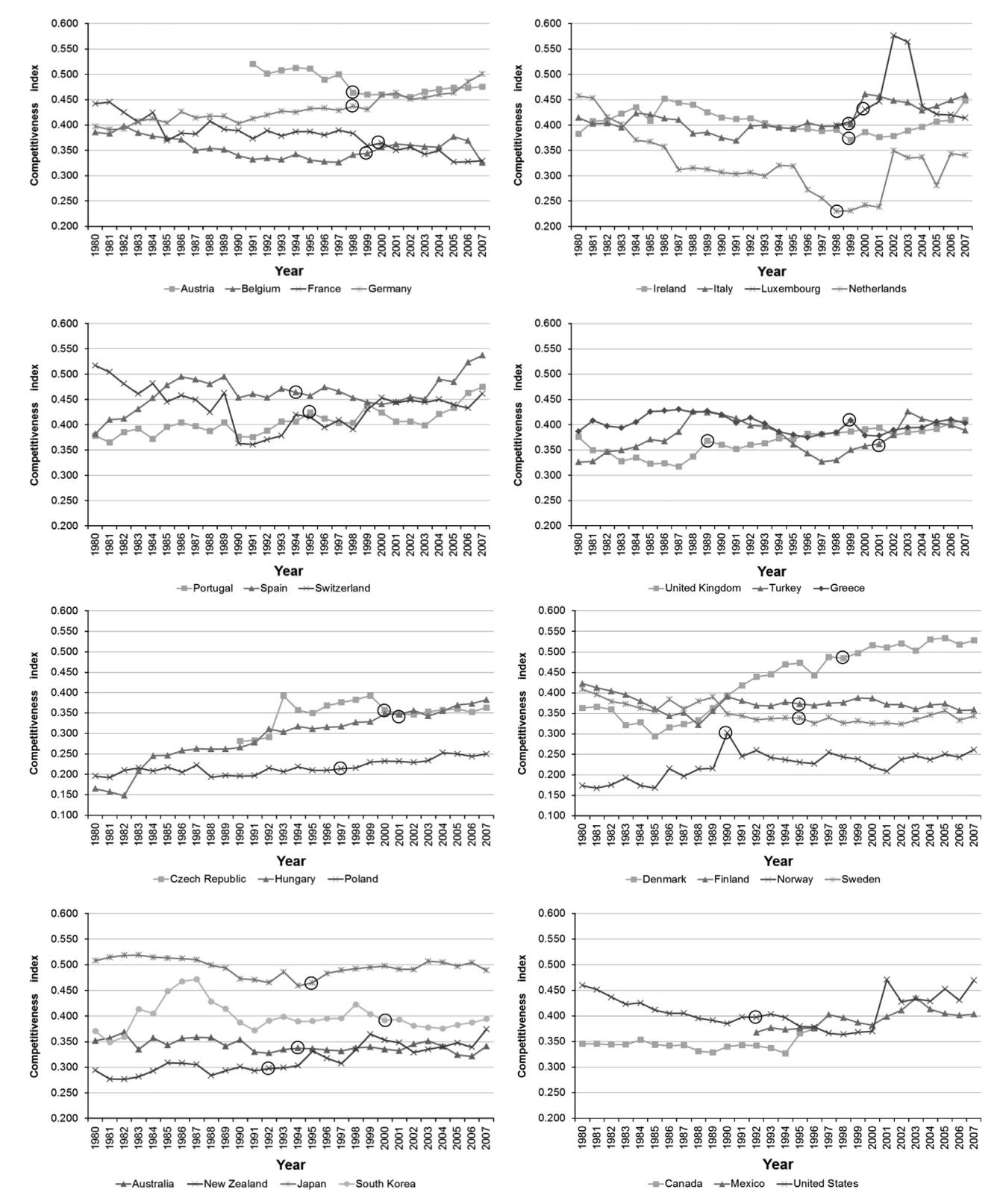
reform 전후 competitiveness 변화 (1990s 후반 ~ 2007): 상위 — Netherlands +0.111 · Ireland +0.078 · New Zealand +0.077, 하위 — Belgium −0.018 · France −0.035 · Norway −0.042, 정체 — Australia +0.004 · South Korea +0.002.
한국 사례 mean values: regulation index 4.94 (vs 평균 4.19) · entry regulation 5.50 · vertical integration 5.25 — 모두 평균보다 높음 → deregulation 여지가 크지만 manufacturing share (0.27) 와 energy intensity (10.81) 도 평균 이상 → 정책 implication 으로는 조심스러운 entry regulation 완화 권고.
방법론 노트
합성지수 구축은 9 sub-factor 를 efficiency · stability · growth 의 3 카테고리로 묶고 계층 분석법 로 가중. AHP 절차: 10 명 전문가의 pairwise comparison survey, inconsistency cutoff = 0.2, 위반 시 2 차 survey. sub-factor 별 weight (예시): generation efficiency · transmission efficiency · capacity margin · energy security (HHI 기반) · innovativeness (특허) · renewable energy · overseas expansion. 각 sub-factor 는 min-max normalization 으로 0-1 정규화.
핵심 식 (고정효과 회귀 with interaction):
여기서 는 country , year 의 competitiveness index, 는 regulation 변수 (entry · public ownership · vertical integration · regulation index), 는 economic environment 변수 (GDP per capita · energy intensity · manufacturing share), 는 두 변수의 interaction, 는 country fixed effect, 는 idiosyncratic error.
식별은 국가 fixed effect 로 시간 불변 country-specific 요인 (지리·자원·역사적 제도) 통제 + interaction 항으로 regulation 의 효과가 economic environment 에 어떻게 의존하는지 식별. AHP 가중치는 한국 전문가 survey 기반이라 Korean perspective bias 가 존재 — 다만 normalization 이 cross-country comparison 을 가능케 하고, 1980-2007 panel 의 시간 변동 + cross-country 변동 의 결합이 식별력을 보장.
연구 계보
본 paper 는 두 라인의 합류. 첫째, British-style reform package 효과 평가의 전통 — Steiner (2001), Hattori–Tsutsui (2004), Alesina et al. (2005), Zhang et al. (2008), Fiorio–Florio (2013), Gugler et al. (2013) 등이 각각 price · investment · efficiency 단일 지표로 reform 효과를 측정. 본 paper 는 KPMG (2012) 의 Global Energy Competitiveness Index 흐름을 학술화하고 7 sub-factor + AHP 가중치 라는 systematic framework 으로 정교화한다. 둘째, economic environment × regulation interaction 의 전통 — Williams–Ghanadan (2006) 의 national context 강조와 Erdogdu (2012) 의 cross-country political economy 분석 라인. Djankov et al. (2002) 의 entry regulation 의 부정적 효과 와 Gassner et al. (2008) 의 민영화의 productivity 향상 효과 가 sub-result 와 부합. 이정동 author page 의 제3기 (2) 에너지 정책의 심화 분류의 국제 비교 축이며, sibling Profitability and productivity changes in the Korean electricity industry 의 한국 단일국 reform 분석 의 cross-country 확장. Profitability Gains of Korean Defense Firms: Technological Progress or Cost Shifting? 의 한국 방위산업 SFA 가 regulated industry 의 efficiency 라는 sister theme.
See also
- Profitability and productivity changes in the Korean electricity industry
- Validation of an R&D-based computable general equilibrium model
- 이정동
- 합성지수
- 계층 분석법
- 고정효과 회귀
- 패널 데이터 분석
- 전력산업 규제완화
- 경쟁력 지수
- British-style 개혁 패키지
- 한국 전력산업
- Energy Policy
인접 그래프
- 인물 3
- 방법론 5
- 개념 4
- 주제 3
- 수록처 2
- 분류 1
- 논문 5