Comparative analysis of iterative approaches for incorporating learning-by-doing into the energy system models
Hansung Kim, Hwarang Lee, 구윤모, Dong Gu Choi (2020) · 에너지 · DOI ↗
에너지시스템 bottom-up model 에 학습-실행 (learning-by-doing) (LBD) 효과 — 누적 설치량 → 단가 하락 — 의 endogenous 반영 방법 3 가지 (MIP 정식, iterative approach 1 myopic Karali et al. 2017, iterative approach 2 repeat-until-convergence Yang et al. 2016) 를 비교 분석 후 수정 iterative approach (Ite3) 제안. 한국 8차 전력수급기본계획 (2017 MOTIE 발표, 2030 까지 14년) 위에서 carbon tax 와 renewable subsidy scenario 적용. 핵심 정량 결과: iterative 가 MIP 대비 계산속도 5-23 배 빠름, LBD scenario 의 필요 carbon tax / 보조금이 NoLR 대비 10-50% 감소, MIP 의 zero carbon tax / 보조금 (PV·풍력의 LBD-induced cost-competitiveness) vs iterative 의 underestimate 또는 overestimate. Ite1 carbon tax: 0 (점진 0 까지), Ite2 carbon tax: 207 T.KRW/tCO₂eq, Ite3 carbon tax: 228 T.KRW/tCO₂eq, NoLR carbon tax: 81 T.KRW/tCO₂eq 일정. 부적절한 LBD method 선택 시 정책 결정 시점·예산 규모가 크게 달라지며 비효율적 예산 발생.
- RQ: bottom-up-energy-system-model 에 학습-실행 (learning-by-doing) 을 도입하는 3 가지 iterative approach 의 정확성 vs 계산 부담 trade-off 는 어떻게 다른가? 한국 8차 전력수급기본계획 의 필요 carbon tax / 보조금 결정에 method 선택이 어떻게 차이를 만드는가?
- 방법론: MIP-based formulation (Messner 1997 piecewise linear segments + binary integer indicator), iterative approach 1 (Karali et al. 2017 Appl Energy — myopic, 시점별 separate solve, ), iterative approach 2 (Yang et al. 2016 CA-TIMES — repeat-until-convergence, ), 본 paper Ite3 (수정 iterative — MIP 와 update 일관성, 평균 unit investment cost 사용)
- 데이터: 한국 8차 전력수급기본계획 (MOTIE 2017), 9 종 발전기술 (nuclear, BCST, ACST, NGCC, NGT, pumped storage, 태양광 PV, 풍력, others), KEEI·KIER·KETEP 비용 데이터, NREL 2018 PV cost benchmark. PV learning rate 25%, 풍력 19% (Koo et al. 2011 Appl Energy 88(6): 2254-60). 2017-2030 14년 계획기간. GAMS 24.1 + CPLEX, Intel core i5 16GB RAM
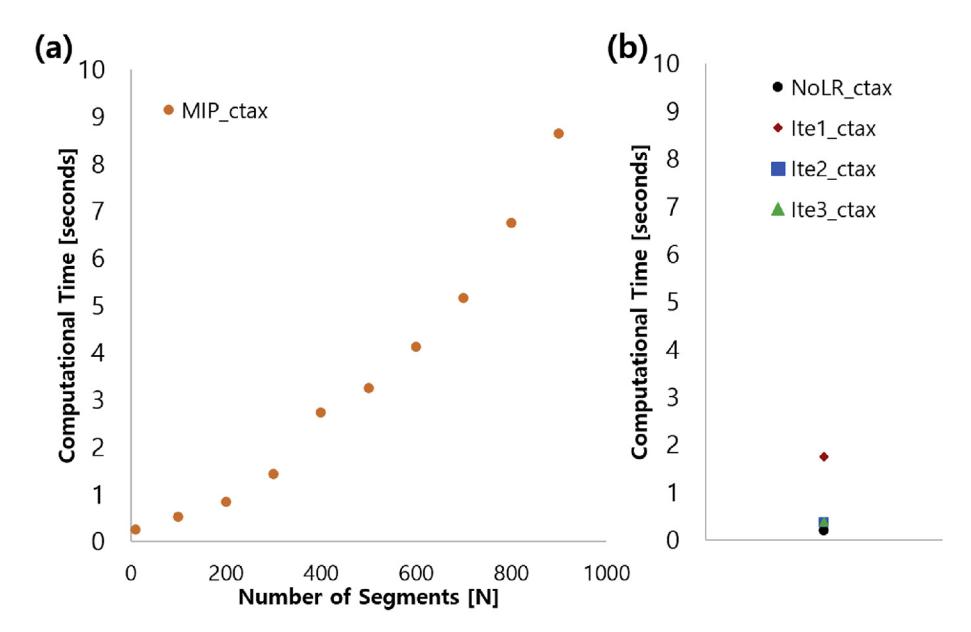
- 주요 발견: (i) 계산속도: iterative approach 가 MIP 대비 5-23 배 빠름 (segment 수에 따라). Ite2, Ite3 는 2 iteration 만으로 수렴, Ite1 는 14 iteration (period 수와 동일). (ii) 필요 carbon tax (Fig.7): NoLR 81 T.KRW/tCO₂eq 일정 vs MIP zero (LBD-induced cost-competitiveness) vs Ite1 = NoLR 81 (2022 이후 0 점감) vs Ite2 207 (2020 후 zero) vs Ite3 228 (2020 후 zero). (iii) 필요 subsidy (Fig.8): NoLR 923 billion KRW (2018) 증가 vs MIP zero vs Ite1, Ite2, Ite3 점감 (2025 zero). (iv) 총 carbon tax / subsidy (Fig.9): LBD scenario 가 NoLR 대비 10-50% 감소; Ite1 vs Ite3 차이 약 69 trillion KRW (NoLR vs Ite3 차이 직전 수준). (v) Sensitivity (PV learning rate 19.2%-32.7%): 결과 -25% ~ +35% 변동, 해석은 robust
- 시사점: (a) iterative 의 부적절한 적용 이 정책 시점 + 예산 결정 을 수십 trillion KRW 규모로 왜곡 — 정책 분석가는 method 선택 의미를 인지해야 비효율 예산 회피. (b) MIP 의 zero carbon tax/subsidy 의 정책적 의미: PV·풍력 의 future investment cost reduction (LBD-driven) 을 현재 stakeholder 가 사회 차원에서 internalize 한 결과 — 현재 stakeholder ≠ 미래 stakeholder 면 MIP 결과 비현실적. (c) 본 paper 의 Ite3 가 practical second-best — MIP 대비 5-23 배 빠르면서 update formula 일관성 확보. (d) NDC 37% (BAU 850.6 Mt CO₂eq) 달성의 전력 부문 (총 GHG 87.1%) 정책 분석에 직접 적용
요약
이 paper 는 구윤모 의 2 기 (2017-2025) 에너지시스템 모형 방법론 라인의 한 갈래로, POSTECH 의 Hansung Kim (박사과정) + Dong Gu Choi (지도교수) 와의 방법론적 공동연구. A bottom-up model of industrial energy system with positive mathematical programming (PMP 정식) + 본 paper (LBD iterative) + A hybrid energy system model to evaluate the impact of climate policy on the manufacturing sector: Adoption of energy-efficient technologies and rebound effects (hybrid) 의 bottom-up 방법론 3 부작 가운데 LBD endogenization 의 정밀 비교 작업이다. 배경은 (i) 한국 NDC 37% (vs BAU 850.6 Mt CO₂eq, 2030) 의 전력 부문 87.1% 비중, (ii) Paris Agreement + 2016/2018 NDC roadmap, (iii) 2017 8차 전력수급기본계획 — 후쿠시마 (2011) + 포항 지진 (2017) 으로 nuclear/coal phase-out + PV/풍력 확대, (iv) MIP 정식 (Messner 1997 J Evol Econ 7(3): 291-313) 의 non-convex non-linear 문제 와 계산 부담 의 dilemma.
방법론적 핵심은 4 가지 LBD endogenization 의 수치적 head-to-head. 학습 곡선 ( learning parameter, learning rate) 는 누적 capacity 가 2 배 되면 단가가 그 비율로 감소 의 정의. MIP 정식은 cumulative cost curve 를 piecewise linear 로 근사 — segment 수 마다 개 continuous + 개 binary 변수 추가 → segment 와 horizon 늘릴 때 계산 부담 rapid 증가. Iterative approach 1 (Karali et al. 2017 Appl Energy 202: 447-58) 는 myopic — 시점 를 separate 풀고, 다음 시점 비용은 (직전 누적량) 으로 update. Iterative approach 2 (Yang et al. 2016 CA-TIMES) 는 전체 horizon LP 로 풀고, 실현된 시점별 로 학습 곡선 적용 → 다시 풀기 → 수렴까지. 본 paper Ite3 (수정 iterative) 는 Ite2 기반에 MIP 와 update 일관성 회복 — Ite1 은 , Ite2 는 , MIP 는 평균 unit cost 의 차이.
핵심 결과는 method 선택의 정책 함의 정량화. 8차 계획 의 PV/풍력 목표 capacity 달성을 위한 필요 carbon tax 의 방법별 격차: NoLR 81 T.KRW/tCO₂eq 일정 vs MIP zero (LBD-induced cost-competitiveness 가 PV/풍력을 화석연료 대비 경쟁력 확보) vs Ite1 81 → 2022 zero (myopic 이 life-time cost-competitiveness 저평가 — NoLR 와 같은 level 에서 점감) vs Ite2 207 → 2020 zero vs Ite3 228 → 2020 zero (Ite2/3 는 future LBD-induced 비용 감소 미반영 으로 초기 over-estimate). 총 carbon tax 의 Ite1 vs Ite3 격차 약 69 trillion KRW — NoLR vs Ite3 격차의 majority. MIP 의 zero 결과는 현재 stakeholder 가 미래 LBD benefit 을 internalize 가능 가정의 결과로, 현재 ≠ 미래 stakeholder 의 현실에서는 iterative approach 가 더 reasonable. 한계는 (i) Ite3 도 solution distortion (시기 간 상호작용 미반영) 의 fundamental 한계 미해결 — 단지 update 일관성만 회복, (ii) 8차 계획 의 specific scenario 결과 — 다른 country / 기술 mix 에서 다른 양상, (iii) 단일 factor LBD model — multi-factor (R&D + capacity) 확장 미적용, (iv) 정부 정책 비용 회수 메커니즘 (carbon tax 수입의 재투입) 미고려.
핵심 결과
4 LBD method 비교 (Table 1)
| Method | 계산부담 | Solution distortion | Update formula | Applicability to other economic models |
|---|---|---|---|---|
| MIP-based | High | None | Low | |
| Iterative 1 (Karali 2017) | Low | High | High | |
| Iterative 2 (Yang 2016) | Low | Low | High | |
| Iterative 3 (본 paper) | Low | Low | (MIP-consistent) | High |
한국 8차 계획 PV/풍력 목표 달성 필요 carbon tax (Fig. 7)
| Scenario | Carbon tax 수준 | Pattern |
|---|---|---|
| NoLR_ctax | 81 T.KRW/tCO₂eq 일정 | LBD 미적용 baseline |
| MIP_ctax | 0 (전 기간) | PV·풍력 cost-competitive (LBD-induced) |
| Ite1_ctax | 81 → 2022 이후 0 점감 | Myopic underestimate |
| Ite2_ctax | 207 → 2020 후 zero | repeat-convergence over-estimate |
| Ite3_ctax | 228 → 2020 후 zero | MIP-consistent intermediate |
필요 subsidy 패턴 (Fig. 8): NoLR 923 billion KRW (2018) ↑ 증가 vs MIP zero vs Ite1/Ite2/Ite3 모두 점감 (2025 zero), 감소 속도 Ite2 > Ite3 > Ite1.
총 carbon tax / subsidy over horizon (Fig. 9)
| 비교 | 차이 |
|---|---|
| LBD scenarios vs NoLR | 10-50% 감소 |
| Ite1_ctax vs Ite3_ctax | 약 69 trillion KRW (NoLR vs Ite3 차이 직전) |
| MIP vs Ite (all) | MIP zero, Ite 는 일부 필요 |
계산속도: iterative 가 MIP 대비 5-23 배 빠름. Ite2, Ite3 는 2 iteration 만으로 수렴, Ite1 는 14 iteration (period 수).
Sensitivity: PV learning rate 19.2%-32.7% 변동 시 결과 -25% ~ +35% 변동 — 해석 robust.
방법론 노트
학습 곡선 (Wright 1936; Arrow 1962).
learning parameter, learning rate . 누적 capacity 2 배일 때 단가 감소율.
MIP cumulative cost curve.
Piecewise linear 로 segment 마다 끝점 정의. 개 continuous + 개 binary 변수 추가 → segment 늘리면 계산 부담 .
Iterative algorithm (Ite3, 본 paper).
- 학습 곡선 무시한 LP 로 시점별 추정
- MIP-consistent update: 평균 unit investment cost 적용
- 새 비용으로 LP 다시 풀기 →
- 까지 반복
Iterative 의 fundamental 한계. Solution distortion — 시기 간 상호작용 (현재 capacity 증가 → 미래 cost 감소 benefit) 미반영. Ite3 도 이 한계는 해결 못 함 — 단지 update formula 일관성만 회복.
모델 specification (Eq. 2-8). Cost minimization (fixed + capital + variable + carbon tax) s.t. demand constraint + peak reserve (margin 으로 uncertainty 대비) + capacity change (vintage 추적) + generation constraints (conventional available, renewable available). 식별은 (i) MIP 정식해 ground truth, (ii) iterative 의 수렴 으로 self-consistency, (iii) sensitivity analysis (learning rate 변동) 로 robustness.
연구 계보
본 paper 의 LBD endogenization lineage 는 (i) Wright (1936) · Arrow (1962 Readings in Theory of Growth, ref [11]) · Argote-Epple (1990) 의 learning curve 본가, (ii) Messner (1997 J Evol Econ 7(3): 291-313, ref [18]) — MARKAL 에 piecewise linear LBD 정식화, (iii) Mattsson-Wene (1997 Int J Energy Res 21(4): 385-93, ref [16]) — LBD 의 multiple local optima 발견, (iv) Fischer-Newell (2008 JEEM 55(2): 142-62, ref [19]) · Gillingham-Newell-Pizer (2008 Energy Econ 30(6): 2734-53, ref [8]) 의 endogenous technological change 종합 review. Iterative approach lineage 는 Yang et al. (2016 CA-TIMES UC Davis, ref [23]) — repeat-until-convergence + Karali-Park-McNeil (2017 Appl Energy 202: 447-58, ref [24] US iron & steel) — myopic 의 두 핵심 prior, 본 paper 가 최초로 둘을 통합 비교 + Ite3 제안 의 명시적 contribution.
TEMEP 직접 predecessor 는 (i) 구윤모 와 협저자 Hwarang Lee 의 A bottom-up model of industrial energy system with positive mathematical programming (PMP 정식) — 같은 bottom-up-energy-system-model 도구 위의 방법론적 자매 paper, (ii) Choi-Park-Hong (2015 RSER 50: 793-803, ref [34]) + Park et al. (2016 RSER 53: 319-, ref [35]) — POSTECH Dong Gu Choi 그룹 의 한국 RPS / 발전 portfolio 분석 의 직접 모델 기반. 학습률 추정 의 한국 PV/풍력 적용은 Koo et al. (2011 Appl Energy 88(6): 2254-60, ref [37]) — 같은 구윤모 의 2009-2011 자기 작업 의 직접 활용. 구윤모 1기-2기 (2010-2020) 의 quantitative energy modeling + 정책 시뮬레이션 라인 위.
TEMEP 내 sibling cluster: Hwarang Lee 의 bottom-up energy modeling 3 부작 — A bottom-up model of industrial energy system with positive mathematical programming (PMP) + 본 paper (LBD iterative) + A hybrid energy system model to evaluate the impact of climate policy on the manufacturing sector: Adoption of energy-efficient technologies and rebound effects (hybrid CGE-bottom-up). 황준석 의 hwang-junseok-2007-cge-rd CGE 라인 과 bottom-up vs top-down hybrid 의 후속 Economic impacts of carbon capture and storage on the steel industry: A hybrid energy system model incorporating technological change (CCS 강철, 2022) 의 직접 방법론 기반 — LBD 의 해당 기술별 endogenization 활용. POSTECH-SNU 기술경영경제정책전공 방법론 협업 의 한 결과.
See also
- 구윤모
- Hansung Kim
- Hwarang Lee
- Dong Gu Choi
- 학습-실행 (learning-by-doing)
- mixed-integer-programming
- bottom-up-energy-system-model
- energy-system-modeling
- 에너지
- A bottom-up model of industrial energy system with positive mathematical programming
- Economic impacts of carbon capture and storage on the steel industry: A hybrid energy system model incorporating technological change
- A hybrid energy system model to evaluate the impact of climate policy on the manufacturing sector: Adoption of energy-efficient technologies and rebound effects
인접 그래프
- 인물 5
- 개관 1
- 주제 2
- 수록처 1
- 논문 5
이 문서를 가리키는 페이지
논문 (3)
- Economic impacts of carbon capture and storage on the steel industry: A hybrid energy system model incorporating technological change
- Is renewable energy acceptable with power grid expansion? A quantitative study of South Korea's renewable energy acceptance
- The impact of technology learning and spillovers between emission-intensive industries on climate policy performance based on an industrial energy system model