Economic impacts of carbon capture and storage on the steel industry: A hybrid energy system model incorporating technological change
Hwarang Lee, Jeongeun Lee, 구윤모 (2022) · applied-energy · DOI ↗
한국 철강 산업의 CCS (carbon capture and storage) 도입 시 2050 단가 64% 하락 (학습률 20%) 이 철강 생산 손실 60% 완화 + GDP 손실 0.3%p 감소. hybrid-energy-system-model 에 내생적 기술학습 (endogenous learning) 을 통합한 방법론적 진보. 37 회 인용 — 2 기 → 3 기 (2022-2026) 전환 의 핵심 작업.
- RQ: 한국 철강 산업의 CCS 도입의 경제적 타당성 은? 기술 학습 으로 인한 비용 감소가 도입 결정에 미치는 영향은?
- 방법론: hybrid-energy-system-model + 내생적 학습-실행 (learning-by-doing) (CGE + bottom-up 의 learning curve 통합 iterative algorithm) — A hybrid energy system model to evaluate the impact of climate policy on the manufacturing sector: Adoption of energy-efficient technologies and rebound effects 의 발전
- 데이터: 한국 철강 산업 부문 + CCS 비용 학습 곡선 (10% / 20% 학습률 + no-learning baseline), 4 시나리오 (BAU, CCS_NL, CCS_LR10, CCS_LR20)
- 주요 발견: (1) 2050 CCS 단가 64% 감소 (학습률 20%, 누적 capacity 증가 기준). (2) 추가 자본·노동 비용 60% 감소. (3) 철강 생산 손실 60% 완화. (4) GDP 손실 0.3%p 감소 (CCS_NL 대비). (5) 충분한 비용 감소 시 CCS 가 철강 산업의 거부감 을 극복.
- 시사점: CCS 의 초기 고비용 (initial high cost) 이 정책 결정을 가로막지만 학습률 20% 가정 시 2050 경제적 타당성 확보. 정부의 초기 보조금 이 학습 경로의 seed. 모형 측 — bottom-up (기술 수준 CCS 비용) + CGE (거시 효과) 의 내생 학습 통합 은 방법론적 진보.
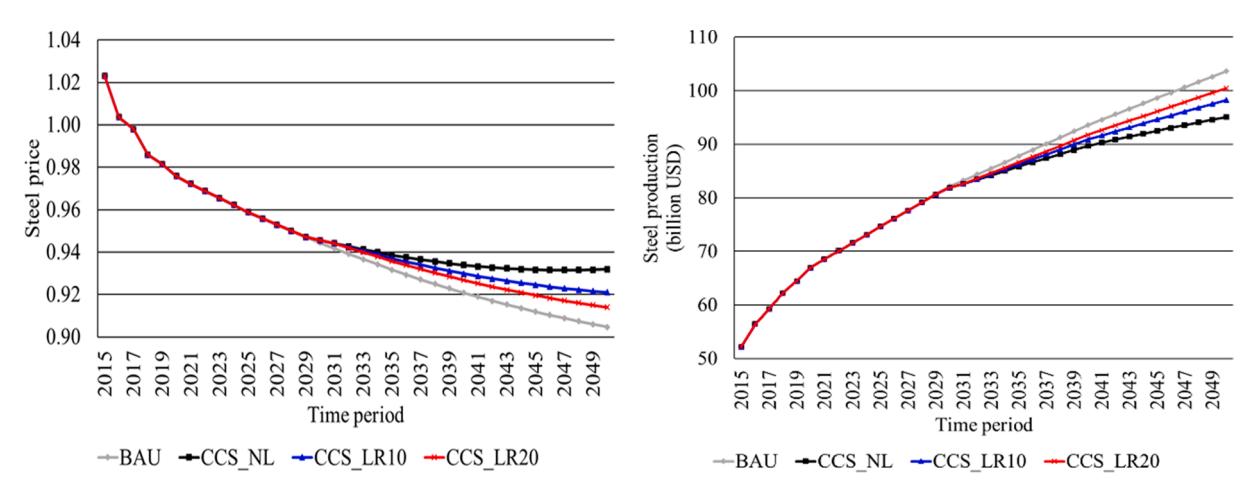
Fig. 5 — 4 시나리오 (BAU, CCS_NL, CCS_LR10, CCS_LR20) 의 철강 가격·생산 추이.
요약
이 paper 는 구윤모 의 2 기 → 3 기 전환 (2022 Georgia Tech 방문 시기) 의 핵심 작업. A hybrid energy system model to evaluate the impact of climate policy on the manufacturing sector: Adoption of energy-efficient technologies and rebound effects (hybrid 모형 기초) + Comparative analysis of iterative approaches for incorporating learning-by-doing into the energy system models (LBD iterative) 의 두 도구를 통합 — 내생적 기술 학습을 포함한 hybrid 모형 의 최초 응용. 한국의 철강 산업 탄소중립 이라는 국가적 정책 과제 에 적용한 정점 작업.
방법론적 핵심은 iterative algorithm 의 학습 곡선 endogenous 처리. (i) Bottom-up — CCS 의 기술 수준 비용 (자본·운영·유지 모두) 을 누적 capacity 의 함수로. (ii) CGE — 철강 생산·가격·GDP 의 거시 효과. (iii) 학습 곡선 — , 학습률 . 두 모형의 soft-link iterative 으로 균형 비용 + 균형 capacity 동시 수렴.
핵심 발견: 학습률 20% 시나리오에서 2050 CCS 단가 64% 감소 — 누적 설치 capacity 가 증가하면서 비용이 경제성 한계점 을 넘어선다. 자본·노동 비용 60% 감소 → 철강 산업의 대체 손실 60% 완화 → GDP 손실 0.3%p 감소.
흥미로운 비용 reduction 의 비대칭 효과: CCS_NL (학습 무) vs CCS_LR20 의 비용 차이가 시간에 따라 증폭 — 학습 곡선의 비선형성 이 long-term 경제성 격차 의 결정 요인. 정책 함의: 초기 고비용 단계 의 정부 보조금이 학습 경로 seed 역할 — 시장 자체로는 학습 시작점에 도달 어려움.
구윤모 의 연구 궤적 안에서 이 paper 는 2 기 → 3 기 (2022-2026) 전환점, A hybrid energy system model to evaluate the impact of climate policy on the manufacturing sector: Adoption of energy-efficient technologies and rebound effects 후속 + 이전 Comparative analysis of iterative approaches for incorporating learning-by-doing into the energy system models 도구 결합. 후속 Effects of sector coupling on the decarbonization potential of the manufacturing sector—an integration of the power, hydrogen, and manufacturing sectors (2024 섹터 커플링), chang-kibyeong-2025-unicon-net-zero (2025 UNICON) 의 방법론 기반.
핵심 결과
| 시나리오 | 2050 CCS 단가 감소 | 자본·노동 비용 감소 | 철강 생산 손실 완화 | GDP 손실 감소 |
|---|---|---|---|---|
| CCS_NL (학습 무) | 0% | 0% | (기준) | (기준) |
| CCS_LR10 (학습률 10%) | 약 50% | 약 50% | 약 50% | 약 0.2%p |
| CCS_LR20 (학습률 20%) | 64% | 60% | 60% | 0.3%p |
- CCS 비용의 학습 곡선이 정책 결정에 결정적
- 초기 보조금이 학습 경로 seed — 시장 자체로는 시작점 도달 어려움
- 방법론적 진보: hybrid 모형의 내생적 기술 학습 통합
방법론 노트
hybrid-energy-system-model + 내생 학습-실행 (learning-by-doing) iterative algorithm:
Initialize: c_t^(0) for all t (no learning baseline)
Iterate n = 0, 1, 2, ...:
  1. Bottom-up: given c_t^(n), solve CCS capacity Q_t* for all t
  2. Apply learning: c_t^(n+1) = c_0 * (Q_t* / Q_0)^(-b)
  3. CGE: given technology costs, solve macro variables (output, GDP)
  4. Update demand → bottom-up demand input
  5. Converge if ∥c_t^(n+1) - c_t^(n)∥ < ε
학습 곡선 (Wright 1936): , learning rate . → LR=20%; → LR=10%.
식별 가정: (i) 학습률이 exogenous (정책으로 변하지 않음), (ii) bottom-up + CGE soft-link 수렴, (iii) 철강 외 다른 부문의 CCS 학습 spillover 무시.
연구 계보
이 paper 는 (i) Wright (1936), Argote & Epple (1990) 의 학습-실행 (learning-by-doing) 정통, (ii) IEA (2010) 의 CCS roadmap, (iii) A hybrid energy system model to evaluate the impact of climate policy on the manufacturing sector: Adoption of energy-efficient technologies and rebound effects (hybrid 모형) + Comparative analysis of iterative approaches for incorporating learning-by-doing into the energy system models (LBD iterative) 직접 선행 — 의 결합. 구윤모 의 연구 궤적 2 기 → 3 기 전환점, chang-kibyeong-2025-unicon-net-zero 의 방법론 기반.
See also
- 구윤모
- Hwarang Lee
- Jeongeun Lee
- hybrid-energy-system-model
- 학습-실행 (learning-by-doing)
- CCS
- steel-industry
- applied-energy
- A hybrid energy system model to evaluate the impact of climate policy on the manufacturing sector: Adoption of energy-efficient technologies and rebound effects
- Comparative analysis of iterative approaches for incorporating learning-by-doing into the energy system models
인접 그래프
- 인물 3
- 방법론 1
- 개념 1
- 주제 2
- 수록처 1
- 논문 7
이 문서를 가리키는 페이지
논문 (7)
- A bottom-up model of industrial energy system with positive mathematical programming
- A hybrid energy system model to evaluate the impact of climate policy on the manufacturing sector: Adoption of energy-efficient technologies and rebound effects
- Comparative analysis of iterative approaches for incorporating learning-by-doing into the energy system models
- Effects of sector coupling on the decarbonization potential of the manufacturing sector—an integration of the power, hydrogen, and manufacturing sectors
- The differentiated impact of emissions trading system based on company size
- The Economic Impacts of Implementing Net Zero Policies in Korea: A Combined Top-Down and Bottom-Up Approach
- The impact of technology learning and spillovers between emission-intensive industries on climate policy performance based on an industrial energy system model