Dynamic policy impacts on a technological-change system of renewable energy: An empirical analysis
kyunam-kim, 허은녕, 김연배 (2017) · environmental-and-resource-economics 66(2):205-236 · DOI ↗
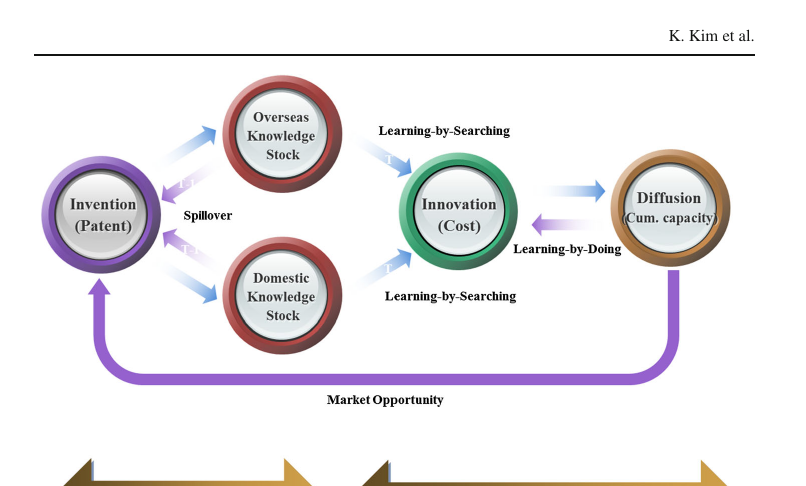
재생에너지 (PV 16 국 1992-2007, Wind 13 국 1991-2006) 의 Schumpeter 3-stage technological-change system (invention 발명 → innovation 비용 절감 → diffusion 보급) 을 3sls simultaneous 으로 endogenous 모델링. learning-by-searching (R&D → cost) + learning-by-doing (deployment → cost) + market opportunity (diffusion → R&D) 의 3 feedback 으로 virtuous cycle 실증. Static — public R&D + tariff 가 invention 자극, renewables obligation + CO₂ tax 가 cost reduction 자극. Dynamic — tariff incentive 가 RPS 를 margin 으로 outperform, CO₂ tax 의 dynamic 효과는 기술 성숙도 (PV vs Wind) 의존.
- RQ: 재생에너지 정책 (technology-push: public R&D / market-pull: tariff incentive, renewables obligation, CO₂ tax) 의 (i) static 단계별 영향, (ii) dynamic 시스템 feedback 효과 는? Solar PV vs Wind 의 maturity 차이가 정책 효과를 어떻게 조절하는가?
- 방법론: 3sls simultaneous 3-equation system (invention / innovation / diffusion), simultaneous-equations cross-stage feedback, 패널 데이터 분석, dynamic-simulation long-run cumulative effect, domestic vs foreign knowledge spillover 분리 (Popp 2006, Dekker et al. 2012 frame)
- 데이터: Solar PV 16 국 unbalanced panel 1992-2007, Wind Power 13 국 unbalanced panel 1991-2006. Invention 측정 = PCT patent applications, Innovation 측정 = unit cost of electricity, Diffusion 측정 = installed capacity. 정책 변수 = public R&D 지출, tariff incentive level, RPS quota 비율, CO₂ tax rate
- 주요 발견: (i) Static — Public R&D + tariff incentive 가 invention 의 dominant driver (양 +), renewables obligation 은 invention 에 마진 효과. (ii) Static — renewables obligation + CO₂ tax 가 cost reduction 의 driver (market-pull 이 비용 절감 lever). (iii) Dynamic simulation — 3 stage virtuous cycle 통계적 식별, tariff incentive 가 RPS 보다 dynamic 효과 small margin 우위. (iv) CO₂ tax 의 dynamic 효과 maturity-conditional: Wind 같은 mature 기술 +, PV 같은 immature 기술에서 부족. (v) Foreign knowledge spillover 가 invention 에 +유의 — 국제 기술 이전의 중요성.
- 시사점: (a) 정책 harmonization 필요 — invention 정책 (public R&D) + innovation 정책 (RPS, CO₂ tax) + diffusion 정책 (tariff) 의 동시 운영. (b) Tariff incentive 의 dynamic 우위 — Germany EEG 모델 정당화. (c) CO₂ tax 의 기술 성숙도별 설계: mature 기술엔 cost-reduction lever, immature 기술엔 direct R&D support 우선. (d) 한국 RPS 중심 정책 (2012-) 의 dynamic 효과 평가 + tariff (FIT) 의 partial 부활 정당화.
요약
본 paper 는 김연배 의 제2기 SNU-TEMEP 확장기 재생에너지 정책 라인의 dynamic 차원 작업. Role of policy in innovation and international trade of renewable energy technology: Empirical study of solar PV and wind power technology 의 R&D-trade simultaneous 모형을 invention-innovation-diffusion 3-stage system 으로 확장 + dynamic simulation 추가. 기존 renewable policy 문헌의 두 한계 극복: (i) Menanteau et al. (2003), Lauber (2004), Sagar-Zwaan (2006), Butler-Neuhoff (2008), Fischer-Newell (2008) 등 qualitative comparison 의 정량 evidence 부재, (ii) Klaassen (2005), Söderholm-Klaassen (2007), Popp et al. (2011), Johnstone et al. (2010), Peters et al. (2012) 등 single-stage empirical 의 전체 시스템 feedback 미식별. 본 paper 의 conceptual move 는 Schumpeter (1934) 의 invention-innovation-diffusion triad 의 endogenous simultaneous 측정 + dynamic feedback 시뮬레이션.
방법론은 3sls 기반 3-stage simultaneous system. (i) Invention: where =domestic knowledge stock, =foreign spillover (Popp 2006 frame), =market opportunity from diffusion. (ii) Innovation: — learning-by-searching (R&D 누적 → know-why) + learning-by-doing (deployment 누적 → know-how) 결합. (iii) Diffusion: . 3 equation 의 cross-stage feedback 의 simultaneous 해법. Dynamic simulation 은 정책 충격 → 향후 10-20 년 cumulative cascading effect 추적.
핵심 발견은 정책의 static vs dynamic ranking 변화. RPS 가 static cost-reduction lever 지만 dynamic 시스템에선 tariff incentive 가 margin 으로 우위 — 이유는 tariff 의 short-loop feedback (R&D → patent → cost ↓ → diffusion → market opportunity → 추가 R&D) 가 RPS 의 direct cost-pressure 보다 전 시스템 가속. CO₂ tax 의 dynamic 효과가 Wind 에서 +, PV 에서 부족한 이유는 Wind 의 cost curve 가 더 평탄 (mature), PV 는 가파른 학습 곡선 위라 CO₂ tax 의 cost-pressure 가 invention 으로 충분히 전이되지 않음. 정책 함의: invention 정책 (public R&D) + innovation 정책 (RPS, CO₂ tax) + diffusion 정책 (tariff) 의 3 단계 동시 운영 이 필수, 단일 정책 처방의 부적합. 허은녕 의 2 기 정책 평가 라인 + 김연배 그룹의 재생에너지 R&D 라인 결합. 한계: (i) 1992-2007 의 pre-PV mass production — 2010s China-led PV cost drop 미반영, (ii) 16+13 국 small panel, (iii) Dynamic simulation 의 external shock (예: 2008 financial crisis) 미반영.
핵심 결과
3-stage system static impact
| Policy | Invention (R&D) | Innovation (Cost) | Diffusion |
|---|---|---|---|
| Public R&D | + 유의 (둘 다) | (간접) | (간접) |
| Tariff incentives | + 유의 (둘 다) | (간접) | + |
| Renewables obligation | margin | + 유의 (cost ↓) | + |
| CO₂ tax | margin | + 유의 (cost ↓) | margin |
| Domestic knowledge stock | + (lag) | (input) | — |
| Foreign knowledge spillover | + 유의 | (input) | — |
Dynamic impact (long-run simulation ranking)
| Policy | Dynamic 효과 | maturity 의존성 |
|---|---|---|
| Tariff incentive | highest | 둘 다 효과적 |
| Renewables obligation | high | Wind 더 강 |
| Public R&D | high | PV 더 강 |
| CO₂ tax | medium | Wind 효과적, PV 약 |
결론. (i) 정책의 static vs dynamic ranking 변화 (RPS=static cost-reduction lever, tariff=dynamic invention-feedback lever). (ii) CO₂ tax 의 maturity-specific 효과. (iii) Public R&D 가 다른 정책의 prerequisite 성격.
방법론 노트
3sls simultaneous 3-equation system:
여기서 =domestic knowledge stock (lagged patent), =foreign knowledge spillover, =cumulative deployment (learning-by-doing source), =unit cost of electricity. Identification 은 (i) 3sls 의 cross-equation instrument (invention 식의 , innovation 식의 , diffusion 식의 ), (ii) 16+13 국가 panel 의 within-country variation, (iii) PCT patent (invention metric) vs unit cost (innovation metric) 의 distinction. Dynamic simulation 은 정책 충격 → 3 stage cascading 의 결과를 단순 사후 차분이 아니라 모형의 endogenous feedback 으로 추적.
연구 계보
본 paper 는 (a) Schumpeter (1934) invention-innovation-diffusion triad, (b) Klaassen et al. (2005), Söderholm-Klaassen (2007), Ek-Söderholm (2010), Hoppmann et al. (2013) 의 renewable cost reduction + learning-by-doing 라인, (c) Lanjouw-Mody (1996), Popp (2002), Popp et al. (2011), Johnstone et al. (2010), Peters et al. (2012), Nemet (2009) 의 renewable policy + invention/diffusion 라인, (d) Foxon et al. (2005), Fischer-Newell (2008) 의 policy comparison 이론 라인을 통합. 3-stage simultaneous + dynamic feedback 의 실증이 distinctive contribution. 직접 선행: Role of policy in innovation and international trade of renewable energy technology: Empirical study of solar PV and wind power technology (RSER) 의 R&D-trade simultaneous 모형 — 본 paper 의 직접 후속작. Foreign knowledge spillover 측정은 Bosetti et al. (2008), Kneller (2005), Popp (2006), Dekker et al. (2012) 의 invention model 라인. 허은녕 의 2 기 정책 평가 라인 + 김연배 의 재생에너지 R&D 라인 협업의 정점 작업.
See also
- 허은녕
- 김연배
- kyunam-kim
- environmental-and-resource-economics
- 3sls
- simultaneous-equations
- 패널 데이터 분석
- dynamic-simulation
- technological-change-system
- invention-innovation-diffusion
- 학습-실행 (learning-by-doing)
- learning-by-searching
- 재생에너지 정책
- Role of policy in innovation and international trade of renewable energy technology: Empirical study of solar PV and wind power technology
인접 그래프
- 인물 2
- 방법론 1
- 주제 2
- 수록처 1
- 분류 1
- 논문 2