Role of policy in innovation and international trade of renewable energy technology: Empirical study of solar PV and wind power technology
kyunam-kim, 김연배 (2015) · Renewable and Sustainable Energy Reviews 44:717–727 · DOI ↗
재생에너지 기술 (solar PV + wind power) 의 국내 R&D 와 국제 무역 (export + import) 의 simultaneous interrelation 을 3sls (3-stage least squares) 로 추정. 16 국 (PV) + 14 국 (wind) × 1991-2008 unbalanced panel. Wind power 는 export → R&D 의 virtuous cycle 확립 (+0.295, p<0.01) — mature technology 의 learning-by-exporting. PV 는 trade → R&D 영향 부재. 두 기술 모두 public R&D 와 tariff incentive 가 dominant 정책 lever.
- RQ: 재생에너지 기술 (Solar PV, Wind Power) 의 국내 R&D 와 국제 무역 사이의 simultaneous interrelation 은? 정책 수단 (public R&D, tariff incentive, renewables obligation, environmental tax, public investment) 의 static vs dynamic 효과는 두 기술에서 어떻게 다른가?
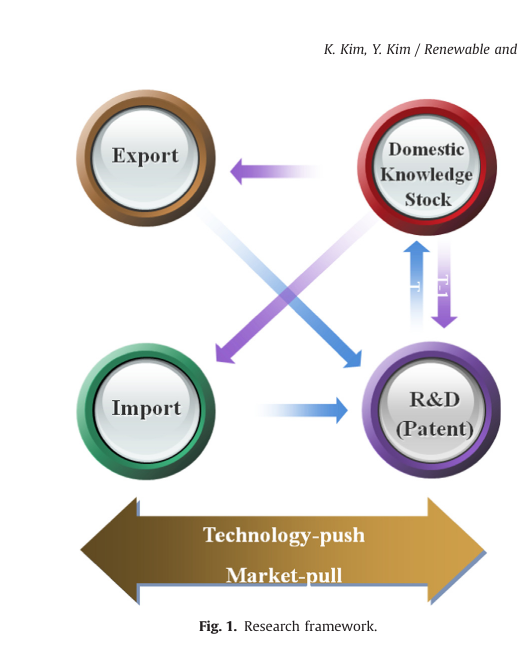
- 방법론: 3sls simultaneous equations — (i) R&D equation (domestic R&D = f(export, import, knowledge stock, policy)), (ii) Export equation, (iii) Import equation 의 joint estimation (endogeneity correction). knowledge-stock-model (Patent applications 의 perpetual inventory)
- 데이터: Solar PV 16 국 + Wind Power 14 국 × 1991-2008 unbalanced panel. R&D = patent applications, knowledge stock = cumulative patents (lagged). 정책 변수 5 종 (public R&D, tariff incentives, renewables obligations, environmental taxes, public investment). 통제 = population, GDP, foreign GDP, fossil fuel prices
- 주요 발견: (i) Wind power 의 export → R&D virtuous cycle: Export 계수 +0.295 (p<0.01) — learning-by-exporting 강. PV 는 export 계수 비유의 (+0.093, p=0.60). (ii) 두 기술 모두 overseas knowledge stock spillover 유의 — international knowledge diffusion 의 evidence. (iii) 정책 lever: Public R&D 가 R&D 증가의 +0.17 (PV), +0.16 (Wind), Tariff incentive 가 R&D 증가의 +0.37 (PV), +0.42 (Wind). (iv) Environmental tax 의 unintended negative effect on Wind R&D (−0.46, p<0.05) — tax 가 기존 fossil 기술 R&D 로 자원 분산 가능성. (v) Export equation: Domestic knowledge stock 의 +0.63 (PV), +1.25 (Wind) — R&D 가 export 증가 lever. Wind 의 renewables obligation 음의 효과 (−2.13) — 국내 demand 흡수 가 export 감소 trade-off. (vi) Import equation: 모든 정책 변수가 PV import 에 양의 효과 — open trade of renewable tech.
- 시사점: (a) **Wind power 의 virtuous cycle 정책 디자인: public R&D + tariff incentive 가 export 를 자극 → export 가 R&D 를 자극 → 추가 export. (b) PV 의 immature technology 단계: trade 가 R&D 에 feedback 못 줌 — 정책이 direct R&D + 시장 형성 양면 필요. (c) Environmental tax 의 분산 risk: 환경세 수입이 generic R&D 로 분산되면 renewable-specific R&D 감소 가능 — earmarked tax 권고. (d) Renewables obligation 의 domestic vs export trade-off: Wind obligation 이 국내 demand 흡수 로 export 감소.
요약
본 paper 는 김연배 author page 의 제2기 (SNU-TEMEP 확장기) 의 재생에너지 정책 라인의 핵심 작업 (author page 분류, 112회 인용). International comparison of industrial CO2 emission trends and the energy efficiency paradox utilizing production-based decomposition 의 industrial CO₂ decomposition 후속작으로 국제 산업 CO₂ 패턴 → renewable technology 정책 simultaneous 분석 으로 라인 진화. Dynamic policy impacts on a technological-change system of renewable energy: An empirical analysis (ERE) 의 dynamic policy impact 분석의 직접 predecessor. 기존 renewable energy policy 문헌 (Johnstone et al. 2010, Popp 2002, 2010, Greaker 2009 등) 은 R&D → trade 또는 trade → R&D 의 one-way 분석에 머물러, simultaneous endogeneity 미식별. 본 paper 의 conceptual move 는 — R&D-export-import 3-equation simultaneous + 5 policy instrument 의 static + dynamic 효과 식별, mature (wind) vs immature (PV) technology 의 정책 효과 differential 명시.
방법론은 3sls — (i) R&D equation: , (ii) Export equation: , (iii) Import equation: . 3SLS 가 equation-specific endogeneity correction + cross-equation error correlation 활용. knowledge-stock-model 은 Hall-Jaffe (1989) perpetual inventory: , .
발견의 정책 함의는 기술 성숙도-specific policy design. (a) Wind 의 mature technology 단계: 1990s 후반 이후 global market share 36.5% (vs PV 10.6%) — export 경험 의 학습 효과 활성. Public R&D + tariff incentive 의 dual policy 가 virtuous cycle ignition. (b) PV 의 immature 단계 (2008 까지): 시장이 충분히 형성 안 됨 → export 경험 의 학습 효과 부재 → direct R&D 정책 + 시장 형성 (FIT, RPS) 의 dual 필요. (c) Renewables obligation 의 국내-export trade-off: Wind 의 RPS-like policy 가 국내 demand 흡수 → export 감소 (−2.13) — 국제 경쟁력 약화 risk. (d) Public R&D 의 Pre-condition 성격: 두 기술 모두 공공 R&D 가 가장 robust 정책 instrument — 시장 실패 (knowledge spillover, network externality) 의 직접 보정. 한계: (i) 1991-2008 단면 — post-Paris (2015) 의 정책 강화 미반영, (ii) Patent 만 R&D output — non-patentable innovation 누락, (iii) 16+14 국가의 small panel, (iv) Endogeneity 의 3SLS 식별 가정 (instrument 의 외생성 검증 부재).
핵심 결과
R&D model (Solar PV vs Wind Power)
| 변수 | Solar PV | Wind Power |
|---|---|---|
| Export | +0.093 (n.s.) | +0.295* (p<0.01) |
| Import | +0.074 (n.s.) | −0.168 (n.s.) |
| Domestic knowledge stock(t−1) | +0.098 (n.s.) | −0.058 (n.s.) |
| Overseas knowledge stock(t−1) | +0.293* | +0.382* |
| Public R&D | +0.167* | +0.162* |
| Tariff incentives | +0.365* | +0.423* |
| Renewables obligations | +0.027 (n.s.) | +0.041 (n.s.) |
| Environmental taxes | −0.158 (n.s.) | −0.462* |
| R² | 0.575 | 0.413 |
정량 결론. (i) Export → R&D feedback 의 wind-only 효과: learning-by-exporting 의 maturity-conditional. (ii) Public R&D + tariff incentive 는 technology-agnostic — 두 기술 모두 효과적. (iii) Environmental tax 의 wind R&D 에 negative 효과는 unintended distortion 의 evidence.
방법론 노트
3sls (Three-Stage Least Squares, Zellner-Theil 1962) 의 simultaneous equation system 추정. (Stage 1) 각 endogenous variable 에 대해 모든 exogenous variable 기반 reduced-form 추정 (instrument 구성). (Stage 2) 2SLS 적용 — 각 equation 의 endogenous regressor 를 fitted value 로 대체. (Stage 3) Error covariance matrix 기반 GLS-like re-estimation — cross-equation efficiency gain.
핵심 식. 3-equation system:
여기서 knowledge stock의 perpetual inventory. 식별은 (i) Reduced-form rank condition, (ii) Exclusion restriction: GDP·foreign GDP 가 R&D equation 에 없음 (export equation 의 instrument), fossil fuel price 가 R&D·export 에 없음 (import equation 의 instrument), (iii) Cross-equation residual correlation 의 GLS weighting.
연구 계보
본 paper 는 (a) Jaffe-Stavins (1994), Popp (2002, 2010), Johnstone-Hascic-Popp (2010), Greaker (2009) 의 renewable energy R&D 정책 literature, (b) Romer (1990), Eaton-Kortum (1996, 1999) 의 R&D + international knowledge spillover literature, (c) De Loecker (2007), Ito-Lechevalier (2010), Love-Ganotakis (2013), Aw-Roberts-Xu (2011) 의 learning-by-exporting literature 의 통합. International comparison of industrial CO2 emission trends and the energy efficiency paradox utilizing production-based decomposition 의 국제 CO₂ trends 분석 의 renewable 기술 정책 차원 으로 진화. 김연배 author page 의 제2기 재생에너지 정책 라인 의 핵심 작업 (author page 분류). 이후 Dynamic policy impacts on a technological-change system of renewable energy: An empirical analysis (Environmental and Resource Economics) 의 dynamic policy 효과 system-dynamics 분석 으로 라인 확장 — 본 paper 가 static + dynamic 효과 식별의 출발점. 기술경영경제정책전공 의 재생에너지 정책 + 국제 무역 연구 의 mid-stage milestone.
See also
- 3sls
- simultaneous-equations
- knowledge-stock-model
- 재생에너지 정책
- solar-pv
- wind-power
- learning-by-exporting
- virtuous-cycle
- kyunam-kim
- 김연배
- International comparison of industrial CO2 emission trends and the energy efficiency paradox utilizing production-based decomposition
- Dynamic policy impacts on a technological-change system of renewable energy: An empirical analysis
- Renewable and Sustainable Energy Reviews
인접 그래프
- 인물 1
- 개관 1
- 방법론 1
- 주제 1
- 수록처 2
- 분류 1
- 논문 6
이 문서를 가리키는 페이지
논문 (6)
- Corporate strategies to protect software innovation: Empirical evidences from South Korea
- Dynamic policy impacts on a technological-change system of renewable energy: An empirical analysis
- Effects of environmental regulations on trade flow in manufacturing sectors: Comparison of static and dynamic effects of environmental regulations
- International comparison of industrial CO2 emission trends and the energy efficiency paradox utilizing production-based decomposition
- R&D investment of electricity-generating firms following industry restructuring
- Strategic and economic behavior of a sued company in patent litigation