Alternative paths of diversification for developing countries
Wonsub Eum, 이정동 (2022) · Review of Development Economics 26:2336-2355 · DOI ↗
Hidalgo-Hausmann 의 제품 공간 + Balland-Boschma-Crespo-Rigby 의 smart specialization framework 이 고복잡성 + 고관련성 의 high road 옵션을 가진 선진국 만 정책 implication 을 제공한다는 비판. 개도국은 high-risk high-return 또는 low-risk low-return 의 양자택일에 갇혀있다. 본 paper 는 84 국 × 1980-2005 × 784 product class 패널에 제품 공간 + 지식 공간 동시 분석. 개도국의 생산 경험 이 미래 기술 다각화 를 견인 (제품 density → 현시 기술 우위 (RTA)) 하고, 선진국의 기술 경험 이 미래 제품 다각화 를 견인 (기술 density → 현시 비교우위 (RCA)) 하는 비대칭 경로 의존성 식별. 개도국에 생산 기반 기술 다각화 라는 alternative path 제시.
- RQ: 개도국이 생산 경험 으로부터 기술 능력 으로 진화하는 path 가 제품 공간 / 지식 공간 의 비대칭 density coefficient 로 식별 가능한가, 그리고 그 path 가 고소득국 의 path 와 반대 방향 인가.
- 방법론: 제품 공간, 지식 공간, 현시 비교우위 (RCA), 현시 기술 우위 (RTA), Proximity 측도, ALP concordance, 패널 고정효과 모형
- 데이터: 84 국 (29 high + 20 upper-middle + 35 lower-middle/low income), 784 product class (SITC Rev. 2 4-digit), 1980-2005, 5-year lag, 3-year moving average. UN Comtrade 무역 + OECD.stat USPTO 특허 + ALP concordance.
- 주요 발견: 개도국: ProdDensity → RTA(+0.397*) 유의, TechDensity → RTA 비유의 — 생산 → 기술 path 만 작동. 선진국: TechDensity → RCA(+1.107***) + ProdDensity → RCA(+1.028***) 둘 다 유의, TechDensity → RTA(+2.332***) 유의 — 기술 → 양방향 path 작동. lower-middle/low 의 RCA 영구성 0.436 < 선진국 0.621.
- 시사점: 개도국에 learning-by-doing 기반 기술 정책 (자동차 생산국 → 내연기관 R&D, 철강 생산국 → 야금 R&D) 의 정량 anchor. innovative cluster 의 colocation of R&D + manufacturing 정책의 학술적 근거.
요약
기술경영경제정책전공 의 축적 → 진화론 전환 cohort 의 개도국 정책 갈래. Wonsub Eum 의 선행 Role of production in fostering innovation (production-technology cross-space 정량의 첫 시연) 의 직접 후속 + sibling The co-evolution of production and technological capabilities during industrial development (같은 1 저자, 같은 framework 의 국가 단위 coevolution 동학) 의 횡단면 anchor. 이정동 anchor 의 제3기 (3) accumulation 의 학술적 기반 구축 + 신은 제4기 진화론적 전환 갈래. 기존 smart specialization 의 개도국 무관성 비판을 정량으로 surface.
이론 framework: Ricardian comparative advantage 의 factor endowment 만으로는 왜 어떤 국가는 복잡한 product 를 만드는가 설명 불가. Hidalgo et al. (2007) 의 제품 공간 는 상품 간 proximity network 로 path dependence surface; Hidalgo · Hausmann (2009) 의 경제 복잡도 가 국가의 capability 잠재력 측정. Balland et al. (2019) 의 smart specialization 의 2 × 2 quadrant (low road / dead end / casino / high road) 가 EU 지역 정책 framework. 그러나 개도국은 dead end 와 casino + slow road 만 — 양자택일 dilemma. 본 paper 의 2 가설: H1 lower-income 은 현재 기술 → 미래 제품 path 미작동, H2 lower-income 은 현재 생산 → 미래 기술 path 작동. 데이터는 84 국 × 1980-2005. UN Comtrade SITC-4 (Feenstra et al. 2005 + Comtrade 2001-) + OECD.stat USPTO patent (4-digit IPC) + Lybbert-Zolas (2014) ALP concordance 로 SITC ↔ IPC 매핑. 표본 조건: 인구 ≥ 1.2M, 수출 ≥ 1M USD, 특허 ≥ 10. World Bank income 분류 — high (n=29), upper-middle (n=20), lower-middle + low 결합 (n=35).
방법론: 두 회귀 — (1) RCA at t+5 회귀 (4-digit SITC), (2) RTA at t+5 회귀 (4-digit IPC). 두 회귀 모두 ProdDensity + TechDensity + lagged dependent + country FE + time FE. 회귀 spec 3 종 — OLS, GLM, Probit (binomial robustness). 결과: (RCA 회귀) 개도국 ProdDensity +0.529*** > 선진국 +0.147*** — 개도국이 생산 path dependence 더 강함. 개도국 TechDensity +0.066* (linear) 만 약하게 유의, GLM/Probit 비유의 — 기술 → 미래 생산 path 약함. (RTA 회귀) 개도국 ProdDensity +0.086* (모든 spec 유의), TechDensity +0.057 비유의 — 생산 → 미래 기술 path 만 작동. 선진국 TechDensity +0.434*** > ProdDensity 0.000 비유의 — 기술 → 기술 path 만 작동. 비대칭 정량 확인.
한계 + 후속: (i) 산업별 이질성 미반영 (자본 집약·암묵 지식·ubiquity 차이), (ii) RCA/RTA 의 이항 측정 한계 (quality upgrading 미식별), (iii) lag 5 년의 fixed 가정, (iv) path dependence beyond (windows of opportunity 의 exogenous factor) 미통합. 후속 The co-evolution of production and technological capabilities during industrial development 가 coevolution 시간 동학 으로 (iii) 확장. 기술경영경제정책전공 의 축적 vs 진화 긴장의 개도국 갈래 anchor.
핵심 결과
| Outcome | Income | ProdDensity | TechDensity | Persistence (Lag DV) |
|---|---|---|---|---|
| RCA(t+5) | High | 0.147*** | 0.140*** | 0.621*** |
| RCA(t+5) | Upper-mid | 0.347*** | 0.156*** | 0.509*** |
| RCA(t+5) | Low-mid/Low | 0.529* ** | 0.066* (비유의 GLM) | 0.436*** |
| RTA(t+5) | High | 0.000 (n.s.) | 0.434*** | 0.461*** |
| RTA(t+5) | Upper-mid | 0.046 (n.s.) | 0.626*** | 0.345*** |
| RTA(t+5) | Low-mid/Low | 0.086* | 0.057 (비유의) | 0.364*** |
Note: Linear probability model. *p<0.10, **p<0.05, ***p<0.01. GLM + Probit 결과 동일 패턴. 굵게: 본 paper 의 alternative path 핵심 명제 — 개도국의 production density 가 미래 RTA 견인 (TechDensity 미작동) + 생산 → 미래 생산 도 강함.
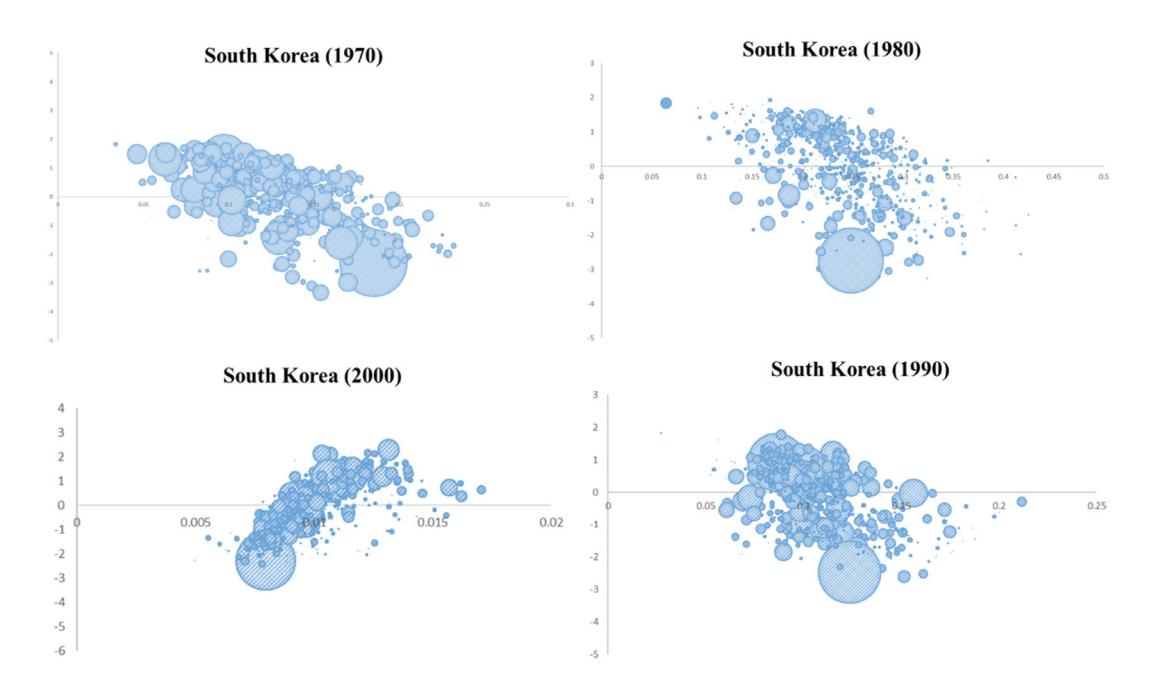
Stylized fact: 한국 1970 plywood + clothes → 2000 microcircuit + automobile — export basket 의 점진적 complexity transition. Regression slope: 1970 음 → 2000 양 — casino 위치에서 high road 위치로의 진화.
방법론 노트
핵심 통찰: 기존 smart specialization 의 technology-only 한계를 production + technology dual space 로 격상. 핵심 도구는 ALP concordance — SITC 무역 분류와 IPC 특허 분류를 확률적 매핑 으로 연결, 두 space 간 density coefficient 비교 가능. Density 자체는 현재 RCA/RTA 가 있는 product 들의 평균 proximity — 얼마나 현재 capability 가까이 새 product 가 있는가.
핵심 식 (RCA, proximity, density, 두 회귀):
여기서 는 국가 의 product 비교우위 (≥1 이면 우위), 는 두 product 간 proximity, 는 주변 density, 는 국가·시간 fixed effect, 는 ALP 매핑된 patent space density. RTA 회귀는 RCA → RTA, ProdDensity → TechDensity 대칭 substitution.
식별 전략: (i) 5-year lag 로 endogeneity 완화 + 3-year MA 로 noise 감쇄, (ii) country + time FE 로 시간 불변 국가 특성 + 공통 시간 충격 제어, (iii) 84 국 × 26 년의 unbalanced panel + 784 product 의 cross-product variation 식별, (iv) 3 income group sub-sample 의 coefficient heterogeneity test, (v) OLS · GLM · Probit 3 spec robustness.
연구 계보
본 paper 의 직접 선조는 Role of production in fostering innovation (기술경영경제정책전공 내부의 production-technology cross-space framework 첫 paper — 같은 1 저자) 와 hayoung-lee-jeon-2020-composite-index-granger-causality-test 형식의 A tale of two technological capabilities: economic growth revisited from a technological capability transition perspective (실행 역량-설계 역량 의 panel Granger 인과 — 같은 capability transition 라인). 외부의 Hidalgo et al. (2007, product space conditions the development of nations), Hidalgo · Hausmann (2009, economic complexity), Balland et al. (2019, smart specialization), Hausmann et al. (2014, atlas of economic complexity). 진화경제학 anchor: Nelson · Winter (1982), Dosi · Pavitt · Soete (1990, technical change and international trade). 개도국 학습 라인: Kim (1980, stages of development of industrial technology), Kim (1997, imitation to innovation), Lall (1992, 2000, technological capabilities), Bell · Pavitt (1992, accumulating technological capability). Catch-up cycle: Lee · Malerba (2017, windows of opportunity), Malerba · Lee (2021, evolutionary perspective on catch-up). 방법론: Hausmann · Klinger (2006, 2007, proximity 도입), Lybbert · Zolas (2014, ALP concordance). 이정동 author page anchor 의 제3기 (3) accumulation 의 학술적 기반 구축 + 제4기 진화론적 전환의 조용한 복선 라인에 위치. TEMEP 내 자매 작업은 Role of production in fostering innovation (직접 선조 framework), The co-evolution of production and technological capabilities during industrial development (동일 author + 동일 cohort 의 coevolution 갈래), A tale of two technological capabilities: economic growth revisited from a technological capability transition perspective (capability transition 의 sibling).
See also
- 제품 공간
- 지식 공간
- 경제 복잡도
- 스마트 특화 (smart specialization)
- 현시 비교우위 (RCA)
- 현시 기술 우위 (RTA)
- ALP concordance
- 경로 의존성
- 공진화 (지식-제품)
- 학습-실행 (learning-by-doing)
- 개발도상국
- Role of production in fostering innovation
- The co-evolution of production and technological capabilities during industrial development
- A tale of two technological capabilities: economic growth revisited from a technological capability transition perspective
- Wonsub Eum
- 이정동
인접 그래프
- 인물 2
- 개관 1
- 방법론 7
- 개념 6
- 주제 6
- 수록처 1
- 분류 2
- 논문 5