Technology strategy for enhancing the public-to-private technology transfer: evidence from the duration of patent
Yoon-Jun Lee, 이정동 (2008) · Applied Economics 40(2):229–240 · DOI ↗
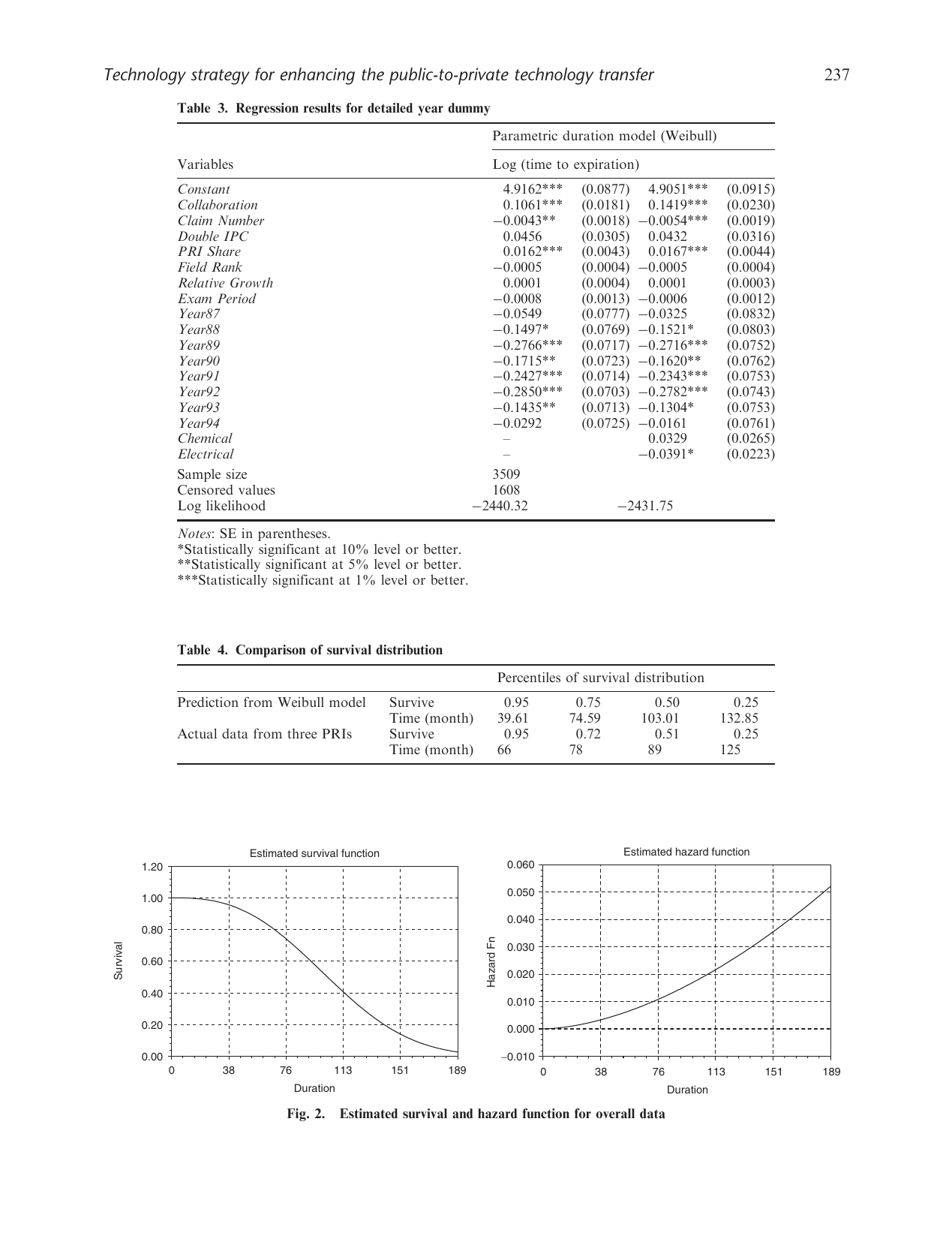
한국 한국 공공연구기관 (PRI) 의 특허 duration (등록 → 만료 까지의 시간) 을 technology transfer 확률의 proxy 로 활용해 어떤 특허가 transferred 되는지 분석. 13 PRI 의 1986–1994 등록 특허 3,509 건 (censored 1,608) 에 Weibull hazard 모형 · Cox 비례 hazard 모형 · 프로빗 모형 3 방법 paired 적용. 핵심 발견: (i) Collaboration (사기업 공동 출원) 더미 +0.087*** — 협력 특허가 더 오래 생존 → transfer 확률 ↑, (ii) Claim Number (특허 청구항 수) −0.0043*** — 넓은 scope 특허가 짧은 생존 (PRI 의 경우 focused 특허가 transferred), (iii) PRI Share (해당 IPC 분야의 PRI 특허 비중) +0.0157*** — PRI 가 우위인 specialized 분야 특허가 더 오래 생존, (iv) chemistry vs electrical/electronic — 일반 직관과 반대로 electrical/electronic 특허가 더 오래 생존 — chemical 의 빠른 obsolescence 가설 부정. 정책 함의: PRI 는 narrow + focused + collaborative + specialized 전략 필요.
- RQ: 한국 한국 공공연구기관 의 특허 중 어떤 특성 (collaboration, scope, competitiveness, attractiveness) 이 transfer 확률을 높이는가? 특허 duration 을 transfer 확률 의 proxy 로 사용해 정량 식별.
- 방법론: Weibull hazard 모형 (parametric), Cox 비례 hazard 모형 (semi-parametric), 프로빗 모형 (binary expired/not) 의 paired 비교; Weibull 의 hazard + survival ; censoring 처리 가능
- 데이터: 13 PRI (KIST · ETRI · KRICT 등) 의 1986–1994 등록 US 특허 N=3,509, 1,608 censored (study end 시점 미만료). KIPRIS 의 application + renewal 데이터; 종속변수 = time to expiration (월 단위)
- 주요 발견: Weibull 결과 — Collaboration +0.087*** (Hypothesis 1 confirmed), Claim Number −0.0043*** (H2 confirmed: narrow scope 가 더 오래), Double IPC +0.056** (multi-field 특허가 더 오래 — application chance proxy), PRI Share +0.0157*** (H3 confirmed: PRI specialized 분야 우위), Relative Growth (attractiveness) n.s. (H4 의 opposing forces 정성적 확인), Year93 · Year90 음 (시간이 가면서 obsolescence ↑); Electrical/electronic 분야의 Electrical 더미 −0.041* — chemical 보다 longer survival (table 5: 평균 survive 시간 50% 분위 chemical 101 개월 vs electrical 105 개월)
- 시사점: PRI 의 공공-사기업 기술 이전 정책 함의. (i) 사기업과의 R&D collaboration 강화 — transfer 확률 most leverage, (ii) strong protection (큰 claim number) 보다 focused application 의 narrow patent 선호 — PRI 의 strategic posture 가 firm 과 다름, (iii) specialized 분야 집중 — PRI Share 가 큰 분야에서 transfer 가 활발, (iv) electrical/electronic 분야가 chemical 보다 transfer 가 더 잘 됨 — fast moving technology 의 obsolescence 가설은 firm-level 에서만 valid
요약
한국 공공연구기관 (PRI) 의 특허는 기술 자체의 product + technology transfer 의 object 의 dual 성격을 가진다. 한국 KIPO (2002) 통계에 따르면 모든 등록 특허 중 11% 만 commercialized, 0.5% 만 다른 기관으로 transfer 됨. 그러나 어떤 특허가 transfer 되는가 의 미시 결정요인은 그동안 정량 분석 부재. 본 paper 의 핵심 idea 는 PRI 가 만료 fee 를 매년 지불해야 특허를 유지하므로, transfer 확률 이 낮은 특허는 빨리 expire — 따라서 duration (등록 → 만료 시간) 이 transfer 확률 의 indirect proxy.
방법론은 Duration analysis 의 표준 hazard rate framework. Weibull · Cox proportional hazard · Probit 의 3 방법 paired 적용으로 robustness 검증. Pakes-Schankerman (1984) 의 patent renewal 모형 lineage 위에 있지만, PRI 의 social return 시각 (Lanjouw-Pakes-Putnam 1998 의 private value 와 대비) 이 incremental contribution. 데이터는 KIPRIS (한국지식재산권정보서비스) 의 13 PRI 1986–1994 등록 특허 3,509 건. 1,608 건 (45.8%) 이 study end 시점 미만료 → censored.
설명변수 4 가지 dimension (Hypothesis 1–4):
- Collaboration (H1): 사기업 공동 출원 더미 — 기술 transfer 의 직접 신호. 협력 자체가 (i) 산업 trend 반영, (ii) 후속 commercialization route 보장.
- Patent scope (H2): Claim Number + Double IPC 더미. Lerner (1994) · Shane (2001) 의 broader scope → 더 가치 가설 vs Palomeras (2003) 의 sleeping patent (broad 한 특허가 unused) 가설. PRI 의 transfer 시각에서는 narrow + focused 가 firm 의 commercialization 에 더 가까움.
- Competitiveness (H3): PRI Share + Field Rank. Pavitt (1991), Castello et al (2003) 의 specialization 가설 — PRI 가 specific 분야에 특허 집중하면 bargaining power 와 signal effect 모두 증가.
- Attractiveness (H4): Relative Growth — IPC 분야의 출원 성장률. Ernst (2003) 의 attractive field 가 transfer 증가 가설 vs Ford-Ryan (1981) 의 attractive 분야는 경쟁자도 많아 PRI alternative 적음 counter 가설 — 두 effect 의 net 부호 ambiguous.
Weibull 결과 (Table 2 발췌): Collaboration +0.087*** (H1 confirmed), Claim Number −0.0043*** (H2 confirmed: narrow 가 더 오래), Double IPC +0.056** (multi-field 가 더 오래 — application chance proxy 로 해석), PRI Share +0.0157*** (H3 confirmed), Relative Growth n.s. (H4 의 ambiguous prediction 정성적 확인), Year90 · Year93 음 (시간이 가면서 obsolescence ↑). Cox 모형 결과 동일 방향. Probit 모형은 censored 데이터 처리 못 해 survival 예측 정확도 86.9%, expiration 예측 정확도만 53.1% — Weibull 우위.
Chemistry vs electrical/electronic 의 striking 발견: 일반 직관 — fast moving technology 의 short cycle 가설 (electrical/electronic 의 technology cycle time 8 년, chemical 10 년, Korean Innovation Survey 2002 의 obsolescence rate electrical > chemical) — 은 firm-level private patent 에서 성립. 그러나 본 paper 의 PRI sample 에서는 반대 방향: chemical 평균 survive 시간 50% 분위 101.2 개월 vs electrical/electronic 105.2 개월. 25% 분위에서 차이 더 커 chemical 125 vs electrical 141 개월. 즉 electrical/electronic 의 PRI 특허가 더 오래 생존 — transfer 가 더 활발 의 indirect 증거. 저자 해석: PRI 는 commercialization 확률 가 높은 특허만 renewal 하므로, electrical/electronic 분야 PRI 특허의 transfer rate 가 chemical 보다 높음. firm-level obsolescence 와 PRI-level transfer-driven retention 의 두 메커니즘이 반대 방향 의 net 효과 — 한국 PRI 의 시스템 특성.
한계는 (i) duration 이 transfer 의 indirect proxy — 실제 license contract 데이터가 결합되면 더 직접 검증 가능, (ii) study period (1986–1994 출원, ~2005 시점 관측) 의 truncation, (iii) PRI 간 institutional heterogeneity (KIST vs ETRI 등) 미통제.
핵심 결과
Hypothesis × 실증 매핑
| Hypothesis | 변수 | Weibull 결과 | Confirmed |
|---|---|---|---|
| H1: Collaboration → longer | Collaboration dummy | +0.087*** | YES |
| H2: Narrow scope → longer | Claim Number | −0.0043*** | YES |
| H2: Multi-field application → longer | Double IPC | +0.056** | partial (multi-field 양) |
| H3: Specialization → longer | PRI Share | +0.0157*** | YES |
| H3: Specialization → longer | Field Rank (negative = 1st rank) | −0.0006 (n.s.) | weak |
| H4: Attractiveness ambiguous | Relative Growth | +0.0001 (n.s.) | YES (no effect, opposing forces) |
산업별 survival 비교 (Table 5, 일반 직관과 반대)
| Industry | Survive Time (50% 분위, 개월) | Survive Time (25% 분위, 개월) |
|---|---|---|
| Chemical | 101.2 | 125.1 |
| Electrical/electronic | 105.2 | 141.4 |
→ Electrical/electronic 이 더 오래 survive — fast moving technology obsolescence 가설 부정. PRI 의 transfer-driven retention 메커니즘.
Weibull vs Cox vs Probit 비교 (Table 2)
| Model | Log L | 강점 |
|---|---|---|
| Weibull (parametric) | −2,480.19 | 시간 모수 + survival 함수 예측 가능 |
| Cox (semi-parametric) | −11,646.29 | baseline hazard 무가정, time-varying covariate 용이 |
| Probit (binary) | −2,012.07 | 단순, 그러나 censoring 무시 |
예측 정확도 (Probit, Table 발췌)
| Survived | Expired | |
|---|---|---|
| Probit 예측 정확도 | 86.9% | 53.1% |
→ Probit 은 censored data 처리 못해 expired 예측 약화.
방법론 노트
Duration analysis 표준 hazard:
가 shape parameter. 이면 exponential (constant hazard), 이면 increasing hazard, 이면 decreasing hazard. Censored 데이터 처리 likelihood:
Weibull 의 regression form (Eq. 6):
이면 hazard decreasing, 이면 hazard increasing at decreasing rate, 이면 hazard increasing at increasing rate.
Cox 비례 hazard 모형 (semi-parametric):
가 baseline hazard — 무가정. partial likelihood 로 만 추정. baseline 무가정의 장점이지만 survival 함수 예측 불가 (study period 외 시점).
식별은 (i) 3,509 특허의 cross-section 변동에서 covariates 효과, (ii) 1986–1994 출원 연도 변동에서 time effect, (iii) censoring 패턴 (1,608 미만료) 에서 right-censored MLE 의 정보. 한국 특허 시스템의 3-year 일괄 갱신 fee 제도가 hazard 의 3 년 전후 spike 를 만들기 때문에 intercept term 명시 포함.
연구 계보
본 paper 의 patent renewal duration lineage 는 Pakes-Schankerman (1984) — patent renewal 데이터로 private value of patent 추정 의 표준 모형, Lanjouw-Pakes-Putnam (1998 Journal of Industrial Economics) — patent count + value, Schankerman (1998 RAND Journal of Economics) — technology field 별 value 위에 있다. 본 paper 의 contribution 은 private value 가 아닌 social value (PRI 의 transfer-driven retention) 시각 추가.
Public-to-private technology transfer lineage 는 Siegel-Waldman-Link (2003 Research Policy) 의 TLO staff effect, Friedman-Silberman (2003 Journal of Technology Transfer) · Lach-Schankerman (2003 NBER WP) 의 royalty share effect, Trajtenberg-Henderson-Jaffe (1997 Economics of Innovation and New Technology) · Henderson-Jaffe-Trajtenberg (1998 Review of Economics and Statistics) 의 university patent basicness, Jensen-Thursby (2001 AER) 의 proofs and prototypes 의 lineage. Open innovation framework 은 Chesbrough (2003) 의 표준 — PRI = 외부 기술 source 의 attractive 위치.
Patent scope lineage 는 Lerner (1994 RAND Journal of Economics) — broader scope = 더 가치, Shane (2001 Management Science) — scope × technological opportunity, Palomeras (2003 IESE WP) — sleeping patent broader hypothesis. Competitiveness lineage 는 Pavitt (1991 Research Policy), Castello-Rojo-Belliodo-Fiore-Tubke (2003 Technovation) — specialization signal. Attractiveness lineage 는 Ernst (2003 World Patent Information), Ford-Ryan (1981 HBR) — opposing forces.
TEMEP 내 sibling: (i) Strategy of start-ups for IPO timing across high technology industries — 같은 batch · 같은 저자의 IPO timing duration 분석으로 로그-로지스틱 hazard 모형 의 sibling 응용. 두 paper 는 같은 startup → IPO 와 PRI patent → transfer 의 duration 시각으로 method lineage 공유. (ii) An in-depth empirical analysis of patent citation counts using zero-inflated count data model: The case of KIST · An Analysis of Citation Counts of ETRI-Invented US Patents · A Study on Factors Affecting Patent Citation Counts and Patent Licensing in Chemistry Field — 같은 시기 한국 PRI 특허 citation 분석 trilogy, citation (quality proxy) vs duration (transfer proxy) 의 paired metric. (iii) The Study on the Technology Finance Policy for Technology Development on the Value Chain Based Innovation System — value chain 시각의 PRI–firm partnership 정책. 본 paper 의 collaboration + specialization 발견은 기술경영경제정책전공 의 PRI 정책 evidence-based 라인의 정량 anchor.
See also
- Weibull hazard 모형
- Cox 비례 hazard 모형
- Duration analysis
- 특허 duration
- 공공-사기업 기술 이전
- 한국 공공연구기관
- 특허 갱신
- 특허 scope (claim 수)
- 화학 vs 전기/전자 산업
- Strategy of start-ups for IPO timing across high technology industries
- An in-depth empirical analysis of patent citation counts using zero-inflated count data model: The case of KIST
- Yoon-Jun Lee
- 이정동
인접 그래프
- 인물 2
- 개관 1
- 방법론 6
- 개념 4
- 주제 3
- 수록처 1
- 분류 2
- 논문 5