AI technology specialization and national competitiveness
Youngsam Chun, Jisoo Hur, 황준석 (2024) · PLOS ONE 19:e0301091 · DOI ↗
본 연구는 국가의 인공지능 기술 전문화 (specialization) 를 결정하는 요인을 (i) 기존 기술 역량 (TECH_DENSITY), (ii) 과학–기술 cross-density (CROSS_DENSITY), (iii) 기술 복잡성 (TCI) 의 세 차원에서 분석한다. USPTO 의 1980-2019 AI 특허 407,386 건 (CPC 654 subclass), Web of Science SCIE 468,104 AI 논문 (230 discipline), 170 countries × 8 (5-year) periods 패널에 three-way-fixed-effects-panel-logit (country, technology, time FE) 로 ENTRY/EXIT 확률을 추정. 핵심 결과: 기존 기술 역량의 path dependence 가 강하게 작용하며, 과학 지식 (cross-density) 의 효과가 기술 복잡성보다 더 큼 — 신기술 영역 (AI) 에서 기존 기술 고도화보다 과학 지식과 산업의 통합 이 더 효과적임을 시사. 후발국 정책 함의: 단순 기술 emulation 보다 최신 AI 과학을 strategically 중요 sector 에 통합하는 전략.
- RQ: 국가의 인공지능 기술 specialization (RCA-based ENTRY/EXIT) 을 결정하는 핵심 요인은 무엇이며, 과학 지식 (cross-density) 과 기술 복잡성 (TCI) 중 어느 것이 더 큰 효과를 가지는가?
- 방법론: 현시 비교우위 (RCA) (Balassa 1965, ENTRY = ), knowledge-relatedness-density (Hidalgo & Hausmann path dependence proxy), science-technology-cross-density (Catalan et al. 2022 의 cross-proximity), method-of-reflections (Hidalgo & Hausmann 2009 의 ECI/TCI), three-way-fixed-effects-panel-logit (country + technology + time FE), 이분 네트워크 (country × technology)
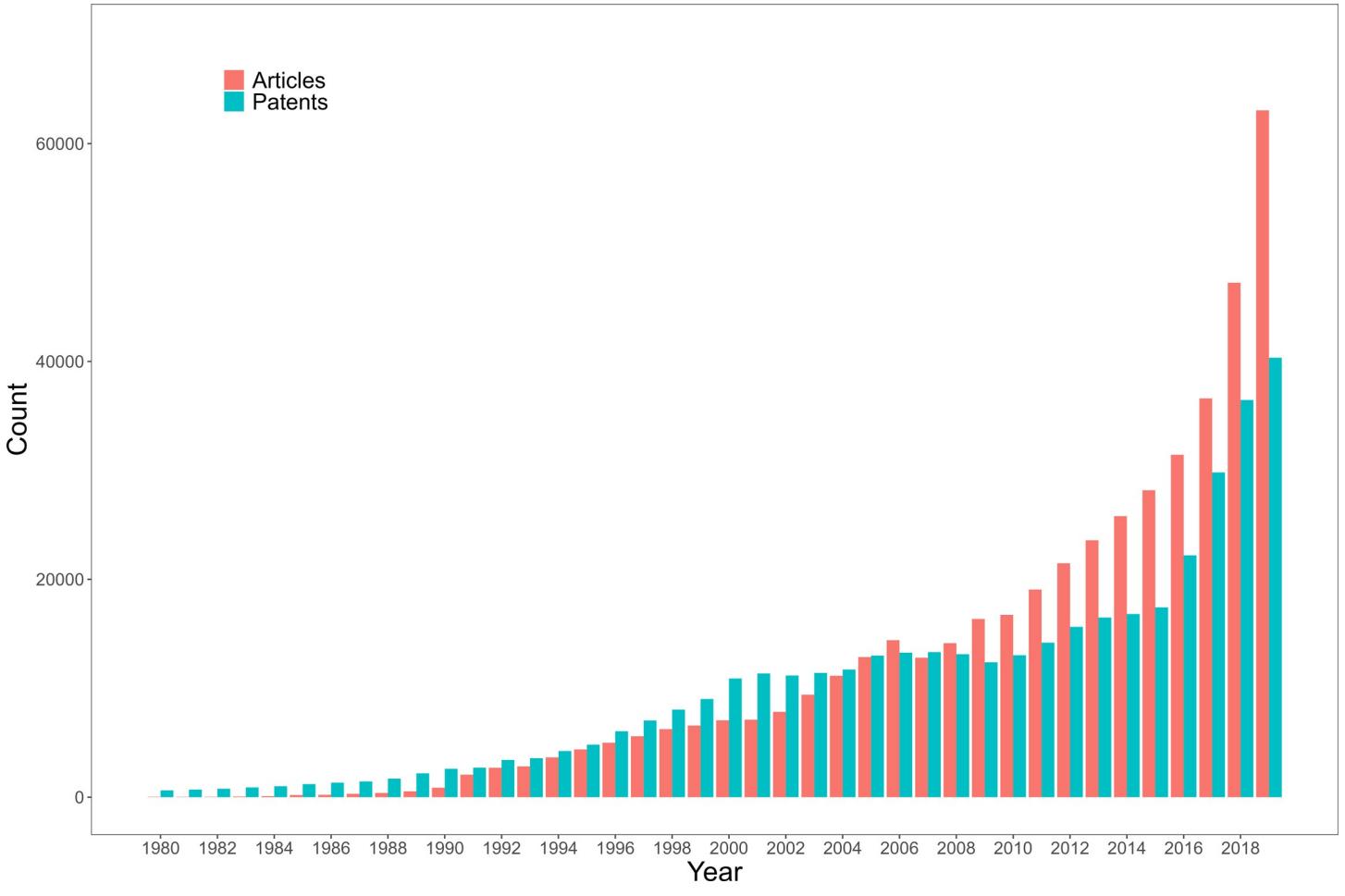
- 데이터: USPTO via PATSTAT 2022 Spring (key-phrase WIPO PATENTSCOPE AI Index), 1980-2019, 654 CPC subclass × 204 countries × 8 (5-year) periods = (204 × 8 × 654) 특허 매트릭스 (407,386 patents); Web of Science SCIE 468,104 articles (170 countries × 8 periods × 230 disciplines); World Bank 경제 데이터; 1960-2018 전체 ~340,000 AI patent families + 1.6M papers (논문이 특허의 4.7배)
- 주요 발견: (1) TECH_DENSITY 강한 양 효과 — path dependence 가 AI specialization 의 가장 강한 driver; (2) CROSS_DENSITY 양 효과 — 국가의 기존 과학 portfolio 가 신기술 진입에 양; (3) TCI 양이지만 효과 더 작음 — 복잡한 기술은 진입 장벽 효과; (4) 과학 지식 효과 > 기술 복잡성 효과 — Catalan et al. (2022) 결과와 반대로, AI 같은 rapidly-evolving 분야에선 cross-density 가 dominant. 국가별 1위: 특허 US (202,867) > 한국 (48,915) > 일본 (36,548) > 독일 > 중국; 논문 US (115,120) ≈ 중국 (114,944) > 영국 > 독일 > 캐나다. CPC 1위 G06F (78,504), 디시플린 1위 Computer Science (AI) (84,501).
- 시사점: 후발국이 AI 경쟁력 확보하려면 단순한 기존 기술 고도화 (단순 TCI 올리기) 보다, 국가의 strategically 중요한 sector 에 최신 AI 과학 지식을 통합 하는 전략이 더 feasible 하고 효과적. 선진국 emulation 보단 niche 형성 우선.
요약
인공지능 기술 의 국가 경쟁력은 1960-2018 약 34만 patent families + 160만 논문 (논문이 특허의 4.7배) 의 폭발적 성장과 함께 global rivalry 의 핵심 차원이 됐다 (Vaswani et al. 2017 “Attention Is All You Need” 의 Transformer → ChatGPT 까지의 progression 이 단적 예시). 그러나 어떤 국가가 어떤 AI 영역에서 specialization 을 달성하는지 의 결정 요인은 — 특히 path dependence vs 신과학 통합 의 상대적 비중은 — empirically 미해결. Catalan et al. (2022) 의 cross-proximity 개념을 AI 영역에 확장하고 Pugliese et al. (2019) 의 multi-layered approach 를 결합해 본 연구는 (i) 현시 비교우위 (RCA) 기반 ENTRY/EXIT, (ii) 기술 path dependence (TECH_DENSITY), (iii) science-technology cross-density (CROSS_DENSITY), (iv) 기술 복잡성 (TCI) 의 4 요인을 동시 추정한다.
데이터: USPTO via PATSTAT 2022 Spring (CPC 분류의 일관성과 unified standard 때문에 다른 patent office 제외; WIPO PATENTSCOPE AI Index 키워드 + CPC 매칭) 으로 1980-2019 AI 특허 407,386 건 추출 (204 countries × 8 5-year periods × 654 CPC subclass). Web of Science SCIE 만 사용 (SSCI, AHCI 제외 — 기술 inventions 직접 관련 한정), conference proceedings·reviews·books 제외, 1980-2019 총 468,104 articles (170 countries × 8 periods × 230 discipline). 국가 분류: 저자 institutional affiliation 기반, multi-country affiliation 시 각 국가에 동일 가중치, 2008 이전 WoS corresponding author 정확성 한계로 first author 기본. China 특허는 PATSTAT applicant 정보 inconsistency 로 underrepresented (UKIPO 식별).
종속변수: ENTRY (0/1, 국가가 시점 t 에 시점 t-1 엔 없던 RCA>1 기술을 새로 획득했는지), EXIT (반대 방향). 독립변수: TECH_DENSITY (Hidalgo 식 기술 relatedness × 국가 portfolio overlap), TCI (Method of Reflections), CROSS_DENSITY (science-tech min conditional probability 기반 cross-proximity 의 국가 portfolio overlap, 3-year lag — AI 분야는 Catalan 의 4-year 보다 빠른 adoption). 통제: POP, GDP_CAPITA, TECH_STOCK, TECH_SIZE (모두 log + 1-year lag). 모형: three-way-fixed-effects-panel-logit .
결과 (요약, table 본문에 미포함): TECH_DENSITY 가장 강한 양 효과 — path dependence 가 dominant; CROSS_DENSITY 양 효과 — 과학 portfolio 와 align 된 sector 에서 specialization 확률 상승; TCI 양 효과지만 cross-density 보다 약함 — 복잡 기술 자체는 lock-in 위험. 과학 지식 효과 > 기술 복잡성 효과 는 Catalan et al. (2022) 의 일반 기술 분야 결과 (TCI > cross-density) 와 반대로, AI 같은 general-purpose technology 의 self-productivity, diffusion potential, complementarity (Brynjolfsson et al. 2018) 가 작용했다는 해석. 함의: 후발국은 단순 기술 emulation 보다 strategically 중요한 sector 에 최신 AI 과학을 통합 하는 전략. 황준석 의 5기 (2024-2026) 국가 혁신 시스템·AI 연구 라인의 일환이며, The Nexus of Artificial Intelligence and Green Innovation: a Cross-Density Analysis at the Country Level 와 자매 작업으로 동일 cross-density framework 를 green technology 영역으로 확장한다.
핵심 결과
| 변수 | 효과 방향 | 효과 크기 (상대) | 해석 |
|---|---|---|---|
| TECH_DENSITY (t-1) | + | 가장 큼 | Path dependence dominant — 기존 기술 역량이 신기술 진입의 1차 driver |
| CROSS_DENSITY (t-3) | + | 큼 (TCI보다 큼) | 과학-기술 cross-proximity 의 강한 spillover |
| TECH_COMPLEXITY (TCI) | + | 작음 | 복잡 기술 진입 어려움 — barrier 역할 |
| Squared 항 (모두) | 검증 | inverted-U 가능성 | overspecialization 시 lock-in 위험 |
| 통제 (POP·GDP·TECH_STOCK) | + | 표준 | 큰 경제·기술 stock = 진입 용이 |
| Top AI knowledge producers | 특허 | 논문 |
|---|---|---|
| 1위 | US (202,867) | US (115,120) |
| 2위 | KR (48,915) | CN (114,944) |
| 3위 | JP (36,548) | UK (39,246) |
| 4위 | DE (35,995) | DE (26,235) |
| 5위 | CN (32,102) | CA (23,667) |
| Top CPC | 특허 | Top discipline | 논문 |
|---|---|---|---|
| G06F (computing) | 78,504 | Computer Science (AI) | 84,501 |
| G06N (neural net) | 71,052 | Engineering (E&E) | 75,808 |
| H04L (data transm) | 38,946 | Computer Science (Interdisc) | 34,659 |
| G06Q (business) | 38,050 | Computer Science (Inf Sys) | 34,287 |
| G06V (vision) | 31,098 | Neuroscience | 33,175 |
- 표본: 204 countries × 8 (5-year) periods × 654 CPC subclass; TECH_DENSITY/TCI 26,300 obs, CROSS_DENSITY 19,035 obs
- 기간: 1980-2019 (AI winter 후 1990s 부활, 2000s 특허 급증, 2012 AlexNet/2017 Transformer 포함)
방법론 노트
현시 비교우위 (RCA) (Balassa 1965) 의 기술 버전:
기술 relatedness (Hidalgo et al. 2007):
knowledge-relatedness-density (국가 portfolio 기반):
science-technology-cross-density (Catalan et al. 2022, minimum conditional probability):
method-of-reflections (Hidalgo & Hausmann 2009) 의 TCI:
여기서 if , otherwise 0. iterate until stable.
추정식 (three-way-fixed-effects-panel-logit):
식별 strategy: (i) 3-year lag for CROSS_DENSITY (AI 의 빠른 adoption 반영, Catalan 의 4-year 보다 짧음), 1-year for TECH_DENSITY/TCI; (ii) country + technology + time three-way FE 로 cross-sectional·time-invariant heterogeneity 모두 흡수; (iii) squared term 으로 inverted-U 검정 (lock-in 위험); (iv) RCA-based ENTRY/EXIT 은 absolute patent count 의 변동성 (patent law 변화, country-level patenting behavior) 을 회피. Robustness check: key-phrase vs CPC-only vs hybrid 분류, time lag 0-4 변화. 한계: China 데이터 underrepresentation (PATSTAT applicant info), USPTO bias (non-US 기업 미국 시장 진입 우선이라 일부 country 의 국내 use 누락), GPT 효과 미반영 (TCI 만으론 AI 의 self-productivity·diffusion 못 잡음).
연구 계보
현시 비교우위 (RCA) 의 기원은 Balassa (1965), 그 기술 응용은 Boschma et al. (2015), Petralia et al. (2017), Catalan et al. (2022) 라인. Path dependence / 기술 relatedness 는 Hidalgo & Hausmann (2009, “The building blocks of economic complexity”) 와 Hidalgo et al. (2007) 의 product space, method-of-reflections 의 ECI/TCI. science-technology-cross-density 는 Catalan et al. (2022, Research Policy) 의 핵심 기여로, 본 연구가 AI 영역에 직접 확장한 출발점. Multi-layered network 는 Pugliese et al. (2019). 지리적 knowledge spillover 는 Jaffe et al. (1993). AI 분류는 WIPO PATENTSCOPE AI Index (2019) 와 다양한 key-phrase / CPC 매칭 전략 비교 (Liu et al. 2021; Cockburn et al. 2018). General-purpose technology 로서의 AI 의 self-productivity·diffusion·complementarity 는 Brynjolfsson et al. (2018), Trajtenberg (2018). 신기술 진입의 잠재적 lock-in 문제는 Arthur (1989), David (1985) 의 path dependence 전통. 황준석 의 5기 (2024-2026) 국가 혁신 시스템·AI 정책 라인의 일환이며, 동일 cross-density framework 를 green technology 영역으로 적용한 The Nexus of Artificial Intelligence and Green Innovation: a Cross-Density Analysis at the Country Level 가 직접 자매 작업.
See also
- 황준석
- Youngsam Chun
- Jisoo Hur
- PLOS ONE
- 인공지능 기술
- national-competitiveness
- 현시 비교우위 (RCA)
- science-technology-cross-density
- method-of-reflections
- three-way-fixed-effects-panel-logit
- 경로 의존성
- 지식 파급
- The Nexus of Artificial Intelligence and Green Innovation: a Cross-Density Analysis at the Country Level
인접 그래프
- 인물 3
- 방법론 2
- 개념 2
- 주제 1
- 수록처 1
- 분류 1
- 논문 4
이 문서를 가리키는 페이지
논문 (4)
- Dynamic patterns of AI technology diffusion: focusing on time series clustering and patent analysis
- Exploring trends and topics in hybrid intelligence using keyword co-occurrence networks and topic modelling
- Measuring ethics level of technological topics using phylogenetic tree
- The Nexus of Artificial Intelligence and Green Innovation: a Cross-Density Analysis at the Country Level