Complementarity and contextuality in the adoption of information systems
yunhee-kim, jaeyoung-choi, 김연배 (2011) · Applied Economics Letters 18(16):1613–1618 · DOI ↗
ERP 와 CRM 의 complementarity 와 그 contextuality (어느 조건에서 보완성이 강해지는가) 의 동시 추정. 한국 616 기업 (NIA + KIS 데이터, 2005). 다항로짓 (NOT/ERP/CRM/BOTH 4 선택) + 성과 회귀에 dubin-mcfadden-correction sample selection 보정. ERP 또는 CRM 단독 도입은 성과에 영향 없음, BOTH 만 매출 +71.5% (DMF 추정) — 강한 supermodularity (Wald χ²=29.6, p<<0.01). IT stock 이 complementarity 의 핵심 contextual 변수 (joint adoption 의 계수 +0.27, p<0.10).
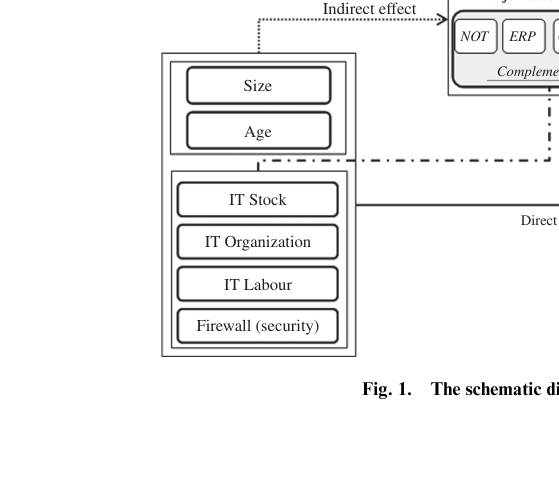
- RQ: 한국 제조업 firm 에서 (i) ERP-CRM complementarity 가 성과에 어떻게 작동하는가? (ii) 그 보완성을 강화 / 약화 하는 contextual 요인 (IT stock, IT organization, IT labour, firewall, age) 은? (iii) IT 관련 변수의 직접 + indirect (IS 매개) 성과 효과는?
- 방법론: 다항로짓 (4-way IS adoption choice — NOT/ERP/CRM/BOTH), 성과 회귀에 dubin-mcfadden-correction (sample selection bias 보정), supermodularity-test (Milgrom-Roberts 1990; Wald χ² inequality test). Cassiman-Veugelers (2006) 의 direct test.
- 데이터: 616 한국 제조업 firm (Korean NIA 2005 survey, 1,005 응답 중 KIS 재무 데이터 매칭). Outcome: log 2005 매출. IT-related: IT STOCK (log PC 수), IT ORGANIZATION (전담 부서 dummy), IT LABOUR (PC 사용 노동 비율), FIREWALL (보안 dummy). Control: LABOR, CAPITAL, MATERIAL, SIZE, AGE
- 주요 발견: (i) Complementarity 통계적 식별: OLS 에서는 BOTH coefficient (0.026) 비유의, DMF 에서는 BOTH +0.715 (p<0.10) — selection bias 보정 후 supermodularity 확인. Wald inequality test χ²(1)=29.56, p<<0.01. (ii) 단독 도입은 성과 무효: DMF 의 ERP coefficient (0.264, n.s.), CRM (0.517, n.s.) — 통계적으로 BOTH 만 유의. (iii) IT STOCK 의 dual role: 성과 직접 효과 +0.131 (p<0.10) + BOTH 도입 확률 강화 (+0.267, p<0.10) — direct + indirect. (iv) IT ORGANIZATION + FIREWALL: ERP, CRM, BOTH 도입의 driver 이지만 성과 직접 효과는 없음 (DMF 계수 비유의) — IT 시스템 도입 매개의 indirect effect only. (v) AGE 효과: BOTH 채택의 negative 유의 (−0.010, p<0.10) — 신생 firm 이 joint adoption 더 적극.
- 시사점: (a) 정부 ICT 정책의 권고는 stand-alone IS diffusion 이 아닌 bundled (ERP+CRM) 도입 지원 — 단독 도입은 성과 무효. (b) IT 인프라 (PC 보유) 가 complementarity 활성화의 필수 조건 — IT stock 부족 firm 은 ERP-CRM 시너지 못 누림. (c) IT organization 과 firewall 같은 softer 보안·조직 변수는 IS 도입 매개 로만 효과 — IT manager 와 보안 강화 자체로는 성과 미상승. (d) 신생 firm 의 strategic flexibility 가 supermodularity 활용 빠름 — 기존 firm 의 IS 도입 정책은 legacy 통합 cost 고려 필요.
요약
본 paper 는 A Bayesian multivariate probit analysis of Korean firms' information system adoption 의 동일 NIA dataset 자매 작업 — Applied Economics Letters short note 형식으로 ERP-CRM 보완성의 inferential test 에 집중. ChoiJY paper 가 4 시스템의 Bayesian correlation matrix 를 통해 보완성 관찰 했다면, 본 paper 는 supermodularity 의 formal hypothesis test + contextual moderator 식별 로 한 단계 심화. Bocquet et al. (2007), Cassiman-Veugelers (2006), Porter-Siggelkow (2008) 의 complementarity in IT-organization 흐름의 한국 데이터 검증.
방법론 핵심은 — (i) 4-alternative 다항로짓 의 IS 도입 모형 + 성과 방정식의 dubin-mcfadden-correction selection bias 보정, (ii) Milgrom-Roberts (1990) supermodularity 조건의 one-sided Wald inequality test — — 의 직접 검증, (iii) IT-related 변수의 adoption equation (Stage 1) 와 performance equation (Stage 2) 계수 비교로 direct vs IS-mediated effect 분리.
발견의 정책 함의는 IS 보급 정책의 paradigm 전환. (a) OLS 의 BOTH 계수 비유의 → DMF 의 +0.72 유의: selection bias 가 진정한 complementarity 를 가렸음을 보임 — 이전 Korean firm IS 효과 연구의 underestimation 의 정량 evidence. (b) IS organization·firewall 의 indirect-only: 정부의 IT 부서 의무화 같은 정책은 IS 도입 매개로만 성과 — IS 도입 없이는 무효. 향후 정책은 bundled adoption + IT stock + IT organization 결합 패키지 권고. (c) 신생 firm 의 advantage: AGE 의 음의 효과는 legacy 시스템 통합 cost 가 incumbent 의 진입 장벽 시사 — incumbent 대상 IS migration 지원 보조금 필요. 한계: (i) 2005 단면 — 시계열 dynamics 미반영, (ii) 616 firm 의 한정 (특히 CRM 단독 도입 = 19 firm 만으로 식별 precision 제한), (iii) IT stock 의 정확한 measurement (PC 수 vs IT 지출 vs 클라우드 사용), (iv) 매출 만 성과 — 생산성·이익률 추가 분석 필요.
핵심 결과
성과 방정식 (Table 2, OLS vs DMF)
| 변수 | OLS 계수 | DMF 계수 |
|---|---|---|
| IT STOCK | +0.142* | +0.131* |
| IT ORGANIZATION | +0.030 (n.s.) | −0.002 (n.s.) |
| IT LABOUR | n.s. | n.s. |
| FIREWALL | n.s. | n.s. |
| ERP only | −0.102* | +0.264 (n.s.) |
| CRM only | +0.020 (n.s.) | +0.517 (n.s.) |
| BOTH (ERP+CRM) | +0.026 (n.s.) | +0.715* |
| SC2 (CRM correction) | — | +0.246* |
| Complementarity test | F=0.03 (n.s.) | χ²=29.56* |
정량 결론. (i) Selection-bias 보정 (DMF) 후에만 complementarity 통계적 식별 — OLS 는 bias 로 인해 0. (ii) BOTH 의 매출 효과 +71.5% (DMF 추정 ≈ exp(0.715)−1) — 단독 도입은 수익화 안 됨. (iii) IT stock 만 direct + indirect dual effect, 다른 IT 변수는 indirect only.
Adoption 방정식 (Table 3, IT STOCK 의 4-way 효과)
| ERP only | CRM only | BOTH | |
|---|---|---|---|
| IT STOCK | +0.130 (n.s.) | +0.137 (n.s.) | +0.267* |
| IT ORGANIZATION | +0.825* | +1.569* | +0.516* |
| FIREWALL | +0.595* | +1.036* | +0.569* |
| AGE | n.s. | n.s. | −0.010* |
IT STOCK 이 BOTH 채택만 유의하게 강화 — complementarity 활성화 의 contextual conditional. IT ORGANIZATION·FIREWALL 은 모든 IS 도입을 강화하지만, BOTH 에 specific 한 advantage 가 없음 — 보완성 활성화의 specific lever 아님.
방법론 노트
dubin-mcfadden-correction (1984) 는 multinomial logit 의 polychotomous choice selectivity model — Heckman binary probit selection 의 multi-alternative 일반화. 각 alternative 의 predicted probability 기반 selection correction term 이 outcome equation 의 inverse-Mills-like adjustment 역할. supermodularity-test 는 Milgrom-Roberts (1990) 의 complementarity-as-supermodular function 의 inferential 검증.
핵심 식. Selection-corrected outcome equation:
여기서 는 Dubin-McFadden selection correction (Stage 1 multinomial logit 의 alternative- probability 기반). Supermodularity inequality:
Wald χ² test, df=1, one-sided. 식별은 (i) DMF correction term 의 exclusion restriction — Stage 1 의 변수 중 일부가 outcome 에는 영향 없어야, (ii) 4-way alternative 의 충분한 cell size, (iii) 616 firm × 4 outcome 의 adequate variation.
연구 계보
본 paper 는 (a) Milgrom-Roberts (1990) supermodularity, Cassiman-Veugelers (2006) complementarity inference, Porter-Siggelkow (2008) contextuality 의 복합 보완성 이론 라인, (b) Brynjolfsson-Hitt (1998), Bresnahan-Greenstein (1996), Bocquet et al. (2007) 의 IT-productivity 실증 라인의 결합. A Bayesian multivariate probit analysis of Korean firms' information system adoption 의 동일 NIA dataset 의 자매 paper — 4 system 의 Bayesian correlation 관찰을 2 system supermodularity 의 inferential test 로 심화. Xu et al. (2006), Hendricks et al. (2007) 의 ERP-CRM/SCM 보완성 분석에 contextual moderator (IT stock, organization, firewall) 추가. 김연배 author page 의 제2기 (SNU-TEMEP 확장기) Bayesian + complementarity inference 라인의 IS 응용으로 분류 (author page) — 같은 시기 기술경영경제정책전공 의 조직 보완성 inference 라인의 일부.
See also
- 다항로짓
- dubin-mcfadden-correction
- supermodularity-test
- complementarity-of-adoption
- contextuality
- enterprise-information-system
- yunhee-kim
- jaeyoung-choi
- 김연배
- A Bayesian multivariate probit analysis of Korean firms' information system adoption
- Applied Economics Letters
인접 그래프
- 인물 1
- 개관 1
- 방법론 1
- 주제 1
- 수록처 1
- 분류 2
- 논문 4
이 문서를 가리키는 페이지
논문 (4)
- A Bayesian multivariate probit analysis of Korean firms' information system adoption
- An Empirical Analysis on Consumer Adoption of Mobile Phone and Mobile Content in Korea
- The complementarities and contextualities of corporate R&D strategies: An empirical analysis of Korean manufacturing industry
- The complementary effect of intellectual property protection mechanisms on product innovation performance