The complementary effect of intellectual property protection mechanisms on product innovation performance
jungmin-lee, sihyung-joo, 김연배 (2018) · rd-management 48(3):320–330 · DOI ↗
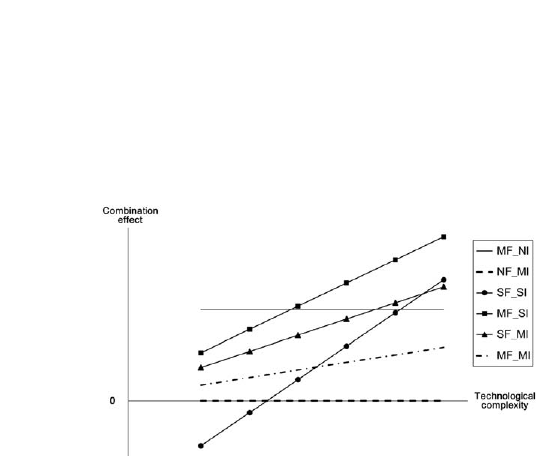
7 가지 IPP mechanism — formal (patent, utility model, design) + informal (영업비밀, complex design, lead time, brand recognition) — 의 simultaneous use 의 complementarity 와 기술 복잡도 (Tr) 의 moderating 효과 분석. 한국 1,297 manufacturing firm. Within-group complementarity 일관 양: MF_NI (+0.082), NF_MI (+0.100), MF_MI (+0.125, p<0.01). Between-group (SF_SI) 은 기술 복잡도 의존 — Tr 낮으면 negative (−0.13), 높으면 positive (+0.35). 산업 별 complement vs substitute 전환.
- RQ: 7 가지 IPP mechanism (3 formal + 4 informal) 의 동시 사용 이 product innovation performance (PIP) 에 미치는 complementarity 효과는? 기술 복잡도 가 within-group vs between-group complementarity 를 어떻게 조절?
- 방법론: 토빗 회귀 (PIP 의 innovative product 매출 비율, 0-100 censored). 8 IP strategy configurations: SF_NI / NF_SI / MF_NI / NF_MI / SF_SI / MF_SI / SF_MI / MF_MI (S=single, M=multiple, F=formal, I=informal). No-IP 가 baseline. 기술 복잡도 (Tr) interaction term
- 데이터: 한국 Korean Innovation Survey (KIS) 의 1,297 manufacturing firms × multi-industry. Tr (technological complexity) = continuous variable (2.833-9.669 range, Korea 산업 별)
- 주요 발견: (i) Single IP 비유의 — SF_NI (+0.023), NF_SI (+0.011) 모두 비유의 → single IP 가 no-IP 보다 효과적이지 않음. (ii) Within-group complementarity 일관 양: MF_NI (multiple formal only) +0.082, NF_MI (multiple informal only) +0.100 (p<0.01), MF_MI (multiple formal + multiple informal) +0.125 (p<0.01). (iii) Between-group (SF_SI) 단독은 비유의 (+0.047). 그러나 interaction with Tr (기술 복잡도) 양의 유의 (+0.070, p<0.01). (iv) Conditional 효과 계산: SF_SI × Tr 의 net effect = → Tr=2.83 (단순 산업) 일 때 −0.13 (substitute), Tr=9.67 (복잡 산업) 일 때 +0.35 (complement). (v) R&D expenditure, small firm size, venture-backed 모두 PIP 양의 효과.
- 시사점: (a) Multi-mechanism dominance: single IPPM 은 no-IP 와 동일 — 2 개 이상의 동질 group (within) 활용이 필수. (b) **Industry-specific between-group 전략: complex 산업 (전자, 통신) 에서 formal + informal 조합 이 효과적, simple 산업 (의류, 음식) 에서는 substitute 관계. (c) TRIPs 의 complex 산업 적용 정당화: WTO TRIPs 가 모든 산업에 formal IPR 균등 강화 — 본 paper 는 complex 산업 에서만 formal+informal hybrid 효과 입증. (d) Korean 정책 함의: 한국 IP 정책의 manufacturing diversity 반영 필요 — 기술 복잡도 별 차별 정책.
요약
본 paper 는 김연배 author page 의 제3기 (SNU 심화-통합기 2018-2025) 의 IP 전략 라인 의 mid-stage milestone (author page 분류). Effects of intellectual property rights and patented knowledge in innovation and industry value added: A multinational empirical analysis of different industries 의 국가-산업 level IPR effect + sequential innovation 의 firm-level 7-mechanism 분석으로 micro 화. Market share and firms' patent exploitation (같은 2018) 의 5-mode patent exploitation 의 자매 paper (firm-level IP 전략 라인). The complementarities and contextualities of corporate R&D strategies: An empirical analysis of Korean manufacturing industry 의 3 R&D sourcing complementarity 의 IP protection mechanism 응용. 본 paper 의 conceptual move 는 — Levin et al. (1987) 의 7-IPPM taxonomy + Cohen et al. (2000) 의 discrete vs complex industry 의 complementarity inference framework 의 통합, between-group complementarity 의 industry-conditional sign reversal 식별.
방법론은 토빗 회귀 — PIP (innovative product 매출 비율, 0-100 censored) 의 upper + lower truncation 처리. 8 IP strategy configurations 의 dummy variable + Tr interaction. 모든 model 에 R&D expenditure, firm size, venture-backed, year, R&D lab 같은 control. Conditional marginal effect (SF_SI × Tr 의 specific Tr value 별 계산).
발견의 정책 함의는 IP 정책의 industry-conditional supermodularity*. (a) Multi-mechanism universal: 어느 industry 든 multi-IP within-group 이 always positive — patent + utility + design (3 formal) 또는 영업비밀 + complex design + lead time + brand (4 informal) 의 bundle 적용 필수. (b) Between-group 의 complex industry specific: Tr 의 threshold (≈ 4.7) 에서 substitute → complement 전환. Discrete 산업 (chemical, pharma) 에서는 formal IP 만으로 충분, complex 산업 (electronics, machinery) 에서는 formal + informal hybrid 필요. (c) 개발도상국 IP 정책 함의: TRIPs 의 universal formal IP 강화 가 *low-Tr 산업 비중 큰 국가에서 between-group substitute 로 효과 감소. 한계: (i) Tr 의 continuous measure 의 specific methodology 부재, (ii) PIP 의 self-reported (survey-based), (iii) Cross-section, (iv) Endogeneity 미처리 (high-IP firm 의 self-selection).
핵심 결과
Tobit 추정 (Table 3, PIP = innovative product 매출 비율)
| IP strategy | Coefficient | 해석 |
|---|---|---|
| SF_NI (single formal only) | +0.023 (n.s.) | single = no-IP |
| NF_SI (single informal only) | +0.011 (n.s.) | single = no-IP |
| MF_NI (multi formal) | +0.082* | within-group ✓ |
| NF_MI (multi informal) | +0.100* | within-group ✓ |
| SF_SI (1 formal + 1 informal) | +0.047 (n.s.) | between-group 불명 |
| MF_SI | +0.105* | within (formal) 양 |
| SF_MI | +0.099* | within (informal) 양 |
| MF_MI | +0.125* | 최강 |
Conditional effect of SF_SI × Tr (Table 4 + Eq.)
| Tr (기술 복잡도) | SF_SI net effect | 관계 |
|---|---|---|
| 2.833 (simple 산업) | −0.130 | substitute |
| 4.686 (threshold) | 0 | indifferent |
| 9.669 (complex 산업) | +0.349 | complement |
정량 결론. (i) Within-group complementarity 는 기술 복잡도 무관 universal. (ii) Between-group complementarity 는 기술 복잡도 의 sign-reversing moderator. (iii) MF_MI (모든 mechanism 활용) 이 +0.125 의 single 가장 큰 효과 — Korea manufacturing 의 IP 의 multi-track 전략.
방법론 노트
토빗 회귀 의 채택은 PIP (혁신 제품 매출 비율) 의 censored at 0 and 100 특성 — OLS 가 boundary 의 bias 가능. Tobit MLE 가 latent variable 의 censored observation 처리.
핵심 식. Tobit:
. Between-group conditional effect:
Sign 전환 조건: 시 . 식별은 (i) 8 IP configuration 의 cross-firm variation (KIS sample), (ii) Tr 의 industry-level continuous variation, (iii) Robust SE 의 heteroskedasticity 처리.
연구 계보
본 paper 는 (a) Levin-Klevorick-Nelson-Winter (1987) 의 7-IPPM taxonomy, (b) Cohen-Nelson-Walsh (2000) 의 discrete vs complex industry 의 IPPM 효과 차이, (c) Teece (1986), Arundel (2001), Hall-Sena (2017), Henttonen et al. (2016), Bogers (2011), Leten et al. (2013) 의 IPPM 의 formal vs informal literature, (d) Harabi (1995), Amara-Landry-Traoré (2008) 의 industry-conditional IPPM effectiveness, (e) Milgrom-Roberts (1990) 의 supermodularity 의 통합. The complementarities and contextualities of corporate R&D strategies: An empirical analysis of Korean manufacturing industry 의 R&D sourcing complementarity + Complementarity and contextuality in the adoption of information systems 의 IS complementarity 와 함께 complementarity inference 의 IP 응용. 김연배 author page 의 제3 실타래 (IP 보호 양면성) 의 mid-stage milestone (author page 분류). Effects of intellectual property rights and patented knowledge in innovation and industry value added: A multinational empirical analysis of different industries 의 industry-level 분석 의 firm-level mechanism choice 로 micro 화. Market share and firms' patent exploitation 의 5-mode patent exploitation 의 자매 paper (같은 2018, firm-level IP 전략). 이후 Corporate strategies to protect software innovation: Empirical evidences from South Korea (MDE) 의 software 산업 IP 전략 분석으로 라인 확장 (author page 제3기 분류).
See also
- 토빗 회귀
- ip-protection-mechanisms
- product-innovation-performance
- complementarity
- formal-vs-informal-ip
- 기술 복잡성
- jungmin-lee
- sihyung-joo
- 김연배
- Effects of intellectual property rights and patented knowledge in innovation and industry value added: A multinational empirical analysis of different industries
- Market share and firms' patent exploitation
- rd-management
인접 그래프
- 인물 1
- 방법론 1
- 개념 1
- 주제 1
- 분류 1
- 논문 8
이 문서를 가리키는 페이지
논문 (7)
- Corporate strategies to protect software innovation: Empirical evidences from South Korea
- Determinants of out-licensing strategy of firms: New empirical evidence
- Effects of intellectual property rights and patented knowledge in innovation and industry value added: A multinational empirical analysis of different industries
- Effects of voluntary R&D disclosure on business performance: Empirical evidence from Korean manufacturing firms
- Market share and firms' patent exploitation
- Strategic and economic behavior of a sued company in patent litigation
- The complementarities and contextualities of corporate R&D strategies: An empirical analysis of Korean manufacturing industry