Demand forecasting for new technology with a short history in a competitive environment: the case of the home networking market in South Korea
Chul-Yong Lee, 이정동, 김연배 (2008) · Technological Forecasting & Social Change 75(1):91–106 · DOI ↗
신기술의 sales 이력이 짧고 analogous proxy 도 부재한 경우 (e.g. 한국 Home Networking 시장 2002–2004) demand forecasting 의 방법론적 어려움을 해결하기 위해 (i) 전문가 판단 + 부트스트랩 + Mahajan-Sharma 대수적 추정 로 로지스틱 성장 모형 의 prior 도출, (ii) 가용 sales 데이터로 베이지안 갱신 의 posterior 갱신, (iii) 건설사·소비자 paired conjoint 의 중첩 선호 구조 로 다층 의사결정 반영, (iv) 기술 roadmap 으로 dynamic utility 도출의 4 단계 framework 제안. 한국 신축 아파트의 HN 기술 (PLC · Wireless LAN · Ethernet) 경쟁 시뮬레이션 결과 — Wireless LAN 이 시장 점유 최고, PLC 표준화 시 PLC 시장 잠식 가능, 정부 PLC 지원 철회 시 PLC 점유 급락. 신기술 demand forecasting 의 ICT 분야 표준 template.
- RQ: 신기술의 sales 데이터가 짧고 analogous proxy 부재한 시장 — 한국 신축 아파트 Home Networking — 에서 demand forecasting 어떻게 수행하며, 건설사·소비자 다층 의사결정 의 nested preference 가 기술 경쟁 결과를 어떻게 결정하는가?
- 방법론: 로지스틱 성장 모형 + 전문가 판단 + 부트스트랩 + Mahajan-Sharma 대수적 추정 (prior) + 베이지안 갱신 (posterior) + 컨조인트 분석 (건설사 54 N=28 회사 + 소비자 1,000) + 순위형 로짓 모형 + 중첩 선호 구조
- 데이터: 건설사 HN 전문가 54 명 (28 회사) email 설문 (2004-12) — diffusion prior · 건설사 conjoint 두 용도; 소비자 face-to-face 1,000 명 (서울·부산·대구·광주 4 지역 quota sampling, 2004-05) — 소비자 conjoint; 2002–2004 HN sales 데이터 — Bayesian posterior 갱신; 기술 roadmap (PLC · Wireless LAN · Ethernet 2005–2009 attribute 진화) — dynamic utility
- 주요 발견: HN 시장 잠재력 = 200 만 가구, peak 2008 (Bayesian posterior); RMSE prior 76,389 → posterior 1,336 (57 배 개선); 건설사 utility — PLC +0.188*, Wireless LAN +0.264** (Ethernet base), Cost −0.00245***, Standardization +0.157*, Gov policy +0.00016**, Consumer preference +0.00701***; 소비자 utility — Price −0.034**, Speed +0.032**, Add (extra device) −0.444**, Wire −0.404** (wireless 선호); 시뮬레이션 결과 — Wireless LAN 점유 항상 최고, PLC 표준화 (sim 2) 시 PLC 점유 잠식, 정부 PLC 지원 철회 (sim 4) 시 PLC 점유 급락
- 시사점: 신기술 demand forecasting 의 ICT 분야 ↔ analogous 부재 시 Bayesian + 전문가 판단의 결합 framework 가 효과적. 정책 함의: PLC 표준화 + 정부 지원이 PLC 의 경쟁력 결정 leverage. 자동화 산업 전반의 신기술 forecasting template
요약
Home Networking (HN) 시스템 — 가정 내 ICT 가전을 네트워크로 연결해 자동화 · 보안 · 통신 · 멀티미디어 서비스 제공 — 은 2002 년 한국에서 신축 아파트 built-in 형태로 시장 진입 시작. 2002 → 2007 세계 시장 118B (연 18% 성장 예측, Korea MIC 2003), 한국 정부는 1999 ICT building 기획부터 digital 주택 지원 정책. 그러나 (i) HN 의 sales 이력이 매우 짧음 (2002–2004 의 3 년만 가용), (ii) HN 과 analogous 한 신제품 부재 — Bayus (1993) HDTV 의 분석법, Jun et al (2000) LEO 위성의 analogous product proxy 방식이 적용 불가, (iii) HN 의 복수 기술 경쟁 (Wireless LAN · PLC · Ethernet) — 단일 기술 diffusion model 부적합. 본 paper 는 이 3 가지 문제를 동시에 해결하는 4 단계 framework 을 제안.
Step 1: Expert-judgment 기반 prior + Bayesian posterior. 로지스틱 성장 모형 의 파라미터를 (i) Mahajan-Sharma (1986) 의 algebraic estimation 으로 3 개 정보 (잠재 채택자 수 , peak 시점 , peak 시점 채택자 수 ) 에서 단순 산식으로 도출, (ii) 54 명 HN 전문가의 응답을 100 회 bootstrap 으로 , prior 추정. 그 후 2002–2004 sales 데이터로 베이지안 갱신:
posterior 가 bivariate normal 로 도출 (Eq. 6). 결과: prior mean −3.15 / dev 1.22, mean 0.46 / dev 0.13 → posterior mean −8.12 / dev 0.023, mean 1.26 / dev 0.0048. RMSE prior 76,389 → posterior 1,336 — 57 배 개선. peak 시점 2008, 누적 채택 2009 년 180 만 가구 (잠재 200 만 의 90%).
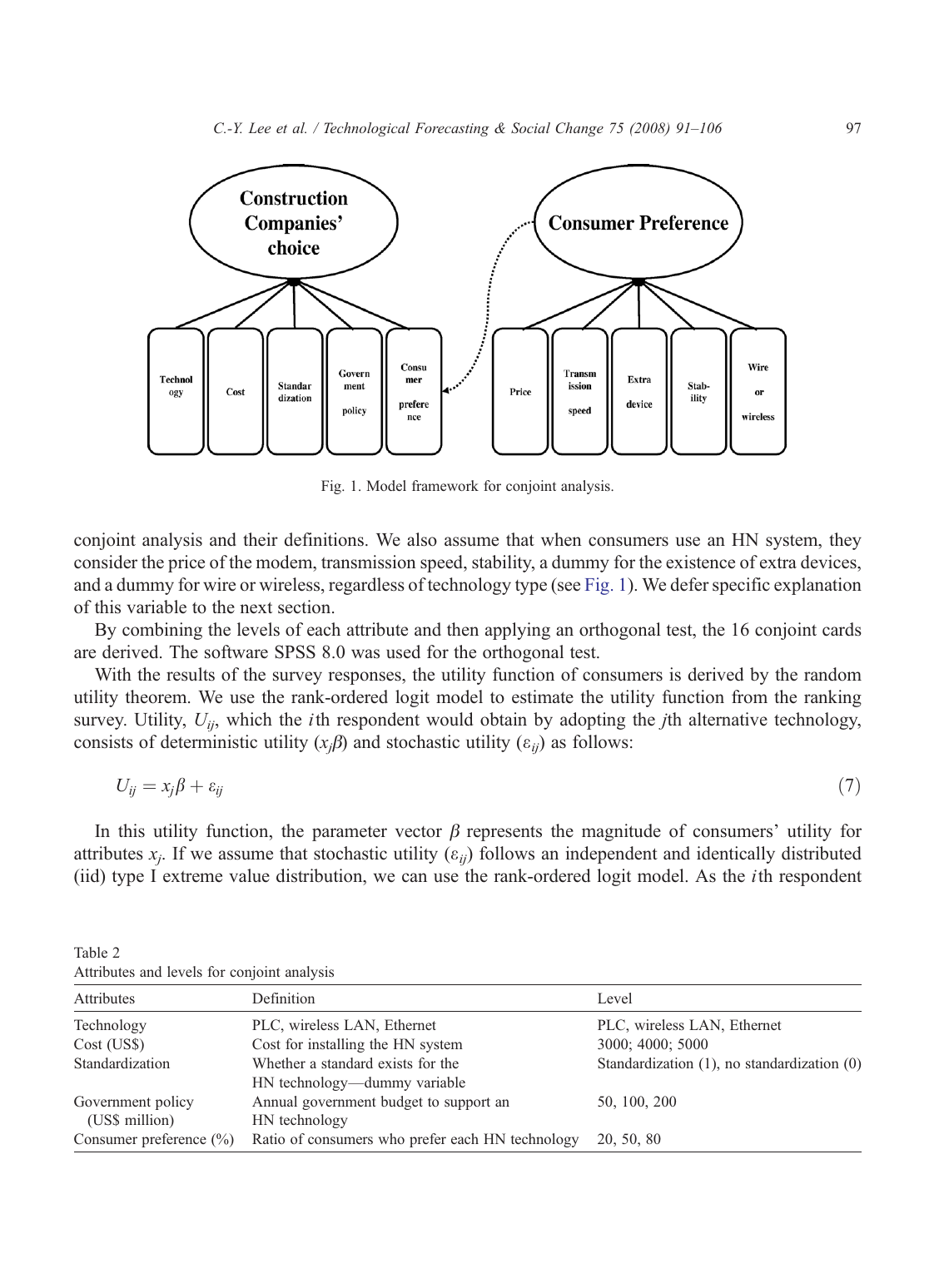
Step 2–3: Nested preference conjoint. 한국 신축 아파트의 HN 의사결정은 건설사가 main decision maker — 그러나 건설사도 consumer preference 를 attribute 로 고려. 따라서 (i) 54 건설사 conjoint (5 attribute: 기술 type · cost · 표준화 · 정부 정책 · consumer preference), (ii) 1,000 소비자 conjoint (5 attribute: price · speed · 추가 장비 · 안정성 · wire/wireless) 의 paired 추정. 건설사 utility 추정: PLC dummy +0.188* (Ethernet base), Wireless LAN +0.264**, Cost −0.00245***, Standardization +0.157*, Gov policy +0.00016**, Consumer preference +0.00701*** — 건설사가 소비자 선호를 strongly 반영. 즉 nested preference 가 정량 confirmed. 소비자 utility 추정: Price −0.034** (가격 회피 강), Speed +0.032** (속도 선호), Add −0.444** (extra device 회피 — Ethernet 의 hub/router 약점), Stability −0.0097⁺ (약 양 — 응답자가 안정성 needs 인식), Wire −0.404** (wireless 강 선호). 소비자는 wireless·저가·고속도·extra 부재 선호 — Wireless LAN 의 핵심 강점.
Step 4: Dynamic 시뮬레이션 + 정책 함의. Roadmap 표 (PLC·WLAN·Ethernet 의 2005–2009 attribute 진화) 위에서 dynamic utility 와 시장점유 계산. Wireless LAN 이 항상 최고 점유 — 표준 (IEEE 802.11) + 저가 + 높은 소비자 선호의 결합. PLC 와 Ethernet 은 점유 패턴 유사하지만 2008 년 이후 PLC > Ethernet — 정부 정책 (0.5B (5 년 누적) 지원이 critical. 정책 함의는 명확 — PLC 표준화 + 정부 지원 지속이 한국 HN 시장 경쟁의 leverage. 한계는 (i) 건설사 utility constant 가정 (panel survey 로 dynamic 가능), (ii) 신축 한정 분석 — 기존 주택 리모델링 시장 (2010 년경 신축 시장 초과 예상) 미포함.
핵심 결과
Logistic growth model parameter — prior vs posterior (Table 3)
| 단계 | mean | dev | mean | dev | RMSE |
|---|---|---|---|---|---|
| Prior (전문가 54 + bootstrap) | −3.1454 | 1.2239 | 0.4567 | 0.1300 | 76,389 |
| Posterior (Bayesian update 2002–2004) | −8.1153 | 0.0226 | 1.2579 | 0.0048 | 1,336 |
→ Bayesian update 로 deviation 50–100 배 축소, RMSE 57 배 개선. peak 시점 = 2008 년.
건설사 utility 추정 (Table 4, Ethernet = base)
| 변수 | Coefficient | t |
|---|---|---|
| PLC dummy | +0.188* | 1.74 |
| Wireless LAN dummy | +0.264** | 2.09 |
| Cost (US$) | −0.00245*** | −7.34 |
| Standardization (0/1) | +0.157* | 1.73 |
| Government policy (US$M) | +0.00016** | 2.19 |
| Consumer preference (%) | +0.00701*** | 3.98 |
→ Consumer preference 가 건설사 의사결정의 strong driver — nested preference confirmed.
소비자 utility 추정 (Table 5, N=1,000)
| 변수 | Coefficient | t |
|---|---|---|
| Price (US$) | −0.0339** | −30.52 |
| Speed (Mbps) | +0.0323** | 8.40 |
| Add (extra device) | −0.4443** | −12.81 |
| Stability (breaks/day) | −0.0097⁺ | −1.59 |
| Wire dummy (1=wire, 0=wireless) | −0.4044** | −11.62 |
→ 소비자는 wireless · 저가 · 고속도 · extra 부재 선호 — Wireless LAN 의 advantage.
시뮬레이션 결과 (Fig. 5 요약)
| Simulation | 변화 | PLC 시장점유 영향 |
|---|---|---|
| 1 | PLC cost −10% | PLC 점유 회복 |
| 2 | PLC 표준화 2006 도입 | Wireless LAN 과의 경쟁 격화 (Ethernet 잠식) |
| 3 | PLC 소비자 선호 +10% | PLC 시장 우위 |
| 4 | PLC 정부지원 철회 | PLC 점유 급락 |
→ 정부 지원 (sim 4) 과 표준화 (sim 2) 가 PLC 경쟁력의 binding 결정요인.
방법론 노트
본 paper 의 incremental contribution 은 4 단계 통합 framework:
Step 1 — Mahajan-Sharma 대수적 추정 (1986). Logistic growth 의 peak 시점 미분으로:
3 개 expert 정보 만으로 산식 도출. 3 정보 → 2 파라미터 의 over-identification 이 bootstrap 의 정당성.
Step 2 — 베이지안 갱신 (Eq. 6). Linear transform 으로 logistic 의 linear 표현 도출, iid. prior independent normal + likelihood (sales 데이터) 결합한 bivariate normal posterior:
는 prior precision matrix + sample 정보 (OLS) 의 합. posterior mean 도 prior precision × prior mean + sample 정보 × OLS mean 의 가중 평균.
Step 3 — paired conjoint + 중첩 선호 구조. 건설사 conjoint (16 cards) + 소비자 conjoint (orthogonal cards) 의 paired 추정. 건설사 utility 에 consumer preference attribute 포함하는 것이 key — nested preference 의 정량 식별. 순위형 로짓 모형 의 표준 sequential conditional logit 우도:
Step 4 — dynamic utility + roadmap. Static utility 의 attribute 를 시간 의존 (roadmap 위) 로 substitute. dynamic market share:
기술별 , 시점별 점유. 누적 채택 × dynamic share = 기술별 채택 수.
식별은 (i) 전문가 54 응답의 between-variation 에서 prior 분산, (ii) 2002–2004 sales 데이터에서 posterior likelihood, (iii) 16 card × 54 건설사 / 16 card × 1,000 소비자의 conjoint variation 에서 utility 추정, (iv) 기술 roadmap 의 시계열 변동에서 dynamic 시뮬레이션의 식별에서 온다.
연구 계보
본 paper 의 choice-based diffusion + Bayesian update lineage 는 두 갈래. (i) Diffusion model lineage — Bass (1969 Management Science), Mansfield (1961 Econometrica) 의 logistic / Bass 표준, Jain-Mahajan-Muller (1991 Marketing Science) 의 supply restriction, Hahn-Park-Krishnamurthi-Zoltners (1994 Marketing Science) 의 repeat purchase 4-segment, Frank (2004 TFSC) 의 경제 상황 결합 위에 서 있다. (ii) Choice-based diffusion lineage — Jun et al (2000 Telecommunication Systems) LEO 위성 RUM+Bass, Forecasting future demand for large-screen television sets using conjoint analysis with diffusion model (Lee J. - Cho Y. - Lee J.D. - Lee C.Y. 2006 TFSC) 대형 TV 4-step framework, Demand forecasting for multigenerational products combining discrete choice and dynamics of diffusion under technological trajectories (Kim W.J. - Lee J.D. - Kim T.Y. 2005 TFSC) DRAM 다세대 결합 — 본 paper 의 framework 의 직접 predecessor. 본 paper 는 (i) Bayesian update + algebraic estimation (Mahajan-Sharma 1986) 의 prior 형성 자동화, (ii) nested preference structure 의 건설사-소비자 2-level 식별 두 측면이 incremental contribution.
Expert judgment bootstrap lineage 는 Goldberg (1971 Organizational Behavior and Human Performance) 의 clinical judgment, Dawes (1971 American Psychologist) 의 graduate admission, Ashton-Ashton-Davis (1994 California Management Review) 의 white-collar robotics, Abdel-Khalik-el-Sheshai (1980 Journal of Accounting Research) 의 default prediction 의 lineage. Bayesian econometric lineage 는 Zellner (1971 An Introduction to Bayesian Inference in Econometrics) 의 표준 표준 + Train (2003 Discrete Choice Methods with Simulation) 의 hierarchical Bayesian 활용 위에 위치.
TEMEP 내 sibling cluster: (i) Forecasting future demand for large-screen television sets using conjoint analysis with diffusion model — 같은 TFSC 발표의 직접 predecessor (대형 TV 4 step framework). (ii) Demand forecasting for multigenerational products combining discrete choice and dynamics of diffusion under technological trajectories — DRAM 다세대 디퓨전 결합. (iii) An Analysis of Consumer Preferences among Wireless LAN and Mobile Internet Services · Estimating the extent of potential competition in the Korean mobile telecommunications market: Switching costs and number portability — 같은 시기 ICT 도메인 conjoint 시리즈. (iv) Consumer preferences for alternative fuel vehicles in South Korea — 같은 batch 의 AFV demand forecasting sibling. 본 paper 의 건설사-소비자 nested preference 식별은 TEMEP 의 다층 의사결정 conjoint 의 첫 사례로, 이후 기술경영경제정책전공 의 B2B-B2C 분석 라인의 발판.
See also
- 로지스틱 성장 모형
- 베이지안 갱신
- 전문가 판단 + 부트스트랩
- Mahajan-Sharma 대수적 추정
- 중첩 선호 구조
- Home Networking
- 무선 LAN
- 한국 아파트 건설
- Forecasting future demand for large-screen television sets using conjoint analysis with diffusion model
- Demand forecasting for multigenerational products combining discrete choice and dynamics of diffusion under technological trajectories
- Chul-Yong Lee
- 이정동
- 김연배
인접 그래프
- 인물 3
- 개관 1
- 방법론 7
- 주제 6
- 수록처 1
- 분류 2
- 논문 9
이 문서를 가리키는 페이지
논문 (4)
- Can search engine data improve accuracy of demand forecasting for new products? Evidence from automotive market
- Measuring the Role of Technology-Push and Demand-Pull in the Dynamic Development of the Semiconductor Industry: The Case of the Global DRAM Market
- One-Person Firm's Application Product Survival Analysis: U.S. vs. Korea in App Store
- Product survival analysis for the App Store