Why do consumers respond to eco-labels? The case of Korea
jungah-hwang, youkyoung-park, 김연배 (2016) · springerplus 5(1):1915 · DOI ↗
한국 eco-label 2 종 (Korea Eco-Label, Energy Efficiency Grade Label) 에 대한 일반 소비자 (eco-friendly 만이 아닌) 의 perceived private value vs perceived social value 의 purchasing intention 영향을 구조방정식 모형 로 분석. Private value 가 social value 보다 label attitude 와 purchasing intention 에 더 강한 효과 (PV→PI 0.37 vs SV→PI 0.06 비유의). Theory of Reasoned Action (TRA) framework. 정책 함의: green credit card 같은 financial incentive 가 SV 를 PV 로 전환 해 효과 증대.
- RQ: 일반 소비자의 eco-label 반응에서 (i) perceived social value (climate change mitigation, energy 감소, pollution 감소) vs perceived private value (economic benefit, usefulness, ease of use) 중 어느 차원이 purchasing intention 의 더 강한 driver 인가? (ii) Korea Eco-Label vs Energy Efficiency Grade Label 의 차이는?
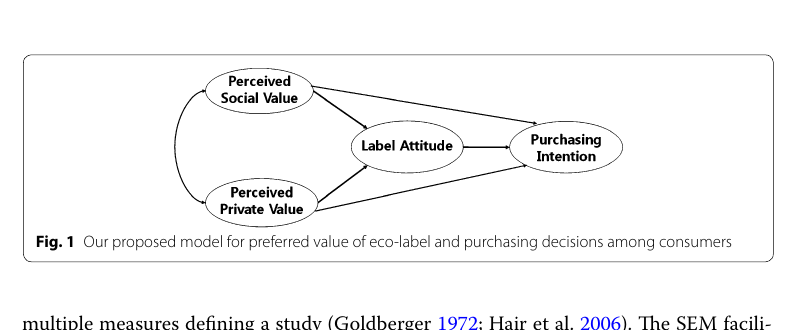
- 방법론: 구조방정식 모형 (SEM) + 확인적 요인분석 (CFA). theory-of-reasoned-action (TRA) framework — Perceived Value → Label Attitude → Purchasing Intention 의 path 모형. Latent variables: Social Value (SV), Private Value (PV), Label Attitude (LA), Purchasing Intention (PI). Cronbach’s alpha, AVE, CR 의 reliability 검증
- 데이터: 한국 일반 소비자 survey. 측정: SV1-3 (climate change, energy 감소, pollution 감소), PV1-3 (economic benefit, usefulness, ease of use), LA1-3 (interest, usefulness, reliability), PI1-3 (purchasing, replacement, recommendation)
- 주요 발견: (i) SEM 결과: SV→LA = 0.29, PV→LA = 0.57 (PV 가 2 배 강). LA→PI = 0.55. SV→PI 직접 = 0.06 (n.s.), PV→PI 직접 = 0.37* (p<0.01). (ii) Integration model fit: χ² = 207 (p<0.001), RMSEA = 0.075, CFI = 0.978 (good fit). (iii) Label 별 결과: Energy Efficiency Grade Label 의 PI 가 가장 높음 (13.50) vs Korea Eco-Label (11.24 without green card, 11.37 with). EEGL 이 더 효과적 — 직접적 economic benefit (전기료 표시). (iv) Green credit card 효과 of Korea Eco-Label: SV 감소 (15.34 → 14.77) + PV 증가 (12.86 → 13.19) — financial incentive 가 SV 를 PV 로 전환, PI 13.50 → 11.37 만큼 미미한 변화. (v) Cronbach’s alpha 모든 latent > 0.89, AVE > 0.74, CR > 0.89 — measurement validity 우수.
- 시사점: (a) 일반 소비자의 private value 우선: SV 가 awareness 단계에서 강 하지만 purchasing intention 으로 전환 의 lever 는 PV. (b) **EEGL 의 private value 통합 design: 전기 cost (private benefit) + CO₂ 배출 (social) 동시 표시 가 효과적인 hybrid label. (c) Korea Eco-Label 의 abstract framing 한계: CO₂ 배출 같은 global framing 이 personally relevant 부재 → low impact. Local framing (e.g., ‘본 제품 사용 시 가정 전기료 X% 절감’) 으로 변환 필요. (d) Green credit card 의 partial 전환: financial incentive 가 SV→PV 전환의 partial 효과 만 가져옴 — 카드 reward 의 magnitude 가 부족 가능성.
요약
본 paper 는 김연배 의 제2기 (SNU-TEMEP 확장기) 의 environmental policy 라인 (author page 분류). jungah-hwang (Hwang Jung-Ah) 와의 협업 — 이후 Effects of environmental regulations on trade flow in manufacturing sectors: Comparison of static and dynamic effects of environmental regulations (BSE) 의 환경 규제 + 무역 분석으로 라인 확장. 기존 eco-label 문헌 (Thøgersen 2000, D’Souza et al. 2006, Rex-Baumann 2007, Daugbjerg et al. 2014) 은 eco-friendly consumer 분석에 집중, 일반 소비자 의 eco-label 무관심의 원인 미식별. 본 paper 의 conceptual move 는 — Grolleau et al. (2009) 의 impure public goods 이론 (eco-products 가 private + public 양 차원) 의 eco-label 적용, psychological 거리 (Grinstein-Riefler 2015) 로 global framing 의 약점 설명.
방법론은 구조방정식 모형 — (i) Stage 1: CFA 로 4 latent variable (SV, PV, LA, PI) × 3 indicator each 의 measurement validity 검증 (Cronbach’s α, AVE, CR), (ii) Stage 2: SEM path model — SV/PV → LA → PI, 그리고 SV/PV → PI 직접 path. theory-of-reasoned-action (Fishbein-Ajzen 1975) 에서 belief → attitude → intention 의 sequential mediation 가정. Model fit 검증 (χ², CFI, RMSEA).
발견의 정책 함의는 eco-label 정책의 paradigm 전환 권고. (a) Awareness 와 Behavior 의 gap: 소비자가 SV 를 더 높게 perceive (16.15) 함에도 PV 가 purchasing intention 의 진정한 driver (path 9.11 vs 4.68). Information disclosure 만으로는 부족. (b) Energy Efficiency Grade Label 의 hybrid 우수: SV + PV 동시 통합 — 전기료 + CO₂ 동시 표시 가 psychological 거리 해소. (c) Green credit card 의 부분 success: SV→PV 전환의 direction 은 맞으나 magnitude 가 작음 — 카드 reward 의 amount 강화 또는 local framing (지역 환경 영향) 결합 필요. (d) Local framing 의 권고: Korea Eco-Label 의 글로벌 CO₂ 배출 → 지역 영향 (가정 에너지 절감, 한국 air quality) 으로 reframing. 한계: (i) Single survey, (ii) Self-reported intention (실제 purchasing 행동 아님), (iii) 가격 frame 의 amount 검증 부재, (iv) Demographic interaction (소득, 교육) 의 separate 분석 부재.
핵심 결과
SEM path loading (Table 3)
| Path | Loading | SE | p-value |
|---|---|---|---|
| Perceived social value (SV) → Label attitude (LA) | 0.29 | 0.055 | <0.01 |
| Perceived private value (PV) → Label attitude (LA) | 0.57 | 0.056 | <0.01 |
| SV → Purchasing intention (PI) direct | 0.06 | 0.062 | 0.156 (n.s.) |
| PV → Purchasing intention (PI) direct | 0.37 | 0.053 | <0.01 |
| LA → PI | 0.55 | 0.052 | <0.01 |
Label 별 효과 (Table 4)
| Energy Efficiency Grade | Korea Eco-Label (no card) | Korea Eco-Label (+card) | |
|---|---|---|---|
| Perceived Social Value | 16.15 | 15.34 | 14.77 |
| Perceived Private Value | 15.99 | 12.86 | 13.19 |
| LA score | 13.80 | 11.78 | 11.80 |
| Purchasing Intention | 13.50 | 11.24 | 11.37 |
정량 결론. (i) PV → PI 의 direct effect 가 SV → PI 보다 6 배 강 (0.37 vs 0.06 n.s.). (ii) PV → LA 가 SV → LA 보다 2 배 강 — awareness 형성에서도 private value 우위. (iii) Energy Efficiency Grade Label 의 PI 가 가장 높음 — 전기료 표시의 직접적 economic benefit. (iv) Green credit card 가 SV 를 PV 로 전환 했으나 magnitude 미미.
방법론 노트
구조방정식 모형 의 Theory of Reasoned Action (Fishbein-Ajzen 1975) framework: belief → attitude → behavioral intention → behavior. 본 paper 의 partial mediation: SV/PV → LA → PI 의 full mediation 과 SV/PV → PI 의 direct path 양립.
핵심 식. SEM measurement + structural model:
Maximum likelihood estimation. Model fit: χ² (small p-value not desired with large N), CFI (>0.90 good), RMSEA (<0.08 good). 식별은 (i) Factor loading (convergent validity), (ii) AVE , CR (composite reliability), (iii) Cronbach’s α .
연구 계보
본 paper 는 (a) Fishbein-Ajzen (1975), Ajzen (1991) 의 Theory of Reasoned Action / Planned Behavior literature, (b) Thøgersen (2000), D’Souza et al. (2006), Daugbjerg et al. (2014), Wan Rashid et al. (2016) 의 eco-label + consumer behavior literature, (c) Grolleau et al. (2009), Kaufman (2014), Kotchen (2005) 의 impure public goods + private incentive literature, (d) Grinstein-Riefler (2015), Scannell-Gifford (2013) 의 local vs global message framing literature 의 통합. 김연배 author page 의 제2기 environmental policy + 소비자 선호 라인 (author page) — Using stated-preference data to measure the inconvenience cost of spam among Korean E-mail users (스팸 inconvenience 의 stated preference), Estimation of consumer preferences on new telecommunications services: IMT-2000 service in Korea (IMT-2000) 의 consumer preference for new technology 라인의 환경 차원 확장. jungah-hwang 의 첫 단독 first-author paper — 이후 Effects of environmental regulations on trade flow in manufacturing sectors: Comparison of static and dynamic effects of environmental regulations (BSE) 의 환경 규제 + 무역 분석으로 라인 확장.
See also
- 구조방정식 모형
- theory-of-reasoned-action
- eco-label
- perceived-private-value
- perceived-social-value
- green-credit-card
- message-framing
- jungah-hwang
- 김연배
- Effects of environmental regulations on trade flow in manufacturing sectors: Comparison of static and dynamic effects of environmental regulations
- springerplus
인접 그래프
- 인물 1
- 방법론 2
- 주제 1
- 분류 1
- 논문 4