Policy for electricity access in African countries: The case of Tanzania
eric-rugabera, jungah-hwang, 김연배 (2013) · Geosystem Engineering 16(3):236–248 · DOI ↗
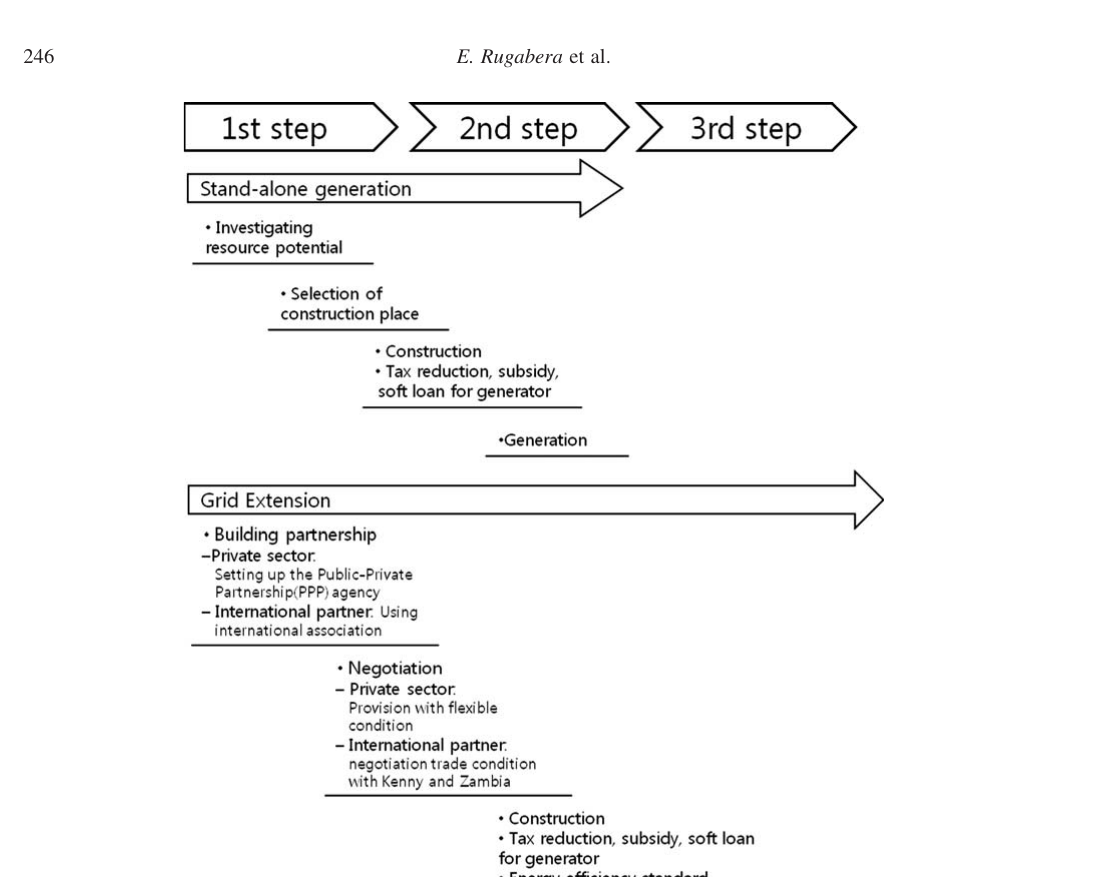
탄자니아의 18.4% 전력화율 (2011) 의 obstacle 진단 + 이웃 아프리카 국 (Tunisia, Egypt, Libya 등 90%+) 과의 비교로 정책 권고. Supply side (PPP-BOT 투자, grid extension, 연료 다양화 — 현재 oil 26% + hydropower 50% 의존) + Demand side (저소득 가구 보조금, tariff 개혁) 의 comprehensive policy package 필요. 단기 대책 = stand-alone renewable generation, 장기 대책 = grid + 이웃국 (Kenya, Zambia) 과의 cross-border interconnection.
- RQ: 탄자니아의 매우 낮은 전력화율의 obstacle 은? 이웃 아프리카 국 (Tunisia 등) 의 high electrification 사례에서 도출 가능한 적용 가능 정책 은?
- 방법론: case-study-policy-analysis (Tanzania single-country deep dive), international-comparison (Tunisia, Egypt, Libya, Algeria, Mauritius, Morocco, South Africa benchmark). Supply-side + demand-side 의 comprehensive framework
- 데이터: Tanzania Ministry of Energy and Minerals 통계, World Bank 데이터, IEA 통계, 7 이웃 아프리카 국 electrification rate · tariff · fuel mix · investment policy 비교 데이터
- 주요 발견: (i) Tanzania 2011 electrification rate 18.4% vs Tunisia·Egypt·Libya 90%+. (ii) Supply-side 장애: (a) 정부 예산 제약 → PPP (BOT/BTO) 도입 필요, (b) Grid 미확장, 농촌 stand-alone 부재, (c) Fuel mix: oil 26% (수입 의존, 가격 변동), hydropower 50% (가뭄 영향, 산업/농업 간 water 분쟁), 풍부한 석탄·가스·지열 미활용. (iii) Demand-side 장애: 저소득 가구 tariff 가 South Africa 평균보다 높음 — unaffordability 가 demand 의 핵심 제약. (iv) 이웃 사례 비교: Tunisia·Morocco 의 decentralized off-grid + grid extension 조합 으로 96% 달성. South Africa 의 low-income subsidy + cross-subsidy tariff 모델. (v) 단기/장기 전략: 단기 = stand-alone renewable, 장기 = grid extension + SAPP (Southern African Power Pool) interconnection.
- 시사점: (a) PPP-BOT 의 risk-sharing 조항: material price fluctuation 시 project cost amendment 가능 — private 투자 회수 보장. 정치적 안정성 + commitment 가 PPP 의 sine qua non. (b) Fuel diversification 우선순위: 풍부한 천연가스 + 지열 활용 → oil import 의 currency depreciation 충격 완화. (c) Demand-side dual policy: (i) 저소득 가구 progressive tariff + subsidy, (ii) energy efficiency labelling + 표준 동시 — price reduction + consumption rationalization 의 균형.
요약
본 paper 는 김연배 author page 의 제2기 (SNU-TEMEP 확장기) 의 개발도상국 에너지 정책 라인의 아프리카 적용 (author page 분류) — Electricity generation and economic growth in Indonesia (Indonesia), An analysis on barriers to renewable energy development in the context of Nepal using AHP (Nepal), Identification and analysis of barriers against electric vehicle use (Nepal EV) 등 개도국 에너지 정책 시리즈 의 아프리카 case. Eric Rugabera (Tanzania Ministry of Energy and Minerals) 와의 practitioner-researcher 협업으로, practice-oriented policy paper 의 성격. 기존 electricity-growth causality literature (Kraft-Kraft 1978, Yang 2000, Shiu-Lam 2004, Soytas-Sari 2003, Wolde-Rufael 2006, Yoo 2006 등) 의 대부분 non-African country 한정의 gap 보충. 본 paper 의 conceptual move 는 — African specific obstacle inventory + neighbor benchmark 의 frame 으로 exportable best practice 도출.
방법론은 (i) case-study-policy-analysis 의 single-country deep description (Tanzania 의 전력 산업 구조, 정책 history, 자원 분포), (ii) international-comparison 의 6-7 neighbor (Tunisia, Egypt, Libya, Algeria, Mauritius, Morocco, South Africa) benchmark — 모두 90%+ electrification rate 달성 사례, (iii) Supply-side 4 차원 (financing, grid, fuel source, infrastructure) × Demand-side 2 차원 (tariff, conservation) 의 6-cell policy matrix.
발견의 정책 함의는 African specific energy 정책 design. (a) PPP-BOT 의 country-specific adaptation: Tanzania 의 1922 first energy policy 부터 2008 Electricity Act 까지 수십 년의 reform 이 18.4% rate 만 달성한 근본 이유 = raw material 가격 변동 risk 의 private 투자자 회피. contract revision clause 가 PPP 활성화의 lever. (b) SAPP (Southern African Power Pool) leverage: Tanzania-Kenya-Zambia 의 ZTK Power Interconnector 가 200 MW 수입 가능 — self-sufficiency 의 가정 자체를 뛰어넘는 regional integration. (c) 저소득 progressive tariff: Tanzania 의 flat tariff 가 South Africa 의 progressive (low-income subsidy + high-use surcharge) 보다 unaffordable — tariff 구조 자체가 access 의 가장 큰 obstacle. 한계: (i) Case study 의 generalization 한계 (Tanzania-specific), (ii) Quantitative model 부재 — causal identification 약함, (iii) 정책 시뮬레이션 부재 (각 policy 의 expected impact 정량 예측 없음), (iv) Single-period analysis — 시간 dynamics 미반영.
핵심 결과
이 paper 는 case-study + policy recommendation 으로 정량 결과 없음. 정량 비교는:
| 지표 | Tanzania (2011) | Tunisia·Egypt·Libya 평균 | South Africa | Morocco |
|---|---|---|---|---|
| Electrification rate (%) | 18.4 | 90+ | 75 | 96 |
| Oil share of generation | 26% | 변동 | <10% | <15% |
| Hydropower share | 50% | <20% | <5% | <10% |
| 저소득 가구 tariff (USc/kWh) | 높음 | 보조 | 보조 | 보조 |
정책 권고 매트릭스 (단기-장기)
| 차원 | 단기 (1-3 년) | 장기 (5-10 년) |
|---|---|---|
| Investment | PPP-BOT, contract revision clause | 정부 budget allocation 확대 |
| Grid | Stand-alone renewable (off-grid 농촌) | National grid + SAPP interconnection |
| Fuel | Existing natural gas 활용 | 지열 + 풍력 + bioenergy 다양화 |
| Demand (가구) | Subsidy + progressive tariff | Energy efficiency labelling/standard |
| Demand (산업) | Tax reduction + energy audit | Voluntary agreement, soft loan |
방법론 노트
Quantitative method 부재. 본 paper 는 applied policy paper 로 (i) 정책 history 의 descriptive analysis, (ii) statistics-based international comparison, (iii) supply-demand 4×2 policy matrix 의 prescriptive recommendation. Literature review 와 policy synthesis 가 핵심 contribution — 본 paper 와 같은 journal venue (Geosystem Engineering) 에서는 technical practitioner 의 case-study + recommendation 형식이 일반적.
(Empirical paper 가 아니므로 핵심 식 절은 생략 — 방법론 노트 절을 paper 의 framework 설명 으로 대체.)
연구 계보
본 paper 는 (a) Kraft-Kraft (1978), Yang (2000), Shiu-Lam (2004), Soytas-Sari (2003), Wolde-Rufael (2006), Electricity generation and economic growth in Indonesia 의 electricity-economic growth causality literature 의 African country gap 보충, (b) Borchers et al. (2001, South Africa), Karekezi-Kithyoma (2002, Africa rural electrification), International Energy Agency (2011) 의 African energy access literature 의 Tanzania-specific 확장. 김연배 author page 의 제2기 (2007-2017) 개발도상국 에너지-환경 정책 라인 — Electricity generation and economic growth in Indonesia (Indonesia) 의 causality 분석 → 본 paper 의 policy prescription 으로 라인 진화 (author page 분류). 기술경영경제정책전공 의 Korean energy policy 경험을 개도국에 transfer 하는 broader 의제의 African pilot case. jungah-hwang 의 환경 정책 + 무역 라인과의 자매 작업 위치 (Hwang 의 후속 Why do consumers respond to eco-labels? The case of Korea, Effects of environmental regulations on trade flow in manufacturing sectors: Comparison of static and dynamic effects of environmental regulations 의 환경-경제 정책 라인의 전력 시장 적용 사례).
See also
- case-study-policy-analysis
- tanzania-electrification
- rural-electrification
- public-private-partnership
- grid-extension
- eric-rugabera
- jungah-hwang
- 김연배
- Electricity generation and economic growth in Indonesia
- An analysis on barriers to renewable energy development in the context of Nepal using AHP
- Geosystem Engineering
인접 그래프
- 인물 1
- 개관 1
- 수록처 2
- 분류 1
- 논문 5