Identification and analysis of barriers against electric vehicle use
madhusudhan-adhikari, laxman-prasad-ghimire, 김연배, prakash-aryal, sundar-khadka (2020) · Sustainability 12(12):4850 · DOI ↗
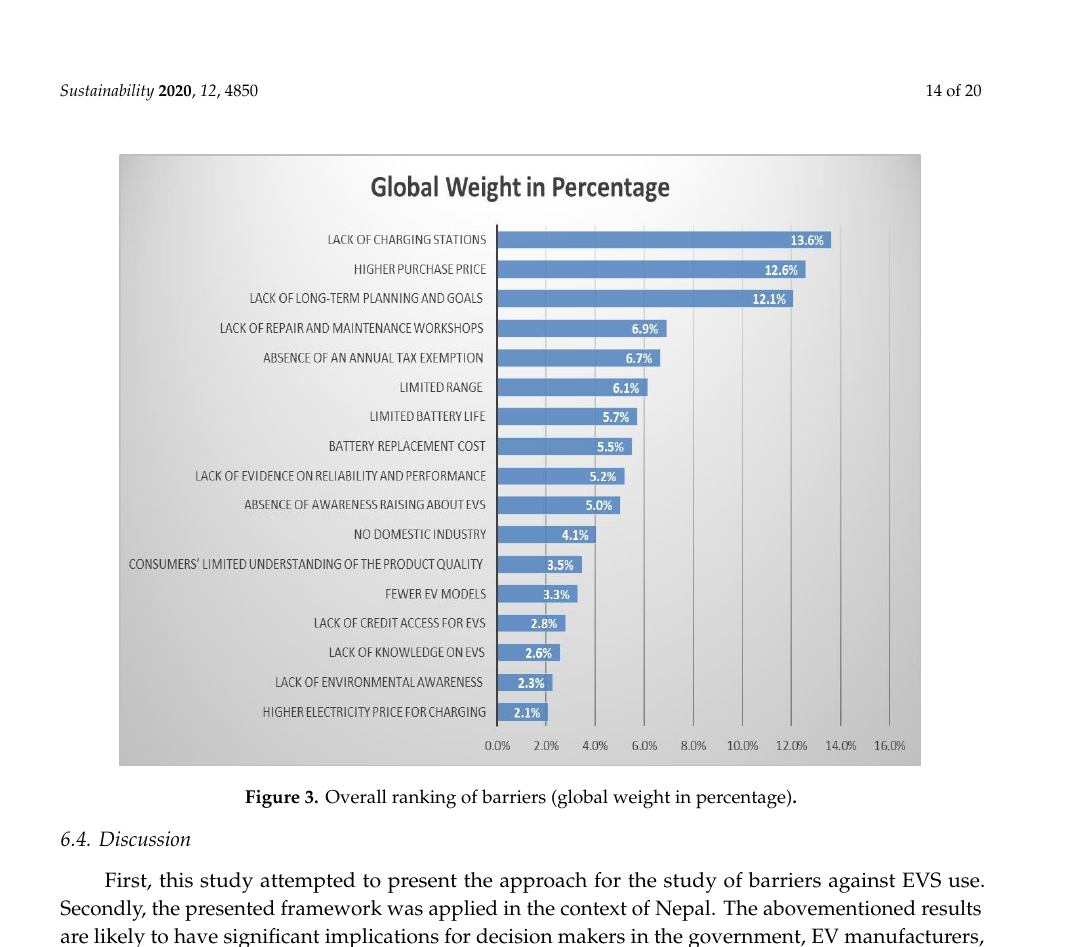
네팔의 EV 보급 장벽 을 계층 분석법 의 5 category × 18 barrier 구조화. Category 우선순위: Infrastructure (24.6%) ≈ Policy (24.1%) ≈ Economic (23.7%) >> Technical (19.4%) > Social (8.2%). Top 3 인프라+정책+경제 가 70%+ 의 가중치. Within-category: 기술 = 제한된 range (31.3%) + 배터리 수명 (28.2%), 경제 = 높은 구매 가격 (54.8%), 사회 = 제품 품질 이해 부족 (41.4%). 174 회 인용 — Nepal EV 정책 의 정량 evidence.
- RQ: 네팔의 EV diffusion 장벽은 5 category (Technical, Policy, Economic, Infrastructure, Social) 중 어느 것이 dominant 인가? Within-category 의 specific barrier 우선순위는?
- 방법론: 계층 분석법 — 5 category × 18 individual barrier 의 hierarchical decomposition. 전문가 pairwise comparison + Consistency Ratio (CR < 0.1) 검증
- 데이터: 네팔 전문가 (AEPC, 정부, 학계, EV 산업) survey. 5 category 의 각 4-5 sub-barrier
- 주요 발견: (i) Category 가중치: Infrastructure (24.6%) > Policy (24.1%) > Economic (23.7%) > Technical (19.4%) > Social (8.2%). 상위 3 개가 비슷한 가중치 + 합 72% — multi-pronged 접근 필요. (ii) Technical: 제한된 range (31.3%) > 배터리 수명 (28.2%) > reliability evidence (23.7%) > 모델 부족 (16.9%). (iii) Social: 제품 품질 이해 (41.4%) > knowledge (31.1%) > 환경 인식 (27.5%). (iv) Economic: 구매 가격 (54.8%) > 배터리 교체 cost (24.0%) > credit access (12.1%) > 전기료 (9.0%). (v) Infrastructure (table 별도): charging station 부족 + 표준화 부재. (vi) Policy: 명확한 EV 정책 부재 + 인센티브 미비.
- 시사점: (a) Multi-pronged 정책 필요: infrastructure + policy + economic 의 3 category 가 동시에 큰 비중 — single-instrument 정책 불충분. (b) 구매 가격 ($54.8% within economic): import tariff 면제 + 보조금 의 상대적 effectiveness. (c) 네팔 hydropower 의 advantage: EV 의 electricity 가 hydropower 의 surplus 활용 시 clean + cheap — charging electricity price 0.09% only (lowest economic barrier). (d) An analysis on barriers to renewable energy development in the context of Nepal using AHP 와 사촌 — *renewable energy 와 EV 의 integrated 정책 framework.
요약
본 paper 는 김연배 author page 의 제3기 (2018-2025) 개발도상국 에너지 정책 라인의 Nepal 분기 확장 (author page 분류). An analysis on barriers to renewable energy development in the context of Nepal using AHP (Renewable Energy 2018) 의 renewable energy barriers 분석 의 EV 차원 응용. 기술경영경제정책전공 의 AHP 방법론 + 개도국 정책 라인 의 전기차 specific 적용. AEPC (네팔 정부 에너지 기관) 의 practitioner-academia 협업. 본 paper 의 conceptual move 는 — EV diffusion 의 5-category 장벽 구조 + AHP 우선순위 의 Nepal-specific 정량 evidence.
방법론은 계층 분석법 (Saaty 1980). (i) 5 category 의 pairwise comparison, (ii) 각 category 의 individual barrier pairwise comparison, (iii) Eigenvector priority weight, (iv) Overall ranking = category weight × within weight, (v) Consistency Ratio 검증.
발견의 정책 함의는 Nepal EV 보급 의 multi-track 전략. (a) Infrastructure 우선: charging station 네트워크 (특히 mountain region 의 off-grid solar charging) 의 국가적 deployment — Korea KEPCO 의 charging infrastructure 의 reference. (b) 구매 가격 의 import tariff 면제 + subsidy: 네팔 의 EV 부문 의 import tariff 50%+ 의 incentive distortion 해소. (c) Hydropower-EV 연계 정책: 네팔 의 9 GW hydropower 잠재력 + EV 충전 demand 의 off-peak 활용 으로 grid efficiency 동시 향상. (d) 사회 장벽 의 낮은 priority: consumer 의 knowledge gap 보다 physical infrastructure 가 dominant — *demand-side education 보다 supply-side investment 우선. 한계: (i) 단일 시점 survey, (ii) Expert 의 self-selection (정부·학계 의 infrastructure bias 가능), (iii) 4W EV vs 2W (autorickshaw) 의 segment-specific 미구분, (iv) Tech-specific (battery EV vs hybrid) 의 granularity 제한.
핵심 결과
Category 가중치 (Table 4)
| Category | Priority Weight | % | Rank |
|---|---|---|---|
| Infrastructure | 0.246 | 24.60% | 1 |
| Policy | 0.241 | 24.07% | 2 |
| Economic | 0.237 | 23.74% | 3 |
| Technical | 0.194 | 19.38% | 4 |
| Social | 0.082 | 8.21% | 5 |
CR = 0.00247 (consistency 매우 우수).
Within-category top barriers
| Category | Top barrier | % | 정책 함의 |
|---|---|---|---|
| Technical | 제한된 range | 31.3% | 배터리 기술 + grid integration |
| Social | 제품 품질 이해 | 41.4% | consumer education |
| Economic | 구매 가격 | 54.8% | import tariff 면제 + 보조금 |
| Infrastructure | charging station | (높음) | 정부 인프라 투자 |
| Policy | EV 정책 부재 | (높음) | comprehensive EV 법 |
정량 결론. (i) Top 3 category (infra + policy + econ) 가 72% 의 가중치 — multi-pronged 정책. (ii) 사회 장벽 의 낮은 priority — technological diffusion 의 supply-side 가 우선. (iii) Within-economic 의 구매 가격 dominance (54.8%) — demand-side incentive 의 핵심.
방법론 노트
계층 분석법 의 standard procedure (Saaty 1980, 1990). 5 category × 18 barrier 의 hierarchical decomposition + pairwise comparison + eigenvector. Consistency check (CR < 0.1). 동일 framework 을 renewable energy (An analysis on barriers to renewable energy development in the context of Nepal using AHP) 와 EV (본 paper) 의 동일 Nepal context 에 적용해 cross-domain comparability 확보.
핵심 식. AHP eigenvector:
Consistency Index , Consistency Ratio (RI = Random Index from Saaty table). CR < 0.1 acceptable. 본 paper 의 CR = 0.00247 (5-category level) 는 매우 일관된 expert response.
연구 계보
본 paper 는 (a) Saaty (1977, 1980) AHP 방법론, (b) Egbue-Long (2012), Browne-O’Mahony-Caulfield (2012), Lieven (2015) 의 EV barriers literature, (c) Bhattarai-Hammig (2001), Mainali-Silveira (2015), Pokharel (2003) 의 Nepal energy policy literature 의 통합. An analysis on barriers to renewable energy development in the context of Nepal using AHP 의 renewable energy barriers 의 EV 차원 확장 (방법론 + 지역 context 동일). 김연배 author page 의 제3기 (2018-2025) 개도국 에너지 정책 라인의 Nepal sub-branch (author page). 본 paper 와 An analysis on barriers to renewable energy development in the context of Nepal using AHP 이 renewable + EV 의 통합 framework. 이후 Which policies and factors drive electric vehicle use in Nepal? (Energies 2023) 의 EV 정책 driver 의 후속 분석.
See also
- 계층 분석법
- Electric Vehicles
- ev-diffusion-barriers
- nepal-energy-policy
- charging-infrastructure
- madhusudhan-adhikari
- laxman-prasad-ghimire
- 김연배
- An analysis on barriers to renewable energy development in the context of Nepal using AHP
- Sustainability
인접 그래프
- 인물 1
- 개관 1
- 방법론 1
- 주제 1
- 수록처 2
- 분류 1
- 논문 4