An analysis on barriers to renewable energy development in the context of Nepal using AHP
laxman-prasad-ghimire, 김연배 (2018) · Renewable Energy 129:446–456 · DOI ↗
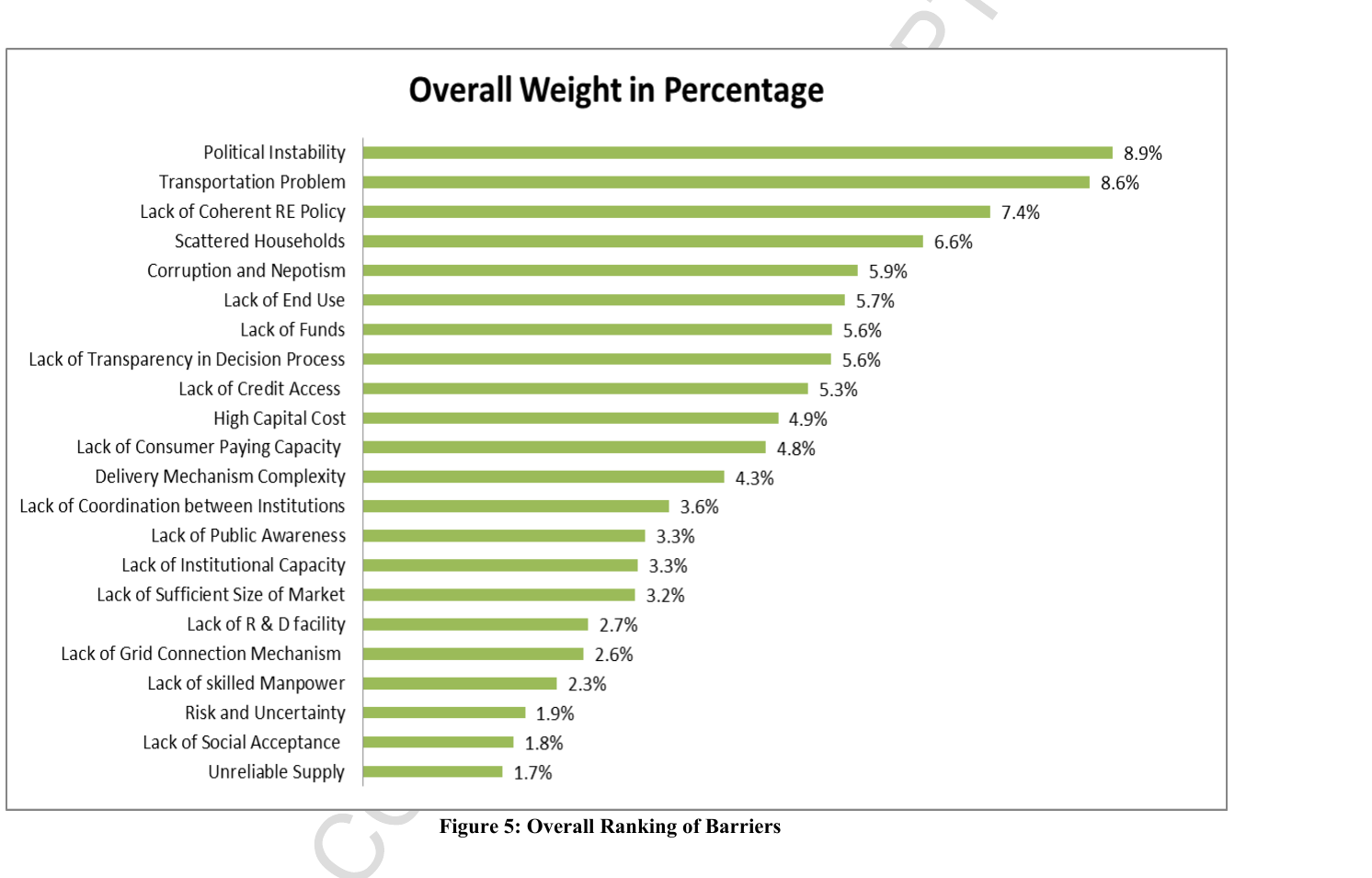
네팔의 renewable energy 개발 장벽 을 계층 분석법 (AHP) 로 6 category × 28 barrier 구조화 및 우선순위화. Expert survey (정부·NGO·민간 전문가). Top 5 barriers: (1) 정치적 불안정 (8.9%), (2) 운송 문제 (8.6%), (3) coherent RE 정책 부재 (7.4%), (4) 산재된 가구 (6.6%), (5) corruption·nepotism (5.9%). Category 우선순위: 정책·정치 > 경제 > 지리 > 행정·사회 > 기술. 기술 장벽 이 가장 작음 — 정책 + 정치 + 경제 의 macro 장벽이 dominant.
- RQ: 네팔의 RE (renewable energy) 개발의 주요 장벽 은 무엇이며 상대적 우선순위 는? Social, political, technical, economic, administrative, geographic 6 category 의 어느 것이 dominant?
- 방법론: 계층 분석법 (Saaty 1980) — 6 category × 28 individual barrier 의 hierarchical decomposition. 전문가 pairwise comparison (1-9 scale) → eigenvector 로 priority weight 계산. Consistency ratio (CR) < 0.1 검증
- 데이터: 네팔 RE 전문가 survey — 정부 (AEPC, Ministry of Energy), NGO, 민간 RE 회사 전문가 응답. 6 category × 28 barrier
- 주요 발견: (i) Category 가중치 (절대 ranking): Policy & Political (highest), Economic, Geographic, Administrative, Social, Technical (lowest). (ii) Overall top 10 barriers: 정치 불안정 8.9% > 운송 8.6% > coherent RE policy 부재 7.4% > 산재 가구 6.6% > corruption 5.9% > lack of end use > 자금 부족 > 의사결정 투명성 부족 > credit access > high capital cost. (iii) Social category: 소비자 지불 능력 부족 > 인식 부족 > 사회적 수용 부족. (iv) Technical: R&D 시설 부족 + grid 연결 메커니즘 부재 가 highest, unreliable supply 가 lowest — Nepal 의 micro-hydro 기술 자체는 maturity 인식. (v) Economic: insufficient daytime demand 가 highest — rural area 의 low load factor 이 financial viability 의 핵심 obstacle.
- 시사점: (a) 정치적 안정성 + 정책 일관성 의 prerequisite: 네팔 RE 개발의 technical 장벽 작음 진단은 정치 안정화 + 정책 framework 정비가 sufficient condition 의 의미. (b) 지리 장벽 의 infrastructure 투자 권고: 운송 + 산재 가구 — off-grid renewable + 도로 인프라 동반 투자. (c) End-use stimulation 정책: 주간 demand 부족 이 economic viability 의 핵심 — productive use 정책 (관개, 농업 가공, 소상공인 power 활용) 의 필요. (d) TEMEP 의 Korean 경험 transfer: 한국 전기 보급 + 산업화 + RE 정책 이 네팔 의 6 category 각각 에 대한 reference.
요약
본 paper 는 김연배 author page 의 제3기 (SNU 심화-통합기 2018-2025) 의 개발도상국 에너지 정책 라인 (author page 분류). Electricity generation and economic growth in Indonesia (Indonesia), Policy for electricity access in African countries: The case of Tanzania (Tanzania), Analysis on gas and oil export intensity changes of MENA countries: Recent changes and drivers (MENA), Electricity-generation mix considering energy security and carbon emission mitigation: Case of Korea and Mongolia (Mongolia) 의 개도국 에너지 정책 시리즈 의 Nepal case. Laxman Prasad Ghimire (네팔 AEPC, Alternative Energy Promotion Center) 의 practitioner-researcher 협업. 본 paper 의 conceptual move 는 — AHP 의 6-category × 28-barrier hierarchical decomposition 으로 정성적 barrier 식별을 정량적 priority weight 로 전환.
방법론은 계층 분석법 (Saaty 1980) — (i) 6 category 의 pairwise comparison (1-9 scale, 1 = equal, 9 = absolutely more important), (ii) 각 category 내 individual barrier 의 pairwise comparison, (iii) Eigenvector 로 priority weight 계산, (iv) Consistency Ratio CR = CI / RI 검증 (CR < 0.1 acceptable), (v) Overall ranking = category weight × within-category weight. 전문가 survey 의 Delphi-like aggregation.
발견의 정책 함의는 정치 안정 + 정책 일관성 의 prerequisite. (a) Top 5 barriers 모두 non-technical: 정치, 운송, 정책, 가구 분포, corruption — 기술 자체는 maturity. (b) Economic barrier 의 end-use specificity: insufficient daytime demand 가 capital cost + credit access 보다 우선 — RE 의 demand-side stimulation 정책 (예: 농업 응용 보조금) 의 lever. (c) Geographic barrier 의 transport + 가구 분포: Nepal 의 산악 지형 + scattered 농촌 가구 의 physical 장벽 — micro-grid + decentralized generation 정책. (d) Korea-Nepal 비교 가능성: 한국 1960s-1980s 의 rural electrification 도 political will + 경제 성장 + 정부 투자 의 결합 — 네팔의 6 category 동시 해결 필요성. 한계: (i) AHP 의 expert opinion 의존 (objective measurement 아님), (ii) 28 barrier 의 exhaustive 보장 안 됨, (iii) Technology-specific (solar vs wind vs hydro) 분석 부재, (iv) Time dynamics 미반영 (single survey).
핵심 결과
Top 10 Overall Ranking (Figure 5 simplified)
| 순위 | Barrier | Category | Weight |
|---|---|---|---|
| 1 | 정치적 불안정 | Political | 8.9% |
| 2 | 운송 문제 | Geographic | 8.6% |
| 3 | Coherent RE 정책 부재 | Political | 7.4% |
| 4 | 산재 가구 | Geographic | 6.6% |
| 5 | Corruption + nepotism | Political | 5.9% |
| 6 | Lack of end use (daytime demand) | Economic | — |
| 7 | Lack of funds | Economic | — |
| 8 | 의사결정 투명성 부족 | Political/Admin | — |
| 9 | Lack of credit access | Economic | — |
| 10 | High capital cost | Economic | — |
Category 우선순위: Political & Policy > Economic > Geographic > Administrative ≈ Social > Technical (lowest).
정성 결론. (i) Top 5 의 4 개가 정치·정책·행정 category — 정치 안정화가 sine qua non. (ii) 기술 장벽 의 lowest priority — technology transfer + adaptation 보다 enabling environment 우선. (iii) Economic barrier 의 end-use demand 핵심 — productive use 정책.
방법론 노트
계층 분석법 는 (i) hierarchical decomposition (goal → criteria → sub-criteria → alternatives), (ii) pairwise comparison 의 fundamental scale (1, 3, 5, 7, 9, 2, 4, 6, 8 reciprocal), (iii) eigenvector 로 priority weight 계산, (iv) Consistency Ratio (CR) check. Multi-criteria decision making 의 대표적 방법론 — Saaty (1977, 1980) 가 도입, Forman-Gass (2001) 의 AHP family.
핵심 식. Pairwise comparison matrix 에서 weight vector :
Priority weight 의 normalization . Consistency Index:
Consistency Ratio CR = CI / RI (RI = Random Index, n=6 의 경우 1.24). CR < 0.1 acceptable. Overall weight = category weight × within-category weight 의 product.
연구 계보
본 paper 는 (a) Saaty (1977, 1980) 의 AHP 방법론, (b) Forman-Gass (2001), Sirikrai-Tang (2006) 의 AHP 응용 literature, (c) Painuly (2001), Wang-Yang (2001), Beck-Martinot (2004), Reddy-Painuly (2004), Karakosta-Doukas-Psarras (2010) 의 renewable energy barriers in developing countries literature, (d) Pokharel (2003), Mainali-Silveira (2015), Bhattarai-Hammig (2001) 의 Nepal energy policy literature 의 통합. 김연배 author page 의 제3기 (2018-2025) 개발도상국 에너지 정책 라인의 South Asia 분기 (author page 분류) — 같은 Ghimire 와의 후속 Which policies and factors drive electric vehicle use in Nepal? (2023) 의 EV 정책 분석 의 predecessor. 기술경영경제정책전공 의 Korean energy policy 의 South Asia transfer 의 Nepal 분기.
See also
- 계층 분석법
- multi-criteria-decision-making
- renewable-energy-barriers
- nepal-energy-policy
- rural-electrification
- laxman-prasad-ghimire
- 김연배
- Policy for electricity access in African countries: The case of Tanzania
- Electricity generation and economic growth in Indonesia
- Renewable Energy
인접 그래프
- 인물 1
- 개관 1
- 방법론 1
- 수록처 2
- 분류 1
- 논문 10
이 문서를 가리키는 페이지
논문 (8)
- Barriers to renewable energy technologies penetration: Perspective in Iran
- Electricity generation and economic growth in Indonesia
- Identification and analysis of barriers against electric vehicle use
- Policy for electricity access in African countries: The case of Tanzania
- Structural vector autoregressive approach to evaluate the impact of electricity generation mix on economic growth and CO2 emissions in Iran
- The Application of AHP Model to Guide Decision Makers: A Case Study of E-Banking Security
- Which policies and factors drive electric vehicle use in Nepal?
- Why do newly industrialized economies deter to adopt responsible research and innovation? The case of emerging technologies in Korea