Competition and investment in telecommunications: Does competition have the same impact on investment by private and state-owned firms?
romain-lestage, david-flacher, 김연배, jihwan-kim, yunhee-kim (2013) · Information Economics and Policy 25(1):41–50 · DOI ↗
통신 자유화의 핵심 가정 — 경쟁이 투자 촉진 — 을 firm ownership 별 (private vs state-owned) 로 분리 검증. 20 incumbent telecom × 1994-2008 dynamic panel. 경쟁이 state-owned firm 의 투자는 증가 (SBC_bb +1.14, FBC_m +7.13), private firm 의 투자는 감소 (SBC_bb −2.36, FBC_bb −0.84) — 대칭 효과 가 interaction term method 의 hidden bias. Pooled regression 은 효과 무 (cancel out), separate 추정 만 진실 식별.
- RQ: 통신 industry liberalization 시 (i) 경쟁 강도 가 private 와 state-owned firm 의 infrastructure 투자 에 동일하게 작용하는가? (ii) Service-based competition (SBC) vs facility-based competition (FBC) 의 차이는?
- 방법론: 시스템 GMM (Arellano-Bond/Blundell-Bond) dynamic panel — lagged dependent + endogeneity + firm fixed effect. 3 model: (a) pooled 전체, (b) state-owned only (p=0), (c) private only (p=1). Sargan over-identification test + AR(1)/AR(2) test
- 데이터: 20 incumbent telecom OECD operators × 1994-2008. SBC/FBC for broadband + mobile (4 변수). Control: age, employee count, profit, GDP/pop, large-city population, mobile subscriber count
- 주요 발견: (i) Pooled Model (a) 의 경쟁 효과 모두 비유의 — cancel-out 가능성 시사. (ii) State-owned Model (b): SBC_bb +1.14 (p<0.05), FBC_bb +2.04 (p<0.10), SBC_m +12.95 (p<0.05), FBC_m +7.13 (p<0.01) — 모든 경쟁 form 이 투자 +. (iii) Private Model (c): SBC_bb −2.36 (p<0.01), FBC_bb −0.84 (p<0.01), SBC_m −7.75 (p<0.10), FBC_m −0.16 (n.s.) — 거의 모든 form 이 투자 −. (iv) Service-based 가 facility-based 보다 강한 음의 효과 (private): broadband SBC (−2.36) vs FBC (−0.84) — SBC 가 escape-competition 보다 Schumpeterian 압력 강. (v) Sargan test p=0.5-0.8 (instrument 유효), AR(2) 비유의 (moment condition 충족).
- 시사점: (a) 자유화 정책의 ownership-dependent 효과: state-owned (welfare-maximizing) 의 escape-competition 메커니즘 + private 의 Schumpeterian rent-erosion 메커니즘 의 simultaneous 존재. (b) Interaction variable method 의 결함: 기존 literature 의 경쟁 × privatization interaction 은 opposite direction 의 평균 으로 null 결과 — 본 paper 가 separate spec 으로 진실 식별. (c) 정책 권고: Private incumbent 시장 (예: BT, T-Mobile) 에서는 경쟁 정책만으로 NGN 투자 부족 — 직접 정부 보조나 facility-based competition 보다 더 정교한 access regime 필요. (d) State-owned vs private 통합 분석의 위험: 한국·일본 등 partial privatization 사례에서 ownership share 효과 의 정량 평가 필수.
요약
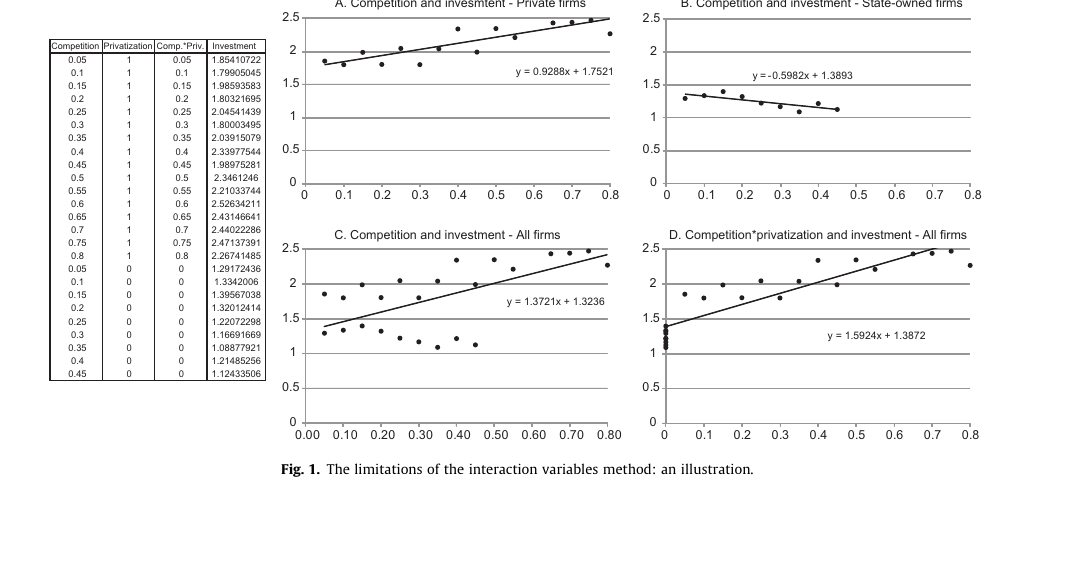
본 paper 는 Access regulation and infrastructure investment in the mobile telecommunications industry (Telecom Policy) 와 R&D investment of electricity-generating firms following industry restructuring (Energy Policy) 의 Korea-France STAR 협업 의 세 번째 paper. 김연배 author page 의 제2기 (SNU-TEMEP 확장기) 의 통신 산업 + 규제-투자 interaction 라인 (author page 분류). 기존 liberalization-investment 문헌 (Alesina et al. 2005, Li 2008, Wallsten 2001, Ros 1999, Li-Xu 2004, Fink et al. 2003, Zhang et al. 2005, 2008) 은 industry-level 데이터 + interaction variable 로 privatization × competition 추정. 본 paper 의 conceptual move 는 — firm-level data + separate sample 분석 으로, competition 이 private 와 state-owned 에 opposite direction임 을 식별 (Appendix 의 Fig 1 이 interaction variable method 가 opposite effect 를 cancel out 함을 시뮬레이션).
방법론 핵심은 — (i) 시스템 GMM 의 dynamic panel: , (ii) 3 sample spec — pooled (a), state-owned (b, ), private (c, ), (iii) Sargan over-identification (instrument 유효) + Arellano-Bond AR(2) test (moment 유효), (iv) 4 경쟁 변수 — SBC_bb (broadband service-based), FBC_bb (broadband facility-based), SBC_m (mobile service-based), FBC_m (mobile facility-based). Service-based = MVNO·resale 등, facility-based = own-network competitor.
발견의 정책 함의는 자유화 정책의 ownership-conditional design. (a) State-owned 의 escape-competition 메커니즘: 시장 경쟁 압력이 welfare-maximizing manager 의 자기-감시 + politicians 의 deregulation 요구 활성 → 투자 증가. (b) Private 의 Schumpeterian rent erosion: 경쟁이 post-investment profit 감소 → 투자 감소. 즉 competition 이 incumbent 에게 prisoner’s dilemma, entrant 의 투자가 이를 보충 할 수 있으나 incumbent 의 NGN 같은 대규모 investment 가 감소. (c) SBC > FBC 의 음의 효과: service-based 가 MNO-MVNO 같은 vertical separation 으로 core network 의 wholesale 의무화 — incumbent 의 core asset 수익화 한계. Facility-based 는 entrant 가 own infrastructure 구축 — incumbent 의 facility 자체는 commoditization 안 됨. 한계: (i) 20 firm × 15 yr 의 small panel, (ii) Ownership 의 binary categorization (실제는 government share 의 spectrum), (iii) Endogeneity (privatization timing 의 historical investment 영향 무시), (iv) Country-specific timing 의 confounding.
핵심 결과
경쟁 변수의 ownership-별 효과 (Table 3 dynamic GMM)
| Competition var | (a) Pooled | (b) State-owned | (c) Private |
|---|---|---|---|
| SBC_bb (broadband service-based) | −0.95 (n.s.) | +1.14* (p<0.05) | −2.36* (p<0.01) |
| FBC_bb (broadband facility-based) | −0.55 (n.s.) | +2.04* (p<0.10) | −0.84* (p<0.01) |
| SBC_m (mobile service-based) | +4.41 (n.s.) | +12.95* (p<0.05) | −7.75* (p<0.10) |
| FBC_m (mobile facility-based) | +0.95 (n.s.) | +7.13* (p<0.01) | −0.16 (n.s.) |
| Sargan test p-value | 0.55 | 0.52 | 0.82 |
| AR(2) p-value | n.s. | n.s. | n.s. |
정량 결론. (i) Pooled Model 의 cancel-out — opposite effect 가 average 0 이 statistical null 의 artifact. (ii) State-owned 와 private 의 sign symmetry — 4 변수 중 3 개 (SBC_bb, FBC_bb, SBC_m) 에서 opposite direction + 통계 유의. (iii) Mobile 시장에서 경쟁의 magnitude 가 broadband 보다 큼 — high-elasticity 모바일 시장 의 경쟁-투자 sensitivity.
방법론 노트
시스템 GMM 은 dynamic panel 의 Nickell bias 회피 — within-transformation 의 lagged dependent 의 negative correlation 문제. Internal instrument (lagged level + difference) 사용 + Sargan over-identification 검증. 본 paper 의 핵심 contribution 은 — interaction variable method 의 opposite effect cancellation 위험 을 Appendix Figure 1 의 시뮬레이션으로 입증 (Fig 1A: private 의 positive, Fig 1B: state-owned 의 negative, Fig 1C: interaction term 의 flat statistical null, Fig 1D: separate spec 의 true 식별).
핵심 식. Dynamic panel:
여기서 는 ownership group 별 다른 계수 — separate spec 으로 각각 추정. 식별은 (i) GMM moment condition for , (ii) Sargan test of over-identifying restrictions (p ≫ 0.05), (iii) Ownership categorization 의 exogenous (privatization decision 가 historical CAPEX 와 무관 가정 — debatable).
연구 계보
본 paper 는 (a) Aghion et al. (2005) 의 Schumpeterian vs escape-competition trade-off 이론, (b) Shapiro-Willig (1990), Shirley-Walsh (2000) 의 mixed oligopoly + state-owned firm 의 objective function 이론, (c) Alesina et al. (2005), Calderini-Garrone (2001), Li (2008), Wallsten (2001), Zhang et al. (2005, 2008), Ros (1999) 의 liberalization-investment 실증 literature 의 결합. Interaction variable method (privatization × competition) 의 limitation 을 명시적으로 비판 + alternative (separate spec) 제시. Access regulation and infrastructure investment in the mobile telecommunications industry 의 MVNO regulation + 단일 ownership 가정 에서 ownership 차이의 명시적 모델링 으로 확장한 직접 후속작. 김연배 author page 의 제2기 (SNU-TEMEP 확장기) 의 통신 산업 라인 (author page) — Korea-France STAR project 의 통신 + 에너지 의 sector-symmetric 분석 의 통신 sector 완결.
See also
- 시스템 GMM
- private-vs-state-owned
- mixed-oligopoly
- liberalization
- service-based-competition
- facility-based-competition
- romain-lestage
- david-flacher
- 김연배
- Access regulation and infrastructure investment in the mobile telecommunications industry
- Information Economics and Policy
인접 그래프
- 인물 1
- 방법론 3
- 수록처 1
- 분류 2
- 논문 2