Accelerating Economic Growth in Industrial Societies: The Process of Expansive Reproduction
Tai-Yoo Kim, Seunghyun Kim, 이종수 (2014) · economic-growth-new-perspectives Ch. 3 · DOI ↗
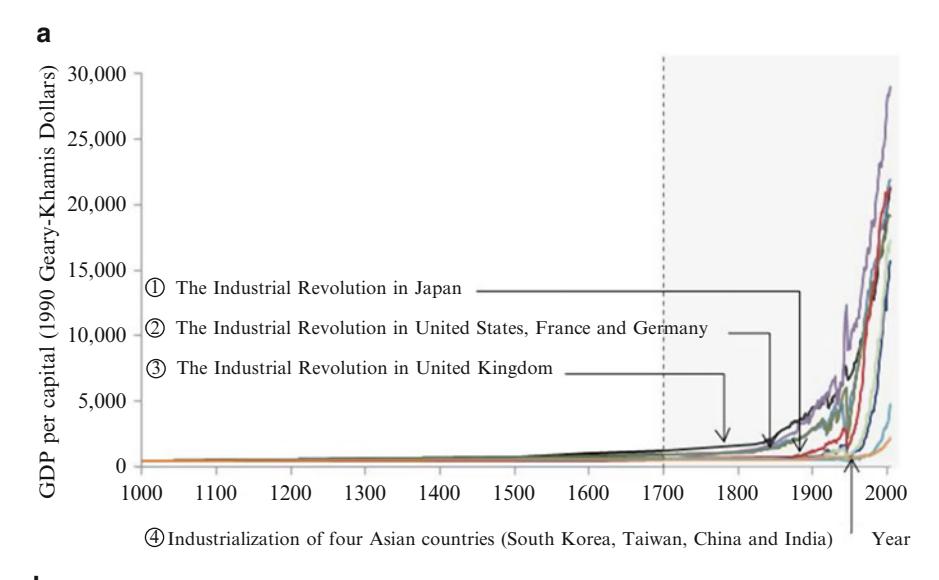
산업 사회의 Accelerating Economic Growth (AEG) — pGDP 의 2 차 도함수 양 (가속) — 이 어떻게 생성되는지의 내부 구조 를 expansive reproduction (확대 재생산) 의 4-stage virtuous cycle 로 설명. 농업 사회의 simple reproduction (감속) 과 대비. 9 개국 (영국·미국·프랑스·독일·일본·한국·대만·중국·인도) 의 산업혁명 전후 pGDP trajectory + 12 개국 1870–1998 노동생산성 + 영국 1700–1800 특허 등록 추세로 historical evidence 제시. Cotton spinning 산업의 required labor hour — 18 세기 인도 50,000 시간 → Crompton (1780) 2,000 → 1825 Roberts 135 → 현대 40 — 으로 기술 혁신의 가속 정량화.
- RQ: (i) 산업 사회의 pGDP 동학 패턴은 무엇이며, 증가율 (1 차) 이 아닌 가속도 (2 차 도함수) 의 부호로 어떻게 농업 사회와 구분되는가? (ii) AEG 의 internal driving force 는 무엇인가? (iii) Solow neoclassical model + Ruttan induced innovation model 을 very long run 으로 확장하면 AEG 가 derivable 한가?
- 방법론: historical-analysis (Maddison 1995, 2001, 2003 의 pGDP series), aggregate-production-function (Solow 1957) + meta-production-function (Hayami-Ruttan 1970) 의 very long run extension, Expansive Reproduction 4-stage 모형 (Market Equilibrium → Capital Accumulation → Supply Expansion → Demand Expansion)
- 데이터: Maddison (1995, 2001, 2003) 의 Monitoring the World Economy pGDP series (9 개국, 산업혁명 전후
200+ 년), Kremer (1993) 의 BC 1 백만년1990 인구, Heston-Summers-Aten (2002) Penn World Table 6.1 (1950–2000 OECD), Mitchell-Dean (1962) 영국 1700–1809 특허 등록, Catling (1970) cotton spinning 노동시간 - 주요 발견: (i) 9 개국의 산업혁명 시점 후 pGDP 의 2 차 도함수 > 0 (가속) — UK 18 세기 mid, US/Germany/France 19 세기, 한국·대만·중국·인도 20 세기 후반. 산업혁명 이전엔 모두 DEG (decelerating). (ii) 영국 cotton spinning 노동시간 — 18 세기 50,000 → 1780 2,000 → 1790 1,000 → 1795 300 → 1825 135 → 현대 40 — 지수적 감소. (iii) 영국 1700–1809 특허 등록 지수 가속. (iv) Lewis (1955) 재투자율 — 산업혁명 전 5% 미만 → 후 10%+ (cotton·steel 주도). (v) 12 개국 1870–1998 GDP/hour 의 후반 절반에서 가속률 증가, 1950s 부근 변곡점. (vi) Reading (W.H. Lever 1880s 비누 산업: £50,000 profit/year 의 대부분 재투자, £400 만 retain) 의 case study
- 시사점: (a) Accelerating growth 의 maintenance 는 기술 혁신 이 critical — 영국·미국이 한국·대만 에 catch-up 당하는 이유는 expansive reproduction cycle 의 정체. (b) 정책은 모든 산업화 단계 에서 expansive reproduction 의 4 stage 모두 를 동시에 활성화 — single-stage 집중 (예: capital accumulation 만) 은 부분적. (c) Post-industrial knowledge economy 도 동일 framework 적용 가능 — production mode 가 다르면 새 growth pattern 가능성
요약
본 paper 는 Tai-Yoo Kim 의 Accelerating Society 이론 시리즈 (Springer book Economic Growth: New Perspectives for Theory and Policy) 의 Chapter 3 — Chapter 2 의 agricultural society DEG 분석 (Kim, Heshmati, Park 2010, TFSC 77(3):479–499) 의 대칭 짝 으로 industrial society AEG 의 구조를 설명. Accelerating vs Decelerating 의 구분은 GDP 증가율 (1 차 도함수) 의 부호가 아니라 pGDP 의 2 차 도함수 의 부호 — 1 차가 양수 (성장) 라도 2 차가 음수면 감속 (DEG), 양수면 가속 (AEG). 이 distinction 이 본 paper 의 conceptual contribution 이다.
방법론은 theoretical extension + historical evidence 의 결합. (i) Solow (1957) 의 aggregate-production-function 을 very long run 으로 확장 — APF 가 각 시점 t 의 technology level 에 따라 shift 하므로, technology 가 가속적으로 발전하면 APF shift 자체가 가속, 결과적 production curve 도 가속 (Fig 3.4). (ii) Ruttan (2001) 의 induced innovation + Hayami-Ruttan (1970) 의 meta-production-function 으로 factor price 변화 → 새 isoquant 의 envelope curve 가 가속 production 도출 (Fig 3.5). (iii) Maddison (1995, 2001, 2003) 의 millennial pGDP series 와 Kremer (1993) 의 1 million BC ~ 1990 인구 로 역사적 확증.
Expansive Reproduction 4-stage cycle 이 본 paper 의 micro mechanism. (1) Market Equilibrium — 확대된 공급과 수요의 균형. (2) Capital Accumulation — 이윤의 reinvestment + 노동자 임금 상승 → 소비력 증가. Lewis (1955) 의 산업혁명 전 5% 미만 → 후 10%+ 의 재투자율 두 배. (3) Supply Expansion through Technological Innovation — 기존 제품 개선 (양적) + 신제품 개발 (질적) 의 두 갈래. cotton spinning 노동시간 (인도 50,000 → 현대 40 = 1,250 배 감축) 이 정량 증거. (4) Demand Expansion — 기존 수요 증가 (소비력) + 신수요 창출 (신제품). 두 sub-stage 의 positive feedback 이 곧 virtuous cycle.
핵심 발견은 셋. 첫째, 산업혁명 시점의 universal AEG transition — 9 개국 모두 산업혁명 직후 pGDP 의 2 차 도함수 가 양으로 전환. 둘째, 기술 발전의 지수적 가속 — cotton spinning labor (18 세기 50,000 → 1825 135 → 현대 40), 영국 특허 등록 (1700–1809 지수 증가), 12 개국 GDP/hour (1870–1998, 후반 가속률 증가). 셋째, expansive reproduction 의 historical evidence — Lewis (1955) 5% → 10%+ 재투자율, William H. Lever 사례 (£50,000 profit 의 99.2% 재투자). 한계 — (i) very long run 의 축적 메커니즘 이 국가별 정치·문화 요인 와 어떻게 상호작용하는지 미분석, (ii) post-industrial knowledge economy (digital, AI) 의 새 production mode 가 본 framework 에 fit 하는지 미검증, (iii) China·인도의 최근 가속 이 단기 catch-up 효과 vs 지속 가능 AEG 의 구분 미명확.
핵심 결과
역사적 evidence 의 정량 점
| 출처 | 수치 | 해석 |
|---|---|---|
| Maddison (2001) 9 개국 | 산업혁명 후 pGDP 2 차 도함수 > 0 | AEG 의 universal 패턴 |
| Catling (1970) cotton spinning labor | 18 세기 50,000h → Crompton 1780 2,000h → 1790 1,000h → 1795 300h → 1825 135h → 현대 40h | 노동생산성 1,250 배 증가 |
| Mitchell-Dean (1962) 영국 특허 | 1700→1800 지수 가속 | 기술 혁신의 자체 가속 |
| Lewis (1955) 재투자율 | 산업혁명 전 <5% → 후 10%+ | Capital accumulation 의 2 배 가속 |
| W.H. Lever (1880s 비누) | £50,000/year profit, retain £400, reinvest 99.2% | 개별 case 의 expansive reproduction |
| Heston-Summers-Aten (2002) PWT 6.1 | 12 개국 1870–1998 GDP/hour 의 후반 가속 | 1950s 변곡점 |
Expansive Reproduction 4-stage callout
(1) Market Equilibrium → (2) Capital Accumulation → (3) Supply Expansion (Tech Innovation) → (4) Demand Expansion → (1) again Simple Reproduction (agricultural) 에선 (3)·(4) 가 약하거나 부재 — 기술 혁신의 cumulative effect 가 AEG vs DEG 의 분기점.
방법론 노트
Accelerating Economic Growth (AEG) 의 정의는 pGDP 의 2 차 도함수 의 부호:
vs DEG = 2 차 도함수 < 0, UEG (Uniform) = 2 차 도함수 = 0. 증가율 (1 차 도함수) 의 부호 가 아닌 가속도 가 분류 기준 — pGDP 가 증가 (1 차 > 0) 해도 증가 속도가 감소 (2 차 < 0) 면 DEG, 증가 속도가 증가 (2 차 > 0) 면 AEG.
Solow (1957) aggregate-production-function 의 very long run extension. 시점 의 APF:
여기서 = 기술 수준. 기술 발전이 가속 — — 이면 APF 의 shift 자체가 가속, production 곡선의 2 차 도함수 양 → AEG. Solow (1957) 의 1909-1929 vs 1930-1949 비교: GDP/man-hour 증가가 Period 1 $0.275 vs Period 2 $0.395 — 기술 변화의 가속 evidence.
Ruttan (2001) meta-production-function: factor price 변화 → 새 production isoquant 의 envelope:
각 는 한 시점의 production technology, envelope 가 meta-function. 시간 따라 envelope 가 가속적 expand → AEG. Identification 은 (i) Maddison 의 2 세기+ pGDP series 가 short-term 변동 (oil shock, 금융 위기) 을 2-period 또는 10-period moving average 로 smoothing 후 long-run trend 추출, (ii) 9 개국의 산업혁명 시점 이 국가별로 다른 exogenous timing 으로 natural experiment 역할.
연구 계보
본 paper 는 기술경영경제정책전공 의 Tai-Yoo Kim 의 Accelerating Society 이론 라인의 industrial side. 직접 predecessor 는 Kim-Heshmati-Park (2010, TFSC 77(3):479–499) 의 agricultural society DEG 분석 — 본 paper 의 대칭 짝. 이론적 backbone 은 Smith (1776) 의 division of labor, Marshall (1920) 의 increasing returns, Chandler (1990) 의 scale and scope, Myrdal (1957) 의 cumulative causation, Romer (1990) 의 endogenous growth, Arrow (1962) 의 learning-by-doing — 본 paper 는 이들을 expansive reproduction 4-stage 의 통합 framework 으로 재구성. 방법론적 조상은 Solow (1957) APF + Ruttan (2001) induced innovation + Hayami-Ruttan (1970) meta-production function. 역사 데이터는 Maddison (1995, 2001, 2003) 의 millennial pGDP series, Kremer (1993) 의 1 million BC ~ 1990 인구, Heston-Summers-Aten (2002) Penn World Table.
sibling 으로 Determinants of Economic Divergence Among Accelerating Societies (Chapter 4 — accelerating societies 간 divergence 의 결정요인) 와 동일 Springer book 의 후속 chapter. The necessity of a new industrial classification based on value-creation behavior (Chapter 10) 가 서비스 부문 분류 의 분기, The Relationship Among Stock Markets, Banks, Economic Growth, and Industry Development (Chapter 9) 이 금융-실물경제 nexus 의 분기 — 모두 industrial society 의 internal structure 라는 공통 anchor 의 다른 axis. 공저자 Seunghyun Kim (STEPI) 의 정책 연구 관점 + 이종수 의 econometric expertise 결합.
See also
- expansive-reproduction
- simple-reproduction
- accelerating-society
- aggregate-production-function
- meta-production-function
- industrial-society
- Tai-Yoo Kim
- 이종수
- Seunghyun Kim
- Determinants of Economic Divergence Among Accelerating Societies
- The necessity of a new industrial classification based on value-creation behavior
- The Relationship Among Stock Markets, Banks, Economic Growth, and Industry Development
인접 그래프
- 인물 3
- 개관 1
- 주제 1
- 분류 1
- 논문 5