Determinants of Economic Divergence Among Accelerating Societies
Tai-Yoo Kim, Seunghyun Kim, 이종수 (2014) · economic-growth-new-perspectives Ch. 4 · DOI ↗
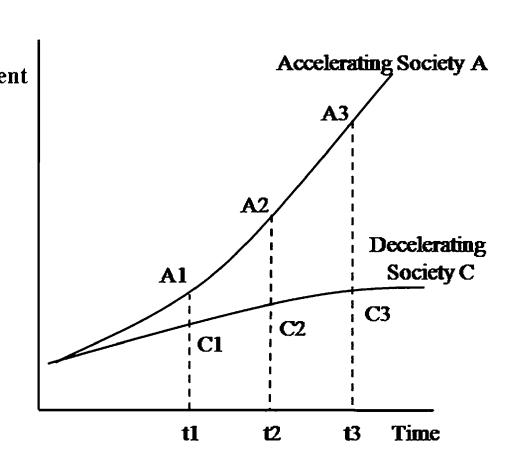
Accelerating Economic Growth in Industrial Societies: The Process of Expansive Reproduction (Chapter 3) 의 accelerating society 의 internal AEG 구조 를 국가 간 income divergence 분석으로 확장. Solow 절대수렴 가설 vs 조건부 수렴 vs technology gap (Fagerberg 1987) vs catch-up strategy (Abramovitz 1994) vs ICT diffusion (Seo-Chung 2002) 5 학파의 divergence evidence 종합. UNDP rich-poor income ratio — 1820 3:1 → 1913 14:1 → 1960 30:1 → 1997 74:1 → 2003 65:1 — 의 지수적 발산 정량. Income Diversion Model — 3-tier 사회 (decelerating agricultural / accelerating industrial / faster accelerating knowledge-based) 의 APF shift 속도 차이 가 long-run divergence 의 핵심.
- RQ: (i) Solow 의 absolute convergence 가설은 실제 데이터에서 성립하는가? (ii) accelerating society 의 내부 divergence (선진국 vs 후발국, 그리고 knowledge-based society 의 faster accelerating 효과) 는 어떻게 모형화되는가? (iii) Technology gap · catch-up · ICT diffusion 의 분기 mechanism 은 무엇인가?
- 방법론: historical-analysis (Maddison 시리즈 + UNDP/UNCTAD/UN ECOSOC reports), Income Divergence Model (3-tier APF shift 속도 비교), Seo-Chung (2002) 회귀 분석 (ICT investment 대비 growth gap 의 OECD·EU 패널)
- 데이터: Maddison (1995, 2001, 2003) pGDP series; UNDP (1999) rich-poor income ratio; UN Economics-Social Council (2005) 20 advanced vs 20 poorest country; Bank of Korea (2005) 2002-2003 GNI; UNCTAD (1996) North-South 무역 시뮬레이션; Baumol (1986) 16 개국 1870-1979 패널; Seo-Chung (2002) OECD/EU 1990s ICT investment 패널
- 주요 발견: (i) Rich-poor income ratio 의 지수 발산: 1820 3:1 → 1870 7:1 → 1913 14:1 → 1960 30:1 → 1990 60:1 → 1997 74:1. (ii) 20 advanced vs 20 poorest GDP 차 — 1960 53.85 배 → 2000 120.67 배. (iii) Baumol 16 개국 1870-1979 절대수렴: Growth rate = 5.25 − 0.75 ln(GDP/work hour 1870), R² = 0.88 — advanced country 들 사이에선 강한 수렴, advanced vs developing 사이에선 발산. (iv) Seo-Chung 1990s ICT investment 패널 — ICT 투자 격차 1% 증가 → 미국과 growth gap 5.1% 감소 (OECD), 4.2% 감소 (EU). 외부효과 — 타국 ICT 투자 1% 증가 → 자국 growth gap 22% 감소. (v) UNCTAD 1996 시뮬레이션 — 남방국 노동 +20% 시 북방 unskilled wage +8.1%, 남방 −2.9%, 남방 1인당 소득 −7.8% — 무역 자체가 발산 강화. (vi) 1990-2001 US vs OECD pGDP gap 8,000 (IT boom), US vs Japan gap 8,000
- 시사점: (a) 후발국 catch-up strategy 는 advanced country 의 successful path (free market + 기술 spillover 자연 흡수) 와 달라야 — 정부 주도 catch-up (Abramovitz 1994) + ICT 인프라 우선 투자. (b) Convergence 는 advanced country 사이 에만 부분적, advanced-developing 사이엔 systematic divergence. (c) Knowledge-based society 의 faster acceleration 이 digital divide 를 기존 income divide 위에 추가 — 후발국이 동시에 산업 + 디지털 catch-up 해야
요약
본 paper 는 Tai-Yoo Kim 의 Accelerating Society 시리즈 Chapter 4 — Chapter 3 (Accelerating Economic Growth in Industrial Societies: The Process of Expansive Reproduction) 가 single industrial society 의 AEG internal structure 를 다뤘다면, 본 paper 는 국가 간 income divergence 의 5 학파 evidence 를 종합하고 income divergence model 로 통합한다. 5 학파는 — (1) neoclassical convergence 가설 (Solow 1956, Tinbergen 1961, Baumol 1986), (2) conditional convergence (Barro-Sala-i-Martin 1992, Mankiw et al. 1992), (3) endogenous growth (Lucas 1988, Xie 1994), (4) technology gap (Fagerberg 1987, Abramovitz 1994), (5) ICT diffusion 발산 (Seo-Chung 2002). 본 paper 의 integrative contribution 은 5 학파를 3-tier society (decelerating agricultural / accelerating industrial / faster accelerating knowledge-based) 의 APF shift 속도 차이 로 unify.
방법론은 evidence triangulation. (i) Maddison 의 millennial pGDP series 로 200 년+ 시계열 발산 trajectory, (ii) UNDP (1999) 의 rich-poor income ratio 6 시점 (1820, 1870, 1913, 1960, 1990, 1997) 으로 지수 발산 정량화, (iii) Baumol (1986) 의 16 개국 1870-1979 회귀 (Growth = 5.25 − 0.75 ln GDP/hr 1870, R² = 0.88) 로 advanced country 사이의 수렴 확인, (iv) Seo-Chung (2002) 의 OECD/EU ICT 투자 vs growth gap 패널 회귀로 ICT 의 catch-up 효과 (1% ICT 증가 → 5.1% gap 감소), (v) UNCTAD (1996) North-South 무역 시뮬레이션으로 무역의 발산 효과 (남방 노동 +20% 가 남방 소득 −7.8%).
핵심 발견은 셋. 첫째, historical 발산의 지수 가속 — UNDP rich-poor ratio 가 1820 (3:1) → 1997 (74:1) 로 24.7 배 발산. 200 년에 걸친 systematic divergence. 둘째, Baumol 의 부분 수렴 paradox — 16 advanced country (1870-1979) 만 보면 R² 0.88 의 강한 수렴, 그러나 advanced + developing 통합 표본에선 발산. 즉 조건부 수렴 (Mankiw-Romer-Weil 1992) 은 기술 수준 동일 집단 내에서만 성립. 셋째, ICT의 catch-up + 발산 양면 효과 — Seo-Chung (2002) 의 1990s OECD/EU 데이터에서 국가의 ICT 투자가 미국 따라잡으면 growth gap 감소 (1% ICT → 5.1% gap 감소), 못 따라잡으면 gap 확대. 한국·아일랜드·핀란드·노르웨이가 catch-up 그룹, 영국·프랑스·일본 등 12 개국은 발산 그룹. ICT 의 network 외부효과 가 결정적 — 타국 ICT 1% 증가 시 자국 gap 22% 감소. 한계 — (i) 본 paper 의 income divergence model 이 형식적 closed-form 이 아닌 3-tier APF shift 비교 의 conceptual model, (ii) 1990s 이후 data (특히 2000s-2010s 의 platform economy) 의 새 divergence channel 미반영, (iii) China · India 의 최근 catch-up 이 모형의 후발국 영원 발산 명제에 부분 도전.
핵심 결과
Rich-Poor Income Ratio (UNDP 1999, Table 4.7)
| 연도 | 1820 | 1870 | 1913 | 1960 | 1990 | 1997 |
|---|---|---|---|---|---|---|
| Rich/Poor ratio | 3:1 | 7:1 | 14:1 | 30:1 | 60:1 | 74:1 |
| 2 배 도달 기간 | — | 50년 | 43년 | 47년 | 30년 | 7년 |
20 Advanced vs 20 Poorest (Oh 2005)
| 연도 | 20 Advanced 평균 pGDP | 20 Poorest 평균 pGDP | 격차 배수 |
|---|---|---|---|
| 1960 | $11,417 | $212 | 53.85× |
| 2000 | $32,339 | $268 | 120.67× |
Baumol (1986) 16 개국 1870-1979 회귀
Growth rate (1870-1979) = 5.25 − 0.75 × ln(GDP per work hour, 1870) R² = 0.88, 계수 ≈ -1 → advanced country 사이 강한 절대수렴 성립. 그러나 advanced + developing 통합 표본 에선 발산 — Baumol paradox.
Seo-Chung (2002) ICT Investment 회귀 (Table 4.5)
| 모형 | 종속변수 | OECD 계수 | EU 계수 |
|---|---|---|---|
| A (no lag) | Growth Gap with US | 0.045** (+4.5%/1% ICT) | 0.043** |
| B (lag 1) | Growth Gap | 0.051** | 0.042** |
| F (with externality) | Growth Gap | ICT +0.044** / EXT +0.22*** | — |
ICT externality (타국 ICT 1% ↑ → 자국 gap 22% ↓) 의 network 효과 dominant.
UNCTAD (1996) North-South 시뮬레이션 (남방 노동 +20%)
| 지표 | 북방 (Advanced) | 남방 (Developing) |
|---|---|---|
| Real wage (unskilled) | +8.1% | −2.9% |
| Real wage (skilled) | +7.2% | −8.9% |
| Per capita income | +4.2% | −7.8% |
| Terms of trade | — | −63.2% |
→ 자유무역 자체가 발산 강화 — 후발국 노동 공급 증가가 자국 임금·소득 감소.
방법론 노트
Income Divergence Model 의 conceptual core 는 3-tier society 의 APF shift 속도 차이. 시점 의 production:
여기서 의 기술 수준 가 서로 다른 속도 로 발전:
(Decelerating < Accelerating < Faster Accelerating). 같은 input level 에도 output 격차가 지수적으로 증가 — Fig 4.7 의 APF shift visualization. 본 paper 는 closed-form 수식 도출 대신 Solow APF + Hayami-Ruttan meta-production function + Romer endogenous growth 의 integrating framework 으로 제시.
Seo-Chung (2002) 회귀 분석 (model A):
여기서 는 미국 대비 growth gap, 는 미국 대비 ICT investment gap. 외부효과 모형:
식별은 (i) Maddison 의 2 세기+ 시계열 이 short-term shock (oil shock, 금융 위기) 보다 long-run trend 우위, (ii) UNDP rich-poor ratio 의 50-quantile/20-quantile 비교 가 country composition heterogeneity 통제, (iii) Seo-Chung 의 cross-country + time variation 으로 ICT 의 country-fixed unobserved factor 분리. 한계 — (i) Baumol paradox 의 advanced-only sample selection, (ii) UNCTAD 시뮬레이션의 strong specialization assumption (북 = skill, 남 = labor 완전 분화) 가 intermediate technology 국가 미포착.
연구 계보
본 paper 는 기술경영경제정책전공 의 Tai-Yoo Kim Accelerating Society 라인의 국가 간 비교 axis. 직접 predecessor 는 Accelerating Economic Growth in Industrial Societies: The Process of Expansive Reproduction (Chapter 3) — single industrial society 의 internal AEG 분석, 본 paper 가 cross-country divergence axis 로 확장. Kim-Heshmati-Park (2010, TFSC 77(3):479-499) 의 agricultural society DEG 분석이 conceptual base. 5 학파의 직접 인용 — (1) Solow (1956), Tinbergen (1961), Baumol (1986), De Long (1988) 의 convergence 가설, (2) Barro-Sala-i-Martin (1992), Mankiw-Romer-Weil (1992) 의 conditional convergence, (3) Lucas (1988), Xie (1994), Romer (1990) 의 endogenous growth, (4) Fagerberg (1987), Abramovitz (1994), Williamson (1994) 의 technology gap + catch-up, (5) Seo-Chung (2002), Machlup (1962) 의 ICT/지식 사회 발산. 실증 데이터는 Maddison (1995, 2001, 2003), UNDP (1999), UN Economics-Social Council (2005), UNCTAD (1996), Bank of Korea (2005).
sibling 으로 Accelerating Economic Growth in Industrial Societies: The Process of Expansive Reproduction (Chapter 3) 의 internal AEG mechanism, The necessity of a new industrial classification based on value-creation behavior (Chapter 10) 의 서비스 부문 분류 reform, The Relationship Among Stock Markets, Banks, Economic Growth, and Industry Development (Chapter 9) 의 금융-실물 nexus 가 같은 Springer book 의 다른 axis. Seunghyun Kim (STEPI) 의 정책 연구 와 이종수 의 econometric expertise 결합.
See also
- economic-divergence
- convergence-hypothesis
- technological-catch-up
- ICT 확산
- knowledge-based-society
- income-divergence-model
- accelerating-society
- Tai-Yoo Kim
- 이종수
- Seunghyun Kim
- Accelerating Economic Growth in Industrial Societies: The Process of Expansive Reproduction
- The necessity of a new industrial classification based on value-creation behavior
- The Relationship Among Stock Markets, Banks, Economic Growth, and Industry Development
인접 그래프
- 인물 3
- 개관 1
- 방법론 1
- 주제 2
- 수록처 1
- 분류 1
- 논문 5