Electricity-generation mix considering energy security and carbon emission mitigation: Case of Korea and Mongolia
hanee-ryu, shonkhor-dorjragchaa, 김연배, kyunam-kim (2014) · 에너지 64:1071–1079 · DOI ↗
한국과 몽골의 2030 발전 mix 를 carbon emission 30% 감축 + energy security 개선 + cost minimization 의 multi-objective scenario 비교. 각 국 3 scenario (CCS, Renewable, Nuclear/Imports). 한국: 두 목표가 complementary — 화석 연료 → 재생 + 원자력 대체가 양 목표 동시 달성. Nuclear scenario 비용 +4% 만 증가, 보안 24.7% 개선. 몽골: 두 목표가 trade-off — 탄소 배출은 국내 석탄, 보안은 Russia 수입 으로 separate; 수입 전력 확대 시 보안 악화. CCS 도입이 불가피 (renewable potential 풍부해도).
- RQ: 한국과 몽골의 2030 발전 mix 가 (i) 30% carbon emission 감축, (ii) energy security 개선, (iii) 발전 비용 최소화 의 3 multi-objective 를 어떻게 동시 달성? 두 국가의 energy structure 차이 가 정책 trade-off 에 어떻게 영향?
- 방법론: 시나리오 분석 3 scenario per country, espi-energy-security-price-index (Energy Security Price Index, 공급 집중도·정치 위험·화석 연료 비율 합성), levelized-cost-of-electricity (LCOE), generation-mix-optimization
- 데이터: Korea: 2010 baseline mix (coal 41.9%, CCGT 21.8%, nuclear, renewable). Mongolia: coal-fired domestic + Russia 수입 + 풍부한 hydro/wind/solar potential. 2030 scenarios: CCS, Renewable Expansion, Nuclear/Import Expansion
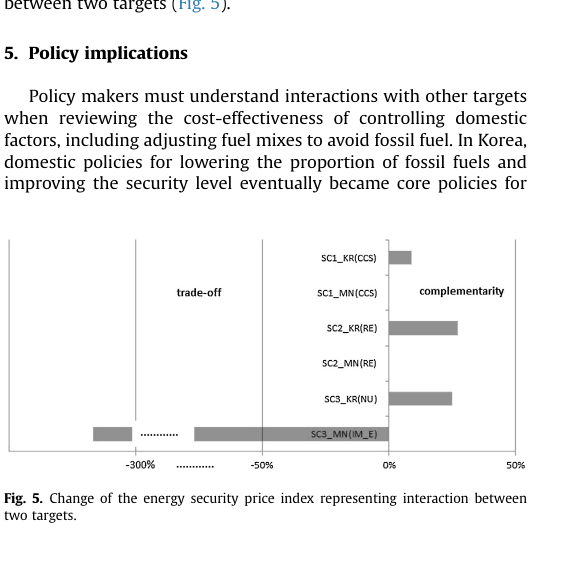
- 주요 발견: (i) Korea 의 complementarity: 모든 scenario 가 ESPI_gen 개선. SC3_KR (Nuclear) 가 비용 +4% 만 증가하면서 보안 +24.7% + 탄소 30% 감축 달성 — dominant scenario. (ii) Mongolia 의 trade-off: SC3_MN (Import Expansion) 이 비용 최소 이나 보안 −316% (Russian oil-fired plant 의존). SC1_MN (CCS) 와 SC2_MN (Renewable) 은 국내 coal 대체 — 보안 미변화 (수입 의존 미변화). (iii) Mongolia 의 CCS 의 inevitability: renewable 30% 확대해도 추가 CCS 50%+ 필요 — 30% 감축 목표 달성. (iv) Cost ranking: Korea — Nuclear (4%) < Renewable (27%) < CCS (40%). Mongolia — Import (smallest) < Renewable < CCS (78.7%).
- 시사점: (a) 국가-특수 interaction structure: 한국 의 경우 탄소 source = 보안 source = 화석 연료 → 동일 정책 (대체) 으로 둘 동시 해결. 몽골 은 탄소 = 국내 coal, 보안 = Russia 수입 의 separable origin → 정책 trade-off. (b) 한국 의 nuclear 의 cost-effective dominant: 4% 비용 증가 only + 두 목표 동시 달성 — 정책 의제는 nuclear share decision + social acceptance. (c) 몽골 의 CCS 의 unavoidable: renewable potential 풍부해도 peak load + grid stability 로 coal-fired 대규모 잔존 → CCS 가 carbon-neutralization 의 유일 lever. (d) 수입 전력 확대 의 risk: short-term cost-saving 이지만 energy security 의 substantial deterioration — self-reliance vs cost trade-off 의 명확 evidence.
요약
본 paper 는 김연배 author page 의 제2기 (SNU-TEMEP 확장기) 의 에너지 정책 라인 의 multi-objective optimization 분기 (author page 분류). International comparison of industrial CO2 emission trends and the energy efficiency paradox utilizing production-based decomposition 의 공저자 Kyunam Kim 과 한-몽 비교 연구의 후속작. 기술경영경제정책전공 의 국제 협력 paper 라인 — Mongolia 의 BSERNED Company 의 shonkhor-dorjragchaa 와의 협업. 기존 energy security + climate mitigation 의 dual-objective 문헌 (APERC 2007, IEA 2007 등) 은 single-country (Europe, US, 일본) 의 generic framework 위주. 본 paper 의 conceptual move 는 — cross-country 의 energy structure 차이가 same 두 목표의 interaction (complementarity vs trade-off) 을 결정함 의 실증.
방법론은 (i) 시나리오 분석 의 3 scenario per country (CCS vs Renewable vs Nuclear/Import), (ii) espi-energy-security-price-index — 공급 집중도 (HHI of suppliers) × 정치 위험 (World Bank political stability) × 화석 연료 비율 의 multiplicative index, (iii) levelized-cost-of-electricity (LCOE) — 기술별 capital + O&M + fuel 의 전 수명 비용 의 연간화, (iv) 두 목표 (탄소 -30%, 보안 +) + 비용 (minimize) 의 Pareto frontier 분석.
발견의 정책 함의는 country-specific dominant strategy. (a) Korea Nuclear 의 cost-effective dominance: nuclear 의 단위 발전 비용이 coal 의 60% + 탄소 = 0 + ESMC_nuclear 가 oil/coal 보다 낮음 — 3 차원 모두 우수. Social acceptance (방사능 우려) + waste 처리 가 유일 trade-off. (b) Mongolia 의 CCS-renewable hybrid: 풍부한 hydro/wind 자원 + base load 안정성 + Russia 수입 의존 회피 의 다중 목표 균형. (c) 수입 전력 의 political risk amplification: SC3_MN(IM_E) 의 보안 −316% 는 Russia 정치 risk + coal vs oil ESMC differential 의 결과 — 수입 의존이 sourcing 단가만이 아닌 structural risk 를 늘림. 한계: (i) Scenario approach 의 static 분석 — dynamic adjustment 미반영, (ii) Social acceptance, transition cost 미정량, (iii) Cross-border interconnection (한·중·일 grid 등) 미고려, (iv) Two-country small panel — generalization 한계.
핵심 결과
Korea 3 scenarios (2030, vs 2010 baseline)
| Scenario | CO₂ 감축 | ESPI 개선 | 비용 증가 |
|---|---|---|---|
| SC1_KR (CCS expansion) | 30% | +8.8% | +40% |
| SC2_KR (Renewable 20%) | ~30% | +27.1% | +27% |
| SC3_KR (Nuclear 45%) | 30% | +24.7% | +4% ← dominant |
Mongolia 3 scenarios
| Scenario | CO₂ 감축 | ESPI 변화 | 비용 증가 |
|---|---|---|---|
| SC1_MN (CCS 75%) | 30% | unchanged | +78.7% |
| SC2_MN (Renewable 30%) | 30% (CCS 50% 보조) | unchanged | +68.8% |
| SC3_MN (Import +25%) | 30% (CCS 보조) | −316% | smallest |
정량 결론. (i) 한국 Nuclear scenario 가 dominant: 두 목표 동시 달성 + 비용 최소. (ii) 몽골 어느 scenario 도 보안 개선 못함 — energy security 와 carbon mitigation 의 disconnected target. (iii) Import expansion 의 catastrophic security loss (−316%) 가 Russia oil-fired plant 의존 의 risk amplification 증명.
방법론 노트
espi-energy-security-price-index 의 구성:
여기서 = fuel 의 발전 mix share, = market concentration (Herfindahl-Hirschman) of suppliers, = political risk index of exporting countries. 화석 연료 비중 ↓ → ESPI ↓ (security 개선). levelized-cost-of-electricity:
여기서 = capital, = O&M, = fuel, = electricity generated. 식별은 (i) Scenario 의 internal consistency (carbon target 30% 가 binding constraint), (ii) ESPI 의 international + domestic factor 분리, (iii) LCOE 의 technology-specific 추정 (NREL, IEA 표준 비용 catalog 활용).
연구 계보
본 paper 는 (a) APERC (2007), IEA (2007), Sovacool (2011) 의 energy security 정량화 literature, (b) Awerbuch (2006), Stirling (2010) 의 energy mix portfolio analysis literature, (c) Hoffert et al. (2002), Pacala-Socolow (2004) 의 carbon mitigation wedge literature 의 결합. Country-pair comparison 의 energy structure → policy trade-off 의 differential 식별 이 distinctive contribution. International comparison of industrial CO2 emission trends and the energy efficiency paradox utilizing production-based decomposition (같은 공저자 Kyunam Kim) 의 국제 비교 + decomposition framework 을 bilateral country case study + scenario optimization 으로 확장. 김연배 author page 의 제2기 에너지-환경 라인의 multi-objective optimization 분기 (author page) — 기술경영경제정책전공 의 Mongolia 자원-에너지 협력 의 academic 시너지. 이후 Restructuring and reliability in the electricity industry of OECD countries: Investigating causal relations between market reform and power supply (RyuH 의 후속 paper) 의 전력 구조개혁 + 신뢰성 라인으로 확장.
See also
- 시나리오 분석
- espi-energy-security-price-index
- levelized-cost-of-electricity
- 에너지 안보
- carbon-emissions-mitigation
- nuclear-power
- carbon-capture-storage
- hanee-ryu
- 김연배
- kyunam-kim
- International comparison of industrial CO2 emission trends and the energy efficiency paradox utilizing production-based decomposition
- 에너지
인접 그래프
- 인물 1
- 개관 1
- 방법론 1
- 주제 2
- 수록처 1
- 논문 5
이 문서를 가리키는 페이지
논문 (4)
- An analysis on barriers to renewable energy development in the context of Nepal using AHP
- Is renewable energy acceptable with power grid expansion? A quantitative study of South Korea's renewable energy acceptance
- R&D investment of electricity-generating firms following industry restructuring
- Restructuring and reliability in the electricity industry of OECD countries: Investigating causal relations between market reform and power supply