Strategic Management of New Products: Ex-ante Simulation and Market Segmentation
Jae Young Choi, Jungwoo Shin, 이종수 (2013) · international-journal-of-market-research 55(2):289-314 · DOI ↗
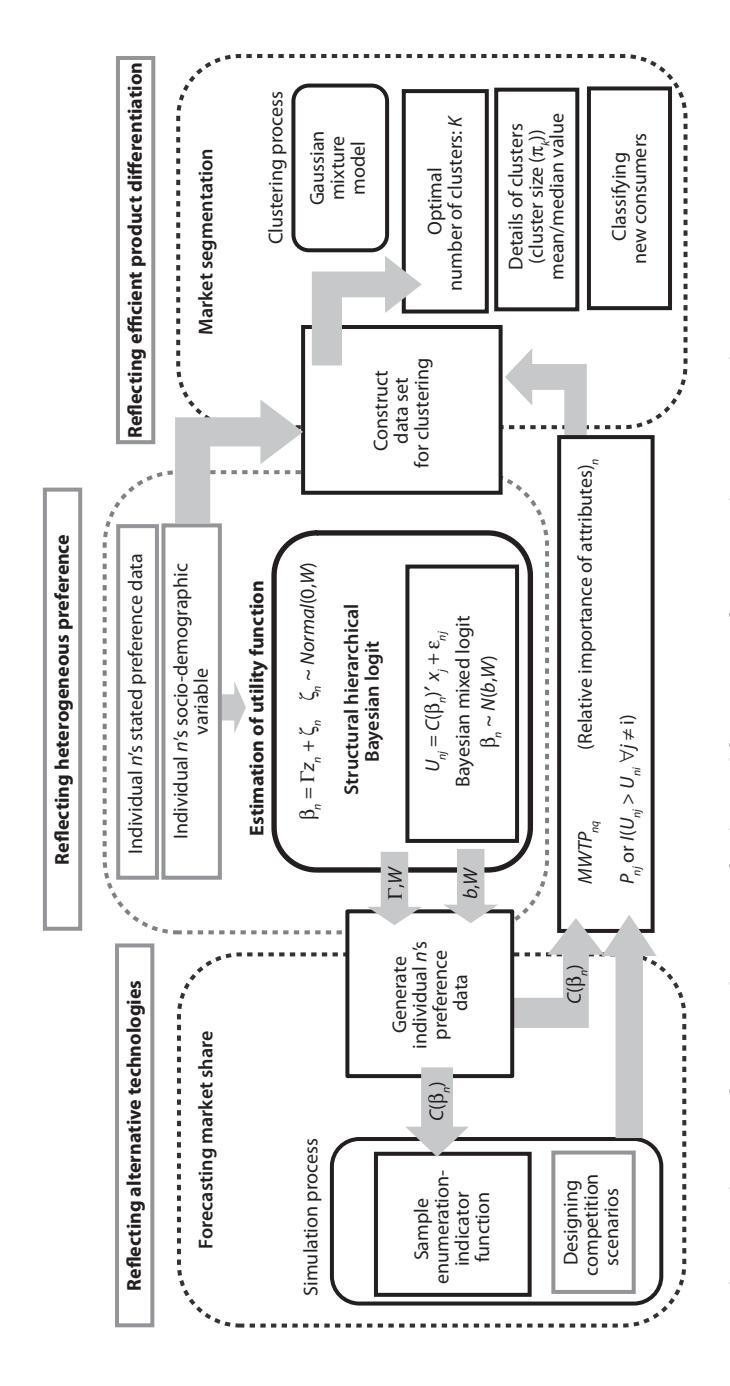
신제품의 통합 전략 demand-side management framework 제안 — (1) structural-hierarchical-bayesian-logit 로 이질적 utility 추정, (2) sample-enumeration indicator function 으로 market share simulation, (3) gaussian-mixture-model 로 optimal segment 도출. 한국 전자결제 수단 (cash, magnetic credit/debit card, IC credit/debit card) 사례 — 500 명 conjoint 설문 (Dongseo Research, 2005-08). 핵심 발견: IC card infrastructure 가 90% 도달 시 IC = cash 점유율; MWTP for infrastructure 13,764 KRW/% (mean), 2,804 KRW/% (median); GMM 으로 5 cluster — 현금 선호 (51.6%, 젊음·저소득), magnetic card (15.2%, 고연령·고소득), IC card (33.2%, 평균 연령·소득).
- RQ: (1) 신제품의 정확한 demand forecast 와 target segmentation 을 어떻게 동시에 구현하나? (2) 한국 전자결제 시장에서 cash → magnetic → IC card 의 substitution 동학과 segment 별 선호 이질성은?
- 방법론: 컨조인트 분석 (6 attribute, 648 → 32 fractional factorial, 8 sub-set), structural-hierarchical-bayesian-logit (Allenby & Lenk 1994 + Train 2003 mixed logit hybrid, MCMC 20,000 iter), market-share-simulation (sample enumeration of indicator function, Choi et al. 2008), gaussian-mixture-model (MDL criterion, MATLAB Bouman et al. 2005)
- 데이터: 한국 서울 500 명 conjoint 설문 (20-60 세, Dongseo Research, 2005 년 8 월). Attribute: carrying charge, credit line, infrastructure, PID (private information divulged %), access time, payment instrument type (cash/cheque/magnetic/IC)
- 주요 발견: (1) MWTP (mean/median, KRW/year): credit line 8,094/1,834, infrastructure 13,764/2,804/%, PID 14,255/326/%, access time 2,378/603/sec. (2) Demographics: 여성·고연령·고소득은 infrastructure 덜 중시; 고연령은 PID 덜 우려; 모두 access time 덜 민감. (3) IC card infrastructure 90% 도달 시 IC ≈ cash 점유율; debit card 가 credit card 보다 빠르게 cash 대체. (4) GMM 5 cluster: cluster 3 (39.6% weight, 젊음·저소득, 모든 attribute MWTP 낮음), cluster 5 (4.0%, 노인·저소득, 모든 attribute MWTP 매우 높음). (5) Sociodemographic + simulated choice cluster: 현금 선호 51.6% / magnetic 15.2% / IC 33.2%.
- 시사점: 신제품 출시 전략에서 attribute 최적화 + target segment 정의 의 통합 도구. 전자결제 무역: cash 가 여전히 dominant — IC card 가 차세대 도구로 자리 잡으려면 infrastructure 90% + access time 30 sec 이하 + PID 0 % 의 multi-attribute 동시 개선 필요.
요약
이 paper 는 이종수 의 2 기 (Bayesian 도구의 stylized empirical 응용 + segmentation extension) 의 대표 작업으로, Jae Young Choi (KIET) 와의 산학 협업. 이종수 author page anchor 의 demand-side management framework 라인에 위치. Ex-ante Simulation of Mobile TV Market Based on Consumers' Preference Data 의 mobile TV Bayesian DCM + market share 시뮬레이션 framework 을 segmentation 으로 한 단계 확장. 한국이 핀테크·전자결제 전환기에 있었던 2005-2013 년 시점의 산업·정책 input.
방법은 세 절차의 결합: (i) structural-hierarchical-bayesian-logit — Allenby & Lenk (1994) 의 hierarchical Bayesian + Train (2003) 의 mixed logit 의 hybrid (오차항을 i.i.d. extreme value I 로 가정, 의 cross-individual heterogeneity 구조). 응답자 socio-demographic 이 의 평균을 결정 — gender, age, household income 의 효과까지 동시 추정. (ii) Sample enumeration of indicator function — Choi et al. (2008) 의 modified simulation: . 기존 logit probability average 의 unrealistic prediction 회피. (iii) gaussian-mixture-model + MDL criterion — 최적 cluster 수를 자동 결정 (K-means 의 사전 K 결정 문제 회피), overlapping cluster 허용 (probabilistic membership), Bouman et al. (2005) MATLAB code 활용.
핵심 발견 (전자결제 사례): MWTP for HD-quality attributes — credit line mean 8,094 / median 1,834 KRW, infrastructure 13,764 / 2,804 KRW/%, PID 14,255 / 326 KRW/%, access time 2,378 / 603 KRW/sec. Mean-median 격차가 매우 큰 PID 와 infrastructure 는 소비자 이질성이 극심 — segment 분석이 의미 있음. IC card 시나리오 시뮬레이션: infrastructure 가 90% 도달해야 IC ≈ cash 점유율, PID 0% + access time 30 sec 동시 달성에도 50% 가 여전히 cash 선호 — 기존 도구의 inertia 효과. GMM clustering on MWTP: 5 cluster, 가장 큰 cluster 3 (39.6% weight) 은 젊고 저소득 + 모든 attribute MWTP 낮음 (현금 선호), cluster 5 (4.0%, 노인·저소득 남성) 은 모든 attribute 에 극단적 MWTP (특히 PID 307,426 KRW/%). GMM clustering on demographic + simulated choice: 4-5 cluster, 현금 선호 51.6% / magnetic 15.2% / IC 33.2% — segment 별 mass 정량화. 시사점: 신제품 전략은 aggregate 평균 utility maximization 보다 최대 cluster 의 marginal preference 충족 가 효과적.
핵심 결과
MWTP (mean / median, KRW/year, 4 핵심 attribute):
| Attribute | Mean MWTP | Median MWTP |
|---|---|---|
| Credit line | 8,094 KRW ($7.87) | 1,834 KRW ($1.78) |
| Infrastructure | 13,764 KRW/% ($13.39/%) | 2,804 KRW/% ($2.73/%) |
| PID (privacy risk) | 14,255 KRW/% ($13.87/%) | 326 KRW/% ($0.32/%) |
| Access time | 2,378 KRW/% ($2.31/%) | 603 KRW/% ($0.59/%) |
GMM 5-cluster on MWTP (medians, KRW/year):
| Cluster | Weight | Age | Income (만원) | MWTP credit | MWTP infra | MWTP PID | MWTP AT |
|---|---|---|---|---|---|---|---|
| 1 | 18.8% | 40 | 350 | 7,936 | 829 | 3,688 | 699 |
| 2 | 11.2% | 35 | 420 | 13,327 | 4,602 | 3,849 | 7,546 |
| 3 | 39.6% | 38 | 300 | 958 | 2,600 | 92 | 276 |
| 4 | 26.4% | 42 | 350 | 1,714 | 23,469 | 114 | 1,000 |
| 5 | 4.0% | 42 | 300 | 46,611 | 1,136 | 55,289 | 2,456 |
GMM 4-cluster on cash/magnetic/IC choice: cash 선호 51.6% (cluster 1+4, 젊음 37-39 세, 저소득 3-3.2M KRW), magnetic card 15.2% (cluster 2, 노년 46-49 세, 고소득 4-4.1M KRW), IC card 33.2% (cluster 3, 평균).
N=500 응답자, 32 alternative cards in 8 sub-sets, 20,000 Gibbs iteration (burn-in 10,000), 환율 $1 ≈ 1,028 KRW (2005-08).
방법론 노트
structural-hierarchical-bayesian-logit 은 Allenby & Lenk (1994) HB logit + Train (2003) mixed logit 의 hybrid. 차이점: Allenby-Lenk 은 가 i.i.d. 인 probit/logit profile evaluation 용, 본 paper 는 i.i.d. extreme value I 가정으로 Train 의 logit choice probability 구조 유지. 동시에 Allenby-Ginter (1995) 의 hierarchical structure 도입해 cross-individual heterogeneity 가 demographic 으로 explain 되는 구조.
핵심 식 (utility):
여기서 , = demographic vector (gender, age, income), = cross-unit coefficient matrix. Attribute 별 distribution transformation 으로 log-normal (선호 방향 일치) 또는 censored normal (일부 무관심) 적용.
MCMC Gibbs sampler 3 단계: , , . Train (2003) mixed logit 의 sampler 와 첫 step 만 다름 (Allenby-Ginter 의 hierarchical step 으로 대체). 20,000 iter, burn-in 10,000, 매 10번째 draw 보존 → 1,000 retained.
Market segmentation 식 (gaussian-mixture-model + MDL):
여기서 = cluster 수, = cluster 가중치·평균·공분산, = parameter 수, = sample size, = feature 수. AIC 대비 consistent — over-fitting 회피. EM algorithm 으로 최적화 (probabilistic membership 허용, K-means 의 hard assignment 회피).
연구 계보
본 paper 는 (i) Allenby & Lenk (1994) JASA 의 hierarchical Bayesian logistic-normal regression, (ii) Train & Sonnier (2005) Springer 의 bounded distribution mixed logit, (iii) Brownstone, Bunch, Train (2000) TRB 의 joint SP-RP mixed logit, (iv) Bouman et al. (2005) Purdue ECE 의 GMM + MDL clustering algorithm, (v) Ex-ante Simulation of Mobile TV Market Based on Consumers' Preference Data 의 modified market share simulation (sample enumeration of indicator function) — 5 갈래의 종합. 이종수 author page anchor 의 2 기 (Bayesian DCM의 stylized 확장기) 라인에서, Ex-ante Simulation of Mobile TV Market Based on Consumers' Preference Data 의 mobile TV 분석을 segmentation 확장 으로 발전시킨 sibling. Jungwoo Shin 의 SNU TEMEP 박사논문 시리즈 (Impact of Electric Vehicles on Existing Car Usage: A Mixed Multiple Discrete-Continuous Extreme Value Model Approach 와 sibling).
See also
- 이종수
- Jae Young Choi
- Jungwoo Shin
- structural-hierarchical-bayesian-logit
- hierarchical-bayesian-logit
- bayesian-mixed-logit
- gaussian-mixture-model
- market-share-simulation
- 컨조인트 분석
- market-segmentation
- ex-ante-policy-simulation
- electronic-payment
- international-journal-of-market-research
- Ex-ante Simulation of Mobile TV Market Based on Consumers' Preference Data
- Strategic Demand Forecasts for the Tablet PC Market Using the Bayesian Mixed Logit Model and Market Share Simulations
- Impact of Electric Vehicles on Existing Car Usage: A Mixed Multiple Discrete-Continuous Extreme Value Model Approach
인접 그래프
- 인물 3
- 방법론 1
- 분류 1
- 논문 3