Effects of intellectual property rights and patented knowledge in innovation and industry value added: A multinational empirical analysis of different industries
seokkyun-woo, pilseong-jang, 김연배 (2015) · Technovation 43-44:49–63 · DOI ↗
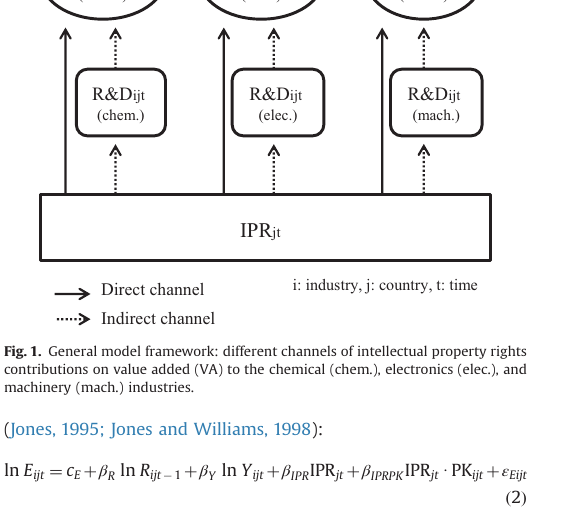
IPR (Intellectual Property Rights) 의 innovation 과 industry value added 에 미치는 효과를 discrete (chemical) vs complex (electronics, machinery) 산업 차이로 식별. 12 국 × 3 산업 × 1995-2005 panel + 3sls simultaneous (R&D-VA 동시). IPR 의 value-added 효과: machinery, electronics 만 양 + inverse-U (excessive IPR 의 patent thicket 효과). Chemical 은 직접 효과 부재. R&D 효과: 모든 산업에서 IPR × patented knowledge interaction 의 음의 유의 — 과도한 propertization 이 sequential innovation 저해 — Bessen-Maskin (2009) 명제 직접 실증.
- RQ: IPR 의 (i) direct effect on industry value-added (commercialization channel), (ii) indirect effect through R&D (innovation channel) 의 두 path 가 discrete vs complex 산업 에서 어떻게 다른가? Patented knowledge stock (PK) 가 sequential innovation 의 IPR 저해 mediator 역할인가?
- 방법론: 3sls simultaneous equations — (i) R&D equation, (ii) Value-added (production function) equation 의 동시 추정. IPR × PK interaction 으로 sequential innovation 의 negative IPR effect 식별. IPR² (quadratic) 로 inverse-U 검정
- 데이터: 12 OECD 국 × 3 산업 (chemical / electronics / machinery) × 1995-2005 panel (각 산업 ~115-124 obs). IPR = IMD World Competitiveness Index, PK = patented knowledge stock (patent count 누적). 통제: 자본 K, 노동 L (hours), R&D stock RDS20 (20% depreciation)
- 주요 발견: (i) Value-added 효과: machinery (+ 유의), electronics (+ 유의), chemical (n.s.) — complex 산업에서만 IPR 직접 효과. (ii) IPR² (quadratic) 의 음의 유의 in machinery, electronics — inverse-U shape, patent thicket 문제 입증. (iii) R&D 효과: 모든 3 산업에서 IPR 의 direct positive effect on R&D. 그러나 IPR × PK interaction 은 모든 산업에서 음의 유의 — patented knowledge 증가 시 IPR 의 R&D-promoting 효과 감소. (iv) Past R&D stock (RDS0) 효과: electronics 에서 가장 큼 — sequential cumulative learning 가장 활발. (v) IPR 의 virtuous cycle — IPR ↑ → R&D ↑ → R&D stock ↑ → value added ↑ (단 chemical 제외).
- 시사점: (a) TRIPs 의 universal strengthening 의 distortion: discrete 산업 (chemical, pharma) 의 strong IPR 정당화 가 complex 산업 (electronics, machinery) 의 patent thicket cost 를 만듦. (b) Inverse-U 의 정책 함의: IPR 강도의 optimum 존재 — 무한정 강화가 industry value added 감소. (c) **Sequential innovation 의 PK interaction: 전자·기계 같은 cumulative knowledge 산업에서 과도한 patenting 이 후속 R&D 저해 — patent pool, compulsory licensing, fair use 같은 access regime 필요. (d) Korea-specific 함의: machinery·electronics 가 한국 산업 의 dominant — IPR 정책 의 balance 가 long-run 성장의 핵심 lever.
요약
본 paper 는 김연배 의 IP 라인의 가장 큰 영향력 작업 (author page 의 제2기 (SNU-TEMEP 확장기) 의 IP-혁신 양면성 핵심, 87회 인용). Determinants of out-licensing strategy of firms: New empirical evidence 의 firm-level out-licensing 결정 → Licensing versus selling in transactions for exploiting patented technological knowledge assets in the markets for technology 의 firm-level licensing vs selling → 본 paper 의 industry-level IPR effect 로 IP 라인의 scale 확장. 기존 IPR-innovation 문헌 (Kanwar-Evenson 2003, Park-Ginarte 1997, Schneider 2005, Falvey et al. 2006, Sweet-Maggio 2015 등) 은 aggregate 또는 single-industry 분석에 머물러, industry heterogeneity (discrete vs complex) 미식별. 본 paper 의 conceptual move 는 — Cohen et al. (2000) 의 discrete (chemical) vs complex (electronics, machinery) 산업 분류 + Bessen-Maskin (2009) 의 sequential innovation literature + Hall-Ziedonis (2001) 의 patent thicket 의 통합 framework 으로 IPR 의 산업-conditional 효과 식별.
방법론은 3sls 의 2-equation simultaneous: (i) R&D investment , (ii) Value-added . 두 equation 의 동시 endogeneity (R&D ↔ VA) correction. IPR² 의 inverse-U 검정, IPR×PK 의 sequential innovation 저해 식별. knowledge-stock-model 의 perpetual inventory — RDS₀ (zero depreciation, sequential learning 측정), RDS₂₀ (20% depreciation, productive R&D stock).
발견의 정책 함의는 TRIPs-era 의 universal IPR strengthening 의 differential cost. (a) Discrete 산업의 IPR-신뢰: chemical 산업의 single-patent 보호 가 blocking 위험 작음 — IPR 강화가 순수하게 incentive effect. (b) Complex 산업의 thicket cost: electronics·machinery 의 cumulative + complementary patents → 강한 IPR 이 후속 inventor 의 licensing cost 폭발 → R&D 감소. (c) Korea 의 dual-industry structure: 화학 (LG화학 등) + 전자 (Samsung Electronics) + 기계 (현대모비스 등) 의 bimodal — 국가 IPR 정책 의 산업-balanced design 필요. (d) Patent pool / standard-essential patent (SEP) 정책: electronics, machinery 의 patent thicket cost 완화의 핵심 regulatory tool. 한계: (i) 12 국 × 3 산업의 small panel (사용 obs 115-124), (ii) IMD IPR index 의 perceived enforcement survey-based (objective measure 아님), (iii) PK 측정의 patent count only (citation-weighted 미반영), (iv) 1995-2005 의 pre-smartphone era — digital economy 의 software patent 이슈 미포함.
핵심 결과
Industry value-added equation (Tables 8-10 simplified)
| 산업 | IPR (m1) | IPR² (m2 quadratic) | inverse-U? |
|---|---|---|---|
| Chemical (discrete) | n.s. | n.s. | 부재 |
| Electronics (complex) | + 유의 | − 유의 | 있음 |
| Machinery (complex) | + 유의 (largest) | − 유의 | 있음 |
R&D investment equation
| 산업 | IPR | IPR × PK (interaction) | RDS₀ (sequential learning) |
|---|---|---|---|
| Chemical | + 유의 | − 유의 | + 유의 |
| Electronics | + 유의 | − 유의 | + 유의 (largest) |
| Machinery | + 유의 | − 유의 | + 유의 |
정량 결론. (i) IPR 의 direct VA 효과는 complex 산업만 (electronics, machinery) + inverse-U. (ii) IPR 의 R&D 효과는 모든 산업 양, 그러나 PK 누적 시 negative — sequential innovation 저해 의 universal pattern. (iii) Electronics 에서 past R&D stock 효과 가장 큼 — cumulative learning 의 활발.
방법론 노트
3sls 의 simultaneous estimation 은 R&D ↔ VA 의 bi-directional causality 처리. Reduced form 의 instrument 로 capital, labor, IPR, IPR² 을 사용 — 각 equation 의 endogenous variable 의 fitted value 로 대체. 두 equation 의 cross-equation residual correlation 활용해 efficiency gain.
핵심 식. Two-equation system:
여기서 = industry, = country, = year. Inverse-U: → IPR 효과의 turning point . 식별은 (i) IMD IPR 의 country-year exogeneity (industry-level outcome 에 외생), (ii) RDS₀ vs RDS₂₀ 의 sequential vs productive knowledge distinction, (iii) 3SLS instrument 의 rank condition.
연구 계보
본 paper 는 (a) Kanwar-Evenson (2003), Park-Ginarte (1997), Schneider (2005), Falvey-Foster-Greenaway (2006), Sweet-Maggio (2015) 의 IPR-growth literature, (b) Cohen-Nelson-Walsh (2000) 의 discrete vs complex industry literature, (c) Bessen-Maskin (2009), Murray-Stern (2007), Encaoua-Guellec-Martinez (2006), Gallini (2002) 의 sequential innovation + IPR literature, (d) Hall-Ziedonis (2001), Heller-Eisenberg (1998) 의 patent thicket + anticommons literature 의 통합. Determinants of out-licensing strategy of firms: New empirical evidence 의 기업 수준 IP 전략 → Licensing versus selling in transactions for exploiting patented technological knowledge assets in the markets for technology 의 기술 거래 mode → 본 paper 의 industry-level IPR effect 로 firm → industry scale-up 의 라인 (author page 분류). 김연배 author page 의 제3 실타래 (IP 보호의 양면성, 2010-2024) 의 mid-stage milestone. 이후 The complementary effect of intellectual property protection mechanisms on product innovation performance (R&D Management) 의 7-mechanism IP protection 보완성 분석으로 라인 확장 (author page 제3기 분류).
See also
- 3sls
- simultaneous-equations
- 지적재산권
- sequential-innovation
- patent-thicket
- discrete-vs-complex-industry
- seokkyun-woo
- 김연배
- Determinants of out-licensing strategy of firms: New empirical evidence
- Licensing versus selling in transactions for exploiting patented technological knowledge assets in the markets for technology
- The complementary effect of intellectual property protection mechanisms on product innovation performance
- Technovation
인접 그래프
- 인물 1
- 방법론 1
- 주제 2
- 수록처 1
- 분류 1
- 논문 7
이 문서를 가리키는 페이지
논문 (6)
- Corporate strategies to protect software innovation: Empirical evidences from South Korea
- Determinants of out-licensing strategy of firms: New empirical evidence
- Market share and firms' patent exploitation
- Strategic and economic behavior of a sued company in patent litigation
- The complementary effect of intellectual property protection mechanisms on product innovation performance
- The impact of efficiency parameters on firms' innovative activities: Evidence from Korean firm-level data