E-Government Challenges in Least Developed Countries (LDCs): A Case of Cambodia
Sinawong Sang, 이정동, 이종수 (2009) · ICACT 2009 (Feb. 15–18, 2009), pp. 2169–2175
캄보디아 Government Administration Information System (GAIS) 의 implementation 단계 challenges 를 최빈국 (LDC) 의 6 challenge category 위에서 분석한 descriptive conceptual paper. 6 categories: (1) infrastructure development, (2) law and ICT policy, (3) management, (4) equity issues, (5) digital divide, (6) privacy and security. Heeks (2003) 의 e-readiness 6 dimensions (data system · legal · institutional · human · technological · leadership) framework 위에서 Cambodia 의 각 dimension 별 상태 진단. 핵심 narrative: 비록 GAIS 가 initial objectives (27 부처 + Phnom Penh 시청 LAN/WAN 연결, 부동산·주민·차량 등록 widely used) 달성했지만 post-implementation phase 에서 infrastructure gaps + legal framework 부재 + 디지털 격차 + female access disparity + privacy/security 위협 의 친정 challenges 가 지속. 정책 함의: ICT 정책 통합 + legal recognition (digital signature 등) + capacity development + female participation 강화.
- RQ: Cambodia 같은 최빈국 에서 e-Government (GAIS) implementation 의 6 challenge dimension 은 무엇이며, 각 dimension 의 정책 leverage 는?
- 방법론: 사례연구 (Cambodia GAIS) + 정책 framework 개념화 (Heeks 2003 의 e-readiness 6 dimensions 적응); 정량 분석 없음, descriptive
- 데이터: Cambodia GAIS 의 secondary 문서 (NiDA 보고서, Phu 2003 등) + LDC e-Government 일반 문헌 (Heeks 2003, InfoDev 2002, Gant 2008, OECD 2003)
- 주요 발견: 6 challenge categories 별 Cambodia 상태 — (i) Infrastructure: 전력·통신 불안정, hardware 접근 부족; (ii) Law/ICT policy: digital signature 법적 인정 부재, 전자 문서 framework 미구축; (iii) Management: vertical 정부 구조 + command-control 운영 모드 + 부처간 비협력; (iv) Equity: 여성·취약계층의 ICT 접근 부족, ICT-related 교육 분야의 여성 참여 낮음; (v) Digital divide: 도시·농촌 + 학력·소득 격차; (vi) Privacy/security: 보안 위협 (환경 재해 포함) + 법적 보호 framework 부재
- 시사점: LDC 의 e-Government 성공의 pre-condition: (i) ICT 정책의 통합 framework (개별 부처 driven 의 fragmented approach 회피), (ii) legal recognition (digital signature, 전자 문서, 무권한 접근 보호), (iii) capacity development — 80% people / 20% technology (InfoDev 2002), (iv) gender equity — 여성 ICT 접근 확대 정책, (v) funding sustainability — donor 지원 종료 후 운영 자금
요약
캄보디아 는 1990 년대 후반 liberal political system + market economy 채택 이후 경제·사회 reform 의 일환으로 e-Government 도입 — GAIS (Government Administration Information System). Goal: corruption, poor public administration, lack of transparency 등 governance challenges 극복. 그러나 GAIS 의 utilization 은 limited — 도입 후 phase 의 challenges 가 핵심 문제. 본 paper 는 이 challenges 를 LDC 일반의 framework 위에서 분석.
LDC e-Government challenges 의 일반 framework (Heeks 2003 의 e-readiness 6 dimensions 위에 구조):
- Data system infrastructure — quality data 의 systematic provision
- Legal infrastructure — e-Government 의 법적 토대 (전자 문서 인정 등)
- Institutional infrastructure — focal 기관, facilitation 메커니즘
- Human infrastructure — 공무원의 ICT 스킬과 attitude
- Technological infrastructure — 전력 · 통신 · hardware
- Leadership and strategic thinking — e-champion 의 vision
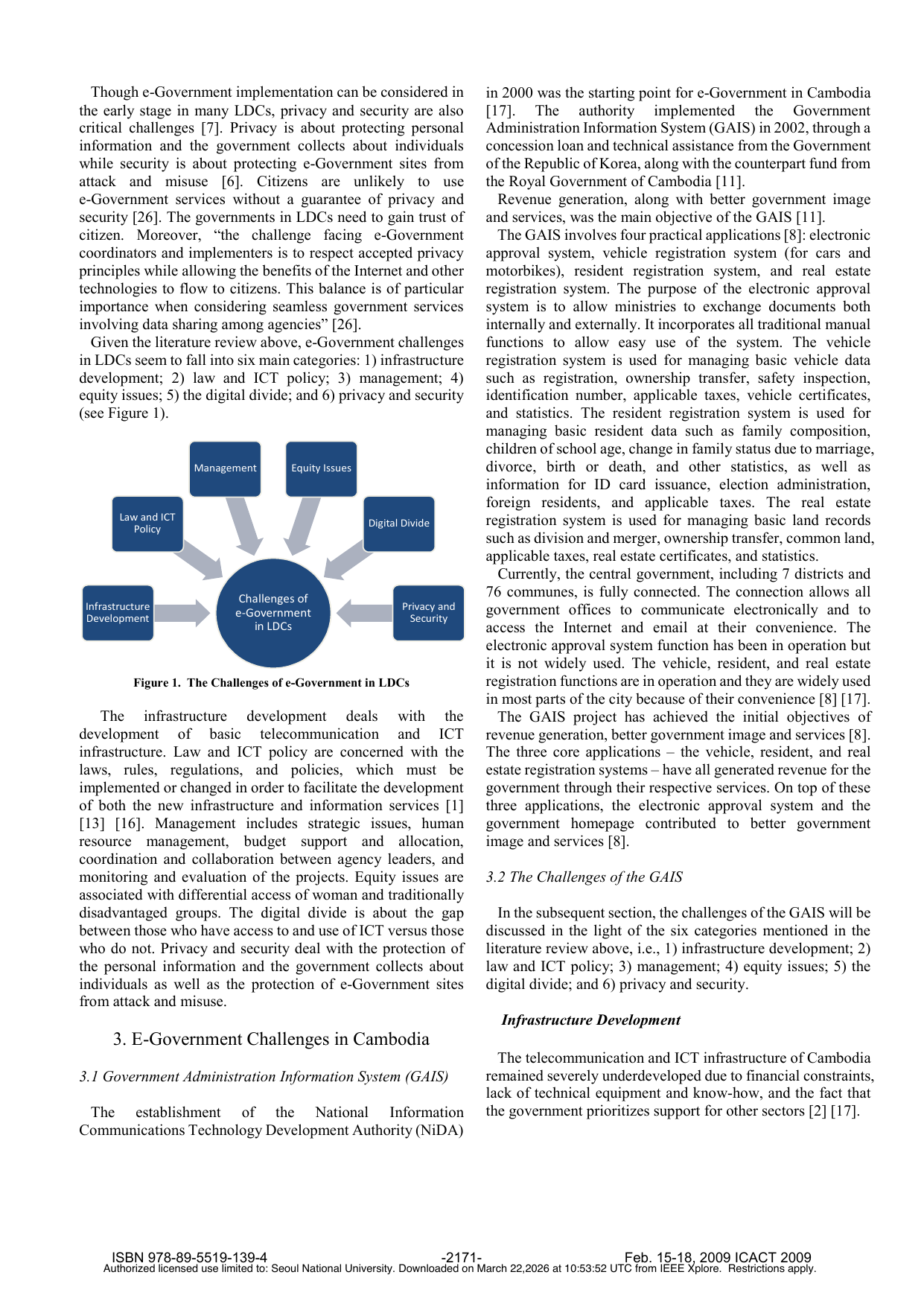
본 paper 는 Cambodia 의 6 challenge categories 로 재구성:
(1) Infrastructure development — Cambodia 의 poor technological infrastructure: 불안정한 전력 + 통신 + Internet 연결성 + hardware 접근성. LDC 들이 basic infrastructure 구축에 struggle.
(2) Law and ICT policy — Heeks 의 legal infrastructure 갈래. 핵심 gap: digital signature 의 legal recognition 부재 → 전자 문서 (특히 sensitive 개인·금융 정보 포함) 의 acceptance 불가. 수직적 정부 구조 (vertical, command-control) 가 부처간 coordination 약화. Fundamental transformation 이 ICT 추가 만으로 발생 안 함 (Bonham 2003).
(3) Management — 부처간 비협력 + fragmented funding — 개별 부처 driven 프로젝트가 donor 지원에 의존, donor 지원 종료 후 funding 단절 → 프로젝트 미완성.
(4) Equity issues — 여성과 전통적 취약계층 의 ICT 접근 격차 — (i) physical access 차이, (ii) ICT-related vocational/college 분야의 여성 참여 낮음, (iii) 경제·사회·심리적 ICT 가치 인식 부족.
(5) Digital divide — ICT 접근 vs 비접근 의 disparity. 3 영역: (i) infrastructure 접근 (hardware, software, telecommunication), (ii) 교육·스킬 접근, (iii) 콘텐츠·서비스 접근.
(6) Privacy and security — e-Government 시스템의 보안 vulnerabilities + 환경 재해 (지진 · 쓰나미 · 정전 · 허리케인 · 화재) 위험 + 법적 보호 framework 부재.
정책 함의 (Section 4):
- Integrated ICT policy framework 채택 — 개별 부처 driven 의 fragmented approach 회피
- Legal infrastructure 구축 — digital signature 인정 + 전자 문서 framework + 무권한 접근 방지법
- Capacity development — InfoDev (2002) 의 80% people 20% technology 원칙 — 단순 typing 이 아닌 시스템 잠재력 강조 training
- Gender equity — 여성 ICT 교육 + access 확대
- Funding sustainability — donor 지원 후의 국내 운영 자금 확보
- Privacy/security strategy — Gant (2008) 의 6 단계 보안 (prevention · detection · damage limit · recovery · correction · awareness)
한계는 본 paper 가 descriptive conceptual 이고 empirical 정량 분석 부재 — sibling E-government adoption in ASEAN: the case of Cambodia 가 이 gap 을 N=112 공무원 설문으로 채움. 본 paper 는 문제 진단, sibling 은 결정요인 정량 추정 의 paired 구조.
핵심 결과
Heeks (2003) e-readiness 6 dimensions 의 Cambodia 적용
| Dimension (Heeks) | 본 paper 의 category | Cambodia 상태 |
|---|---|---|
| Data system infrastructure | (Management 의 일부) | 부처간 data standard 미통일 |
| Legal infrastructure | Law and ICT policy | digital signature 법적 인정 부재 |
| Institutional infrastructure | Management | NiDA 존재하지만 부처간 coordination 약 |
| Human infrastructure | (Equity, digital divide 와 결합) | 공무원 ICT 스킬 격차 + 여성 참여 부족 |
| Technological infrastructure | Infrastructure development | 전력·통신 불안정 |
| Leadership and strategic thinking | (Management 의 일부) | e-champion 존재하지만 vision 통합 부족 |
6 challenge categories 의 Cambodia 진단 요약
| Category | Cambodia 상태 | 정책 leverage |
|---|---|---|
| 1. Infrastructure development | 전력·통신 불안정 | 기본 인프라 투자 |
| 2. Law and ICT policy | digital signature · 전자 문서 법적 framework 부재 | 법제화 |
| 3. Management | vertical + command-control + fragmented funding | 통합 ICT 정책 framework + 운영 자금 확보 |
| 4. Equity issues | 여성·취약계층 ICT 접근 부족 | gender equity 정책 + 취약계층 ICT 교육 |
| 5. Digital divide | 도시·농촌 + 학력·소득 격차 | universal access + ICT 교육 |
| 6. Privacy and security | 법적 보호 + 보안 기술 framework 부재 | 6 단계 보안 전략 + 법제화 |
방법론 노트
본 paper 는 empirical 정량 분석 부재 — 사례연구 + 정책 framework 개념화 의 결합. 방법론적 elements:
- Framework 도입 — Heeks (2003) 의 e-readiness 6 dimensions 를 Cambodia case 에 적응. 6 challenge categories 로 재구성.
- Secondary 데이터 — NiDA (National ICT Development Authority) 보고서, Phu (2003) 의 GAIS 도입 보고서, World Bank 의 e-Government 정의, InfoDev (2002) 의 e-Government 핸드북, OECD (2003) 의 e-Government imperative.
- Comparative 사례 reference — 기타 LDC (Africa Heeks 2003, 기타 ASEAN 등) 와의 정성적 비교.
방법론적 한계: (i) Cambodia 단일 케이스 — generalization 어려움, (ii) 6 challenge categories 의 상대 중요도 정량 비교 없음, (iii) Cambodia 의 시간적 dynamics (challenge 가 시간에 따라 어떻게 변하는가) 미관측.
연구 계보
본 paper 의 e-readiness framework lineage: Heeks (2003) “Most eGovernment-for-Development Projects Fail” 의 6 dimensions 가 핵심 anchor — 본 paper 가 이를 Cambodia 에 적용. Heeks 의 후속 Design-Reality Gap (2003) 도 본 paper 의 Section 4 정책 분석에서 reference. LDC e-Government 일반 lineage: InfoDev (2002) E-Government Handbook for Developing Countries, Gant (2008) ITU Electronic Government for Developing Countries, OECD (2003) E-Government Imperative, Song (2004) Building E-Government through Reform (Korean 경험), Bonham et al (2003) 의 ICT 와 fundamental transformation.
Cambodia-specific literature: Phu (2003) NiDA 의 GAIS implementation 보고서가 핵심 source. Sinawong Sang 의 후속 paper 들이 본 conceptual baseline 위에서 정량 분석으로 확장 — 본 paper 와 A Study on the Contribution Factors and Challenges to the Implementation of E-Government in Cambodia, E-government adoption in ASEAN: the case of Cambodia, Adoption of E-Government Services: The Case of Electronic Approval System 의 4 paper 시리즈가 문제 진단 (descriptive) + 결정요인 (정량) + EAS 특정 (focused 정량) 의 Sinawong Sang trilogy.
TEMEP 내 sibling: 위 3 paper 외 Sira Maliphol 라인의 개도국 STI 정책 sibling. 본 paper 는 기술경영경제정책전공 의 개도국 ICT 정책 + LDC 적용 라인의 첫 conceptual baseline.
See also
- 사례연구
- 정책 framework 개념화
- e-Government 채택
- 캄보디아
- 최빈국
- GAIS
- 디지털 격차
- e-Readiness
- E-government adoption in ASEAN: the case of Cambodia
- A Study on the Contribution Factors and Challenges to the Implementation of E-Government in Cambodia
- Adoption of E-Government Services: The Case of Electronic Approval System
- Sinawong Sang
- 이정동
- 이종수
인접 그래프
- 인물 4
- 개관 1
- 방법론 2
- 개념 1
- 주제 5
- 수록처 1
- 분류 2
- 논문 7
이 문서를 가리키는 페이지
논문 (7)
- A Conceptual Model of e-Government Acceptance in Public Sector
- A Study on the Contribution Factors and Challenges to the Implementation of E-Government in Cambodia
- Adoption of E-Government Services: The Case of Electronic Approval System
- Adoption of E-Government Services: The Case of Electronic Approval System
- E-government adoption in ASEAN: the case of Cambodia
- E-government adoption in Cambodia - a partial least squares approach
- Evaluation Telecenter Performance in Social Sustainability Context: A Cambodia Case Study