E-government adoption in ASEAN: the case of Cambodia
Sinawong Sang, 이정동, 이종수 (2009) · Internet Research 19(5):517–534 · DOI ↗
캄보디아 Government Administration Information System (GAIS) — ASEAN 의 신규 회원국 캄보디아 가 2000 e-ASEAN Framework 후 도입한 4-application e-Government 플랫폼 (EAS, 부동산·주민·차량 등록) — 의 adoption 결정요인 을 기술수용모형 + TAM2 (확장) + DOI 이론 + e-Government 신뢰 의 통합 모형으로 분석. 12 부처 N=112 공무원 의 multiple regression. 핵심 발견: (i) intention to use 의 결정요인 — perceived usefulness +0.347*** + trust +0.257** + relative advantage +0.212*; 그러나 perceived ease of use 와 compatibility 는 무의미; (ii) perceived usefulness 의 결정요인 — image +0.378*** + output quality +0.191*; subjective norm · job relevance 는 무의미. Cambodia 같은 LDC 의 e-Government 정책은 유용성·신뢰·상대적 우위 + image 와 output quality 에 focus 필요.
- RQ: ASEAN 회원국 중 신규 가입한 캄보디아 의 e-Government 시스템 (GAIS) 의 공무원 채택 결정요인은 무엇이며, TAM + TAM2 + DOI + trust 통합 모형이 LDC 환경에서 어떻게 작동하는가?
- 방법론: 기술수용모형 (Davis 1989), TAM2 (확장) (Venkatesh-Davis 2000), DOI 이론 (Rogers 2003), e-Government 신뢰 (Warkentin et al 2002) 의 통합 모형 + Fishbein-Ajzen (1975) TRA 위에 다중회귀분석 (2 단계 회귀)
- 데이터: Cambodia 12 부처 N=112 공무원 자기보고 설문 (5-point Likert), 65% office Internet 사용, 50.9% low-level 직위. 변수 — PU · PEOU · TRUST · CP · RA · IMG · SN · JR · OQ · IUSE
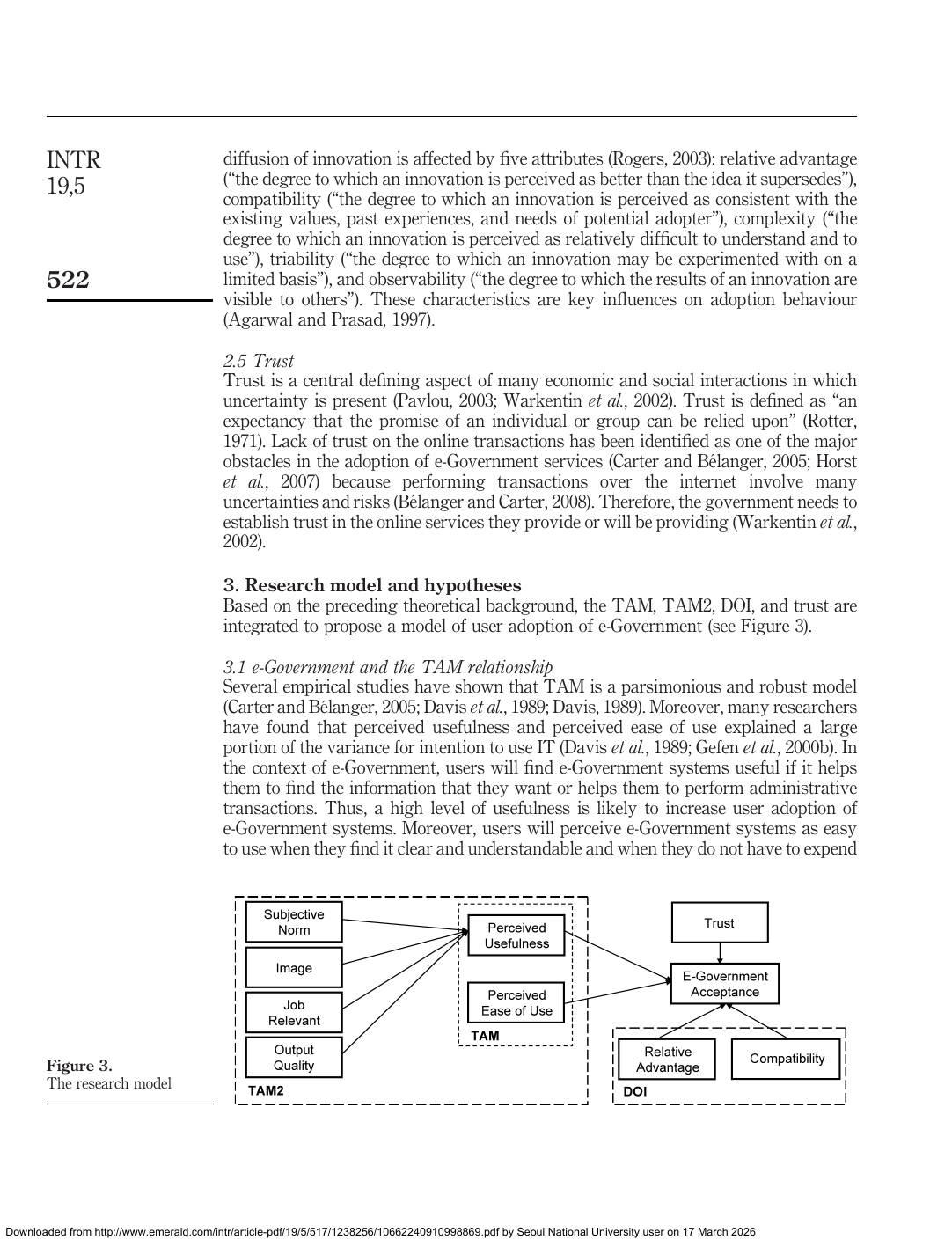
- 주요 발견: First regression (DV = PU): IMG +0.378***, OQ +0.191*, JR n.s., SN n/a; R² = 0.272. Second regression (DV = IUSE): PU +0.347***, TRUST +0.257**, RA +0.212*, PEOU −0.146 n.s., CP +0.094 n.s.; R² = 0.305. H1 · H3 · H5 supported, H2 · H4 not
- 시사점: Cambodia 의 e-Government 정책 4 leverage — (i) perceived usefulness 향상 (포털 정확성·시간 절약), (ii) trust + security (6 단계 전략), (iii) image 와 output quality (training 강조), (iv) Relative advantage 메시지. ease of use 는 부수적, compatibility 도 약함
요약
2000 년 ASEAN 10 개 회원국이 e-ASEAN Framework Agreement 를 endorse 하면서 6 pillar 중 e-Government 가 명시. 회원국 별 implementation 사례: 말레이시아 MSC (7 pilot — SPPII, HRMIS, GOE, EP, e-Services, ELX, e-Syariah); 싱가포르 eCitizen portal; 필리핀 BIR e-broadcasting; 미얀마 e-procurement; 베트남 Tale of Two Cities. 캄보디아 는 신규 회원으로 Government Administration Information System (GAIS) — 4 core application (EAS · 부동산 · 주민 · 차량 등록 + worldwide web) — 을 NiDA (National ICT Development Authority) 주도로 도입. 27 부처 + Phnom Penh 시청의 LAN/WAN 연결, 부동산·주민·차량 등록 widely used. 그러나 EAS 는 infrequent use — 본 paper 의 핵심 motivation.
방법론은 4 가지 IT/e-Government 이론 통합:
(1) Technology Acceptance Model (TAM) — Davis (1989) 의 Fishbein-Ajzen (1975) TRA 기반 PU + PEOU → intention → use 체인. 후속 단순화로 attitude 제외 (Carter-Bélanger 2005).
(2) TAM2 — Venkatesh-Davis (2000) 의 PU 결정요인 추가: SN, IMG, JR, OQ, RD + moderator (experience, voluntariness).
(3) Diffusion of Innovations — Rogers (2003) 의 5 attribute (RA, CP, complexity, trialability, observability). 본 paper 는 RA + CP 채택.
(4) Trust — Pavlou (2003), Warkentin-Gefen-Pavlou-Rose (2002) 의 online 거래 불확실성 시각. Bélanger-Carter (2008) 의 e-Government 의 trust + risk 분석.
데이터: Cambodia 12 부처 N=112 공무원 5-point Likert. Sample 65% office Internet 사용, 50.9% low-level, 37.5% 5 년 이상 경험.
2 단계 nested regression. First regression (DV = PU): IMG +0.378*** + OQ +0.191*, JR n.s., SN excluded. R² = 0.272. Second regression (DV = IUSE): PU +0.347*** + TRUST +0.257** + RA +0.212* — 모두 양 유의. PEOU −0.146 n.s. (의외 음 부호), CP +0.094 n.s. R² = 0.305.
저자 해석:
- H1 supported — PU 가 IUSE 의 dominant driver
- H3 supported — TRUST 양 유의. 6 단계 보안 전략 (prevention · detection · damage limit · recovery · correction · awareness, Gant 2008) + 법적 framework (전자 문서 인정, 무권한 접근 방지, 전자 인증) 권장
- H5 supported — RA 양 유의. 기존 시스템 대비 정보 공유 + transparency + 비용 절감 메시지
- H2 not supported — PEOU 가 IUSE 에 부정적 또는 무의미, Legris-Ingham-Collerette (2003) 의 PEOU 약효과 가설과 일치
- H4 not supported — CP 무의미, LDC 의 기존 절차 부재 가 reference 모호
정책 함의 4 leverage: (i) PU 향상 (포털 정확성 + 시간 절약), (ii) Trust + Security 강화, (iii) image 와 output quality 강조 training, (iv) RA 메시지. 본 paper 는 Cambodia 에 대한 첫 e-Government adoption 정량 연구. 한계: (i) N=112 + Cambodia 공무원 한정 (시민 perspective 부재), (ii) R² 0.27–0.31 의 unexplained variance (information quality · service quality · culture 추가 필요), (iii) cross-section 의 dynamic 미관측.
핵심 결과
Sample (N=112 Cambodia 공무원, Table 4 발췌)
| 차원 | 분포 |
|---|---|
| Position | Top 4.5% / Middle 36.6% / Low 50.9% / Others 8.0% |
| Internet 사용 장소 | Office 65.2% / Internet cafe 17.9% / Both 13.4% / Home 3.6% |
| Internet 경험 | < 1 yr 10.7% / 1-3 yrs 26.8% / 4-5 yrs 25.0% / > 5 yrs 37.5% |
| 학력 | Master 34.8%, Doctor 1.8% |
First regression — Perceived Usefulness (Table VI)
| Variable | Coefficient | t | Supported |
|---|---|---|---|
| IMG (image) | +0.378 | 4.27*** | YES (H1b) |
| OQ (output quality) | +0.191 | 2.16* | YES (H1d) |
| JR (job relevance) | +0.125 | 1.50 n.s. | NO (H1c) |
| SN (subjective norm) | excluded | — | n/a (H1a) |
R = 0.522, R² = 0.272.
Second regression — Intention to Use (Table VIII)
| Variable | Coefficient | t | Supported |
|---|---|---|---|
| PU (perceived usefulness) | +0.347 | 3.65*** | YES (H1) |
| PEOU (perceived ease of use) | −0.146 | −1.67 n.s. | NO (H2) |
| TRUST | +0.257 | 3.13** | YES (H3) |
| CP (compatibility) | +0.094 | 1.02 n.s. | NO (H4) |
| RA (relative advantage) | +0.212 | 2.28* | YES (H5) |
R = 0.552, R² = 0.305.
e-Government 보안 전략 (Table IX, Gant 2008)
| 단계 | 목적 |
|---|---|
| Prevention | 인적 error · 무권한 접근 방지 |
| Detection | 시스템 공격 감지 |
| Damage limitation | 신속 복구 |
| Recovery | 정식 재해 복구 계획 |
| Correction | 원인 분석 및 재발 방지 |
| Awareness | 직원·외부 이해관계자 교육 |
방법론 노트
기술수용모형 (Davis 1989): PU + PEOU → attitude → intention → use. Fishbein-Ajzen (1975) TRA 의 IT 응용.
TAM2 (확장) (Venkatesh-Davis 2000): PU 결정요인을 (i) 사회적 영향 — SN, IMG, (ii) 인지적 도구적 process — JR, OQ, RD, PEOU 로 분해.
DOI 이론 (Rogers 2003): 5 attribute — RA, CP, complexity, trialability, observability.
본 paper 의 통합 nested regression:
Stage 1:
Stage 2:
5-point Likert multiple item 평균 (예: PU = 4 item 평균 5.62). Cronbach α > 0.7 충족 가정. 식별은 (i) N=112 cross-section, (ii) 5 결정요인 paired variation, (iii) PU 결정요인 사전 추정 → Stage 2 endogenous 처리에서 온다. PEOU 의 음 부호는 PU 와의 multicollinearity 신호.
연구 계보
본 paper 의 IT adoption theory lineage: TAM (Davis 1989 MIS Quarterly), TAM2 (Venkatesh-Davis 2000 Management Science), TAM3 (Venkatesh-Bala 2008 Decision Sciences) + DOI (Rogers 2003) + TRA (Fishbein-Ajzen 1975). Trust in e-government lineage: Warkentin-Gefen-Pavlou-Rose (2002 Electronic Markets), Carter-Bélanger (2005 Information Systems Journal), Bélanger-Carter (2008 Journal of Strategic Information Systems), Horst-Kuttschreuter-Gutteling (2007 Computers in Human Behaviour). e-Government in LDCs lineage: Heeks (2003) 의 e-readiness 6 dimensions, InfoDev (2002) 의 80% people 20% technology, Gant (2008) 의 ITU/UN 보고서, OECD (2003) 의 e-Government imperative.
TEMEP 내 sibling: (i) Adoption of E-Government Services: The Case of Electronic Approval System — 같은 batch · 같은 데이터의 후속 IJEA 발표 (EAS 만 focus). (ii) A Study on the Contribution Factors and Challenges to the Implementation of E-Government in Cambodia — 같은 batch 의 contribution factors + challenges conceptual 분석. (iii) E-Government Challenges in Least Developed Countries (LDCs): A Case of Cambodia — 같은 batch 의 LDC e-Government 6 challenges descriptive 분석. (iv) Sira Maliphol 라인의 개도국 STI 정책 sibling. 본 paper 는 기술경영경제정책전공 의 ICT 정책 + 개도국 적용 라인의 첫 정량 anchor — Cambodia 에 대한 첫 e-Government adoption 실증.
See also
- 기술수용모형
- TAM2 (확장)
- DOI 이론
- e-Government 신뢰
- 다중회귀분석
- e-Government 채택
- 캄보디아
- GAIS
- ASEAN e-Government
- Adoption of E-Government Services: The Case of Electronic Approval System
- A Study on the Contribution Factors and Challenges to the Implementation of E-Government in Cambodia
- E-Government Challenges in Least Developed Countries (LDCs): A Case of Cambodia
- Sinawong Sang
- 이정동
- 이종수
인접 그래프
- 인물 4
- 개관 1
- 방법론 3
- 개념 3
- 주제 4
- 수록처 1
- 분류 2
- 논문 8
이 문서를 가리키는 페이지
논문 (8)
- A Conceptual Model of e-Government Acceptance in Public Sector
- A Study on the Contribution Factors and Challenges to the Implementation of E-Government in Cambodia
- Adoption of E-Government Services: The Case of Electronic Approval System
- Adoption of E-Government Services: The Case of Electronic Approval System
- An Empirical Study on the Determinants of User Acceptance of e-Government in Public Sector
- E-government adoption in Cambodia - a partial least squares approach
- E-Government Challenges in Least Developed Countries (LDCs): A Case of Cambodia
- Evaluation Telecenter Performance in Social Sustainability Context: A Cambodia Case Study