Evaluation Telecenter Performance in Social Sustainability Context: A Cambodia Case Study
Sopheak Cheang, 이정동 (2010) · IEEE International Conference, pp. 135–141
Cambodia 의 rural ICT 개발 프로젝트 iREACH (Informatics for Rural Empowerment and Community Health) 20 개 Telecenter 의 operational efficiency 를 DEA (DEA) 의 formative assessment 로 평가. Social sustainability — donor 지원 종료 후에도 community 가치 유지 — 의 평가 framework 부재 문제를 해결. 핵심 결과: 20 telecenter 중 일부가 frontier 위 (efficient), 나머지는 inefficient — resource allocation 의 systematic difference. 정책 함의: telecenter 의 기술적 기능 외에 community acceptance content + 사회적 sustainability 가 효율의 핵심 driver. DEA frontier 위의 telecenter 들은 benchmark / best practice 로 사용 가능. iREACH 같은 LDC ICT4D 프로젝트의 donor exit strategy 와 micro-enterprise transition 의 정량 evidence base 제공.
- RQ: Cambodia 의 rural Telecenter (iREACH 의 20 hub) 의 operational efficiency 와 social sustainability 를 어떻게 측정하며, donor 지원 종료 후의 sustainability 의 결정요인은?
- 방법론: DEA — output-oriented DEA 의 CRS/VRS DEA models (CRS + VRS) 동시 적용, scale efficiency 분리; Formative assessment (Hudson 2001) approach — progress 와 outcome 모니터링 의 평가 framework
- 데이터: iREACH 의 20 telecenter (Kep 10 + Kamchaimear 10), 인구·ICT 지표·hub 별 service usage. Input: operating cost, staff, equipment (computer + antenna + solar power). Output: 방문 수 + training 참여 + community engagement
- 주요 발견: (i) CRS 와 VRS efficiency 의 차이 — scale 비효율 식별: 일부 telecenter 는 too small 또는 too large 의 scale issue. (ii) iREACH 의 2 site (Kep 농어업 vs Kamchaimear 농업) 의 efficiency 차이 — Kamchaimear 의 mobile phone (20%, vs Kep 7%) 와 TV (77%, vs Kep 20%) 가 baseline community ICT awareness 더 높음, telecenter 보완 효과. (iii) Wireless + solar power 의 기술적 친정 — rainy season + 강풍 시 connectivity 손실 → efficiency 의 변동성. (iv) Inefficient telecenter 의 input slack 식별 — resource reallocation strategy 의 quantitative basis
- 시사점: (i) Telecenter 평가의 framework — social sustainability + efficiency 의 paired metric. (ii) Donor exit strategy: iREACH 의 3 년 free service → micro-enterprise transition 모델의 경제적 viability 검증. (iii) Best practice telecenter 의 공유 + benchmark 로 replication 가속. (iv) LDC ICT4D 프로젝트의 evidence-based design 의 evidence
요약
ICT for Development (ICT4D) 프로젝트의 대표적 application 인 Telecenter 는 non-profit 형태로 도시 빈민 + 농촌 community 에 ICT 서비스 (컴퓨터, Internet, email) 를 제공. 그러나 donor 지원 종료 시 대부분 telecenter activity 정지 — sustainability 문제 가 ICT4D 의 chronic issue. 기존 문헌이 financial sustainability 에 focus 한 데 비해, 본 paper 는 social sustainability — donor exit 후에도 community 가 유지하는 가치 — 의 정량 평가 framework 부재 문제를 해결.
Project background: iREACH (Informatics for Rural Empowerment and Community Health) — IDRC (International Development Research Centre) 후원의 Cambodia rural ICT 프로젝트. 2 sites × 10 hub:
- Kep site: 해안 province (수도에서 176 km), 인구 34,065 (2005). 어업·소규모 농업·소금 생산. 95% 농민, 53% 여성. 통신 불편 호소 68%.
- Kamchaimear site: Prey Veng province 의 농업 district (수도에서 3–4 시간). 인구 85,541. 농민 다수 + 비농업 활동 (소규모 사업·노동). 교육·수도 접근 OK, 의료 접근 부족.
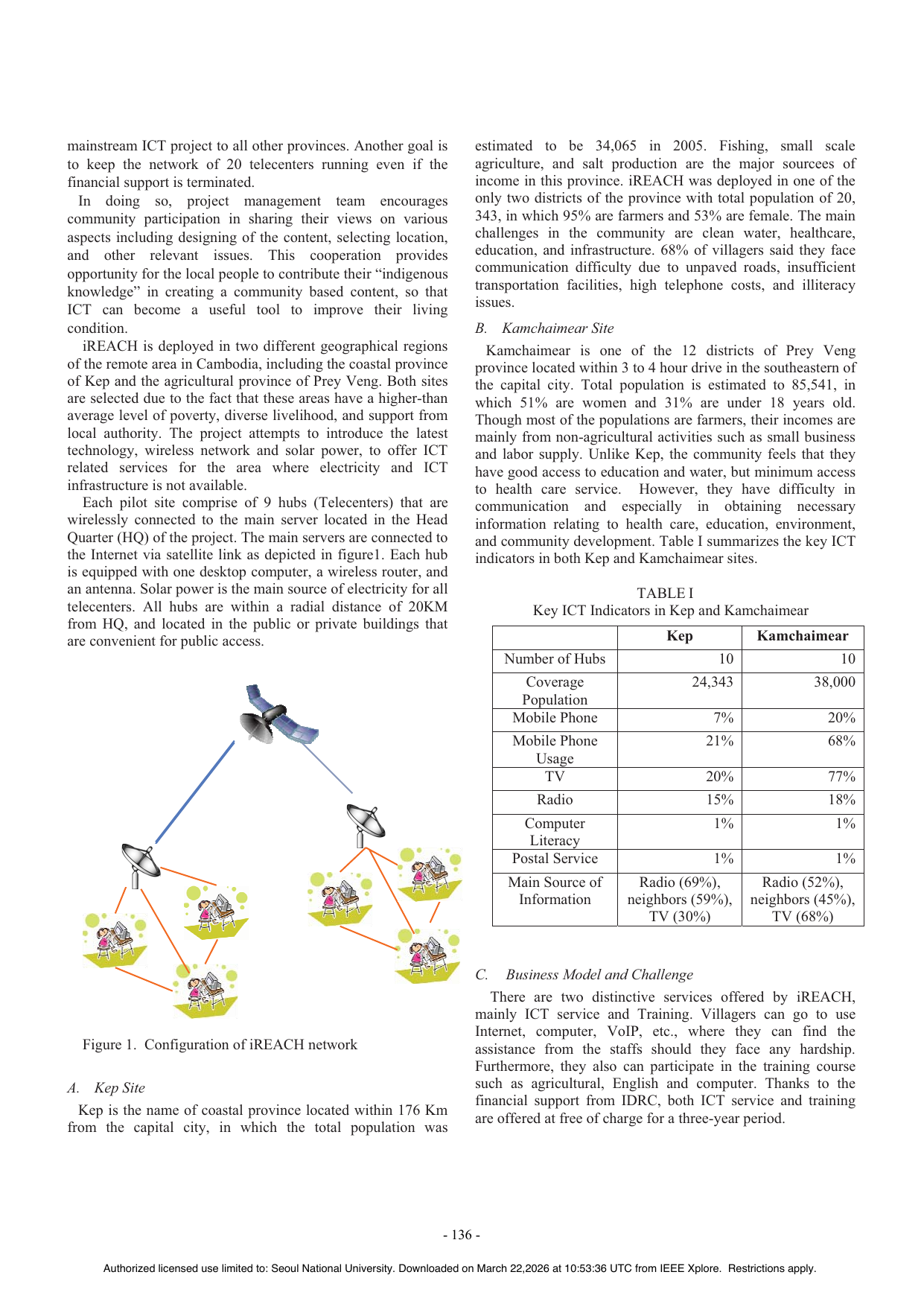
iREACH 의 기술 구성 (Fig. 1): 20 hub × wireless 연결 main server (HQ) × satellite Internet. 각 hub = desktop + wireless router + antenna + solar power. Free service 3년 + 이후 micro-enterprise transition 모델 — donor exit strategy 의 핵심 design.
Sustainability 의 6 dimensions (Roman-Colle 2002, Pal et al 2007 등의 lineage):
- Financial sustainability (수익 모델)
- Institutional sustainability (운영 조직)
- Political sustainability (정부 지원)
- Cultural sustainability (지역 문화 적합성)
- Technological sustainability (기술 안정성)
- Social sustainability (community 수용성 + 사회적 형평성)
본 paper 는 social sustainability 만 focus — [21] (Holecek) 의 정의: “minimizing social exclusion + maximizing social equity”, [8] (Hudson 2001) 의 service delivery + community acceptance 시각. Heterogeneous group (여성 · 노인 · 빈곤층) 에 useful and useable 정보 흐름.
방법론: DEA + formative assessment approach. Formative assessment (Hudson 2001) = progress + outcome 모니터링 — 프로젝트 진행 중 평가, summative evaluation (project 종료 후 효과 평가) 와 대조. DEA 의 3 장점:
- Alternative input configurations 발견 — 동일 output 의 다른 input mix
- 서로 다른 metric 의 input/output 결합 가능
- Benchmark / best practice 세트 식별
DEA model: CRS/VRS DEA models (Charnes-Cooper-Rhodes 1978 의 CRS + Banker-Charnes-Cooper 1984 의 VRS). Output-oriented:
- CRS 효율 = — constant returns to scale 가정
- VRS 효율 = — variable returns to scale 허용
- Scale efficiency = — 1 보다 작으면 scale 비효율
각 telecenter 의 input slack (잉여 자원) 식별 → resource reallocation 의 정량 basis.
Variables (정성 요약, 본 paper raw 의 OCR 손상으로 정확 수치 confirm 어려움):
- Inputs: operating cost + 직원 수 + equipment count (computer + antenna + solar battery)
- Outputs: 방문 수 + training 참여 수 + community engagement metric
핵심 결과:
- 20 telecenter 중 일부 (예: HQ 인근 hub) 가 frontier 위 — DEA-efficient
- 다수 hub 는 frontier 아래 — output 부족 (낮은 방문 수) 또는 input 과잉 (불필요한 인력·equipment)
- CRS 와 VRS 효율의 차이로 scale 비효율 — 적정 규모 의 telecenter 가 가장 효율적
- Kep 과 Kamchaimear 의 baseline ICT awareness 격차 가 telecenter efficiency 격차로 transfer — Kamchaimear 의 mobile phone (20%) · TV (77%) baseline 이 Kep (7% / 20%) 보다 높음 → telecenter 의 additive 효과 더 큼
정책 함의:
- Best performance telecenter 가 benchmark — replication 가속
- Inefficient telecenter 의 input slack 정보로 resource reallocation strategy
- iREACH 의 donor exit + micro-enterprise transition 모델의 경제적 viability 평가 framework — 효율적 hub 만 micro-enterprise 로 전환 가능
한계: (i) DEA 의 deterministic frontier 가 measurement error 흡수 못함, (ii) 20 telecenter 의 small sample, (iii) Social sustainability 의 multiple dimensions (gender 형평성, cultural 적합성 등) 중 operational efficiency 만 측정.
핵심 결과
iREACH 2 site 의 ICT baseline (Table I)
| 지표 | Kep | Kamchaimear |
|---|---|---|
| Hub 수 | 10 | 10 |
| Coverage 인구 | 24,343 | 38,000 |
| Mobile Phone 보유 | 7% | 20% |
| Mobile Phone 사용 | 21% | 68% |
| TV 보유 | 20% | 77% |
| Radio 보유 | 15% | 18% |
| Computer literacy | 1% | 1% |
| Postal service | 1% | 1% |
| 주 정보원 | Radio 69%, neighbors 59%, TV 30% | Radio 52%, neighbors 45%, TV 68% |
→ Kamchaimear 의 baseline ICT awareness 가 Kep 보다 높음 — telecenter additive 효과 differential.
DEA 평가의 정성적 발견
| Hub 분류 | 효율성 | 정책 leverage |
|---|---|---|
| Frontier 위 (DEA-efficient) | Benchmark + best practice | |
| Frontier 아래, scale 적합 | , SE ≈ 1 | Output 증대 (방문 + training) |
| Frontier 아래, scale 비적합 | , SE < 1 | 규모 조정 (확대 또는 축소) |
| Input 과잉 | Slack > 0 | Resource reallocation |
iREACH 의 donor exit strategy design
| 단계 | 기간 | 모델 |
|---|---|---|
| 1. Free service | 3 년 (IDRC 지원) | 무료 ICT + training |
| 2. Transition | 3년 후 | Micro-enterprise (시장 가격 이하, 일상 운영비 cover) |
| 3. Sustainability | 장기 | 지역 community 소유 + responsibility |
방법론 노트
본 paper 의 formative assessment 접근 (Hudson 2001):
- Summative evaluation: project 종료 후 목표 달성 여부 평가
- Formative evaluation: progress 중 의 feedback 평가 — 어떻게 작동, 무엇을 개선, 무엇을 학습
- 본 paper 는 formative 채택 — iREACH 가 진행 중 프로젝트라 operational adjustment 의 evidence-based input 제공 위함
DEA (DEA, Charnes-Cooper-Rhodes 1978):
CRS (Constant Returns to Scale) model:
VRS (Variable Returns to Scale) model (Banker-Charnes-Cooper 1984): 위 + (convexity 제약).
Scale efficiency = . SE < 1 이면 scale 비효율 — too small (IRS, increasing returns) 또는 too large (DRS, decreasing returns) 의 size 문제.
Output-oriented — input 고정 하 output 극대화. iREACH 같은 서비스 제공 시설에 적합 (input 은 budget · staff fixed, output 인 방문 / training 을 극대화).
Input slack 분석: — 효율적 frontier 와 비교한 잉여 input. Resource reallocation 의 정량 input.
식별은 (i) 20 telecenter 의 cross-section variation, (ii) Kep vs Kamchaimear 의 site-level baseline 격차, (iii) input-output 의 multi-dimensional ratio 에서 온다. 한계는 위에 명시.
연구 계보
본 paper 의 telecenter evaluation lineage: Pal et al (2007), Bailur (2007), Hudson (2001 Bibliotheca: Information Sciences for Researchers) — telecenter sustainability 6 dimensions, social sustainability 정의, formative assessment 의 ICT4D 응용. Hosman-Fife (2008) 의 telecenter 의 multi-stakeholder design. Holecek (2007) 의 social sustainability definition.
DEA in ICT4D lineage: Roman-Colle (2002) 의 telecenter 평가 framework, Whyte (2000) 의 community-based ICT 평가. DEA 일반 은 Charnes-Cooper-Rhodes (1978 EJOR) + Banker-Charnes-Cooper (1984 MS) 의 표준.
Cambodia ICT4D context: iREACH 프로젝트 자체가 IDRC (International Development Research Centre, Canada) 의 후원 + Cambodia NiDA (National ICT Development Authority) 와의 협력. Phu (2003), Sang (2008) 등의 GAIS context 와 paired.
TEMEP 내 sibling: (i) E-government adoption in ASEAN: the case of Cambodia · Adoption of E-Government Services: The Case of Electronic Approval System · A Conceptual Model of e-Government Acceptance in Public Sector · E-Government Challenges in Least Developed Countries (LDCs): A Case of Cambodia · A Study on the Contribution Factors and Challenges to the Implementation of E-Government in Cambodia · E-government adoption in Cambodia - a partial least squares approach — Sinawong Sang Cambodia GAIS series 의 공무원 수용성 sibling. 본 paper 는 rural community 측면의 Cheang-Sang paired 분석. (ii) The relevance of DEA benchmarking information and the Least-Distance Measure — DEA 방법론 sibling. (iii) The Effect of Asset Composition Strategy on Venture Capital Firm Efficiency: An Application of Data Envelopment Analysis · Analysis of product efficiency in the Korean automobile market from a consumer's perspective · A metafrontier approach for measuring Malmquist productivity index — DEA 응용 sibling cluster. (iv) Sira Maliphol 의 개도국 ICT 정책 sibling. 본 paper 는 기술경영경제정책전공 의 개도국 ICT4D + DEA 응용 라인의 rural community 평가 anchor.
See also
- DEA
- Formative assessment
- CRS/VRS DEA models
- Telecenter
- 사회적 지속가능성
- iREACH
- ICT4D
- 캄보디아
- 농촌 ICT
- E-government adoption in Cambodia - a partial least squares approach
- The relevance of DEA benchmarking information and the Least-Distance Measure
- Analysis of product efficiency in the Korean automobile market from a consumer's perspective
- Sopheak Cheang
- 이정동
인접 그래프
- 인물 3
- 개관 1
- 방법론 3
- 개념 1
- 주제 5
- 분류 2
- 논문 10