R&D activities for becoming a high-growth firm through large jumps: evidence from Korean manufacturing
Taewon Kang, Chulwoo Baek, 이정동 (2018) · Asian Journal of Technology Innovation 26(2):222-245 · DOI ↗
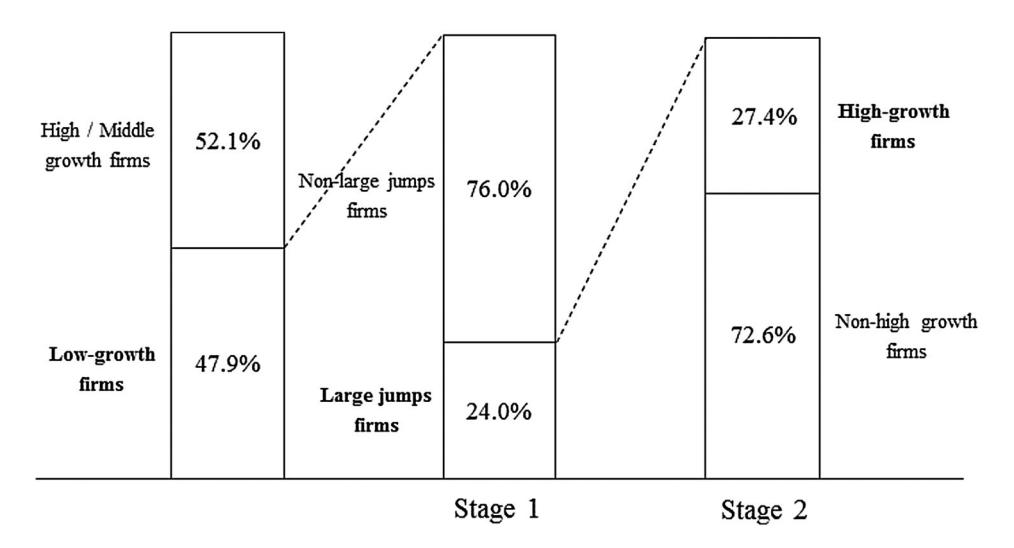
기업 성장이 연속적 누적 (resource-based, evolutionary) 이라는 기존 이론으로 설명되지 않는 불연속적 도약 (large jumps) 의 결정 요인을 한국 제조업 데이터로 실증한다. 2002-2009 한국 제조업 패널 (R&D 활동조사 + KIS-Value) 의 저성장 firm 969 개 중 24% 가 large jump 를 경험했고, 그 중 27.4% 만 high-growth firm 으로 모멘텀 유지에 성공. 프로빗 모형 + Cox 비례 위험 모형 의 2-stage 추정 결과, 진입 단계 에서는 R&D 투자 수준과 R&D 협력 이 large jump 확률을 높이지만, 모멘텀 유지 단계 에서는 R&D 지속성 와 internal capability 가 결정적이며 R&D 협력 은 오히려 부정적. 단계별 R&D 전략의 비대칭이 low-growth trap 탈출 mechanism 이다.
- RQ: 저성장 기업이 어떤 R&D 활동을 통해 불연속적 large jumps 를 달성하고, 이후 어떤 R&D 동학으로 그 모멘텀을 유지해 high-growth firm 이 되는가?
- 방법론: 프로빗 모형 (stage 1, large jump 진입), Cox 비례 위험 모형 (stage 2, 모멘텀 hazard), 패널 고정효과 모형 보조, group mean t-test
- 데이터: 한국 제조업 (R&D 활동조사 + KIS-Value 결합), N=2,025 firms / 969 low-growth firms (적어도 한 번 Q1·Q2 2년 연속), 2002-2009 (적어도 4년 연속 obs)
- 주요 발견: 저성장 기업의 24.0% 가 large jump (Q5 도약, 매출 1년 ≥50% 성장) 경험, 그 중 27.4% 가 다음해 모멘텀 유지 (전체 6.6% 만 high-growth 도달). Stage 1: R&D_in 계수 +0.562 (p<0.01), R&D_collabo +0.134 (p<0.05) 로 진입 촉진. Stage 2: R&D_in 비유의, Vol_R&D +2.057 (p<0.10) → 변동성은 모멘텀 hazard 증가, R&D_collabo +0.380 (p<0.05) → 협력은 모멘텀 hazard 증가.
- 시사점: low-growth trap 탈출에는 R&D 투자량 + 외부 협력의 공격적 전략이 필요하지만, 일단 도약한 뒤에는 R&D 지속성 + internal capability 의 방어적·안정적 전략으로 전환해야. 정부 정책도 단계별 차별화 (저성장 보조금 → high-growth 후엔 R&D 스무딩 유도) 가 필요.
요약
기업 성장 이론의 두 주류 — 자원기반관점 (Barney 1991, Penrose 1959, Wernerfelt 1984) 의 경쟁우위 누적 모형과 진화경제학 (Nelson and Winter 1982) 의 firm-specific routine 모형 — 은 모두 연속적·점진적 성장 을 강조한다. 그러나 Garnsey et al. (2006) 의 entrant 추적 결과 단 6% 만 linear 성장하고 14% 는 delayed take-off 의 nonlinear 패턴이며, Yoshiyuki (2014) 가 Laplace 분포의 fat tail 을 large jumps 개념으로 설명한 뒤 intra-distribution mobility 의 미시 메커니즘 식별이 학계의 빈자리로 부각되었다. 본 paper 는 low-growth firm 의 large jump 진입 과 모멘텀 유지 의 2-stage 비대칭 결정 요인 을 한국 제조업 패널로 처음 실증하는 데 의의가 있다. 기술경영경제정책전공 의 이정동 가 author page anchor 의 제3기 (3) accumulation 라인 에 위치시킨 The persistency and volatility of the firm R & D investment: Revisited from the perspective of technological capability 의 직접 후속작이며, R&D 지속성 vs R&D 변동성 의 비대칭 을 firm life-cycle 의 단계 의존 으로 확장한 작업이다.
데이터는 The persistency and volatility of the firm R & D investment: Revisited from the perspective of technological capability 와 동일한 한국 R&D 활동조사 + KIS-Value 결합 패널 (2002-2009) 에서 적어도 4년 연속 observation 을 가진 외부감사 대상 + R&D 단위 보유 기업 2,025 개. 매출 성장률 (log-difference) 을 5 분위 (Q1-Q5) 로 나누고 low-growth firm 을 Q1·Q2 연속 2년 (Cameron, Kim, Whetten 1987 의 organizational decline 정의), large jump 을 Q5 (1년 매출 50% 이상 도약, Halabisky et al. 2006), high-growth firm 을 large jump 후 Q5 유지 연속 2년 이상으로 조작화했다. 분석은 2-stage: Stage 1 은 low-growth firm 의 large jump 진입 확률 의 프로빗 모형, Stage 2 는 모멘텀 실패 (Q5 이탈) 의 Cox 비례 위험 모형 hazard model. 핵심 explanatory variable 은 R&D 강도 (R&D_in = R&D/매출), R&D 변동성 (Vol_R&D = R&D 강도의 누적 표준편차, Frankish et al. 2013 방식), R&D 협력 dummy (외부 firm·대학·연구소 R&D in/outflow). 통제 변수는 size, age, export, listed, debt_ratio, ΔIndustry. Stage 1 추정 결과 R&D_in 계수 +0.562 (p<0.01), R&D_collabo +0.134 (p<0.05) 로 진입 단계 에서는 R&D 양과 외부 협력이 large jump 확률을 높임 (Vol_R&D 비유의). Stage 2 추정 결과는 정반대 — R&D_in 비유의, Vol_R&D +2.057 (p<0.10, 변동성이 모멘텀 hazard 증가), R&D_collabo +0.380 (p<0.05, 협력이 모멘텀 hazard 증가). 진입 과 유지 의 R&D 전략은 비대칭 이라는 결론.
한계는 (i) 7년 short window 로 long-term cycle (PLLC, 제품계보 수명주기) 의 부활 검증 불가, (ii) R&D 의 exploration vs exploitation 분해 미시 portfolio 미관측, (iii) acquisition·기타 외부 성장 요인 미포함, (iv) Korea 단일국 — 다른 disaggregated level 에서도 large jumps 의 분포는 유사하나 결정요인 의 generalizability 는 추가 검증 필요. 향후 작업으로 (i) 프로젝트 단위 R&D 추적, (ii) M&A·정책 외부 요인 결합, (iii) 다국가 비교가 제시된다. 기술경영경제정책전공 의 축적 (accumulation) 라인 내 sibling 으로 The persistency and volatility of the firm R & D investment: Revisited from the perspective of technological capability (asymmetric TC 조절 mechanism) 와 Effects of knowledge accumulation strategies through experience and experimentation on firm growth (지식 composition 의 experience-experimentation 갈래) 가 같은 R&D 동학 anchor 라인의 단계 분화로 위치한다.
핵심 결과
Stage 1: Large jumps 진입 확률 (프로빗 모형 Model 3, N=4,436)
| Variable | 계수 | 해석 |
|---|---|---|
| R&D_in (t-1) | +0.562*(0.160) | R&D 양이 large jump 확률 증가 |
| Vol_R&D | -0.294 (0.332) | 변동성 비유의 (진입에 무관) |
| R&D_collabo | +0.134(0.071) | 외부 협력이 large jump 확률 증가 |
| Size | -0.172*** | 작은 firm 일수록 large jump 확률 ↑ |
Stage 2: 모멘텀 유지 실패 hazard (Cox 비례 위험 모형 Model 3, N=220)
| Variable | 계수 | 해석 |
|---|---|---|
| R&D_in (t-1) | -1.001 (0.688) | 비유의 (level 무관) |
| Vol_R&D | +2.057*(1.215) | 변동성이 모멘텀 hazard 증가 → R&D 지속성 가 유지 |
| R&D_collabo | +0.380*(0.193) | 외부 협력이 모멘텀 hazard 증가 → internal capability 가 유지 |
| Debt_ratio | -0.396** | 외부 자금이 모멘텀 보호 |
Transition probability: low-growth (969) → large jump (234, 24.0%) → high-growth at t+1 (64, 27.4%) → high-growth at t+2 (18, 7.7%). 전체 low-growth 중 6.6% 만 high-growth 도달.
방법론 노트
Stage 1 의 latent linear regression model 과 Stage 2 의 모멘텀 실패 hazard 의 결합으로 진입 과 유지 의 단계별 결정요인을 분리해 추정한다. Stage 1 프로빗 모형 추정식:
여기서 는 표준정규 cumulative distribution, 는 size·age·export·listed·debt·ΔIndustry·year-dummy 통제 vector.
Stage 2 Cox 비례 위험 모형 hazard model:
여기서 event (failure) 는 firm 이 large jump 후 다음해 Q5 (top 20%) 모멘텀을 잃는 것. 는 baseline hazard, 모델은 proportional hazards 가정 위에서 partial likelihood 로 추정.
식별 핵심: low-growth 정의가 2 년 연속 Q1-Q2 라는 organizational decline 정의 (Cameron et al. 1987) 위에 있어 transient noise 를 거른다. Large jump 정의는 1 년 매출 ≥50% 성장 (Halabisky et al. 2006 의 rapid growth 정의와 정합). High-growth 는 연속 2 년 Q5 유지 로 제품계보 수명주기 의 모멘텀 부재 와 구별. Robustness 는 VIF<2 (multicollinearity 무) 및 group mean t-test (large jump vs non 의 사전 차이 확인) 로 검증. Stage 1 의 R&D 통상 변수 + Stage 2 의 동일 변수 — 같은 변수가 단계 의존적으로 반대 부호 라는 결과가 본 paper 의 핵심 contribution.
연구 계보
본 paper 는 기술경영경제정책전공 의 축적 (accumulation) → R&D 동학 anchor 라인의 firm life-cycle 단계 분화 작업이다. 가장 가까운 선조는 The persistency and volatility of the firm R & D investment: Revisited from the perspective of technological capability — 동일 저자팀이 동일 데이터 (R&D 활동조사 + KIS-Value, 2002-2009) 의 비대칭 매출 충격에 대한 TC 조절 메커니즘을 식별한 작업이며, 본 paper 는 그 비대칭 framework 을 low → high-growth 단계 전환 에 적용한 후속 작업. Yoshiyuki (2014) 의 large jumps 개념과 Capasso, Cefis, Frenken (2014) 의 intra-distribution mobility 가 이론적 motivation, Daunfeldt and Halvarsson (2015) 의 low-growth → rapid growth 전환 확률 패턴이 직접 empirical precedent. 방법론적으로는 진입 의 probit + 유지 의 hazard model 의 2-stage 결합이 Economic Impact Assessment of the Government-led Venture Firm Certification Policy 의 식별 series 와 정합. exploration-exploitation 의 단계 의존성은 March (1991), Hölzl (2009) 와 닿는다. Chulwoo Baek 가 듀크성 여대로 옮긴 뒤 이정동 와 협업한 2017-2019 듀크성 협업 cohort 의 일부로, sibling 으로 Effects of knowledge accumulation strategies through experience and experimentation on firm growth 가 같은 R&D 동학 → 지식 composition 의 한 갈래로 위치한다.
See also
- 이정동
- Taewon Kang
- Chulwoo Baek
- 프로빗 모형
- Cox 비례 위험 모형
- 고성장 기업
- 대도약
- R&D 지속성
- R&D 협력
- The persistency and volatility of the firm R & D investment: Revisited from the perspective of technological capability
- Effects of knowledge accumulation strategies through experience and experimentation on firm growth
- 기업 동학
인접 그래프
- 인물 3
- 개관 1
- 방법론 3
- 개념 3
- 주제 7
- 수록처 1
- 분류 3
- 논문 6
이 문서를 가리키는 페이지
논문 (5)
- Corrigendum to "The persistency and volatility of the firm R & D investment: Revisited from the perspective of technological capability" [Res. Policy (2017) 1570–1579]
- Dynamic relationship between technological knowledge and products: diversification strategy for firm growth
- Effects of knowledge accumulation strategies through experience and experimentation on firm growth
- R&D Dynamics and Firm Growth: The Importance of R&D Persistency in the Economic Crisis
- The persistency and volatility of the firm R & D investment: Revisited from the perspective of technological capability