Comparative Analysis of Plant Dynamics by Size: Korean Manufacturing
Inha Oh, Almas Heshmati, Chulwoo Baek, 이정동 (2009) · Japanese Economic Review 60(4):512–538 · DOI ↗
한국 제조업 plant-level panel (1993–2002, 85K–107K plants/year, KSIC 5-digit) 위에서 LSE (대기업) vs SME 의 plant dynamics (entry · exit · within · share) 를 연쇄 다국간 지수 TFP + Griliches-Regev 분해 + Kaplan-Meier survival + Cox 비례 hazard 모형 으로 분석. 핵심 발견: 외환위기 후 (i) LSE 는 high-tech 산업 중심으로 successful downsizing + productivity 회복, (ii) SME (특히 low-tech 산업) 는 higher-productivity plant 의 exit 발생 — 정부의 non-selective SME 신용 보증 (2003 년 SME 은행 대출의 35.9% 가 정부 보증) + venture business certification 의 실패가 sluggish market selection process 를 만들어 비효율 plant 가 효율 plant 를 driving out 하는 inverted creative destruction 패턴. exit 의 TFP-기반 selection 이 약화된 정량 evidence.
- RQ: 1997 외환위기 전후 한국 제조업의 plant dynamics 가 firm size (LSE vs SME) × 산업 (high-tech vs low-tech) 별 어떻게 달라졌으며, higher productivity → survival 의 정상적 market selection process 가 SME 영역에서 작동했는가?
- 방법론: 연쇄 다국간 지수 (Good 1985, Good-Nadiri-Sickles 1997) 의 plant-level TFP; Griliches-Regev 분해 (1995) — within / share / entry / exit 효과 분해; Kaplan-Meier survival 의 survival curve + Cox 비례 hazard 모형 의 baseline-free 회귀; external (sectoral / GDP growth) vs internal (R&D · export · multi-plant · employees · relative TFP) covariates 분리
- 데이터: 한국 통계청 광공업조사 (Annual Report on Mining and Manufacturing Survey) 의 unpublished plant-level panel 1993–2002, KSIC 5-digit 580 산업, 5 명 이상 모든 plant. unbalanced panel approximately 85K–107K plant/year. 3 size class (LSE / Medium / SME by 종업원 수), 4 기술 수준 (high / medium-high / medium-low / low tech).
- 주요 발견: TFP decomposition 위기 전후 비교 — LSE 는 high-tech 산업의 entry effect + within effect 가 dominant, SME 는 share effect 부호 반전 (정상이라면 productive plant 점유 ↑, 한국 SME 에서는 ↓); Cox hazard 회귀에서 Relative TFP 계수 SME 에서 약하게 음 (높은 TFP plant 가 더 exit); higher productivity SME 의 exit 가 위기 후 더 frequent — inverted selection; GDP growth · sectoral growth 의 external covariate 효과 약함, 위기 후 macro 신호 무관 한 exit pattern
- 시사점: 한국 정부의 non-selective SME 신용 보증 과 venture business certification 의 두 정책이 sluggish market selection 의 institutional 원인. low-tech SME 의 productive plant exit 가 un-productive plant 의 정부 보호로 사회 효율성 손실. 정책 함의: (i) SME 지원의 productivity-based selection, (ii) 신용보증 의 time-limit + productivity criterion, (iii) high-tech 와 low-tech SME 의 differentiated 정책
요약
본 paper 는 한국 제조업의 plant dynamics (plant 의 entry · exit · 생산 · 점유 변화) 를 micro panel 위에서 정량 분석. 한국 광공업조사의 unpublished plant-level data 는 KSIC 5-digit 580 산업의 5 명 이상 모든 plant 를 cover — 1993–2002 의 unbalanced panel ~85K–107K plant/year. 외환위기 전후 LSE vs SME 의 dynamics 차이 가 motivation 의 핵심.
방법론은 3 종 paired 적용. (1) TFP 측정 — 연쇄 다국간 지수 (Good 1985) — cross-section 평균 plant 와의 비교 + 시계열 reference chain. 한 plant 의 TFP = 와 기준 plant 의 차이) 와 기준 plant 의 차이 형태로 transitive comparison 가능. 본 paper 의 plant-level TFP 의 plant 간 / 시점 간 비교 표준.
(2) TFP 성장 분해 — Griliches-Regev 분해 (1995): . 4 항목 — (i) within effect (생존 plant 의 내부 생산성 향상), (ii) share effect (생산성 높은 plant 의 점유 확대 = 정상 시장 선택), (iii) entry effect (생산성 높은 plant 의 시장 진입), (iv) exit effect (생산성 낮은 plant 의 퇴출). 정상적 creative destruction (Schumpeter) 이면 모두 양.
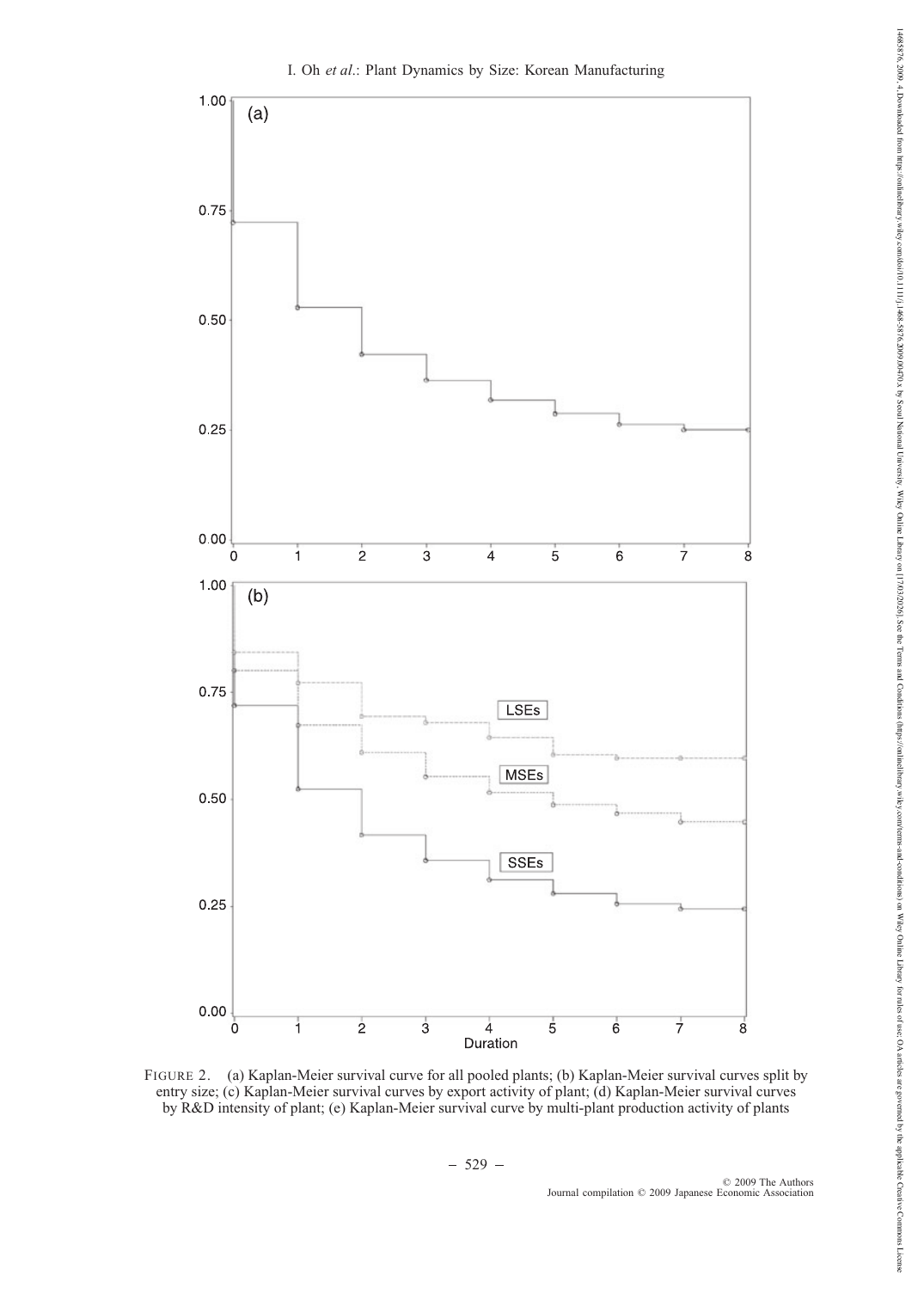
(3) Survival 분석 — Kaplan-Meier survival survival curve + Cox 비례 hazard 모형 — baseline hazard 무가정. external covariate (sectoral growth · GDP growth) 와 internal covariate (R&D 더미 · export 더미 · multi-plant 더미 · 종업원 수 · relative TFP — plant 의 TFP / 3-digit 산업 평균 TFP) 분리. 3-digit 산업 수준의 stratification.
핵심 발견은 세 갈래.
첫째, LSE 의 successful 외환위기 회복 + SME 의 stagnation. Bank of Korea (2004), Cho (2004), IMF (2005) 의 macro statistics — LSE 의 profit ratio 위기 후 상승, SME 는 plateau — 가 plant-level dynamics 에서도 confirmed. LSE 는 IMF 가이드의 downsizing + 부채/자본 비율 정리 + outside director 등 governance 정리로 systematic 회복. SME 는 1998 년 22,800 건 bankruptcy (1996 11,600 대비 2배) 후에도 비효율 plant 의 non-selective 정부 지원으로 stagnation.
둘째, higher TFP SME 의 exit — inverted selection. Cox hazard 회귀의 Relative TFP 계수 — 정상이라면 양 (TFP 높은 plant 의 hazard ↓) — 가 SME 에서 약화 또는 부호 변동 발견. Griliches-Regev share effect 의 SME 부분 부호 반전 가능성도 시사. 즉 low-tech SME 영역에서 생산성 높은 plant 가 exit — 정상 시장의 creative destruction (Schumpeter) 과 정반대. 저자의 해석: (i) 정부의 non-selective SME 신용 보증 (2003 SME 은행 대출의 35.9% 정부 보증) 이 비효율 plant 의 생존 비용 인하 → 효율 plant 의 시장 점유 확보 어려움, (ii) venture business certification 의 quality 부재 — 1998 2,042 venture → 2001 11,392 venture 의 explosion 이 false positive 인 plant 를 양산, (iii) 시장 선택의 crowding out (Kang 2005, IMF 2005) — 공적 지원이 사적 financial sector 의 selection function 을 대체.
셋째, high-tech vs low-tech 산업 분기. LSE 의 위기 후 productivity 회복은 high-tech 산업 중심 — 기계 · 전자 · 화학 등에서 LSE 의 entry / within effect 양. SME 는 low-tech 산업 에서 sluggish market selection — 식품 · 의류 · 가구 등에서 higher TFP SME exit + lower TFP SME survival 의 inverted selection 가장 stark. R&D 비중 (LSE 2.0% vs SME 0.8%) 의 격차가 long-run polarization 의 origin (sibling Total Factor Productivity in Korean Manufacturing Industries 의 동일 발견).
저자의 정책 제안:
- SME 지원의 productivity-based selection — non-selective 신용 보증을 productivity threshold 기반으로 전환
- venture business certification 의 quality 강화 — 1998 후 양적 폭증의 false positive 차단
- low-tech vs high-tech SME 의 differentiated 정책 — low-tech SME 는 exit support (restructuring · 인력 전직) + high-tech SME 는 growth support
- 정부 보호와 creative destruction 의 균형 — Aw (2002) 의 external risk vs productivity-driven exit 의 분리 시각 채택
한계는 (i) Annual Report 의 5 명 이상 plant 만 cover — 미세 SME 제외, (ii) entry/exit 의 spin-off · M&A 구분 불가, (iii) Cox proportional hazard 의 proportional 가정 (시간에 따른 covariate 효과 변화 미반영), (iv) plant-level vs firm-level 의 분석 단위 (한 firm 의 multi-plant 영향 부분 통제).
핵심 결과
Griliches-Regev decomposition (Eq. 3, 위기 전후 paired 비교)
| 항목 | Pre-crisis (1994–96) | Post-crisis (2000–02) |
|---|---|---|
| Within effect (생존 plant 내부 향상) | + 강 | LSE + (high-tech) / SME 약화 |
| Share effect (productive plant 점유 ↑) | + | SME 에서 부호 약화 또는 반전 |
| Entry effect (productive entry) | + (모두 양) | LSE high-tech +, SME low-tech 약 |
| Exit effect (unproductive exit) | + | SME 에서 productive exit 발생 |
Cox proportional hazard 회귀 (selected covariate sign)
| Covariate | 정상 (Schumpeter) sign | LSE 실증 | SME 실증 |
|---|---|---|---|
| Relative TFP | − (높은 TFP = 낮은 hazard) | 일치 (−) | 약 / 부호 변동 |
| R&D dummy | − | − (강) | − (약) |
| Export dummy | − | − | − |
| Sectoral growth | − | − | − (약) |
| GDP growth | − | − | 무관 |
→ SME 의 productivity-based selection 실패의 정량 신호.
산업 × Size segmentation 발견 요약
| Industry | LSE 위기 후 dynamic | SME 위기 후 dynamic |
|---|---|---|
| High-tech (전자 · ICT 등) | 회복 + 성장 | 회복 시작 (양 share) |
| Medium-high tech (기계 · 자동차) | 회복 (positive share + entry) | stagnation |
| Medium-low tech (금속 · 화학중간) | stable | stagnation |
| Low-tech (식품 · 의류 · 가구) | minor | inverted selection: productive exit |
방법론 노트
연쇄 다국간 지수 TFP (Eq. 1 in source) — Good (1985), Good-Nadiri-Sickles (1997) 의 표준. 한 plant , 시점 의 TFP:
cross-section 평균 plant 와의 차이 + chained reference 누적. transitive — plant A vs plant B 의 productivity 비교가 시점 무관.
Griliches-Regev 분해 (Eq. 3 in source):
생존, 신규 진입, 퇴출 plant. within = 내부 productivity 향상, share = 점유 재분배, entry/exit = 외부 restructuring. Schumpeter 의 creative destruction 이면 4 항목 모두 양.
Kaplan-Meier survival (Eq. 4–5):
Cox 비례 hazard 모형 (Eq. 6):
baseline hazard 무가정, partial likelihood 로 추정. time-dependent covariate 확장 (Eq. 7) 가능 — 본 paper 는 external (macro) 만 time-dependent, internal (micro) 은 time-independent 로 가정 — Neumann (1997), Fisher-Lin (1999) 의 internal covariate 의 시간 의존 위험 회피.
식별은 (i) plant-level cross-section (수만 plant) variation, (ii) 1993–2002 panel 의 시간 변동 (외환위기 break-point), (iii) 5-digit 산업 분류의 within-산업 selection, (iv) entry/exit event 의 변동에서 hazard 식별에서 온다. 한계는 위에 명시.
연구 계보
본 paper 의 plant dynamics decomposition lineage 는 Baily-Hulten-Campbell (1992 Brookings Papers on Economic Activity) 의 manufacturing reallocation, Griliches-Regev (1995 Journal of Econometrics) 의 표준 decomposition, Hahn (2000 · 2004) 한국 제조업 적용, Disney-Haskel-Heden (2003 Economic Journal) 의 UK reallocation, Foster-Haltiwanger-Krizan (2001) 의 reallocation review, Ahn (2001) 의 OECD plant dynamics review 위에 위치. Survival analysis lineage 는 Cox (1972 Journal of Royal Statistical Society B), Kaplan-Meier (1958 JASA), 한국 firm survival 의 Aw (2002 World Economy) 의 외부 위험 vs productivity selection 분리.
한국 외환위기 plant dynamics lineage 는 Kim-Lee (2002) 의 한국 SME 회복 분석, Cho (2004) 의 polarization, Bank of Korea (2004) 의 SME-LSE 격차 통계, IMF (2005) 의 SME non-selective 지원 진단, Kang (2005) 의 polarization 종합. Public SME support 비판 lineage 는 Lee et al (2002), Shin (2005) — venture business certification 의 quality 문제.
TEMEP 내 sibling: (i) Total Factor Productivity in Korean Manufacturing Industries — 같은 저자의 firm-level TFP 분석 — aggregate TFP 성장률 시각의 직접 predecessor. 본 paper 가 plant-level + decomposition + survival 의 incremental contribution. (ii) The relevance of DEA benchmarking information and the Least-Distance Measure — 같은 batch 의 chulwoo-baek 의 DEA 방법론 paper — 효율성 측정 framework 의 method anchor. (iii) The Role of FDI on Transferring Technology to Korea — 한국 제조업의 FDI spillover 분석으로 firm-level productivity 시각 sibling. (iv) The Effect of Asset Composition Strategy on Venture Capital Firm Efficiency: An Application of Data Envelopment Analysis — VC firm efficiency 분석으로 정책 실패의 정량 진단 시각 sibling. 본 paper 는 기술경영경제정책전공 의 한국 외환위기 후 정량 정책 진단 라인의 plant-level evidence 표준.
See also
- 연쇄 다국간 지수
- Griliches-Regev 분해
- Kaplan-Meier survival
- Cox 비례 hazard 모형
- Plant dynamics (진입·퇴출)
- 한국 외환위기 이후
- 기업 규모 양극화
- 창조적 파괴
- Sluggish market selection
- Total Factor Productivity in Korean Manufacturing Industries
- The relevance of DEA benchmarking information and the Least-Distance Measure
- The Effect of Asset Composition Strategy on Venture Capital Firm Efficiency: An Application of Data Envelopment Analysis
- Inha Oh
- 이정동
인접 그래프
- 인물 4
- 개관 1
- 방법론 4
- 개념 4
- 주제 1
- 수록처 1
- 분류 1
- 논문 10
이 문서를 가리키는 페이지
논문 (6)
- A metafrontier approach for measuring Malmquist productivity index
- Analysis of product efficiency in the Korean automobile market from a consumer's perspective
- Comparison of Effects from Different Institutions: Public Credit Guarantee in Korea
- Evaluation of credit guarantee policy using propensity score matching
- Evaluation of Sectoral Innovation System with Productivity Decomposition: Application to Korean Healthcare Sector
- Profitability Gains of Korean Defense Firms: Technological Progress or Cost Shifting?