Analysis of product efficiency in the Korean automobile market from a consumer's perspective
Inha Oh, 이정동, Seogwon Hwang, Almas Heshmati (2010) · Empirical Economics 38(1):119–137 · DOI ↗
Consumer-side product efficiency 분석의 첫 paper — 기존 production-side efficiency 의 Farrell (1957) 분해 (overall = technical × allocative) 를 consumer 의 효용 maximization framework 으로 전치. 핵심 idea: 기술적으로 효율 (price-quality space 의 frontier 위) 인 product 가 항상 소비자 선호 구조 와 match 되지 않을 수 있음 — technical 효율 와 allocative 효율 의 분리. 방법: Discrete additive DEA (Cooper et al 1999 의 additive DEA 위에 Free Disposal Hull 의 discreteness 가정 추가) + 이산선택 모형 의 utility 함수 추정 결합. Indifference curve 를 DCM 으로 추정, DEA 가 product 의 frontier 와의 거리 측정. 한국 자동차 시장에 적용 — technical efficient 한 product 가 market share 와 인과 관계 약함, allocative efficient 가 시장 점유 와 더 가까운 양 상관. 효율 측정의 consumer-side framework 의 정량 evidence.
- RQ: 제품의 consumer-side product efficiency (technical + allocative) 가 어떻게 측정되며, 시장 점유 (market share) 와 어떤 관계인가? 기술 frontier 위 efficient 제품이 항상 시장에서 선택되는가?
- 방법론: DEA + Free Disposal Hull 의 discreteness + 이산선택 모형 결합. Indifference curve 의 utility function 을 DCM 으로 추정 후 DEA frontier projection 으로 efficiency 분해. IV-Logit (BLP) (Berry-Levinsohn-Pakes 1995, BLP) 의 endogeneity 처리
- 데이터: 한국 자동차 시장 의 product-level 데이터 — 가격, 출력, 연비, 차체 type 등 quality attribute + 모델별 market share. 분기·연간 cross-section
- 주요 발견: (i) Discrete additive DEA 의 efficiency 형태로 additive decomposition. (ii) Technical efficiency 만 으로는 market share variation 충분히 설명 불가 — allocative efficiency 도 함께 고려해야 utility-based 선택 패턴 explainable. (iii) 한국 자동차 시장의 efficient product 가 항상 market share 1 위 아님 — consumer preference structure 와의 match 가 핵심. (iv) IV-Logit 의 endogeneity 통제 후에도 allocative efficiency 의 양 효과 robust
- 시사점: (i) 방법론적 — Production-side Farrell efficiency framework 의 consumer-side 전치 가 첫 정식화, allocative efficiency 의 product level 측정 가능. (ii) 자동차 산업 경쟁 분석에서 기술 우위만으로 부족 — 소비자 needs match 의 정량 평가가 필수. (iii) 정책 함의: 신차 출시 firm 의 positioning strategy 가 단순 quality maximization 이 아니라 target consumer 의 indifference curve 와의 distance minimization 으로 평가돼야 함
요약
Porter (1990) 의 competitive advantage 4 요인 중 demand condition 이 firm innovation 의 핵심 driver — 소비자 needs 와의 match 가 firm survival 과 market share 결정. 그러나 기존 efficiency 분석은 production-side (Koopmans 1951, Farrell 1957) 에 집중 — consumer-side product efficiency 의 정량 framework 부재.
기존 consumer-side 접근: Lancaster (1966) 의 price-quality space 위에서 product 를 점으로 표현, 가격 낮고 quality 높은 점들의 frontier 와의 거리로 competitiveness 측정. Papahristodoulou (1997), Fernandez-Castro-Smith (2002), Lee et al (2005) 의 lineage. 그러나 이 framework 는 technical efficiency 만 측정 — 가격 같다면 quality 의 sum 이 큰 product 가 좋다는 가정. 그러나 실제 quality mix 가 소비자 선호 구조와 match 되지 않으면 technical 효율 product 도 선택받지 못함 — allocative efficiency 의 가능성.
본 paper 의 contribution: allocative efficiency at the product level 의 첫 정식화 + 측정 framework. Methodologically (i) Discrete additive DEA — Cooper et al (1999) 의 additive DEA 위에 discreteness (소비자가 product 들의 combination 못 만들고 existing product 중 선택) 가정 추가, (ii) Free Disposal Hull (FDH, Deprins-Simar-Tulkens 1984) 으로 convexity 가정 없는 frontier 구성, (iii) 이산선택 모형 (McFadden 1974, Anderson-de Palma-Thisse 1992, Train 2003) 으로 indifference curve 추정 — DCM 의 추정 utility 가 DEA 의 allocative efficiency 측정의 reference utility 로 작동.
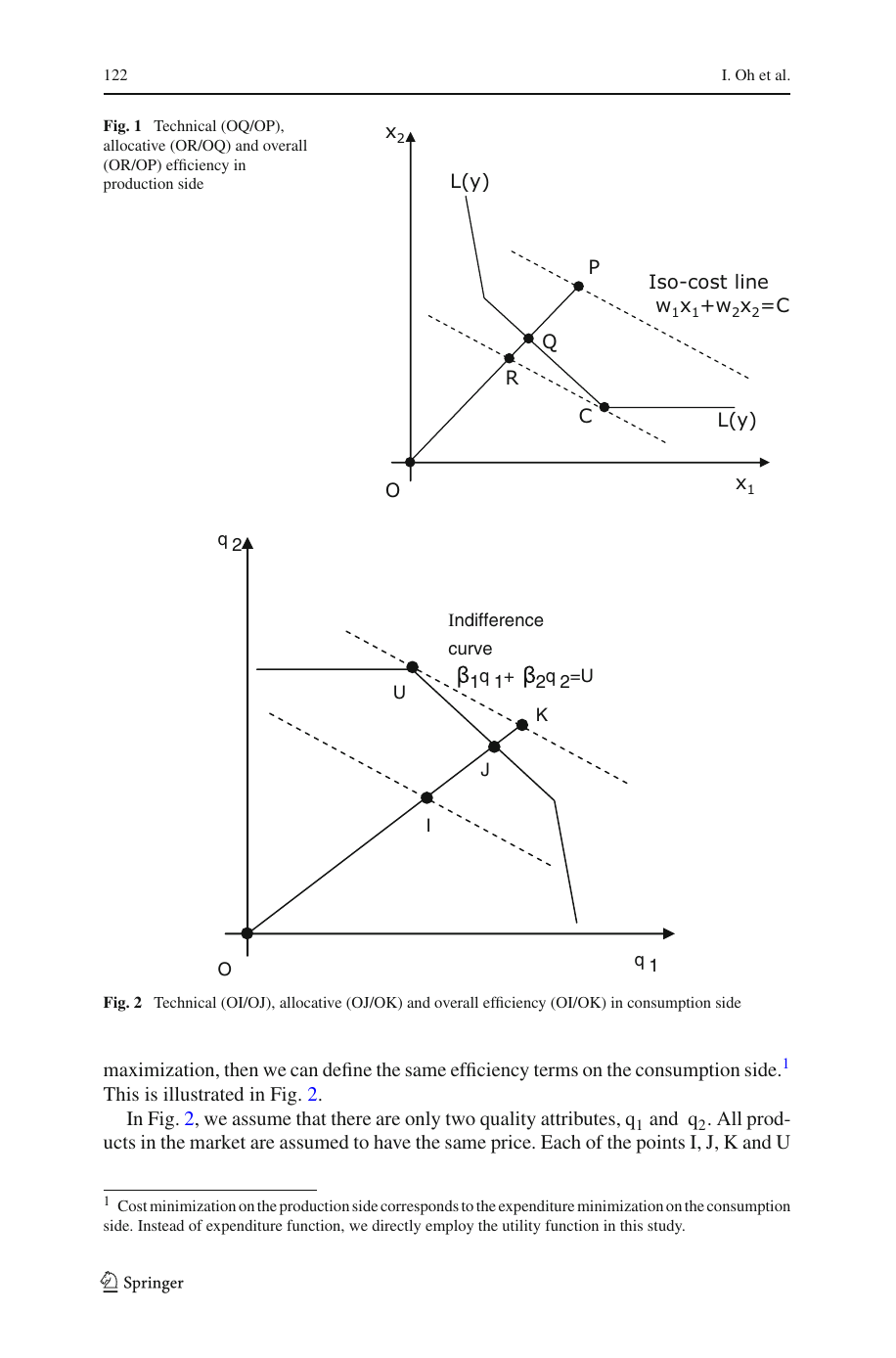
3 종류 efficiency (consumer-side, Fig. 2):
- Technical efficiency: product 의 OI/OJ — frontier 와의 거리. 상대적 quality 우위.
- Allocative efficiency: product 의 OJ/OK — frontier 위 점 (기술 효율) 와 indifference curve tangent point 의 거리. quality mix 와 소비자 선호 의 match.
- Overall efficiency: 의 OI/OK = TE × AE — 둘의 곱.
본 paper 의 discrete additive DEA 형식 ( 의 additive decomposition):
가 0 또는 1 (discreteness — 소비자는 product 의 combination 만들 수 없음). 추정된 가 indifference curve 의 parameter.
IV-Logit (Berry-Levinsohn-Pakes 1995, BLP) 로 utility function 추정 — price 가 demand shock 과 상관 (endogeneity) 이 있으므로 IV 활용 (보통 cost shifters 또는 rival products’ characteristics) 으로 통제.
Empirical 결과: 한국 자동차 시장 product-level 데이터 (모델별 가격 · 출력 · 연비 · 차체 · 점유). 발견:
- Technical efficiency 와 market share 의 상관 약 — 기술 효율 product 가 시장 1 위 아님.
- Allocative efficiency 와 market share 의 양 상관 — 소비자 선호 와 match 되는 product 가 시장 우위. consumer-side allocative 가 market 결과의 dominant driver.
- IV-Logit 의 endogeneity 통제 후에도 결과 robust.
- 일부 high-end 차량은 technical 효율 이지만 allocative 비효율 (Korean 대중 시장과 mismatch) — small share. 반면 일부 mid-range 차량은 technical 비효율 (frontier 와 거리) 이지만 allocative 효율 (대중 needs match) — large share.
정책·전략 함의: 신차 출시 firm 의 positioning strategy 가 quality maximization 이 아니라 consumer indifference curve 와의 distance minimization. 정부 R&D 정책은 target consumer needs 의 empirical 측정 위에서 설계. Product efficiency 가 시장 점유 의 정량 leading indicator 역할.
한계: (i) FDH 의 deterministic frontier — measurement error 흡수 못함, (ii) DCM 의 random coefficient 미반영 — heterogeneous consumer preferences 의 aggregate utility 함수 가정, (iii) 자동차 industry-specific — generalizability 한계.
핵심 결과
Consumer-side 3 efficiency 의 conceptual decomposition (Fig. 2 기반)
| Efficiency | 정의 | 측정 |
|---|---|---|
| Technical (TE) | Frontier 와의 거리 | OI/OJ |
| Allocative (AE) | Frontier 위 점 와 indifference curve tangent 와의 거리 | OJ/OK |
| Overall (OE) | I 와 indifference curve tangent 와의 거리 | OI/OK = TE × AE |
Discrete additive DEA 의 OE 형식 (additive decomposition)
s.t. , .
→ Discrete 가 핵심 — consumer 는 product 의 combination 만들 수 없음 (continuous DEA 의 limitation 회피).
한국 자동차 시장 분석 결과 (정성 요약)
| Group | TE | AE | Market share | 해석 |
|---|---|---|---|---|
| High-end (수입차 일부) | 높음 | 낮음 | 작음 | 기술 우수, 한국 대중 needs 와 mismatch |
| Mid-range (현대·기아 중심) | 중 | 높음 | 큼 | 한국 needs match — 시장 우위 |
| Low-end | 낮음 | 중 | 중 | 가격 sensitivity |
→ Allocative efficiency 가 market share 의 dominant driver — TE 단독으로 부족.
방법론 노트
Discrete additive DEA (Cooper-Park-Pastor 1999 의 additive DEA + Deprins-Simar-Tulkens 1984 의 FDH discreteness 결합):
s.t. , , (점 가 점 0 보다 utility 큼).
기존 additive DEA 의 non-radial (input · output dimension 무관 동시 조정 가능) 특성을 consumer-side 로 적용 + discreteness 의 binary 추가.
Free Disposal Hull (FDH): convexity 가정 없는 frontier — individual product points 의 dominance relation 만으로 frontier 구성. 소비자가 product combination 못 만드는 현실 반영.
Indifference curve 추정: 이산선택 모형 (logit / probit) 의 random utility . MNL 의 share function 로 market share 와 product attribute 의 관계 추정. Price endogeneity 가 demand shock 과 상관 — IV-Logit (BLP) (Berry-Levinsohn-Pakes 1995) 의 IV (cost shifters · rival characteristics) 로 통제. Berry (1994) inversion routine 으로 unobserved characteristics 처리.
식별은 (i) product-level cross-section variation (가격 · quality attribute · share), (ii) IV-Logit 의 endogeneity 통제 후 utility parameter 추정, (iii) DEA frontier 의 dominance relation 에서 온다. 한계는 위에 명시.
연구 계보
본 paper 의 consumer-side efficiency lineage 는 두 갈래. (i) Production-side Farrell efficiency: Koopmans (1951), Farrell (1957) 의 OE = TE × AE 분해 + Cooper et al (1999) 의 additive DEA. (ii) Consumer-side product efficiency: Lancaster (1966) 의 price-quality space, Papahristodoulou (1997), Fernandez-Castro-Smith (2002), Lee et al (2005) 의 technical efficiency 만 측정 lineage. 본 paper 가 Production Farrell 의 consumer-side 전치 + allocative efficiency 추가 의 first formulation.
Discrete additive DEA lineage: Charnes-Cooper-Lewin-Seiford (1994) 의 표준 + Cooper-Park-Pastor (1999) 의 additive form. FDH: Deprins-Simar-Tulkens (1984), De Borger-Kerstens (1996) 의 non-convex frontier.
Discrete choice + DEA 결합 시도: Sefton-Yang (2000) 의 efficient market hypothesis 분석, Lee-Lee-Hwang (2005) 의 한국 자동차 efficiency 분석 — 본 paper 의 직접 predecessor.
Berry-Levinsohn-Pakes (BLP) lineage: Berry (1994 RAND J Economics), Berry-Levinsohn-Pakes (1995 Econometrica) — 자동차 시장 endogenous price 처리 의 표준.
TEMEP 내 sibling cluster: (i) The relevance of DEA benchmarking information and the Least-Distance Measure — Least-Distance Measure DEA 방법론 — consumer-side allocative efficiency 의 method anchor 와 paired. (ii) The Effect of Asset Composition Strategy on Venture Capital Firm Efficiency: An Application of Data Envelopment Analysis — DEA 응용 sibling. (iii) A metafrontier approach for measuring Malmquist productivity index — 같은 batch 의 metafrontier Malmquist sibling. (iv) Total Factor Productivity in Korean Manufacturing Industries · Comparative Analysis of Plant Dynamics by Size: Korean Manufacturing · Evaluation of credit guarantee policy using propensity score matching — Inha Oh 의 TFP · DEA · PSM 라인. 본 paper 는 기술경영경제정책전공 의 productivity 측정 방법론 라인 의 consumer-side 확장 — production-side 의 firm-level 분석을 product-level + consumer-side 로 확장한 incremental contribution.
See also
- DEA
- Discrete additive DEA
- Free Disposal Hull
- 이산선택 모형
- IV-Logit (BLP)
- 제품 efficiency
- 배분적 효율성
- 기술적 효율성
- 한국 자동차 시장
- 소비자 효용
- The relevance of DEA benchmarking information and the Least-Distance Measure
- The Effect of Asset Composition Strategy on Venture Capital Firm Efficiency: An Application of Data Envelopment Analysis
- A metafrontier approach for measuring Malmquist productivity index
- Inha Oh
- 이정동
인접 그래프
- 인물 4
- 개관 1
- 방법론 5
- 개념 5
- 주제 1
- 수록처 1
- 분류 2
- 논문 9
이 문서를 가리키는 페이지
논문 (5)
- A metafrontier approach for measuring Malmquist productivity index
- Evaluation Telecenter Performance in Social Sustainability Context: A Cambodia Case Study
- Profitability Gains of Korean Defense Firms: Technological Progress or Cost Shifting?
- The relevance of DEA benchmarking information and the Least-Distance Measure
- The Role of FDI on Transferring Technology to Korea