The relevance of DEA benchmarking information and the Least-Distance Measure
Chulwoo Baek, 이정동 (2009) · Mathematical and Computer Modelling 49(1-2):265–275 · DOI ↗
DEA (DEA) 의 benchmarking 정보 는 비효율 DMU 가 효율 frontier 로 어떻게 이동할지의 처방 을 제공하지만, 기존 모형 (BCC orientation, RAM/Russell slack-max, Frei-Harker least-norm projection) 은 (i) 가장 먼 효율점을 benchmark 으로 제시하거나 (slack max), (ii) hypothesis hyperplane 위의 가능 영역 밖 projection 을 생성하거나, (iii) well-defined efficiency measure (P1: 0–1 range, P2: monotonicity, P3: translation invariance, P4: unit invariance) 를 만족하지 못한다. 본 paper 는 Least-Distance Measure (LDM) (LDM) 를 제안 — strongly efficient set 에서 가장 가까운 benchmark 를 찾는 projection 으로, 비효율 DMU 가 attainable 한 처방을 제공하면서 동시에 4 properties 모두 만족하는 well-defined 측도. 4-step linearization 알고리즘으로 standard LP 로 풀 수 있다.
- RQ: 기존 DEA benchmarking 정보의 한계 — 가장 먼 benchmark 제시 또는 not-well-defined efficiency measure — 을 어떻게 극복할 수 있으며, 가장 가까운 benchmark 와 well-defined efficiency measure 를 동시에 제공하는 모형은 어떻게 설계되는가?
- 방법론: Least-Distance Measure (LDM) (LDM) — strongly efficient set 의 정의 + range-normalized Euclidean distance 의 minimization + Pareto efficient subset 위의 projection; Slack 최소화 의 일반화; Pareto efficient set (DEA-extreme-efficient set 과 동등) 위에서 quadratic minimization
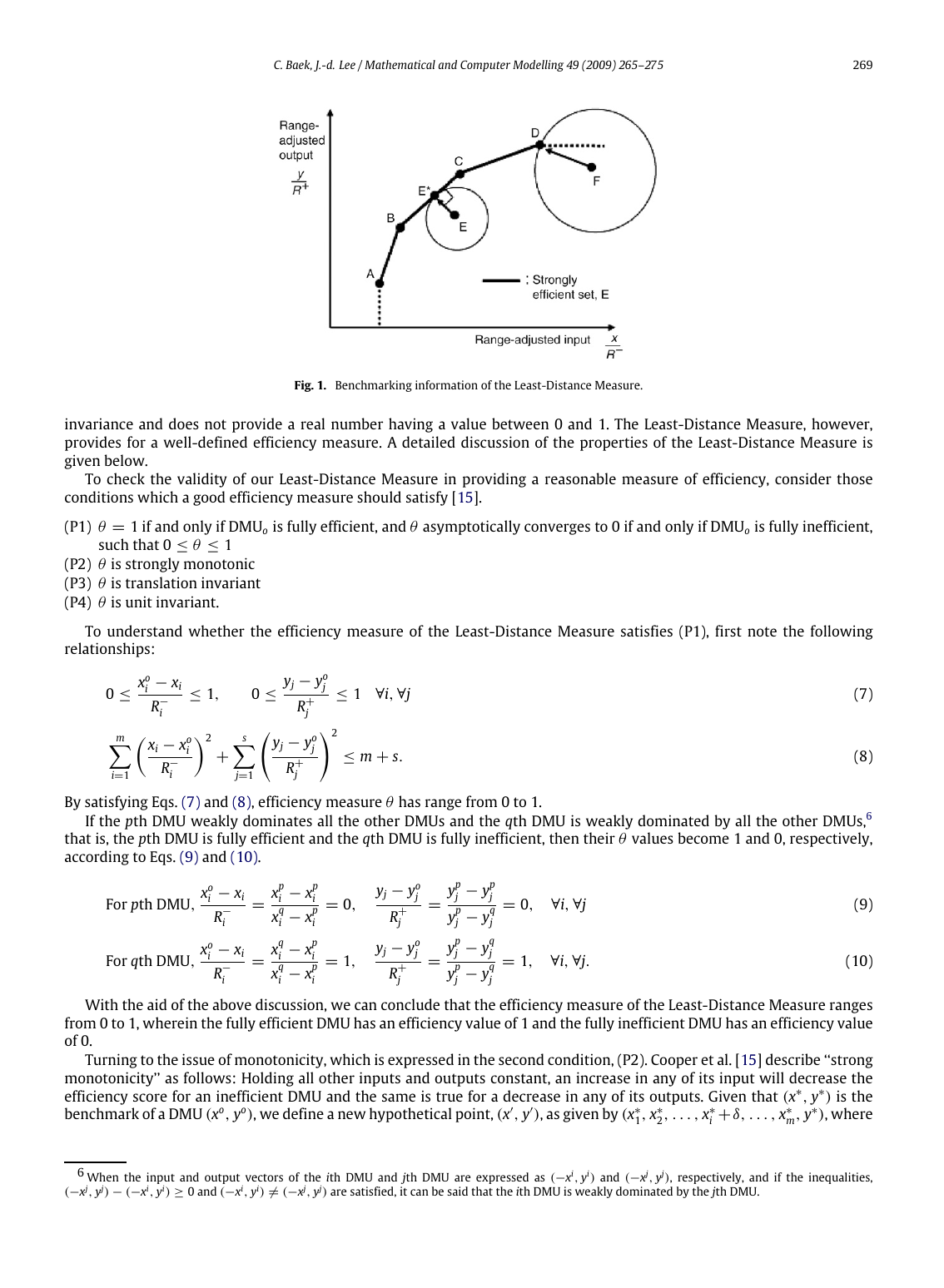
- 데이터: 본 paper 는 방법론 으로 실증 데이터 없음. 다만 conceptual figure 1 (LDM 의 benchmark 위치) 와 후속 paper 의 응용에서 검증
- 주요 발견: (i) LDM 의 efficiency measure 가 P1–P4 모두 만족, (ii) 4-step 알고리즘 — additive DEA → Pareto efficient set → 조합 × quadratic distance → 최소 distance benchmark 선택, (iii) Frei-Harker 의 supporting hyperplane projection 의 불가 영역 문제 해결 (LDM 은 strongly efficient set 위 projection 이라 항상 가능 영역 안), (iv) Cooper et al (1999) 의 GEM properties 5 가지 (range / monotonicity / unit invariance / translation invariance / fully efficient point at 1) 의 검증 완료
- 시사점: DEA benchmarking 정보의 attainable (실현 가능) 처방 제공 — 비효율 firm 의 학습 부담 최소화. Sapienza et al · Lane-Lubatkin 의 learning 의 similarity-driven 가설과 호환. 실제 정책·전략 응용에서 최소 변화 의 benchmark 가 현실적 도달 가능성 의 핵심
요약
DEA (DEA) 는 1978 년 Charnes-Cooper-Rhodes (CCR) 이후 non-parametric efficiency 측정 의 표준 도구로 자리잡았으며, 두 종류의 정보를 동시에 생성한다 — (i) DMU (Decision Making Unit) 의 efficiency level (0–1 사이 점수), (ii) 비효율 DMU 가 효율 frontier 로 이동하는 처방 (benchmarking 정보, 어느 input 을 얼마나 줄이고 어느 output 을 얼마나 늘릴 것인가). 그러나 기존 모형은 efficiency 측정 에 focus 하고 benchmarking 의 quality — 비효율 firm 이 실현 가능 한 처방인가 — 에는 secondary 한 위치를 부여한다. González-Álvarez (2002), Bogetoft-Hougaard (1999), Coelli (1998) 등은 가장 similar 한 efficient firm 이 가장 좋은 benchmark 임을 주장 — 학습 부담이 가장 작기 때문.
본 paper 의 motivation 은 DEA benchmarking 의 attainability — 처방 의 실현 가능성. 기존 모형의 한계:
- BCC orientation model (Banker-Charnes-Cooper 1984): equiproportionate input contraction (또는 output expansion) 만 허용 — 한 dimension 만 변화, 다른 dimension fixed. 현실적 firm 은 양 dimension 동시 조정 needs.
- Range Adjusted Measure (RAM) (Cooper-Park-Pastor 1999): slack 의 합을 최대화 — 가장 먼 benchmark 가 제시됨. P1–P4 properties 모두 만족하지만 “가장 먼 benchmark” 는 비효율 firm 에 비현실적 처방.
- Russell measure (Färe-Lovell 1978): RAM 과 유사 slack-max 형태로 같은 한계.
- Frei-Harker (1999) 의 least-norm projection: 양 dimension 동시 변화 + 가장 가까운 점 — 그러나 supporting hyperplane 위 projection 이라 생산 가능 영역 밖 으로 projection 될 수 있음. 또한 objective value 가 unit invariance 위반, 0–1 사이 not 보장.
- Portela et al (2003) 의 Pareto-efficient facet: nonlinear multiplicative form 으로 analytic solution 부재. translation invariance 위반 (음 output 사용 어려움).
본 paper 의 Least-Distance Measure (LDM) (LDM) 은 두 문제를 동시에 해결. 핵심 아이디어:
- Strongly efficient set 정의 (Eq. 5) — Charnes-Cooper-Lewin-Seiford (1994) 의 DEA-extreme-efficient set 와 동등한 primal-space 표현. supporting hyperplane 이나 Pareto-efficient facet 대신 strong efficiency 의 DMU points + convex combination 위에서 projection.
- Range-normalized Euclidean distance 의 minimization (Eq. 6) — 비효율 DMU 와 의 distance 를 최소화. range 로 normalize 해 unit invariance 보장.
- Efficiency measure (Eq. 6): Euclidean distance. P1 (0–1 range), P2 (strong monotonicity), P3 (unit invariance), P4 (translation invariance) 모두 만족 (Eq. 7–13 에서 증명).
- 4-step 알고리즘 (Section 3.2): (i) additive DEA → Pareto efficient set 분류, (ii) 의 차원 조합 enumerate, (iii) 각 조합에 대해 quadratic distance 최소화 (LP 풀 수 있게 linearize), (iv) 최소값 갖는 조합 select. 컴퓨터 시간 polynomial 한 의 worst case enumeration 이지만 standard LP 로 풀 수 있다.
본 paper 의 contribution 은 모든 well-defined efficiency measure properties + attainable benchmark + 양 dimension 동시 조정 + 생산 가능 영역 내 projection 의 동시 만족 — 기존 모형 중 일부만 충족하던 desiderata 의 통합. 한국 firm-level DEA 분석 (Inha Oh · Jeong-Dong Lee 의 후속 작업) 에서 표준 측도로 활용. 한계는 (i) Pareto efficient set 의 조합 enumeration 이 large dataset 에서 computational 부담, (ii) Euclidean distance 가 경제적 distance 와 항상 일치 못함 — 일부 input 의 practical 조정 비용이 다른 input 보다 크다면 weighted distance 필요, (iii) Halme et al (1999) 의 Value Efficiency Analysis (VEA) 처럼 decision maker preference 의 통합 부재.
핵심 결과
LDM efficiency measure (Eq. 6, conceptual form)
. , .
Properties 검증 (P1–P4 만족)
| Property | LDM 검증 |
|---|---|
| P1: , iff 완전 효율 | 만족 (Eq. 7, 8 의 normalization) |
| P2: Strong monotonicity | 만족 (Eq. 11 의 ceteris paribus 증명) |
| P3: Unit invariance | 만족 (Eq. 12 의 range normalization) |
| P4: Translation invariance | 만족 (Eq. 13 의 평행이동 불변) |
기존 모형 vs LDM 비교
| Model | Benchmark 위치 | Well-defined? | 양 dimension 동시? |
|---|---|---|---|
| BCC orientation | One-dimension shift | YES | NO |
| RAM (slack-max) | 가장 먼 효율점 | YES | YES |
| Russell measure | 가장 먼 효율점 | YES (Graph form) | YES |
| Frei-Harker least-norm | 가장 가까운 supporting hyperplane | NO (P3, P1 위반) | YES |
| Portela et al Pareto-efficient | 가장 가까운 facet | NO (P4 위반) | YES |
| LDM (본 paper) | 가장 가까운 strongly efficient set | YES (P1–P4) | YES |
4-step 알고리즘 (Section 3.2)
- Additive DEA 로 각 DMU 가 Pareto efficient 여부 분류 → 구성
- 비효율 DMU 에 대해 의 조합 enumerate ()
- 각 조합에서 quadratic distance 최소화 (LP linearization 가능)
- 최소 distance 조합을 benchmark 으로 선택, efficiency 계산
방법론 노트
Strongly efficient set 정의 (Eq. 5):
. 즉 모든 slack 합이 0 인 점 + convex combination. Charnes-Cooper-Lewin-Seiford (1994) 의 DEA-extreme-efficient set 와 동등하지만 primal space 에서 정의되어 least-distance 측정 직관 부합.
Production possibility set (Eq. 1, convex 기술 가정):
, 의 DMU 벡터.
P1 (range 0–1) 증명 (Eq. 7–10):
- ,
- (Eq. 8) — 따라서 가 0–1 사이
- 완전 효율 DMU (): 모든 normalized 차이 = 0 → (Eq. 9)
- 완전 비효율 DMU (): 모든 차이 = 1 (range 의 한계점에 도달) → (Eq. 10)
P2 (monotonicity) 증명 (Eq. 11): 번째 input 에 추가 시 benchmark 와의 distance 가 만큼 증가 → 감소. 따라서 ceteris paribus monotonicity 만족.
P3 (unit invariance) 증명 (Eq. 12): 에 상수 곱하면 range 도 로 동시에 변화 → — normalized 값 불변.
P4 (translation invariance) 증명 (Eq. 13): 번째 input 에 상수 더하면 strongly efficient set 와 DMU 모두 축으로 만큼 평행이동 → distance 불변. Banker (1984) 의 negative input 처리, Pastor (1996) 의 negative output 처리 가능.
알고리즘의 핵심 trick 은 step 2 의 조합 enumeration. 의 모든 차원 부분집합 ( 가지) 각각에 대해 step 3 의 quadratic minimization 풀고, 최소값을 가진 부분집합을 benchmark 으로 선택. 한 부분집합 안에서는 standard quadratic LP 로 해결 가능 — exponential 한 enumeration 외부, polynomial 한 LP 내부 의 구조.
연구 계보
본 paper 의 DEA benchmarking lineage 는 Charnes-Cooper-Rhodes (1978 European Journal of Operational Research) 의 CCR 표준 + Banker-Charnes-Cooper (1984 Management Science) 의 BCC variable returns to scale + Charnes-Cooper-Lewin-Seiford (1994 Data Envelopment Analysis) 책의 종합 위에 위치. Slack-max 라인은 Cooper-Park-Pastor (1999 Journal of Productivity Analysis) 의 RAM, Färe-Lovell (1978 Journal of Economic Theory) 의 Russell, Tone (2001 European Journal of Operational Research) 의 slacks-based measure (SBM).
Closest target lineage 는 본 paper 의 가장 가까운 predecessor — Bogetoft-Hougaard (1999 Journal of Productivity Analysis) 의 closest target, Coelli (1998 Eur. J. Oper. Res.) 의 multi-stage DEA — sum of slacks 최소화, González-Álvarez (2001 Eur. J. Oper. Res.) 의 shortest path, Frei-Harker (1999 Eur. J. Oper. Res.) 의 least-norm projection — 본 paper 가 직접 한계 지적, Portela-Borges-Thanassoulis (2003 Eur. J. Oper. Res.) 의 Pareto-efficient facet. 본 paper 는 이 lineage 중 (i) Bogetoft, González 의 closest target 가설을 (ii) Frei-Harker 의 양 dimension 동시 + (iii) Cooper et al 의 GEM properties 5 가지의 통합 — 모든 desiderata 동시 만족 의 first 모형.
Learning 의 similarity lineage 는 Sapienza-Parhankangas-Autio (2004 Strategic Management Journal) 의 knowledge base overlap regulates learning, Yi-Liang-Wu (2002) 의 Euclidean distance similarity, Lane-Lubatkin (1998 Strategic Management Journal) 의 teacher-student firm 의 lineage. 본 paper 의 attainable benchmark = closest similar firm 시각의 SMJ-rooted 정당성.
TEMEP 내 sibling: (i) The Effect of Asset Composition Strategy on Venture Capital Firm Efficiency: An Application of Data Envelopment Analysis — 같은 batch 의 VC firm DEA efficiency 분석으로 본 paper 의 LDM 방법론 활용 가능. (ii) Total Factor Productivity in Korean Manufacturing Industries · Analysis of product efficiency in the Korean automobile market from a consumer's perspective · Evaluation of credit guarantee policy using propensity score matching 의 기술경영경제정책전공 DEA · TFP 라인의 method anchor. (iii) Technological Progress versus Efficiency Gain in Manufacturing Sectors — Malmquist-Solow productivity 분해 framework 의 lineage origin. 본 paper 는 TEMEP 의 operations research methodology 라인 contribution — 한국 firm 실증에 응용하기 위한 새 측도 정립.
See also
- DEA
- Least-Distance Measure (LDM)
- Slack 최소화
- Pareto efficient set
- Strongly efficient set
- Efficiency measure properties (P1-P4)
- DEA benchmarking
- The Effect of Asset Composition Strategy on Venture Capital Firm Efficiency: An Application of Data Envelopment Analysis
- Total Factor Productivity in Korean Manufacturing Industries
- Chulwoo Baek
- 이정동
인접 그래프
- 인물 2
- 개관 1
- 방법론 5
- 개념 2
- 수록처 1
- 분류 2
- 논문 14
이 문서를 가리키는 페이지
논문 (11)
- A metafrontier approach for measuring Malmquist productivity index
- A new approach to measuring shadow price: Reconciling engineering and economic perspectives
- An Analysis of the Efficiency of the Oil Refining Industry in the OECD Countries
- Analysis of product efficiency in the Korean automobile market from a consumer's perspective
- Comparative Analysis of Plant Dynamics by Size: Korean Manufacturing
- Evaluation Telecenter Performance in Social Sustainability Context: A Cambodia Case Study
- Growth of De Alio and De Novo firms in the new and renewable energy industry
- Productivity dynamics and the cleansing effect of two recessions: evidence from the manufacturing sector in Korea
- Profitability and productivity changes in the Korean electricity industry
- Profitability Gains of Korean Defense Firms: Technological Progress or Cost Shifting?
- The Effect of Asset Composition Strategy on Venture Capital Firm Efficiency: An Application of Data Envelopment Analysis